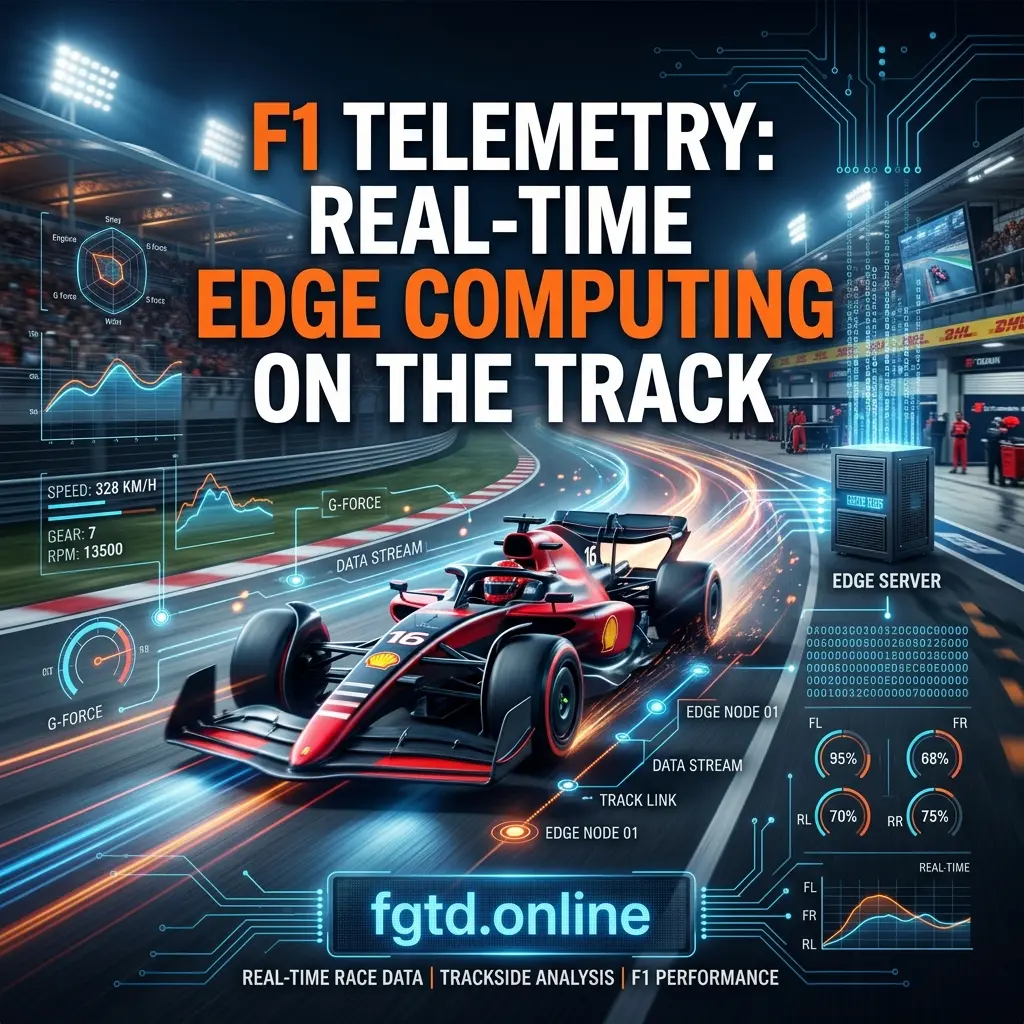
F1 Telemetry: Real-Time Edge Computing on the Track
Modern Formula 1 represents the absolute pinnacle of motorsport engineering, automotive aerodynamics, and elite athletic performance. Yet beneath the roar of hybrid power units and the spectacle of high-speed overtakes lies an equally fierce technological battleground: the real-time processing of high-velocity data.
Today, a Grand Prix car is not merely a high-performance mechanical vehicle; it is a distributed, mobile Internet of Things (IoT) edge device traveling at over 340 km/h. During every lap of a race weekend, hundreds of sensors capture critical performance variables, generating billions of data points that dictate race strategy, aerodynamic efficiency, engine reliability, and tire degradation.
Historically, telemetry analysis in motorsport operated on severe latency. Engineers downloaded data logs via physical umbilical cables after a car returned to the pit lane, manually parsing sensor charts to adjust mechanical setups for subsequent sessions.
Continues after advertising
However, in modern Grand Prix racing, margins of victory are measured in hundredths or thousandths of a second. Waiting until the end of a stint to discover thermal runaways in brake ducts or abnormal vibrations in the crankshaft can result in catastrophic mechanical failure or lost podium finishes.
To solve this competitive challenge, Formula 1 teams have engineered advanced distributed data architectures centered on Real-Time Edge Computing on the Track.
By processing, filtering, and executing machine-learning inference directly on-car and across specialized trackside edge servers, racing teams transform raw sensor streams into actionable tactical intelligence within milliseconds.
This post examines the high-density sensor networks embedded in modern Grand Prix machinery, breaks down the multi-tier telemetry pipeline, contrasts cloud processing with trackside edge computing, and explores how real-time inference dictates race-winning tactical decisions.
1. The Anatomy of an F1 Sensor Network
To understand the sheer computational demand placed on trackside infrastructure, one must inspect the physical and electrical sensor footprint distributed across an F1 chassis:
1. High-Density Sensor Infrastructure
A single Formula 1 car features between 300 and 400 specialized physical sensors, supplemented by hundreds of virtual or synthetic mathematical channels:
- Aerodynamic Telemetry: Differential pressure taps, Pitot tubes, and laser ride-height sensors measure downforce generation, rake angle, and floor ground-effect sealing along high-speed straights.
- Thermal Imaging and Temperature Sensors: Infrared optical sensors monitor carcass and surface temperatures across all four tire compounds across three distinct lateral zones (inner, middle, and outer shoulder). Thermocouples monitor brake rotor temperatures that exceed 1,000°C under heavy deceleration.
- Powertrain and Hybrid Dynamics: Pressure transducers, oil flow meters, and piezoelectric strain gauges track internal combustion pressures, turbocharger rotational speeds exceeding 100,000 RPM, battery state-of-charge (SoC), and energy deployment from the Motor Generator Units (MGU-K and MGU-H).
- Kinematics and Structural Load: Multi-axis accelerometers, gyroscopes, and linear suspension potentiometers measure cornering g-forces (routinely hitting 5g to 6g) and track surface curbstrike impacts.
2. High Sampling Rates and Bandwidth Realities
Certain high-frequency acoustic and vibration sensors sample at rates reaching 100 kHz to identify micro-fractures and mechanical resonance. In total, a single car produces roughly 2 to 3 megabytes of raw telemetry data per second, culminating in over 30 gigabytes of operational data per Grand Prix weekend.
Transmitting that continuous, uncompressed stream across a moving circuit presents a major physical constraint: wireless bandwidth is strictly limited by governing body regulations and trackside RF propagation limits.
2. The Multi-Tier Edge Computing Pipeline
To handle extreme data volumes under rigid bandwidth limits, F1 engineering teams deploy a tiered data processing pipeline extending from the cockpit to the paddock:
Tier 1: The In-Car Electronic Control Unit (On-Car Edge)
At the heart of every F1 car sits the mandatory Standard Electronic Control Unit (SECU), developed and supplied across the grid under strict regulatory governance:
- The SECU acts as the immediate onboard edge processor, running dedicated microcode to control engine firing sequences, energy recovery limits, and transmission gear shifts.
- Onboard Edge Filtering: High-frequency data cannot all be beamed over the air. The SECU aggregates, compresses, and prioritizes data packets. Critical safety and engine-preservation channels are broadcast over encrypted radio frequencies instantly, while less volatile diagnostic channels are stored in local flash memory buffers for wired extraction during pit stops.
Tier 2: Low-Latency Wireless Transmission
Data packets are transmitted from the car’s specialized chassis antenna to a network of distributed receivers positioned around the perimeter of the racing circuit:
- Utilizing ultra-reliable, specialized trackside telemetry networks, data packets are routed via multi-gigabit fiber backbones directly into the team’s mobile paddock data center.
- The end-to-end transmission latency from on-car sensor trigger to garage receiver is kept well under 100 milliseconds.
Tier 3: The Trackside Mobile Data Center (Paddock Edge)
Inside the paddock garage sits a containerized, industrial-grade micro data center featuring high-performance compute clusters and low-latency storage fabrics:
- This trackside edge cluster ingests the real-time telemetry stream, unpacks the compressed data packets, runs automated validation routines, and populates the engineering workstations lining the pit wall and garage telemetry islands.
- Because the compute cluster sits adjacent to the track, processing is completely immune to international internet outages or transcontinental latency spikes.
3. Structural Comparison: Centralized Cloud vs. Trackside Edge Computing
Evaluating the architectural, performance, and logistical trade-offs between centralized cloud analysis and local edge computing illustrates why edge infrastructure remains mandatory in elite motorsport:
Processing Latency and Feedback Speed
- Centralized Cloud Processing: High latency (100ms to 500ms+ round-trip); constrained by intercontinental fiber links connecting remote circuits to primary engineering headquarters.
- Trackside Edge Computing: Sub-millisecond to low-millisecond execution; local edge appliances compute physics calculations immediately adjacent to the racing pit wall.
Network Dependence and Operational Resiliency
- Centralized Cloud Processing: Vulnerable to external backhaul disruptions; any satellite or undersea fiber link degradation blindfolds race engineers during critical strategy windows.
- Trackside Edge Computing: Completely autonomous; operations run on a private local network, ensuring zero telemetry downtime even if external global connectivity is severed.
Data Volume Reduction and Ingestion Efficiency
- Centralized Cloud Processing: Requires massive WAN bandwidth; streaming gigabytes of raw, noisy high-frequency sensor readings strains satellite uplinks.
- Trackside Edge Computing: Localized data triage; edge nodes clean, compress, and run anomaly detection on-site, syncing only curated summary data to remote factories.
Real-Time Tactical Applicability
- Centralized Cloud Processing: Best suited for heavy post-session computational fluid dynamics (CFD) regressions, multi-race predictive modeling, and long-term simulation runs.
- Trackside Edge Computing: Purpose-built for split-second tactical calls; instantaneous undercut alerts, immediate engine parameter warnings, and live suspension adjustments.
4. Live Edge Analytics: Turning Telemetry into Victory
The real-world application of edge computing on the track manifests across three tactical domains during a live Grand Prix:
1. Dynamic Tire Degradation and Thermal Management
Tire life is the primary variable governing modern race strategy:
- Machine learning algorithms deployed on trackside edge servers continuously correlate optical infrared tire temperature maps with GPS lap deltas, driver steering angles, and corner apex speeds.
- The edge model calculates non-linear rubber degradation curves in real time, alerting the race strategist to the exact moment tire performance will “fall off the cliff.”
- This enables the pit wall to call an undercut pit stop with mathematical certainty, gaining track position while rival teams hesitate.
2. Anomaly Detection and Powertrain Protection
Modern turbocharged hybrid engines are strictly rationed across a season, with steep grid penalties imposed for exceeding mechanical component allocations:
- Trackside edge nodes run continuous multivariate anomaly detection models over live telemetry.
- If a slight fluctuation in fuel rail pressure coincides with a micro-spike in exhaust gas temperature, the edge system flags the anomaly before physical alarms illuminate on the driver’s steering wheel display.
- Engineers can immediately radio the driver to switch to an alternative engine mapping, short-shift out of key corners, or adjust brake bias, preserving the power unit from terminal damage.
3. Dynamic Sector Optimization and Driver Coaching
Between the driver completing a corner and reaching the next braking zone, trackside systems analyze high-resolution GPS trace overlays:
- Performance engineers compare the live car’s throttle application, brake pressure trace, and gear selection against the team’s baseline simulator models and the teammate’s telemetry.
- The edge pipeline identifies that the driver is losing 0.08 seconds by braking two meters too early into Turn 4.
- Within seconds, the race engineer delivers concise, actionable coaching over team radio, allowing the driver to adapt their inputs on the very next lap.
5. The Hybrid Edge-to-Cloud Continuum: Factory Mission Control
While trackside edge computing handles the split-second operational tempo of the race, it does not exist in isolation. Modern teams operate a synchronized Edge-to-Cloud Continuum:
- Factory Mission Control Rooms: While twenty engineers manage operations trackside, dozens of additional data scientists, vehicle dynamicists, and aerodynamicists sit inside dedicated mission control facilities at the team’s home base (such as Brackley, Milton Keynes, or Maranello).
- Continuous Uplink Synchronization: The trackside edge nodes stream verified, structured summary metrics to centralized cloud data lakes via high-bandwidth satellite uplinks.
- Monte Carlo Strategy Simulations: Cloud infrastructure executes millions of parallel race-simulation scenarios, testing changing weather forecasts, safety car probabilities, and competitor pit windows.
- The cloud-computed simulation results are pushed back down to the trackside edge nodes, providing the pit wall with updated probabilistic decision trees throughout the Grand Prix.
Read More👉 The Economics of Polo: Inside the Sport of Kings
Conclusion: The Edge as the Decisive Competitive Advantage
Formula 1 has always been a development race of mechanical ingenuity and human bravery. However, in an era of strict cost caps, aerodynamic testing restrictions, and hyper-converged vehicle engineering, the difference between winning a world championship and falling down the midfield order is defined by computational velocity.
Relying on delayed manual evaluations or distant, high-latency cloud infrastructure cannot keep pace with an environment where millisecond delays dictate race-winning strategy.
By deploying robust on-car electronic controllers, high-speed telemetry links, and autonomous trackside edge clusters, modern Grand Prix teams have turned real-time data into an indispensable engineering asset.
As industrial edge architectures, low-power machine learning accelerators, and specialized sensor arrays continue to mature, the lessons forged on the racing circuit will redefine connected transport and industrial automation—permanently establishing F1 Telemetry: Real-Time Edge Computing on the Track as the premier benchmark for high-speed edge computing worldwide.