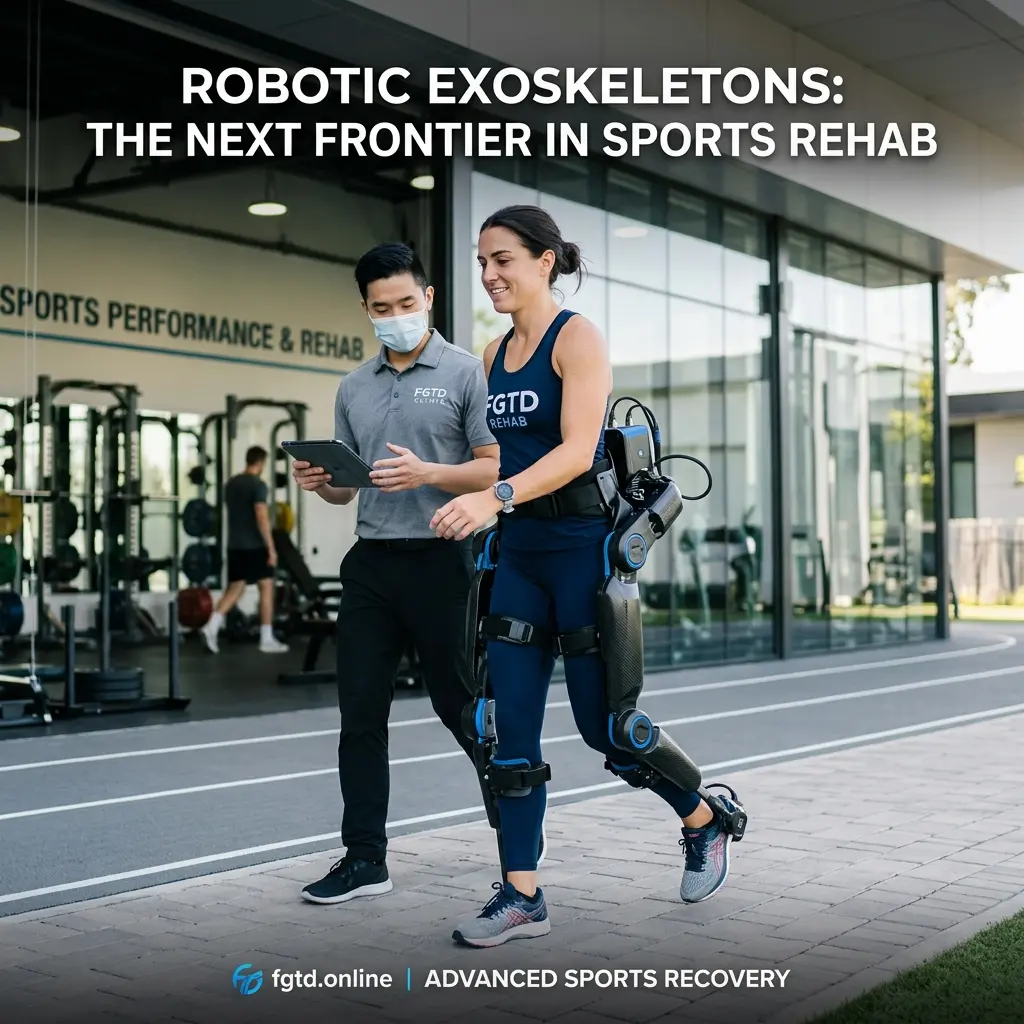
Robotic Exoskeletons: The Next Frontier in Sports Rehab
Orthopedic trauma and severe musculoskeletal injuries represent the most significant threat to an elite athlete’s career. When a professional competitor sustains a ruptured anterior cruciate ligament (ACL), a catastrophic Achilles tendon tear, or a complex compound fracture, the road to recovery has historically been defined by rigid clinical constraints: long periods of physical immobilization, high muscular atrophy, and slow, repetitive physical therapy regimens.
Traditional sports rehabilitation relies heavily on subjective physical assessments, manual manipulation by physiotherapists, and progressive bodyweight resistance exercises.
While manual therapy remains an essential component of clinical care, it suffers from structural limitations:
Continues after advertising
- Manual therapy cannot deliver perfectly identical, high-repetition gait cycles over extended treatment sessions without therapist fatigue.
- Early weight-bearing carries substantial reinjury risk, forcing clinicians to keep recovering athletes non-weight-bearing longer than ideal.
- Subjective visual assessments often miss micro-compensations—such as subtle asymmetrical hip hitches or unequal load distribution—that entrench poor movement mechanics and elevate the likelihood of secondary tears.
To accelerate return-to-play timelines and protect multi-million-dollar athletic contracts, elite sports medical facilities and orthopedic research hospitals are adopting an advanced clinical technology: Powered Robotic Exoskeletons.
Originally developed for military load augmentation and neurological rehabilitation for spinal cord injury patients, wearable motorized robotic suits are now engineered specifically for sports performance medicine. By combining carbon-fiber motorized joints, real-time electromyography (EMG) tracking, and intelligent adaptive resistance algorithms, robotic exoskeletons are reshaping the sports recovery timeline.
This post examines the biomechanical architecture of modern robotic rehabilitation suits, details the neuroplastic benefits of powered gait training, contrasts traditional sports therapy with exoskeleton-assisted recovery, and explores the clinical future of quantitative athletic return-to-play protocols.
1. Biomechanical Engineering: Wearable Robotics in Orthopedics
A medical-grade rehabilitation exoskeleton is an integrated mechatronic system engineered to work in harmony with human anatomy. Unlike passive braces that merely restrict joint motion, active exoskeletons augment and guide joint mechanics through advanced engineering:
1. Actuation and Joint Kinematics
Modern sports exoskeletons deploy lightweight, high-torque brushless DC motors situated coaxially with key anatomical pivot points (hips, knees, and ankles):
- Harmonic Drive Gearing: Provides high torque density with near-zero mechanical backlash, delivering smooth, natural joint actuation that matches biological movement.
- Variable Impedance Control: Rather than locking a joint into a rigid path, actuators dynamically adjust their mechanical compliance. The system can provide 100% active assistance when an athlete cannot bear weight, gradually reducing assistance to transparent mode (zero resistance) as the athlete rebuilds voluntary motor control.
2. Sensor Telemetry and Surface Electromyography (sEMG)
To synchronize with the athlete’s neuromuscular system, robotic suits integrate multi-sensor telemetry layers:
- EMG Skin Sensors: Non-invasive electrode arrays monitor electrical muscle activation in the quadriceps, hamstrings, and gastrocnemius muscles milliseconds before physical movement begins.
- In-Sole Force Sensing Resistors: Dynamic pressure plates embedded in the footwear measure ground reaction forces and center-of-pressure shifts across every millisecond of the stance phase.
- Joint Angle Resolvers: Continuous optical encoders record sagittal joint angles to a fraction of a degree, measuring knee flexion and extension velocity in real time.
2. Structural Comparison: Traditional Sports Rehab vs. Exoskeleton-Assisted Rehab
Evaluating the operational, mechanical, and clinical differences between conventional physical therapy and robotic exoskeleton-assisted rehabilitation illustrates why elite sports franchises are investing in powered medical suits:
Early Mobilization and Weight-Bearing Timing
- Traditional Sports Rehab: Conservative and delayed; athletes remain non-weight-bearing on crutches for weeks to prevent mechanical graft strain, causing acute muscular atrophy.
- Exoskeleton-Assisted Rehab: Accelerated and controlled; motorized assistance unloads specific percentages of gravitational body weight, allowing safe, upright physiological gait within days of surgery.
Repetition Volume and Movement Consistency
- Traditional Sports Rehab: Limited by therapist stamina; manual gait training is physically demanding, capping high-quality rehabilitation repetitions at 100 to 200 cycles per session.
- Exoskeleton-Assisted Rehab: High-density repetition; robotic actuators guide the lower extremities through 1,000 to 2,000 identical, physiologically correct gait cycles per session without fatigue.
Detection of Kinetic Asymmetries and Compensation
- Traditional Sports Rehab: Visual observation; therapists evaluate joint symmetry using video playback and visual observation, which can miss minor joint angle discrepancies.
- Exoskeleton-Assisted Rehab: Sub-millimeter objective telemetry; embedded sensors identify bilateral load imbalances down to single-digit percentages, preventing the brain from adopting harmful compensatory limps.
Neuromuscular Re-Education and Proprioception
- Traditional Sports Rehab: Relies on conscious athlete effort and verbal coaching, which can result in inconsistent neuro-motor engagement during early fatigue phases.
- Exoskeleton-Assisted Rehab: Closed-loop biofeedback; real-time visual dashboards and motorized resistance loops retrain neuromuscular pathways via intense sensory feedback.
3. The Clinical Advantages: Accelerating the Recovery Continuum
The integration of powered exoskeletons into sports medicine centers provides clear clinical advantages across three critical phases of athletic rehabilitation:
1. Preventing Muscle Wasting and Joint Stiffness in Phase One
Following major knee reconstruction (such as bone-patellar tendon-bone autografts), arthrogenic muscle inhibition often shuts down voluntary quadriceps recruitment:
- Robotic suits bypass this inhibition by moving the joint through continuous passive and active-assisted ranges of motion.
- This early mobilization stimulates synovial fluid circulation within the joint capsule, breaks up intra-articular scar tissue formation, and prevents deep vein thrombosis (DVT) by encouraging venous blood return through assisted calf pumping.
2. Restoring Symmetry Through Dynamic “Assist-as-Needed” Control
The most sophisticated software paradigm in sports robotics is the Assist-as-Needed (AAN) algorithm:
- The exoskeleton monitors the athlete’s voluntary torque output.
- If the recovering athlete provides 40% of the force necessary to complete knee extension during terminal swing, the robotic actuator delivers exactly the remaining 60%.
- As the athlete gains strength over successive sessions, the algorithm reduces its mechanical output, requiring the athlete to perform an increasing percentage of the physical work.
- This prevents patient passivity, demanding active cortical engagement throughout every single step.
3. Objective Clearance Metrics for Safe Return-to-Play
Determining when an athlete is truly ready to return to live contact competition is historically one of the most contentious decisions in sports medicine:
- Traditional hop tests and manual dynamometer measurements provide isolated snapshots of strength rather than continuous dynamic data.
- Exoskeletons generate comprehensive digital reports documenting joint stiffness, limb velocity, peak ground reaction force, and side-to-side force symmetry across thousands of strides.
- Medical teams use these objective benchmarks to clear athletes based on verifiable biomechanical health rather than subjective timelines or external schedule pressures.
4. The Horizon: Soft Exosuits and Field-Based Recovery
While rigid robotic exoskeletons dominate early indoor clinical rehabilitation, the next evolutionary leap is already taking shape on training pitches: Soft Exosuits.
Constructed of breathable structural textiles, flexible elastomer anchors, and lightweight cable-driven Bowden actuators, soft exosuits discard heavy metal frames:
- Unobtrusive Wearability: Weighing under three kilograms, these suits can be worn under standard training apparel during outdoor pitch drills, running intervals, and sport-specific agility workouts.
- Targeted Assistance During Acceleration: Instead of moving entire limbs, miniature waist-mounted motors pull on synthetic tendons running down the posterior chain, applying assistance to the hip extensors and plantarflectors during sprinting and deceleration.
- This bridges the gap between clinical physical therapy and live athletic competition, shielding vulnerable muscle groups as athletes transition back to maximum workloads.
Read More👉 Esports Arbitration: Resolving Multi-Million Dollar Disputes
Conclusion: Engineering the Resilient Athlete
Robotic exoskeletons represent a fundamental turning point in sports medicine and athletic longevity. The historical approach of treating severe orthopedic trauma with prolonged bed rest, subjective visual checks, and exhausting manual therapist labor is rapidly giving way to precision robotic intervention.
By uniting high-torque motorized actuators, real-time physiological sensing, and adaptive control algorithms, powered exoskeletons allow injured athletes to stand, mobilize, and rebuild neuromuscular pathways sooner, safer, and with scientific precision.
As hardware costs decrease, battery energy densities climb, and algorithms become more attuned to athletic kinetics, robotic rehabilitation systems will become standard fixtures in team training facilities worldwide—permanently establishing Robotic Exoskeletons: The Next Frontier in Sports Rehab as a core discipline protecting the health, longevity, and performance of modern athletes.