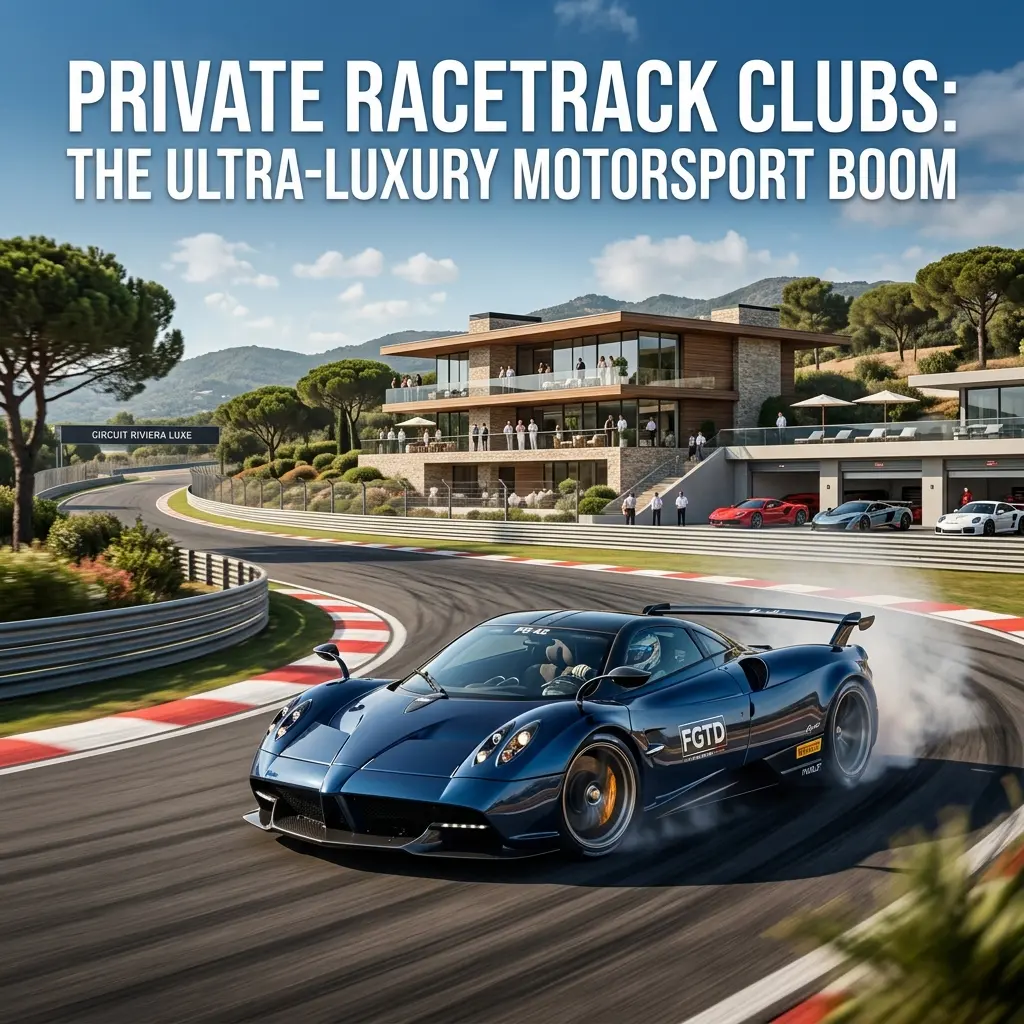
Private Racetrack Clubs: The Ultra-Luxury Motorsport Boom
For generations, premier private country clubs centered on 18-hole championship golf courses, pristine tennis pavilions, and secluded dining verandas. Membership symbolized social arrival and business networking. High-net-worth individuals, executives, and family offices spent weekends polishing handicaps and talking commerce over manicured greens.
Yet, over the past decade, demographic and cultural shifts among ultra-wealthy collectors have spurred an alternative luxury retreat: Private Racetrack Clubs.
The macro-automotive landscape has evolved dramatically. Modern supercar manufacturers—such as Ferrari, Porsche, McLaren, Aston Martin, and Koenigsegg—now mass-engineer hypercars producing between 700 and 1,500 horsepower. These extreme performance machines feature active downforce aerodynamics, carbon-ceramic braking arrays, and acceleration figures reaching 100 km/h in under three seconds.
Continues after advertising
However, driving these track-focused machines on public roads has become practically impossible:
- Strict municipal speed enforcement, speed cameras, and severe liability penalties turn high-performance street driving into an operational hazard.
- Deteriorating highway infrastructure and heavy metropolitan traffic prevent owners from ever accessing higher gear ratios or operating tire temperatures.
- Standard public track days at regional road courses often feature congested run groups, mixed vehicle classes, varying driver competence, and high risks of collision with uninsured vehicles.
To unleash the full engineering potential of their high-value automotive collections in complete safety and privacy, ultra-high-net-worth motoring enthusiasts are investing heavily in country clubs built around paved asphalt circuits.
These private automotive sanctuaries eliminate the frictions of public track days, combining FIA-grade racing circuits, climate-controlled collector garages, on-site mechanical race teams, and five-star resort hospitality.
This post examines the architectural and economic mechanics of private racetrack clubs, evaluates member demographics, contrasts public open track days with private circuit memberships, and analyzes the long-term investment dynamics of automotive residential real estate.
1. The Anatomy of an FIA-Grade Private Circuit
To understand why collectors are committing six- and seven-figure sums to private automotive clubs, one must inspect their engineering and operational layout, pioneered by premier venues like the Thermal Club in California, Monticello Motor Club in New York, Apex Motor Club in Arizona, and Ascari Race Resort in Spain:
1. FIA Safety Certification and Track Geometry
A world-class private automotive club does not simply pave a ribbon of asphalt in an open field; it hires legendary circuit architects (such as Hermann Tilke or Alan Wilson) to design challenging, technical circuits:
- FIA Safety Standards: Tracks incorporate wide run-off areas, impact-absorbing Tecpro barriers, FIA-specification debris fencing, and computer-controlled electronic flag marshaling systems.
- Configurable Layouts: Many private facilities feature modular courses spanning 3 to 5 miles that can be divided into multiple independent loops, allowing simultaneous member run groups, private testing sessions, or corporate product unveilings.
- Elevation and Technical Variety: Circuits integrate blind crests, multi-apex sweepers, decreasing-radius hairpins, and straightaways exceeding half a mile, enabling members to safely reach speeds over 250 km/h.
2. High Barriers to Entry: Capital and Vetting Protocols
Access to a private automotive resort requires a substantial financial commitment that keeps member density low:
- Upfront Initiation Fees: Prospective members pay non-refundable joining fees ranging from $75,000 to well over $250,000, supplemented by annual dues between $10,000 and $30,000.
- Track Capacity Caps: Premier clubs strictly limit total membership (often capped at 250 to 500 members) to guarantee that the circuit remains empty and accessible, ensuring members can pull onto the pit lane at almost any moment without scheduling reservations.
- Licensing and On-Track Coaching: Prospective members must undergo internal driver certifications, classroom sessions, and on-track evaluations by professional racing instructors before obtaining clearance for open, unescorted lapping sessions.
2. Structural Comparison: Public Track Days vs. Private Racetrack Clubs
Evaluating the operational, mechanical, and safety distinctions between traditional public track days and private circuit memberships highlights why serious collectors make the transition:
Track Access and Session Density
- Public Track Days: Highly congested; drivers are organized into crowded 20-minute run groups, frequently slowed down by yellow flags, beginner spin-outs, and traffic jams.
- Private Racetrack Clubs: Virtually unlimited open track; low member density allows drivers to lap at their own leisure for hours without encountering high traffic.
Driver Competence and Safety Standards
- Public Track Days: Mixed driver experience; varied skill levels and unpredictable beginner reactions create severe accident and collision risks.
- Private Racetrack Clubs: Rigorous vetting; all members complete standardized safety certifications, driving etiquette schools, and private coaching with professional racing drivers.
Facilities and Hospitality
- Public Track Days: Spartan; porta-potties, open-air gravel paddocks, folding lawn chairs, and concession stands.
- Private Racetrack Clubs: Ultra-luxury resort standard; private clubhouses, fine-dining restaurants, cigar lounges, spa facilities, swimming pools, and executive meeting rooms.
Logistics and Vehicle Support
- Public Track Days: Self-service; drivers must tow vehicles on flatbeds, haul their own fuel and tools, and perform mechanical checks in the hot sun.
- Private Racetrack Clubs: Concierge mechanics; on-site professional race shops provide vehicle storage, tire mounting, telemetry analysis, fueling, and post-session detailing.
3. The Rise of Trackside Villas and Automotive Real Estate
The most lucrative financial pillar of modern private racetrack clubs is the integration of master-planned Trackside Residential Real Estate.
Members are no longer satisfied with storing their multi-million-dollar vehicle collections in detached industrial warehouses across town. Instead, they purchase custom-built trackside homes, commonly known as car condos or circuit villas:
- Multi-Vehicle Climate-Controlled Galleries: These residential properties feature ground-floor garages with space for 10 to 30 vehicles, equipped with hydraulic car lifts, epoxy-finished floors, industrial ventilation systems, and specialized air filtration to preserve paintwork and rubber seals.
- Luxury Living Quarters: Above the expansive vehicle showrooms, owners construct multi-level luxury penthouses featuring floor-to-ceiling glass viewing galleries, cantilevered balconies overlooking track apexes, gourmet chef kitchens, and wine cellars.
- Turnkey Rental Ecosystems: When owners are not occupying their trackside residences, select clubs manage interior rental programs, catering to visiting luxury automakers, media production crews, or guest drivers.
This fusion of passion-asset collecting and residential property has transformed private racetracks into resilient real estate plays, with trackside lots appreciating into seven- and eight-figure valuations due to absolute land-use scarcity.
4. White-Glove Fleet Logistics and Race Engineering
Owning a stable of track-only hypercars (such as the Ferrari XX program, McLaren Senna GTR, or Porsche 911 GT3 Cup) carries immense operational complexity. These machines are not designed for simple ignition keys; they require professional engineering laptops, pre-warmed fluids, external battery tenders, and specific tire pressures.
Private racetrack clubs solve this logistical friction through on-site race support:
- The “Arrive-and-Drive” Program: A member calls the club concierge prior to arrival. An on-site factory-trained mechanic inspects the vehicle, checks torque specs, heats the racing slicks, tops up race-fuel mixtures, and parks the running car on the pit lane. The member simply steps off their helicopter or private transport, suits up, and drives onto the circuit.
- Telemetry and Driver Development: Modern club pit lanes feature professional engineering hubs. Technicians review onboard video overlays and telemetry traces with members, comparing throttle position, braking pressure, and steering inputs against professional baseline laps to trim tenths of a second off lap times.
Read More👉 Sports Insurance: Protecting Multi-Million Dollar Athletes
Conclusion: The Ultimate Playground for Performance Enthusiasts
The private racetrack club boom represents a natural convergence of high-performance automotive engineering, wealth expansion, and luxury lifestyle evolution. What was once dismissed as a niche, noisy hobby has matured into a multi-billion-dollar global industry characterized by sovereign-grade safety infrastructure, world-class amenities, and resilient real estate values.
By offering a secure, secluded environment where collectors can push automotive engineering to its physical boundaries, these circuits provide what public roads and standard country clubs no longer can: total privacy, pure adrenaline, and peer community.
As street vehicle performance climbs and public road regulations tighten, the demand for exclusive asphalt circuits will continue its rapid acceleration—permanently establishing Private Racetrack Clubs: The Ultra-Luxury Motorsport Boom as the definitive sanctuary for modern automotive passion.