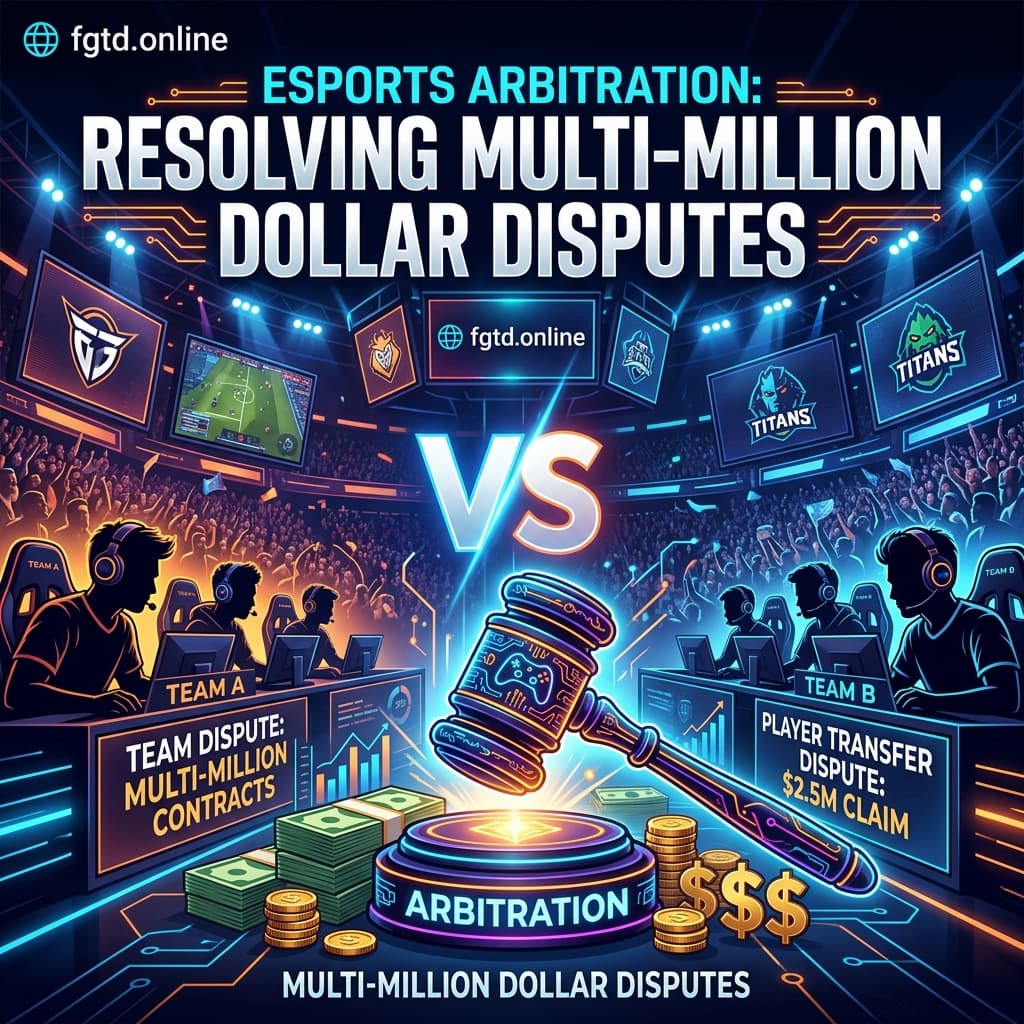
Esports Arbitration: Resolving Multi-Million Dollar Disputes
In the formative era of professional competitive gaming, contractual arguments and competitive disagreements were handled informally. League administrators, tournament organizers, and game developers possessed unilateral authority to issue fines, hand down bans, or resolve financial conflicts behind closed doors. With players competing in modest regional events, formal legal recourse was rare, costly, and structurally impractical.
However, over the past decade, competitive gaming transformed into a multi-billion-dollar global entertainment industry.
Tier-one franchised leagues, eight-figure team franchise slots, venture-backed gaming organizations, and multi-million-dollar player and creator agreements have reshaped the stakes. When a contract breaches, an international transfer falls apart, or a tournament publisher issues a disqualification, the financial damage is immediate and immense.
Continues after advertising
This rapid financial expansion created a pressing legal challenge: traditional municipal courts are ill-equipped to handle the fast-paced, digital, and cross-border nature of competitive video games. Filing a traditional lawsuit across international jurisdictions takes years, risks public leak of sensitive proprietary metrics, and puts complex digital disputes before judges who may lack basic literacy in video game mechanics or platform ecosystem rules.
This gap catalyzed an essential institutional evolution: The Rise of Esports Arbitration.
From dedicated sports tribunals like the Court of Arbitration for Sport (CAS) to bespoke commercial arbitration bodies and independent dispute resolution mechanisms, arbitration has emerged as the premier forum for settling high-stakes conflicts in competitive gaming.
This post analyzes the legal foundations of esports arbitration, breaks down the primary categories of multi-million-dollar disputes, compares traditional litigation against private arbitration, and explores how modern dispute resolution secures the future of competitive gaming.
1. The Jurisdiction Dilemma: Why Courts Struggle with Digital Sports
To understand why commercial arbitration is essential in esports, one must examine the complex jurisdictional and regulatory web governing competitive gaming.
1. The Publisher’s Absolute Intellectual Property Monopoly
Unlike traditional sports, where no single entity owns the intellectual property (IP) of basketball, football, or tennis, every esports title exists entirely at the discretion of its publisher (e.g., Riot Games, Valve, Epic Games, Electronic Arts):
- The game software, digital character assets, code, and broadcast rights belong exclusively to the publisher under copyright law.
- Every player, team owner, and tournament organizer operates strictly under an End User License Agreement (EULA) and commercial tournament licenses.
- When a dispute arises, publishers historically attempted to act as legislator, investigator, judge, and jury—creating acute conflicts of interest when the publisher’s commercial objectives clashed with player welfare or team investments.
2. Multi-Jurisdictional Cross-Border Operations
Esports is intrinsically global from day one:
- An esports organization incorporated in the United States might sign a South Korean player living in Europe to compete in a league hosted across multiple Asian and European venues.
- If the organization breaches the player’s salary contract, where should the dispute be filed?
- Traditional state courts face protracted jurisdictional fights over choice-of-law clauses, service of process across borders, and international judicial enforcement.
Arbitration solves this friction by providing a neutral, internationally recognized legal framework that sidesteps fractured local courts.
2. The Core Arenas of Multi-Million-Dollar Esports Disputes
High-stakes arbitration panels in esports typically confront four major commercial categories:
Franchise Slot Valuations and League Revenue Sharing
In permanent franchised leagues, organizations paid between $10 million and $40 million to secure permanent participation slots.
- These franchise agreements require league operators to pool and distribute media rights, league sponsorships, and in-game digital sales back to teams.
- When media revenue projections falter or publishers fail to deliver promised minimum commercial distributions, disputes involve tens of millions of dollars in damages.
- Specialized commercial arbitration tribunals assess these complex financial audits, evaluating whether league organizers met their fiduciary obligations and performance benchmarks.
Player Transfers, Restrictive Buyouts, and Contract Lock-ins
Elite competitors command base salaries reaching seven figures alongside massive buyout clauses:
- When buyout terms are disputed between international clubs, or when an organization benches a player to prevent them from moving to a rival competitor, millions of dollars hang in the balance.
- Arbitrators evaluate restraint-of-trade doctrines, international labor law standards, and contract interpretation to determine whether a buyout figure is commercially enforceable or a punitive barrier to athlete mobility.
Media Distribution, Sponsorships, and Streaming Exclusivity
Disputes between esports teams, talent agencies, and global brand sponsors frequently escalate into high-value arbitration:
- Issues include non-payment of multi-year sponsorship retainers due to missed broadcast impressions, force majeure disputes over canceled live LAN tournaments, and exclusivity breaches when streamers broadcast on competing platforms.
- Resolving these cases requires specialized commercial arbitrators who understand digital audience metrics, platform algorithms, and creator equity.
Integrity Infractions, Match-Fixing, and Anti-Cheating Sanctions
When an anti-cheat system or integrity body flags a team or player for software exploitation, match-fixing, or betting irregularities:
- Disqualification carries immediate brand destruction, lost tournament prize pools, and terminated sponsorship deals.
- Fast-track arbitration provides a structured evidentiary review where independent forensic software experts evaluate server telemetry, data logs, and behavioral betting trends to uphold or overturn lifetime competitive bans.
3. Structural Comparison: Municipal Litigation vs. Dedicated Esports Arbitration
Evaluating the operational, procedural, and economic differences separating traditional courtroom litigation from private arbitration demonstrates why industry stakeholders mandate arbitration clauses in their agreements:
Adjudicator Expertise and Industry Literacy
- Municipal Court Litigation: Assigned at random to generalist judges and juries with little understanding of digital assets, latency, server rollback, or publisher licensing frameworks.
- Dedicated Esports Arbitration: Parties mutually select neutral arbitrators with proven expertise in sports law, software licensing, commercial entertainment, and digital gaming economics.
Speed and Procedural Agility
- Municipal Court Litigation: Protracted timeline; civil lawsuits routinely drag on for three to five years before a trial and subsequent appeals conclude.
- Dedicated Esports Arbitration: Accelerated proceedings; expedited rules allow emergency arbitrators to issue preliminary injunctions or final rulings within weeks—critical for time-sensitive roster lock deadlines before major world championships.
Confidentiality and Commercial Brand Protection
- Municipal Court Litigation: Public record; discovery documents, proprietary team financials, player salaries, and organizational communications are exposed to public and media scrutiny.
- Dedicated Esports Arbitration: Strictly confidential; hearings, evidentiary filings, and final awards remain entirely private, shielding enterprise valuations and player reputations from public fallout.
International Enforceability of Judgments
- Municipal Court Litigation: Complex; enforcing a domestic court money judgment against assets held in foreign jurisdictions requires tedious, often unsuccessful diplomatic recognition procedures.
- Dedicated Esports Arbitration: Universally enforceable; arbitral awards are directly recognized and executed across more than 170 nations under the New York Convention (the United Nations Convention on the Recognition and Enforcement of Foreign Arbitral Awards).
4. Key Arbitration Forums: The Battle for Institutional Neutrality
As esports arbitration formalizes, several arbitral bodies and frameworks have stepped forward:
- The Court of Arbitration for Sport (CAS): Long the supreme court of traditional Olympic athletics, CAS has increasingly adapted its arbitral panels to handle esports governance and competitive disputes, providing high institutional credibility and legal precedent.
- World Intellectual Property Organization (WIPO) Arbitration and Mediation Center: WIPO specializes in technology and IP disputes, offering tailored procedures for video game software rights, licensing disagreements, and publisher digital asset conflicts.
- Commercial Arbitral Institutions (ICC, LCIA, AAA): The International Chamber of Commerce (ICC), the London Court of International Arbitration (LCIA), and the American Arbitration Association (AAA) remain the preferred forums for high-value franchise contracts, private equity joint ventures, and international corporate sponsorship pacts.
- Specialized Industry Tribunals (e.g., ESIC): The Esports Integrity Commission (ESIC) manages independent disciplinary hearings for match-fixing, betting fraud, and doping violations across multiple competitive titles, providing an initial layer of quasi-arbitral review.
Read More👉 Virtual Production: How Game Engines Reshape Cinema
Conclusion: The Legal Bedrock of Sustainable Professional Gaming
Esports arbitration is not a mere procedural alternative to the courtroom; it is the fundamental legal framework enabling the commercialization of digital sports. The era when video game publishers exercised unchecked power or players faced protracted legal gridlock in foreign courts has been replaced by a mature, professionalized dispute resolution landscape.
By providing specialized expertise, procedural speed, strict confidentiality, and global cross-border enforceability, arbitration bridges the critical gap between fast-moving digital entertainment and the rule of law.
As global media deals grow larger and private equity investments expand, robust arbitration frameworks will remain essential—permanently establishing Esports Arbitration: Resolving Multi-Million Dollar Disputes as an indispensable pillar of modern competitive gaming.