Sports Longevity Clinics: The Rise of Elite Biohacking
For the greater part of athletic history, the career trajectory of a professional sports star was governed by a biological timer that ran out quickly. By the time an athlete reached their early thirties, natural cellular breakdown, accumulated scar tissue, and declining hormonal efficiency signaled an inevitable decline. Retiring at thirty-two or thirty-four was treated not as an anomaly, but as the natural order of athletic physiology. Traditional sports medicine was almost entirely reactive: an orthopedic surgeon repaired a ruptured ligament after a tear occurred, and a physiotherapist applied ice packs and electrical stimulation to manage post-match swelling.
However, an extraordinary scientific and medical revolution is rewriting the timeline of human physical peak performance: The Proliferation of Sports Longevity Clinics and Elite Biohacking.
Today, modern legends across international soccer, basketball, tennis, and Formula 1 are competing at world-class championship levels well into their late thirties and early forties. This extended prime is not accidental. It is the output of specialized private medical clinics, advanced biomarker mapping, regenerative cellular therapeutics, hyperbaric oxygen chambers, and AI-driven predictive health modeling.
Continues after advertising
Athletes no longer wait for catastrophic injury to visit medical specialists. Instead, they invest hundreds of thousands—often millions—of dollars annually into bespoke biohacking protocols designed to optimize mitochondrial health, reverse cellular senescence, and accelerate biological recovery at microscopic scales.
What once sounded like experimental science fiction has become a standard competitive requirement for the athletic elite.
This post analyzes the technological and clinical foundations of sports longevity centers, details the cellular and physiological mechanics of elite athletic biohacking, compares traditional sports therapy with longevity medicine, and evaluates how extending biological primes impacts sports economics.
1. The Paradigm Shift: From Reactive Rehabilitation to Cellular Preemption
To understand why longevity clinics are commanding immense capital, one must examine the fundamental failure of the traditional athletic training model.
The Problem of Reactive Medicine
Under legacy athletic management, medical intervention followed a binary failure threshold:
- Athletes trained until pain, inflammation, or structural failure forced them to stop.
- Treatment protocols relied primarily on non-steroidal anti-inflammatory drugs (NSAIDs), cortisone injections, standard physical therapy, and surgical repair.
- While masking pain allowed competitors to stay on the field in the short term, systemic inflammation and repetitive joint wear accelerated long-term osteoarthritis and early career retirement.
The Emergence of Proactive Cellular Optimization
Modern longevity centers treat the athletic body not as a mechanical engine that must wear out, but as an adaptable biological network that can be continuously restored.
By intervening at the cellular and genetic levels before structural tissues degrade, clinicians target the core biological hallmarks of aging:
- Preserving mitochondrial density and adenosine triphosphate (ATP) production efficiency.
- Clearing senescent “zombie” cells that release pro-inflammatory cytokines into muscular tissue.
- Maintaining telomere integrity and reducing systemic epigenetic biological age relative to chronological age.
2. Structural Mechanics: The Core Modalities of Modern Longevity Clinics
A premier sports longevity facility operates far beyond the scope of a luxury spa or standard sports medicine ward. It functions as an advanced biotechnology laboratory integrating several cutting-edge clinical modalities:
Comprehensive Biomarker and Multi-Omic Profiling
Before administering a single therapy, clinics map an athlete’s unique biochemical baseline:
- Epigenetic DNA Methylation Clocks: Measuring biological age across tissues to evaluate whether heavy training stress is accelerating cellular degradation.
- Deep Metabolomics & Micronutrient Panels: Analyzing intracellular levels of amino acids, fatty acids, and heavy metals via mass spectrometry.
- Continuous Biomarker Telemetry: Integrating continuous glucose monitors (CGMs) and wearable autonomic sensors to evaluate heart rate variability (HRV), autonomic tone, and metabolic flexibility in real time.
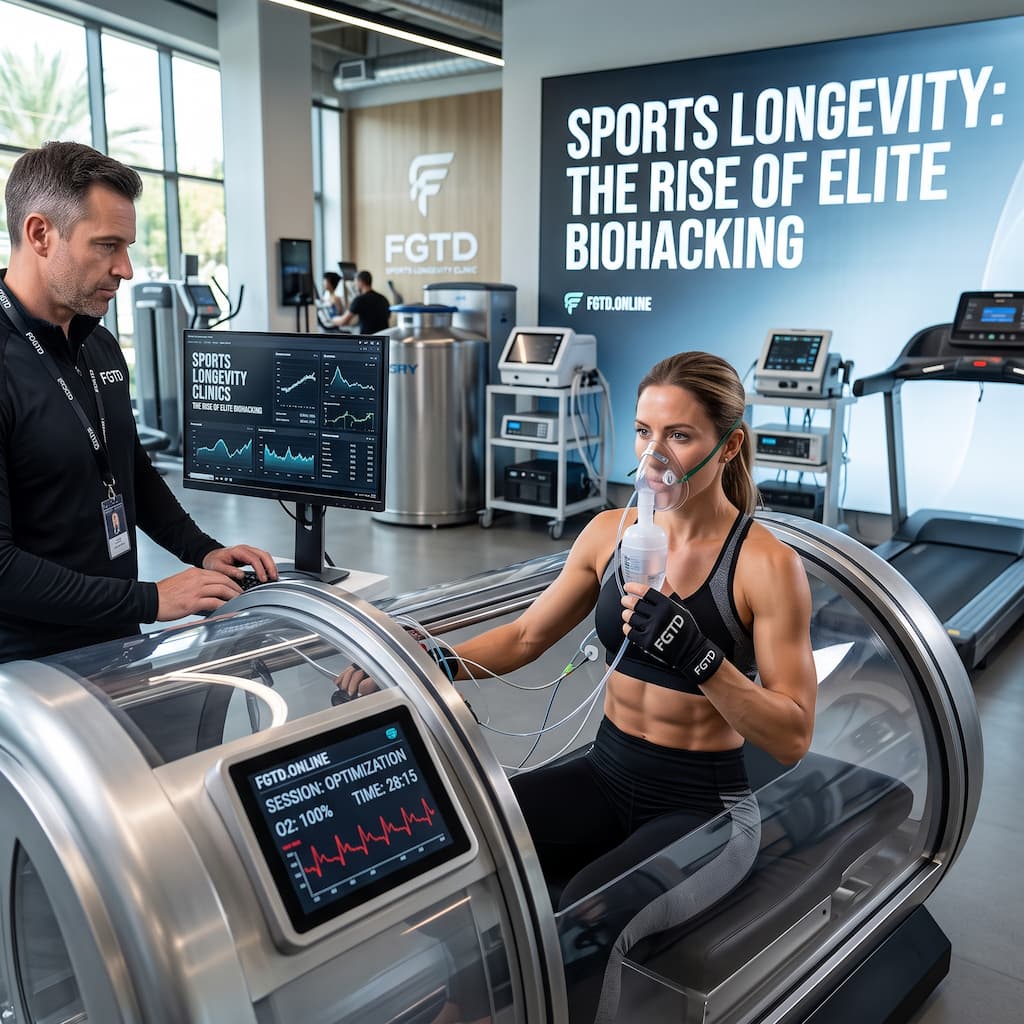
Hyperbaric Oxygen Therapy (HBOT)
Athletes spend multiple sessions per week inside hard-shell monoplace or multiplace hyperbaric chambers pressurized up to 2.0 to 2.5 atmospheres (ATA) while breathing 100% medical-grade oxygen:
- Mechanisms of Action: Dissolves high concentrations of oxygen directly into blood plasma, bypassing red blood cells and saturating poorly vascularized tissues like cartilage, tendons, and ligaments.
- Clinical Benefits: Stimulates rapid angiogenesis (new micro-capillary formation), promotes stem cell mobilization from bone marrow, and downregulates inflammatory gene expression following high-impact trauma.
Regenerative Orthobiologics and Cellular Therapies
Where permitted by regulatory bodies and sports anti-doping codes, longevity clinics utilize autologous biologic agents to heal micro-tears:
- Platelet-Rich Plasma (PRP) and Autologous Conditioned Serum (ACS): Centrifuging the athlete’s own blood to isolate growth factors and anti-inflammatory cytokines, injecting them directly into damaged joints.
- Exosome Therapies and Cellular Signaling: Harnessing extracellular vesicles secreted by stem cells to deliver targeted microRNA instructions directly to fatigued muscle cells, accelerating tissue regeneration without cell transplantation.
Whole-Body Photobiomodulation (Red-Light Therapy)
High-intensity medical red and near-infrared (NIR) light beds expose the skin to wavelengths between 660 nm and 850 nm:
- Photons penetrate deep into muscle tissues, stimulating cytochrome c oxidase within the mitochondrial electron transport chain.
- This light-driven reaction amplifies ATP cellular energy synthesis, reduces delayed-onset muscle soreness (DOMS), and mitigates oxidative stress following exhaustive competition.
3. Structural Optimization Ledger: Traditional Sports Medicine vs. Elite Longevity Clinics
Evaluating the clinical, technological, and strategic differences separating conventional sports physical therapy from modern longevity clinics illustrates why elite athletes are investing heavily in specialized centers:
Core Treatment Philosophy
- Traditional Sports Medicine: Symptom-focused and reactive; prioritizes structural repair, pain suppression, and rapid clearance for immediate competition.
- Elite Longevity Clinics: Root-cause and preemptive; prioritizes cellular health, systemic anti-inflammation, tissue rejuvenation, and multi-decade career extension.
Diagnostic Depth & Evaluation Metrics
- Traditional Sports Medicine: Standard X-rays, local MRI scans, basic blood chemistry, and physical range-of-motion assessments.
- Elite Longevity Clinics: Full-body 3T MRI scans, genetic vulnerability mapping, epigenetic age tracking, gut microbiome sequencing, and comprehensive hormone-metabolite panels.
Inflammation Management Protocols
- Traditional Sports Medicine: Heavy reliance on NSAIDs (ibuprofen), corticosteroid injections, and ice baths to suppress immediate pain signals.
- Elite Longevity Clinics: Targeted peptide signaling, hyperbaric oxygenation, personalized anti-inflammatory nutrition, and infrared light to resolve inflammation naturally.
Integration of Sleep Architecture & Autonomic Balance
- Traditional Sports Medicine: Sleep is treated as a general lifestyle recommendation; minimal clinical tracking.
- Elite Longevity Clinics: Clinical polysomnography, circadian phase-shifting protocols, peptide-assisted neurochemical balance, and autonomic nervous system optimization via vagus nerve stimulation.
4. The Human Capital Dimension: The Multi-Million-Dollar ROI of Longevity
For professional franchises, international sponsors, and individual athletes, longevity biohacking is not a luxury vanity expense; it is a high-return financial investment.
Consider the modern commercial realities of elite athletics:
- Protecting Guaranteed Payrolls: In leagues like the NBA, MLB, and European soccer, superstar player contracts often exceed $40 million to $60 million per year guaranteed. If an elite longevity protocol reduces injury downtime by 20% or extends a player’s peak performance window by three seasons, the franchise protects tens of millions of dollars in invested enterprise capital.
- Individual Endorsement Longevity: An athlete’s commercial marketing power peaks after a decade of accumulated global fame. Extending an athletic prime from age thirty-two to age thirty-eight enables athletes like LeBron James, Cristiano Ronaldo, and Novak Djokovic to sign historic, multi-year shoe and lifestyle contracts that would have been impossible in prior eras.
- The Rise of Private Personal Medical Teams: The most successful modern athletes rarely rely exclusively on team physicians. They travel with their own private performance squads—including longevity doctors, functional medicine specialists, private chefs, and biohacking technicians—who coordinate daily health regimens around the clock.
5. Democratization and the Future: From Billionaires to Everyday Enthusiasts
While private hyperbaric chambers, genetic sequencing, and custom orthobiologics were initially accessible only to elite champions with multi-million-dollar health budgets, the technology is democratizing rapidly:
- Commercial Longevity Franchises: Specialized longevity clinics and biohacking wellness clubs are launching across major metropolitan hubs, offering commercial memberships that grant everyday amateurs access to cold plunges, infrared saunas, red-light beds, and biomarker blood panels.
- Consumer Wearable Intelligence: Advanced consumer wearables and continuous biosensors track autonomic recovery, metabolic health, and sleep architecture, putting tour-level physiological feedback into the hands of everyday runners, cyclists, and fitness enthusiasts.
- AI-Assisted Preventative Protocols: Machine-learning platforms are increasingly able to analyze consumer biomarker data and recommend dynamic nutritional, training, and sleep modifications, turning personalized longevity care into a scalable digital software service.
Read More👉 From Mods to Megahits: How Community Creations Built Gaming
Conclusion: Redefining the Boundaries of Human Potential
Sports longevity clinics and elite biohacking represent the most significant paradigm shift in athletic performance since the advent of modern strength and conditioning. The long-standing belief that the human athletic prime must decline after the age of thirty has been systematically dismantled by cellular medicine, proactive biomarker monitoring, and regenerative therapy.
By viewing the human body as an interconnected biological system that can be repaired, nourished, and optimized at the cellular level, longevity clinicians have turned time from an athlete’s greatest adversary into a manageable variable.
As biotechnology advances, stem cell research evolves, and AI diagnostics accelerate worldwide, the athletic prime will continue to expand—permanently cementing Sports Longevity Clinics: The Rise of Elite Biohacking as the foundation of modern athletic excellence and human vitality.