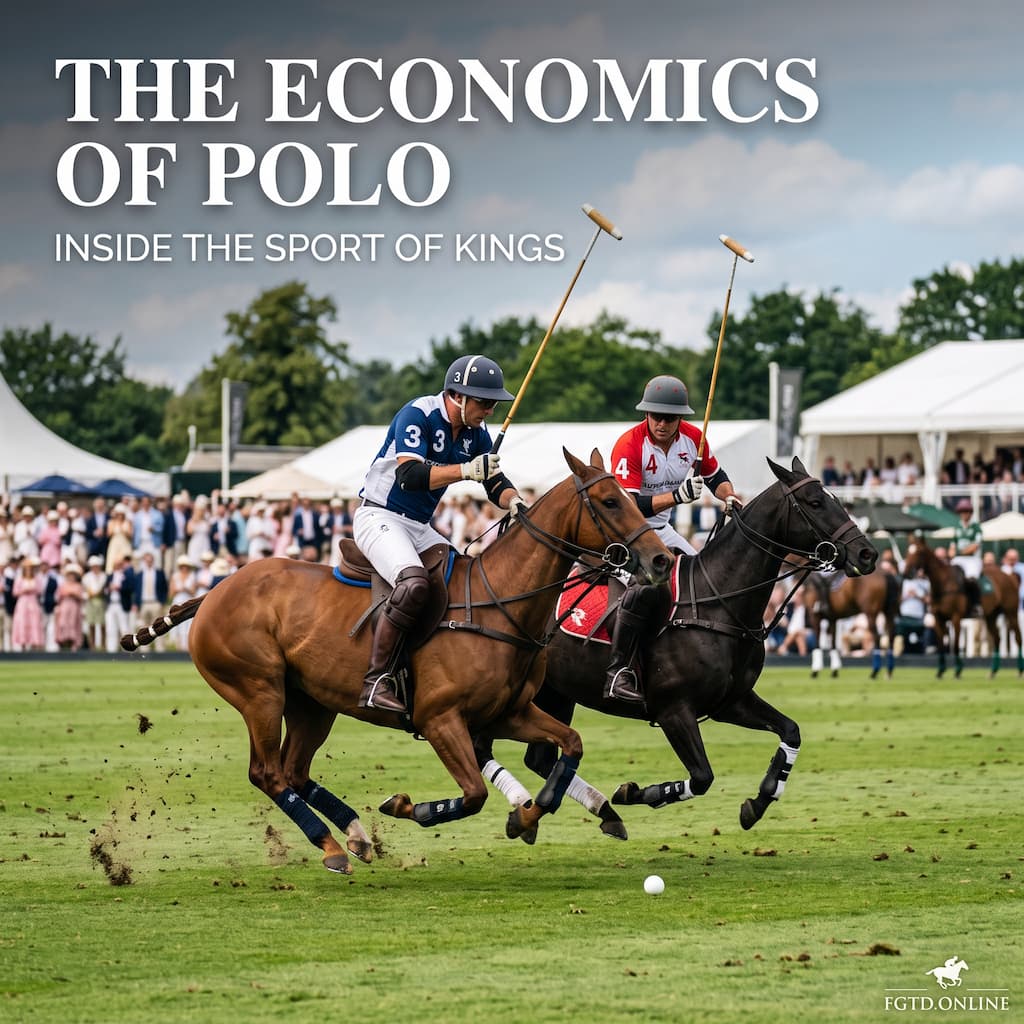
The Economics of Polo: Inside the Sport of Kings
For centuries, polo has carried one of the most enduring titles in athletic history: The Sport of Kings. Originating over two millennia ago as a cavalry training exercise for nomadic warriors across Central Asia and imperial Persia, the game transformed during the nineteenth century into the preferred pastime of British aristocrats, Indian maharajas, and Gilded Age industrialists.
On the surface, high-goal polo appears to be an idyllic tableau of sporting tradition: lush emerald grass fields stretching across the length of nine football pitches, gleaming white marquees, champagne flutes, and majestic equine athletes sprinting at 35 miles per hour.
Yet, beneath this refined veneer of leisure lies an economic engine unlike any other in international athletics. Polo is not merely expensive; it operates under a unique, capital-intensive financial model that defies the conventional economics of commercial sports.
Continues after advertising
Unlike professional soccer, Formula 1, or American football—where revenue is generated primarily through multi-billion-dollar broadcast rights, mass stadium ticket sales, and global sportswear merchandise—high-goal polo is largely funded from the top down by private capital, high-net-worth team patrons, specialized equine breeding dynasties, and ultra-luxury brand sponsorships.
To understand high-goal polo is to understand the mechanics of extreme personal patronage, complex global logistics, and multi-million-dollar genetic biotechnology.
This post analyzes the macroeconomic architecture of modern high-goal polo, breaks down the annual operational balance sheet of fielding a competitive team, explores the multi-million-dollar equine breeding and cloning industry, and evaluates the luxury sponsorship ecosystem that sustains the Sport of Kings.
1. The Patron Model: Sports Economics Reversed
In almost every mainstream professional sport, team owners are investors seeking operational profits, media royalties, and equity appreciation. The team owner hires players to compete on the field while remaining in executive luxury suites.
High-goal polo reverses this paradigm entirely through the Patron System (known as the patrón):
The Playing Investor
- In high-goal tournaments—such as the Argentine Open in Palermo, the USPA Gold Cup in Wellington, Florida, or the Queen’s Cup at Guards Polo Club in England—the team owner is actively mounted on a horse, competing directly on the field alongside three hired professional superstars.
- The patron is typically an ultra-high-net-worth individual: a hedge fund founder, real estate magnate, private equity partner, or generational industrialist who personally finances the entire team’s operations.
Team Balancing via the Handicap System
Polo operates on a dynamic handicap scale ranging from -2 to 10 goals (with a 10-goal rating representing the pinnacle of world-class polo mastery, held by only a few dozen athletes globally):
- High-goal tournaments set strict cumulative handicap limits (typically 22 to 26 goals for the entire four-player team).
- Because the amateur patron usually holds a 0-to-2-goal handicap, they must use their financial capital to hire top-tier 9- and 10-goal Argentine professionals (such as Adolfo Cambiaso or Facundo Pieres) to balance the team’s collective rating.
- Top professional players command seasonal salaries ranging from $500,000 to over $1.5 million per tournament circuit, funded entirely from the patron’s pocket.
High-goal polo is rarely designed to produce operating profits. The financial reward for the patron is not cash flow, but the pursuit of sporting prestige, access to elite social networks, and the privilege of competing at the highest level of an international championship.
2. The True Cost Center: Equine Logistics and the String of Ponies
The most famous adage in polo states that the horse accounts for 75% to 80% of a player’s performance. Even the most brilliant 10-goal polo superstar is ineffective without an exceptional mount beneath them.
Because polo matches consist of four to six high-intensity periods known as chukkers—each lasting seven minutes of relentless sprinting, abrupt stopping, and physical jostling—a polo pony cannot play an entire match. A horse can typically play only one, or at most two non-consecutive chukkers before physical exhaustion sets in.
The Mathematics of the High-Goal “String”
- A single four-player team competing in a high-goal tournament requires a minimum of 30 to 40 world-class polo ponies per match to ensure fresh mounts for every chukker and provide immediate backup if a horse pulls a muscle.
- The capital expenditure to acquire an elite, tournament-ready high-goal polo pony ranges from $50,000 to over $250,000 per horse.
- A patron fielding a high-goal team across the international triple crowns (United States, United Kingdom, and Argentina) oversees an equine asset portfolio valued between $2 million and $6 million in horseflesh alone.
The Operational Balance Sheet
Maintaining dozens of elite equine athletes across global seasons requires an extensive operational infrastructure:
- Grooms and Equine Physiotherapists: Each horse requires specialized, daily care. High-goal organizations employ an army of dedicated Argentine grooms (petiseros), veterinarians, equine chiropractors, and exercise riders.
- Nutrition and Stable Boarding: High-protein grain feeds, performance supplements, veterinary care, shoeing, and luxury barn leases in polo capitals like Wellington, Florida, or Sotogrande, Spain, cost between $1,500 and $3,000 per horse per month.
- Transcontinental Equine Aviation: When the global polo season shifts between continents, teams transport strings of horses via specialized chartered cargo aircraft. Flying an equine string from Buenos Aires to Miami or London incurs six-figure freight, quarantine, and customs expenses per season.
3. Structural Comparison: Mainstream Commercial Sports vs. High-Goal Polo
Evaluating the economic, operational, and financial dimensions that separate conventional commercial sports leagues from high-goal polo highlights why polo remains an exclusive enclave of private wealth:
Primary Capital Source
- Mainstream Commercial Sports (NFL, Premier League, NBA): Institutional capital, multi-billion-dollar broadcast television rights, mass retail merchandise, and corporate arena ticket sales.
- High-Goal Professional Polo: Private wealth patronage, direct family enterprise funding, boutique private wealth sponsorships, and elite hospitality packages.
Team Ownership Role
- Mainstream Commercial Sports: Passive executive governance; corporate boards and institutional owners manage balance sheets from executive suites.
- High-Goal Professional Polo: Active on-field participation; the patron finances the roster and physically plays alongside world-champion professionals.
Primary Asset Base
- Mainstream Commercial Sports: Player employment contracts, stadium real estate, media rights, and global intellectual property licensing.
- High-Goal Professional Polo: Equine bloodlines, breeding ranches (estancias), specialized transport fleets, and expansive private playing turf facilities.
Financial Return Profile
- Mainstream Commercial Sports: Franchise capital appreciation, television broadcast dividends, and commercial sponsorship distributions.
- High-Goal Professional Polo: Highly negative cash-flow operating model; treated as a private lifestyle pursuit, cultural investment, and personal brand statement.
4. The Biotechnology Revolution: Polo Breeding and Genetic Cloning
The relentless pursuit of equine athletic perfection has turned polo into one of the most technologically aggressive sectors in commercial animal genetics.
Historically, breeding a champion polo pony required decades of careful cross-breeding, pairing Thoroughbred stamina and speed with the agile, docile temperament of the Argentine Criollo horse. Even with careful bloodline management, natural breeding carries significant genetic unpredictability: a champion mare might produce an ordinary foal, and mares can carry only one foal per year.
Embryo Transfer
During the 1990s and 2000s, the Argentine polo industry embraced embryo transfer (ET):
- A champion mare continues to play high-goal tournaments while her fertilized eggs are flushed and transferred into surrogate draft mares.
- A single elite playing mare can produce five to ten biological foals per season without ever interrupting her competitive playing career, drastically accelerating bloodline propagation.
The Cloning Epoch
In the 2010s, Argentine polo legend Adolfo Cambiaso revolutionized the industry by partnering with biotech labs to commercially clone his most famous mounts, most notably his legendary mare Cuartetera:
- In 2016, Cambiaso made sporting history by winning the Argentine Open riding six different horses that were all genetic clones of the same mare.
- Today, leading Argentine polo breeding facilities (crías) routinely clone retired champions. Cloning a horse costs between $100,000 and $150,000, with elite cloned mares selling at private auctions in Buenos Aires for sums exceeding $500,000 to $800,000.
- What was once an artisanal craft has transformed into a high-tech biotechnology sector where cellular longevity, genomic sequencing, and genetic replication drive the sport’s performance frontier.
5. The Luxury Sponsorship Nexus: Reaching the Ultra-Affluent
Because high-goal polo does not attract stadium crowds of 80,000 spectators or generate tens of millions in domestic television ratings, commercial sponsorships take on an entirely different character.
Polo sponsors do not seek mass consumer impressions; they seek hyper-targeted access to ultra-high-net-worth decision-makers:
- Private Banking and Wealth Management: Institutions like UBS, Julius Bär, and J.P. Morgan sponsor polo tournaments to host private client luncheons where advisors mingle directly with family office principals, real estate titans, and corporate executives.
- Haute Horlogerie and Fine Jewelry: Watchmakers like Jaeger-LeCoultre (whose iconic Reverso watch was originally created in 1931 specifically for British army officers in India to survive polo mallet impacts), Hublot, and Piaget maintain deep brand heritage within the sport.
- Super-Luxury Automotive & Aerospace: Brands like Maserati, Land Rover, Bentley, and private aviation charter firms dominate tournament perimeter boards and VIP paddocks, treating polo tournaments as captive showrooms for multi-million-dollar transport assets.
In polo, a tournament with only 2,000 in-person attendees can deliver a higher commercial return on investment for a private bank or private jet charter than a billboard in a major metropolitan transit station.
6. The Argentine Epicenter: The Global Engine of Polo Talent
While high-goal tournaments take place in luxury hubs across Florida, Berkshire, Saint-Tropez, and Dubai, the entire global polo economy depends upon a single nation: Argentina.
Argentina is the undisputed epicenter of world polo due to unique socioeconomic advantages:
- The Pampa Plains: The vast, fertile grasslands of the Argentine Pampas provide ideal conditions for raising and training horses at a fraction of the cost of North American or European land.
- Generational Horsemanship: The deep cultural heritage of the gaucho produces the world’s most skilled equine trainers, handlers, and players.
- The Global Talent Pipeline: Nearly all of the world’s top 10-goal players, thousands of trained polo ponies, and the majority of high-goal team managers originate from Argentina. The annual Argentine Open Polo Championship (Palermo) in Buenos Aires is the spiritual cathedral and premier commercial showcase of the entire industry.
For foreign patrons, maintaining an estancia in Argentina is an essential strategic asset—serving as the nursery, training camp, and proving ground that supplies their international tournament campaigns.
Read More👉 Ping-Pong Diplomacy: How Table Tennis Thawed the Cold War
Conclusion: The Enduring Grandeur of Athletic Patronage
The modern economy of polo is a fascinating paradox: a centuries-old aristocratic tradition operating alongside cutting-edge biotechnology, private aviation logistics, and ultra-high-net-worth wealth management.
While conventional sporting leagues chase mass broadcast subscriber counts and algorithmic digital impressions, polo remains rooted in the extraordinary commitment of private patrons willing to invest millions for the sheer love of equine beauty, competitive speed, and athletic glory.
From the quiet breeding paddocks of the Argentine Pampas to the sun-drenched championship fields of Palm Beach and Windsor, the sport of kings continues to survive and thrive.
As long as human beings are captivated by the bond between horse and rider, and as long as private capital seeks the ultimate expression of competitive passion, polo will remain the grandest, most magnificent spectacle in the sporting world.