Ping-Pong Diplomacy: How Table Tennis Thawed the Cold War
For more than two decades following the establishment of the People’s Republic of China in 1949, diplomatic relations between Washington and Beijing were virtually non-existent. Paralyzed by ideological hostility, proxy confrontations in Korea and Vietnam, and strict trade embargoes, the two global superpowers maintained an atmosphere of mutual suspicion. Neither side maintained an embassy in the other’s capital, civilian travel was banned, and official diplomatic channels were frozen in an uncompromising Cold War stalemate.
Yet, the geopolitical thaw that reshaped the international balance of power did not begin with secretive nuclear treaties or high-level summits between heads of state. It began with an accidental encounter on a shuttle bus, a silk scarf, and a small celluloid ball: Ping-Pong Diplomacy.
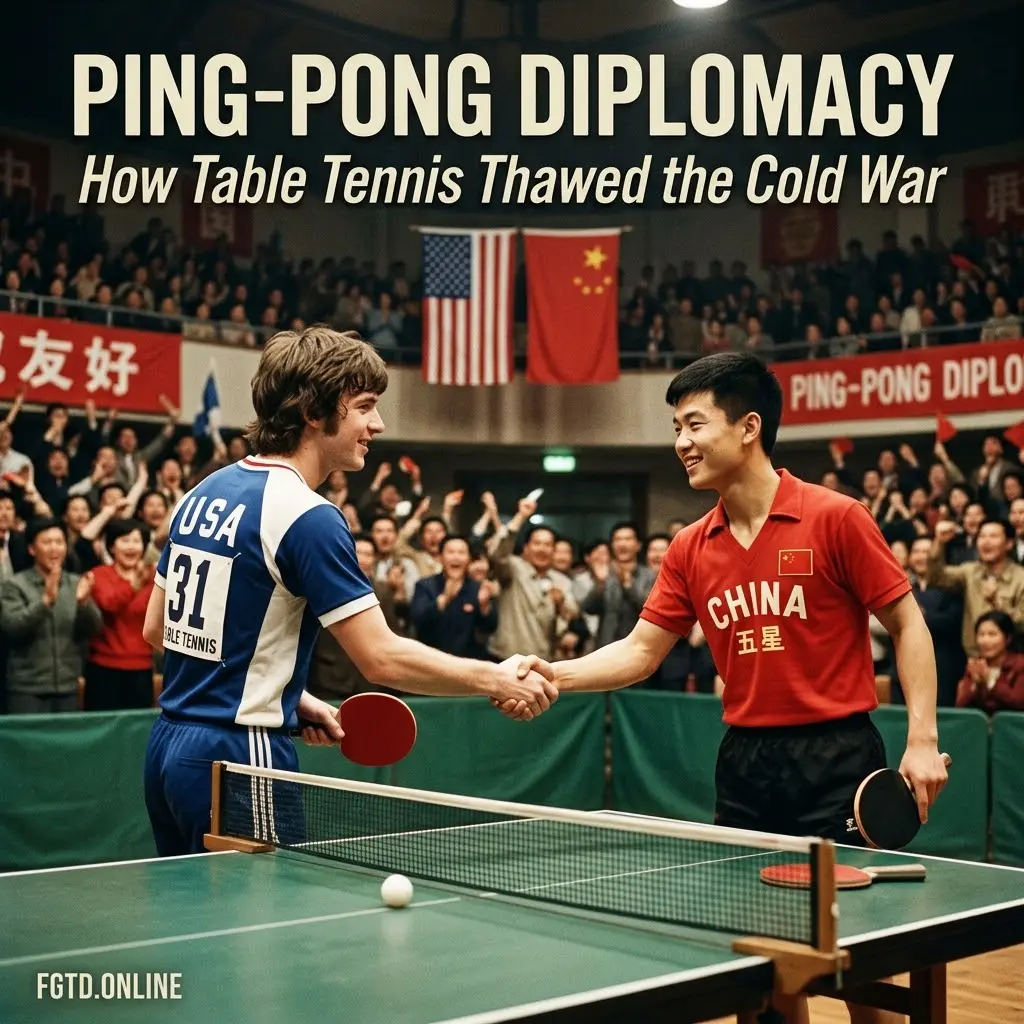
In April 1971, during the 31st World Table Tennis Championships held in Nagoya, Japan, an unexpected personal interaction between two athletes broke through decades of state-mandated silence. That spontaneous moment triggered a rapid sequence of events: an official invitation to the American team to visit China, the first authorized American delegation to step foot on Chinese soil in over twenty years, and the diplomatic breakthrough that paved the way for President Richard Nixon’s historic visit to Beijing in 1972.
Continues after advertising
This post analyzes the historical dynamics of Ping-Pong Diplomacy, evaluates the role of soft power and sports in international relations, compares conventional statecraft with athletic diplomacy, and examines the lasting legacy of athletic exchanges on global culture.
1. The Geopolitical Impasse: Two Decades of Isolation
To appreciate the impact of a friendly table tennis exhibition, one must understand the severity of the diplomatic deadlock that preceded it.
The Bamboo Curtain and Strategic Deadlock
Following the Chinese Civil War and the retreat of the Nationalist government to Taiwan, the United States refused to recognize the Communist government in Beijing as the legitimate representative of China. Throughout the 1950s and 1960s:
- The Korean Conflict: Direct military confrontation between Chinese and American troops solidified ideological enmity.
- Trade and Travel Embargoes: The United States imposed strict economic sanctions, cutting off maritime trade, financial transactions, and civilian travel.
- The Sino-Soviet Split: By the late 1960s, relations between Beijing and Moscow deteriorated into armed border clashes along the Ussuri River, leaving China strategically isolated between two nuclear-armed adversaries.
In Washington, President Richard Nixon and National Security Advisor Henry Kissinger recognized that normalizing relations with Beijing could offer a strategic counterbalance to the Soviet Union and assist in negotiating an exit from Vietnam.
In Beijing, Chairman Mao Zedong and Premier Zhou Enlai sought to break out of diplomatic isolation and deter Soviet aggression.
Both sides were actively seeking a diplomatic opening, but neither could risk the domestic and international humiliation of making a public overture that might be rejected.
2. The Nagoya Encounter: How a Missed Bus Changed History
The breakthrough arrived by chance in Nagoya, Japan, during the spring of 1971.
The Glenn Cowan and Zhuang Zedong Encounter
Nineteen-year-old Glenn Cowan, an eccentric American table tennis player with long hair and a bohemian style, accidentally missed his team bus after an evening practice session. With no other transportation available, Cowan stepped onto the shuttle bus carrying the national team of the People’s Republic of China.
At the time, Chinese athletes were under strict orders from state officials to avoid informal contact with foreigners, particularly Americans.
A tense, uncomfortable silence filled the bus. Then, Zhuang Zedong—a three-time World Table Tennis Champion and the star of the Chinese team—made a deliberate choice to walk from the back of the bus to greet Cowan:
- Zhuang extended his hand and presented Cowan with a traditional gift: a woven silk tapestry depicting the Huangshan mountains.
- Cowan, deeply touched, apologized for having nothing to offer in return, famously remarking that he would find something for Zhuang the next day.
- As the bus arrived at the tournament venue, international photojournalists captured the sight of the American and Chinese athletes walking together, smiling and conversing through an interpreter.
The following day, Cowan fulfilled his promise, presenting Zhuang with a red, white, and blue T-shirt featuring a peace symbol and the lyrics “Let It Be.”
When foreign correspondents asked Cowan if he would like to visit China, he replied, “Of course.”
Mao’s Midnight Gamble
Reports of the friendly exchange between Zhuang and Cowan reached the desks of Premier Zhou Enlai and Chairman Mao Zedong.
Initially, the Chinese Foreign Ministry recommended a cautious approach, advising against inviting the Americans due to the volatile political climate.
Mao initially agreed and signed off on the conservative recommendation. However, late on the night of April 6, 1971, Mao reconsidered.
Recognizing that a public sports exchange carried minimal geopolitical risk while opening a massive public relations channel, Mao gave the historic order: “Invite the American team to visit China immediately.”
3. Friendship First, Competition Second: The American Tour
On April 10, 1971, nine American players, four team officials, and two spouses crossed the railway bridge connecting Hong Kong to mainland China, accompanied by a small pool of Western journalists. They became the first official group of Americans to walk freely on the Chinese mainland since 1949.
The Goodwill Exhibition Matches
The American team spent a week touring Guangzhou, Shanghai, and Beijing. The slogan framing the entire journey was simple and diplomatic: “Friendship First, Competition Second.”
In sports terms, the American players were amateurs compared to the world-champion Chinese squad.
During friendly exhibition matches held before capacity crowds of 18,000 spectators at Beijing’s Capital Indoor Stadium, Chinese champions deliberately played with restrained technique, ensuring competitive, crowd-pleasing rallies rather than clinical, one-sided sweeps.
Premier Zhou Enlai’s Historic Audience
On April 14, Premier Zhou Enlai hosted the entire American delegation for a formal banquet inside the Great Hall of the People.
Zhou looked directly at the American team and delivered a quote that echoed across international news networks:
“You have opened a new chapter in the relations of the American and Chinese people. I am confident that this beginning will certainly meet with the majority support of our two peoples.”
Glenn Cowan boldly raised his hand during the meeting, asking the Premier what he thought of the American youth movement and the “hippies.”
Zhou smiled and replied thoughtfully about the natural questioning of tradition among youth, demonstrating a warm, pragmatic humanity that softened Western perceptions of the Chinese state overnight.
Within hours of the banquet, President Nixon announced the immediate lifting of the 20-year trade embargo on non-strategic goods and relaxed travel restrictions to China.
4. Structural Optimization Ledger: Conventional Statecraft vs. Sports Diplomacy
Evaluating the mechanisms that separate traditional formal diplomacy from cultural and athletic diplomacy illustrates why soft-power sports initiatives resolve entrenched political impasses.
Diplomatic Barrier & Risk Profile
- Conventional Statecraft: High diplomatic risk. Public overtures risk domestic political backlash, legislative resistance, and international loss of face if rejected.
- Sports & Cultural Diplomacy: Low risk, high flexibility. Framing interactions as informal athletic exchanges allows governments to test public sentiment without formal commitments.
Public Perception & Media Soft Power
- Conventional Statecraft: Bureaucratic and opaque. Framed in dense legal treaties, communique drafts, and closed-door bilateral negotiating rooms.
- Sports & Cultural Diplomacy: Highly visual and humanizing. Compelling photojournalism of smiling athletes captures global imaginations and softens entrenched ideological hostility.
Structural Velocity & Channel Activation
- Conventional Statecraft: Slow and deliberate. Formal diplomatic protocols often require months or years of preparatory ambassadorial meetings.
- Sports & Cultural Diplomacy: Rapid. Exploits spontaneous, real-time cultural moments to create immediate political momentum and break procedural stagnation.
5. The Diplomatic Dominoes: From Nagoya to the Shanghai Communique
The momentum generated by the table tennis delegation moved international relations at breakneck speed.
In July 1971, just three months after the American team left Beijing, Henry Kissinger departed on a public diplomatic tour of South Asia.
Faking a stomach illness in Pakistan, Kissinger slipped away on a secret flight directly to Beijing for covert bilateral talks with Zhou Enlai.
During this meeting, the two sides finalized arrangements for the ultimate diplomatic summit.
On February 21, 1972, President Richard Nixon landed in Beijing on Air Force One, greeting Premier Zhou Enlai with a firm handshake on the tarmac—symbolically rectifying the snub delivered by Secretary of State John Foster Dulles in Geneva eighteen years earlier, when Dulles famously refused to shake Zhou’s hand.
The summit concluded with the signing of the Shanghai Communique, a historic document in which both nations recognized their ideological differences while pledging to work toward normalized diplomatic relations, mutual trade, and regional stability.
Two months later, the Chinese table tennis team completed an extensive reciprocal tour across the United States, playing exhibition matches in Detroit, Washington, D.C., and Los Angeles, and visiting Nixon at the White House Rose Garden.
As Nixon later wrote in his memoirs: “The ping-pong balls had set the wheels of history in motion.”
6. The Blueprint: How Ping-Pong Diplomacy Reshaped Modern Sports Soft Power
The legacy of the 1971 table tennis tour extended far beyond Cold War geopolitics; it established the modern blueprint for how athletic competition serves as an engine of international soft power.
Prior to Nagoya, major international sporting events were frequently viewed by governments merely as stages for nationalistic display or ideological friction. Ping-Pong Diplomacy demonstrated that athletic arenas provide a unique, neutral space capable of de-escalating conflicts where traditional diplomacy fails:
- Lowering Defensive Barriers: Athletic matches remove the rigid posturing of political negotiators, reframing rivals as fellow competitors operating under shared rules of fair play.
- Humanizing the Adversary: Mass media coverage of athletes sharing meals, exchanging souvenirs, and engaging in good-humored competition challenges demonizing political propaganda and shifts broader public opinion.
- Creating a Precedent for Cultural Exchange: The success of the table tennis initiative laid the groundwork for subsequent athletic bridges, including the 1998 friendly soccer match between the United States and Iran at the FIFA World Cup and joint Korean marching delegations at the Olympic Games.
By elevating table tennis from a recreational parlor game to an instrument of global statesmanship, the tour proved that sports possess an intrinsic cultural authority that treaties alone cannot replicate.
Read More👉 When Sports Paused Wars: Historical Games of Peace
Conclusion: The Enduring Power of the Unexpected Bridge
Ping-Pong Diplomacy remains one of the most remarkable episodes in modern history. It demonstrated that when formal political channels are completely paralyzed by ideology, suspicion, and military posturing, the simple human connections forged through sport can transcend boundaries that conventional statecraft cannot cross.
A spontaneous act of kindness between two athletes on a Japanese shuttle bus transformed a global Cold War standoff into an era of diplomatic engagement.
The legacy of Ping-Pong Diplomacy proves that sports are never merely games; they are powerful universal languages capable of dismantling barriers, transforming perceptions, and thawing the coldest geopolitical divides.