When Sports Paused Wars: Historical Games of Peace
The annals of human civilization are predominantly written in the ink of geopolitical conflict, territorial disputes, and military strategy. For centuries, when nation-states or rival factions reached an institutional impasse, the ultimate arbiter was kinetic warfare. Societies mobilized resources, drew battle lines, and braced for campaigns designed to enforce political will through attrition and force. In these high-intensity environments, cultural expressions, civilian normalcy, and commercial exchange routinely collapsed under the weight of total war.
Yet, running parallel to this history of division is a remarkable, recurring anomaly: the capacity of competitive sports to act as a neutral plane of human interaction. Far from being mere entertainment or a distraction from reality, athletic competition has repeatedly demonstrated the unique power to freeze active front lines, dismantle hostile political rhetoric, and create profound windows of peace. When weapons are lowered for a ball or a running track, sports bypass formal diplomatic delays and forge a direct, instinctive human connection that structural diplomacy often takes months to negotiate.
This post explores the historical milestones where sports stood taller than armed conflict, deconstructing the psychological and cultural mechanics that allowed games to pause wars.
Continues after advertising
The Ancient Blueprint: The Greek Ekecheiria
To understand the relationship between sports and peace, one must return to the eighth century BCE in ancient Greece. The region was fractured into hyper-competitive, militaristic city-states locked in a destructive cycle of shifting alliances and territorial skirmishes. The Peloponnese was draining its agricultural resources, and generational warfare threatened the foundational fabric of Greek society.
Recognizing this impending civilizational collapse, Iphitos, the King of Elis, sought an alternative to endless kinetic attrition. In alignment with Cleosthenes of Pisa and Lycurgus of Sparta, he established the Ekecheiria—literally meaning “the holding of hands”—commonly known today as the Sacred Olympic Truce.
The operational parameters of the Ekecheiria were revolutionary for their time and were inscribed upon a bronze discus kept at the sanctuary of Olympia. The treaty mandated an absolute cessation of hostilities for a defined window before, during, and after the Olympic Games. The rules were clear:
- Demilitarized Zones: The entire territory of Elis, as the host region of the games, was declared strictly neutral and inviolable. Armed troops were legally forbidden from crossing its borders.
- Safe Passage Frameworks: All highways and maritime trade routes leading to Olympia were transformed into protected transit corridors. Athletes, artists, spectators, and diplomats from rival city-states were granted immunity to travel freely, even through explicitly hostile territories.
- Institutional Penalties: Any city-state that violated the truce faced immediate financial fines and, crucially, total banishment from the athletic and religious network of the games—a punishment that carried immense cultural and spiritual disgrace.
The Ekecheiria was not born out of sudden pacifism; it was a pragmatic societal mechanism. It recognized that even the most bitter political enemies required a shared ritual space to preserve their collective identity. For over a millennium, the Olympic Truce successfully created a repeating, predictable sanctuary where kings who were actively warring could sit in the same arena, witnessing their best soldiers compete with muscles and agility rather than bronze spears and shields.
No Man’s Land: The Spontaneous Football of 1914
While the ancient Greeks engineered peace from the top down through formal treaties, modern history’s most striking example of athletic de-escalation emerged entirely from the bottom up, born from the spontaneous instincts of front-line combatants.
By December 1914, the initial romanticized notions of World War I had vanished into the freezing mud of Flanders. The Western Front had solidified into a brutal, low-velocity war of attrition. Millions of British, French, and German soldiers were entrenched just dozens of yards from one another across a devastated, body-strewn strip of earth known as No Man’s Land. The daily routine was defined by artillery bombardments, sniper fire, and the psychological trauma of industrial warfare.
On Christmas Eve, a strange atmospheric shift occurred. The heavy rain stopped, a sharp frost hardened the mud, and British sentries noticed a visual anomaly: small Christmas trees, illuminated by candles, were being raised along the parapets of the German trenches. Soon after, the sound of German carols traveled across the frozen air. The British troops responded in kind, singing across the darkness.
By dawn on Christmas morning, individual soldiers defied the explicit orders of their respective high commands. They climbed out of their defensive earthworks without weapons, hands raised, walking into the open expanse of No Man’s Land.
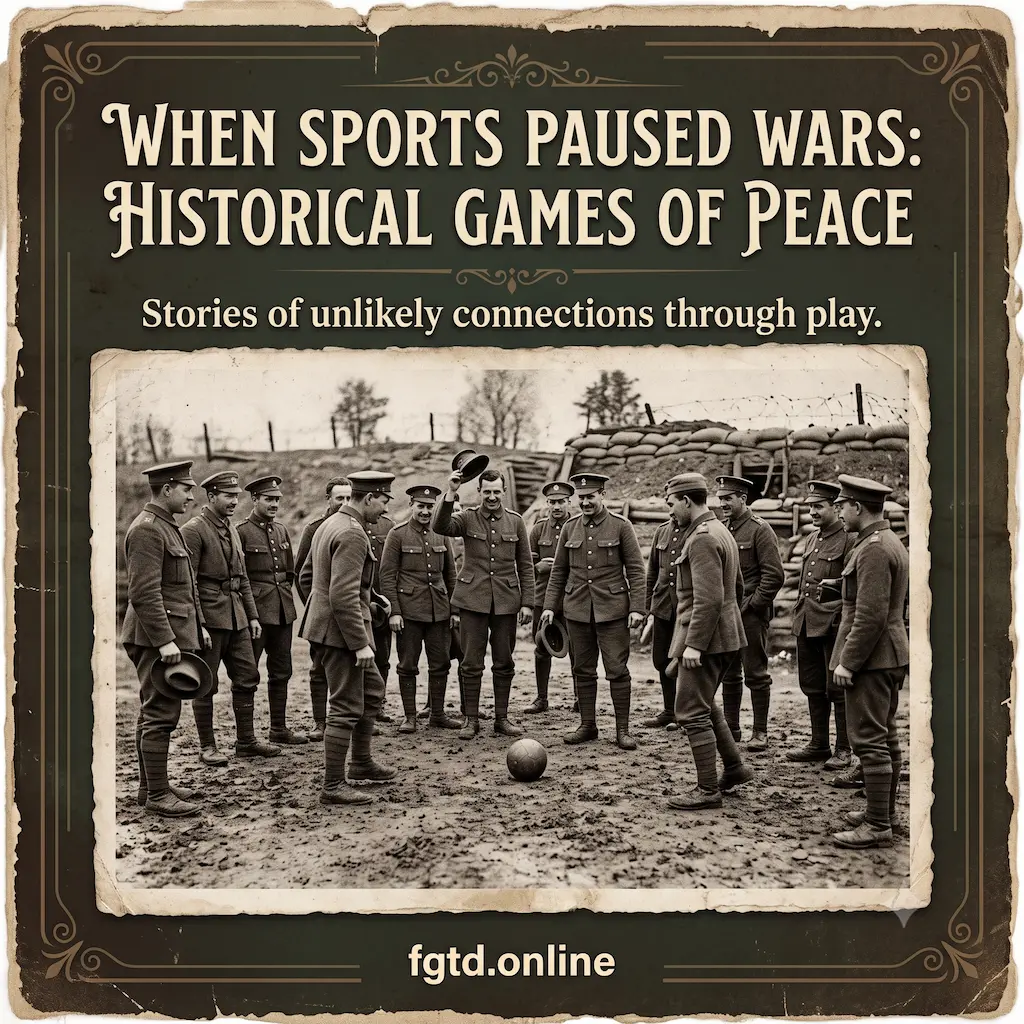
What followed was a profound breakdown of military programming. Men who had been ordered to systematically eliminate one another shared rations, lit cigarettes, and compared photographs of families back home. Amid this spontaneous human realignment, soccer balls appeared—some were genuine leather balls brought by British regiments, others were improvised spheres made from bundled rags, straw, and uniform caps tied together with twine.
Improvised goalposts were mapped out using frozen dirt clods, heavy trench coats, and military boots. Across multiple sectors of the front, units such as the Royal Regiment of Welch Fusiliers, the Seaforth Highlanders, and the Saxon and Prussian regiments engaged in open, competitive football matches.
The game transformed the psychological landscape of the battlefield:
- The Removal of Hierarchy: In the absence of formal referees, the players operated under an organic code of fair play, resolving fouls and boundaries through mutual consensus.
- The Dissolution of Language Barriers: Football served as a universal, open-source language. A well-timed pass or a missed shot required no translation, allowing men to communicate through shared movement rather than political ideology.
- The Shielding of Identity: For a few hours, the military uniforms lost their hostile connotations, transforming soldiers back into young men playing a weekend game in a park.
The immediate operational impact of these matches was so severe that it deeply alarmed the military high commands on both sides. Generals viewed the fraternization and the shared matches as a fundamental threat to the “fighting spirit” required to sustain an industrial war. In the days that followed, units that participated in the truce were rotated to different sectors, artillery bombardments were ordered from deep within the rear to break the local peace, and strict censorship guidelines were placed on letters home to bury the event. Yet, the matches of 1914 proved permanently that a simple sport could instantly dismantle the most intense wartime propaganda.
Breaking Cold War Ice: The Architecture of Ping-Pong Diplomacy
As the twentieth century progressed into the Cold War, the nature of global conflict shifted from open trench warfare to deep ideological gridlock, economic embargoes, and complete diplomatic isolation. By 1971, the relationship between the United States and the People’s Republic of China had been completely frozen for over two decades. There were no direct flights, no open communication lines, and no formal diplomatic ties. The risk of a massive military escalation in Asia remained a constant, unhedged vulnerability for global stability.
The catalyst that broke this multi-decade deadlock was not a sophisticated diplomatic summit, but an accidental interaction during the 1971 World Table Tennis Championships in Nagoya, Japan.
Glenn Cowan, a 19-year-old American player with a flamboyant style, missed his team bus after a practice session. Stranded at the venue, he was waved onto the passing shuttle bus carrying the Chinese national team. Under strict geopolitical protocols, the Chinese players had been instructed to avoid any direct interaction or conversation with Americans. For the first few minutes of the ride, an intense, silent tension dominated the vehicle.
However, Zhuang Zedong, China’s triple world champion, chose to prioritize athletic peerage over political mandates. He walked from the back of the bus, greeted Cowan through a translator, and presented him with a traditional silk tapestry gift depicting the Huangshan mountains. Cowan, touched by the gesture, searched his bag and returned the favor the next day by gifting Zhuang a t-shirt bearing a peace symbol.
This highly publicized moment of athletic connection caught the immediate attention of international planners in Washington and Beijing. Chairman Mao Zedong famously remarked, “Zhuang Zedong is not only a good ping-pong player, but he’s a good diplomat.” Days later, the Chinese government bypassed formal diplomatic delays and issued an official state invitation for the U.S. Table Tennis team to visit Beijing.
The team became the first American delegation to legally enter the Chinese capital since 1949. The event, quickly dubbed “Ping-Pong Diplomacy,” served several crucial operational functions:
- A Soft Launch for Public Opinion: The matches provided a non-threatening, culturally neutral environment for the publics of both nations to see one another in a positive light, softening decades of hostile media framing.
- Plausible Deniability: Because it was framed as a simple athletic exchange, both governments could test the waters of reconciliation without risking political face if the initiative failed.
- A Fast Track for Formal Treaties: The goodwill generated by the table tennis matches cleared a direct pathway for secret high-level communications, culminating in National Security Advisor Henry Kissinger’s secret trip to Beijing and President Richard Nixon’s historic 1972 visit that permanently altered global trade and geopolitics.
Modern Ice: The Unified Korean Hockey Team of 2018
The enduring power of sports to cool active military rhetoric remains highly relevant in the modern era. The Korean Peninsula has stood as one of the most volatile flashpoints in international relations since the armistice of 1953. Separated by the heavily fortified Demilitarized Zone (DMZ), North and South Korea have endured decades of intense brinkmanship, cross-border psychological warfare, and nuclear proliferation anxieties.
During the lead-up to the 2018 Winter Olympics in PyeongChang, South Korea, regional tensions had reached a peak, with active missile tests and escalatory political threats dominating global news cycles. In a calculated move of sports diplomacy, the governments of Seoul and Pyongyang negotiated an unprecedented athletic intervention.
During the opening ceremony, athletes from both nations entered the Olympic stadium together, marching as a single delegation under the unified Korean Unification Flag—a minimalist white banner displaying a blue silhouette of the peninsula. More importantly, the two countries deployed a completely unified women’s ice hockey team into active Olympic competition.
This implementation required navigating immense logistical and cultural friction:
- The Language Divergence: Decades of physical separation had caused the sports vocabularies of the two teams to drift, requiring coaches to create a unified dictionary translating complex English hockey terms into shared phonetic phrases.
- Roster Synchronization: Athletes who had spent their entire lives training under completely different socio-political systems had to instantly synchronize their physical movements, sharing a single locker room, eating together, and coordinating high-velocity tactical plays on the ice.
- The Public Symbol: While the unified team did not win a gold medal on the ice, their presence created an unassailable visual statement. Seeing players in identical jerseys hugging after a goal provided a powerful reminder of a shared cultural heritage that lay deeper than the ideological walls of the DMZ.
The Behavioral Mechanics: Why Sports Work Where Diplomat Fail
When analyzing these historical milestones cleanly, it becomes evident that sports possess unique structural attributes that allow them to override human hostility when traditional communication networks fail.
1. The Rule-Bound Environment
Warfare is inherently chaotic, defined by the erosion of boundaries, unverified data, and the breakdown of international treaties. In stark contrast, a sports match is an oasis of absolute predictability. It operates under a strict, mutually accepted code of conduct where rules are universal and enforcement is immediate. This structural transparency creates an instant baseline of trust; players know that regardless of their external political differences, inside the boundaries of the pitch or court, they are bound by the exact same laws.
2. The Substitution of Kinetic Energy
Human conflict is driven by deep-seated competitive drives, tribal loyalty, and the evolutionary urge to defend a group. Sports do not attempt to suppress these powerful human drives; instead, they provide a safe, symbolic alternative. Athletics channel the physical energy, tactical planning, and intense focus of combat into a non-lethal format. Victory is determined by points and goals rather than casualties and territorial destruction, allowing societies to achieve a sense of triumph without incurring the human cost of kinetic warfare.
3. The Humanization of the “Other”
Wartime propaganda relies heavily on the systematic dehumanization of the adversary, reducing complex societies to flat, hostile caricatures. Athletic competition forces direct, close-quarters physical proximity. It is impossible to view an opponent as an abstract monster when you are looking into their eyes during a face-off, running alongside them on a track, or exchanging a handshake at the end of a exhausting match. Sports reveal the shared vulnerabilities of the human condition—fatigue, dedication, emotion, and skill—effectively piercing the veil of political manipulation.
Read More👉 From Arcades to Arenas: The History of Early Esports
Conclusion: Securing the Legacy of Fair Play
The historical record confirms that the deployment of sports as a bridge for peace is not an accidental footnote or a collection of sentimental myths; it is a vital, proven mechanism for cross-cultural connection. From the bronze discus of ancient Olympia to the frozen mud of Flanders, the ping-pong tables of Japan, and the ice rinks of PyeongChang, games have consistently stepped into the vacuum left by failed diplomacy to preserve our collective humanity.
In a globalized landscape that frequently fractures along geopolitical, ideological, and digital lines, protecting the integrity, accessibility, and neutrality of sports environments remains a fundamental requirement for our collective future. The visionary enterprises and platforms that understand how to host, broadcast, and protect these shared cultural spaces ensure that humanity always retains a neutral arena where conflict can be paused, rules are respected, and competitive drives are channeled into glory rather than destruction.
Hosting high-performance sports analytics dashboards, managing decentralized media distribution networks, and securing international athletic platforms requires world-class, zero-downtime server infrastructure. Ensure your organization’s digital perimeter stands on an unassailable foundation by exploring the premium enterprise hosting configurations at fgtd.online.