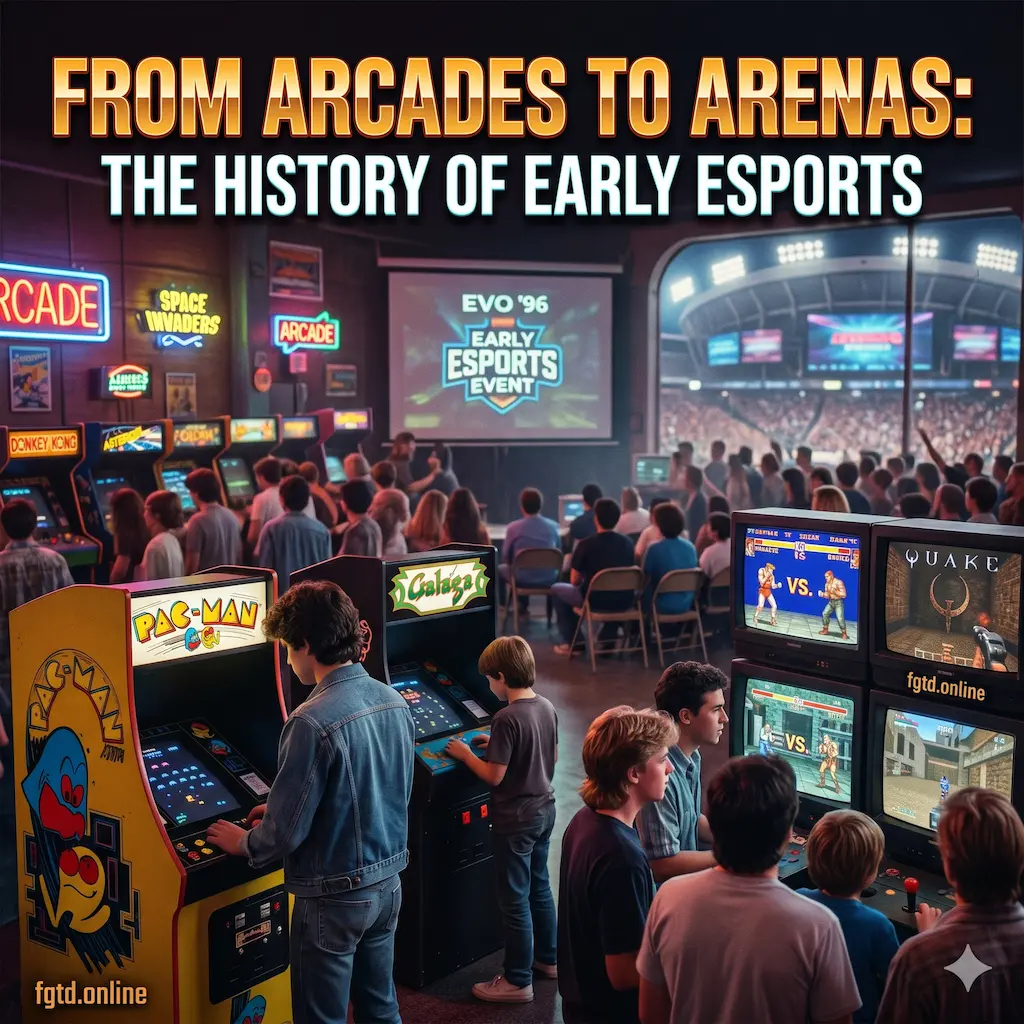
From Arcades to Arenas: The History of Early Esports
The modern esports ecosystem is an undisputed titan of global media. Today, premier competitive gaming tournaments pack iconic physical arenas, command multi-million-dollar corporate sponsorship profiles, and utilize advanced, low-latency network architectures to stream live broadcasts to hundreds of millions of concurrent viewers worldwide. To a casual contemporary observer, this hyper-monetized phenomenon might look like a sudden byproduct of the modern internet era—an organic convergence of high-speed broadband, streaming media platforms, and rapid capital injections into game development.
However, the structural foundation of competitive gaming was engineered long before the dawn of modern digital infrastructure. The lineage of esports traces back through decades of structural, mechanical, and cultural transformations. It is a narrative that chronicles how local, coin-operated mechanical arcade terminals in the 1970s and 1980s laid the baseline behavioral code for digital competition, which was subsequently accelerated by the crude dial-up netcode architectures of the 1990s and localized PC-bang infrastructures.
Unearthing the history of early esports is not merely a nostalgic retro exercise; it is a critical study in technical evolution, showing how human competitive drive has continuously weaponized every generation of silicon computational hardware to transform video games from solitary casual amusements into a highly structured global athletic arena.
Continues after advertising
[The Arcade Era (1972-1989)]: Local High-Score Arrays ➔ Asynchronous Mechanical Competition
│
▼
[The PC & Netcode Revolution (1990-1999)]: Peer-to-Peer Packets ➔ LAN Tournaments ➔ Early Global Arenas
1. The Primordial Spark: Intergalactic Competition and the First Localized Tournaments
Before video games occupied commercial shopping malls or living room entertainment hubs, they existed exclusively as experimental application programs inside high-end university research laboratories. It was within these institutional mainframe environments that the baseline code for competitive gaming was first compiled.
The 1972 Spacewar! Tournament at Stanford
The historical genesis of competitive gaming occurred on October 19, 1972, at the Stanford University Artificial Intelligence Laboratory. The game was Spacewar!, a vector-graphics space combat application developed a decade prior by Steve Russell and a team at MIT, running on a massive PDP-11 minicomputer connected to a CRT display array.
The event, officially dubbed the “Intergalactic Spacewar! Championship,” featured a modest bracket of Stanford computer science students and research engineers competing across two distinct structural formats: a free-for-all battle royale and a definitive team-based match layout.
[Human Visual Reflex] ➔ [Custom Mechanical Control Panel] ➔ [PDP-11 Core Mainframe Processing] ➔ [Real-Time Vector CRT Output]
The prize for winning this inaugural digital tournament was a one-year subscription to Rolling Stone magazine. While small in scale, this event established the primary psychological primitive that defines modern esports: the weaponization of high-performance computing hardware to facilitate real-time, face-to-face tactical competition between individual human operating systems.
2. The Arcade Paradigm: High-Score Monopolies and the Standardization of Value
By the late 1970s and early 1980s, the computing revolution moved out of university cleanrooms and into the public sphere through coin-operated arcade cabinets. This era introduced the structural concept of asynchronous competition—a model where players did not necessarily compete side-by-side in real time, but instead battled for dominance across an immutable, shared digital ledger: the high-score table.
[Local High-Score Table (8-Slot RAM Ledger)] ➔ [Twin Galaxies Centralized Registry] ➔ [National Standardized Leaderboard]
Space Invaders and the Scaling of Tournament Operations
The release of Taito’s Space Invaders in 1978 acted as a massive catalyst for the formalization of tournament scale. In 1980, Atari orchestrated the National Space Invaders Championship across the United States.
Attracting over 10,000 regional competitors to regional brackets, the event culminated in a massive final arena cluster in New York City. This tournament proved that competitive gaming could generate massive public interest, shifting executive perception of video games from localized teenage novelties into a viable, mass-audience entertainment medium.
Twin Galaxies and the Unification of Metrics
In an era before interconnected servers and global internet pipelines, proving historical gaming supremacy was a localized, highly fragmented challenge. A high score achieved in an arcade in Chicago had no structural mechanism to validate itself against a record set in Los Angeles. To solve this metric friction, an entrepreneur named Walter Day founded Twin Galaxies in Ottumwa, Iowa, in 1981.
Twin Galaxies functioned as the absolute, centralized database for international video game records. Day dispatched team members to physical arcades across the United States to manually verify cabinet settings, microchip integrity, and player scores.
By defining strict, standardized rule templates—such as disabling cheat vectors, enforcing default difficulty dips on motherboard toggle switches, and requiring continuous video recordings of gameplay—Twin Galaxies built the first global competitive metric system. This infrastructure laid the foundation for the structural statistics and auditing engines that power today’s professional leagues.
3. The Structural Shift: The Fighting Game Boom and Direct Kinetic Conflict
While the arcade high-score era validated numerical optimization, it remained fundamentally asynchronous. A player executed a run against an automated, predictable computer script; they were not actively countering the changing intentions of a live human mind. This changed permanently in 1991 with the release of Capcom’s Street Fighter II.
[Player 1 Kinetic Input] ──┐
├──> [Zero-Delay Local JAMMA Interface] ➔ Simultaneous Frame Arbitration
[Player 2 Kinetic Input] ──┘
The Inception of Head-to-Head Spatial Mastery
Street Fighter II introduced a revolutionary concept to the arcade space: a zero-delay, local two-player competitive canvas operating over standard JAMMA hardware interfaces. Players were no longer memorizing robotic, algorithmic patterns; they had to execute real-time, sub-second psychological adaptations against a human opponent sitting right next to them.
The game introduced deep structural combat mechanics that remain core esports primitives today:
- Frame Data Arbitration: Calculating the precise microsecond windows of execution vulnerability (startup, active, and recovery frames) for individual combat animations.
- Spatial Spacing (Footsies): Manipulating pixel-level character vectors to bait an opponent into an unsafe mechanical input and executing an immediate kinetic counter-punish.
- The Combo Engine: Exploiting a coding quirk in frame execution buffers to link multiple strikes together into un-blockable sequence chains, creating a high reward for perfect mechanical inputs.
The Dawn of Evolution (EVO)
This head-to-head fighting game culture scaled rapidly out of smoke-filled arcades into organized national tournaments. In 1996, a small group of tournament organizers (including Tom and Tony Cannon) launched Battle by the Bay in Sunnyvale, California, a 40-player localized Super Street Fighter II Turbo bracket.
This tournament would eventually undergo an evolutionary shift to become the Evolution Championship Series (EVO)—the longest-running, most prestigious fighting game open tournament matrix on earth. It established a ruthless open-bracket standard where any individual, regardless of team pedigree or sponsorship capital, could enter the open arena floor and challenge top legends on equal footing.
4. The PC and Netcode Revolution: LAN Corridors and the Birth of FPS Strategy
As the late 1990s approached, the technological center of gravity for competitive gaming migrated out of local coin-operated arcades directly into the home computing ecosystem. The catalyst for this transformation was the rise of the first-person shooter (FPS), pioneered by id Software’s Doom (1993) and Quake (1996).
[Local Client machine] ──(Asynchronous UDP Unreliable Packets)──> [QuakeWorld Server Engine]
│
▼
Compensated Client-Side State
The Birth of Deathmatch and the LAN Party Culture
Doom introduced the technical term “Deathmatch” into the global lexicon, enabling players to link computers together locally using IPX network protocols over coaxial cables. For the first time, players were navigating 3D environments, hunting human targets through complex spatial corridors.
This birthed the LAN Party subculture—events where hundreds of individuals physically carried their bulky CRT monitors and custom desktop towers into community centers and warehouses to construct massive, localized high-bandwidth gaming networks.
QuakeWorld: The Dawn of WAN Infrastructure
While local LAN play delivered near-zero latency, executing competitive matches over the early public internet (WAN) via dial-up modems introduced severe data fragmentation and latency jitter. To address this, id Software released QuakeWorld in 1996, a specialized software update to the Quake network stack.
QuakeWorld implemented groundbreaking Client-Side Prediction netcode algorithms. Historically, when a player pressed a movement key, the client computer had to wait for a round-trip network packet to travel to the server and back before rendering the character’s movement, creating an unplayable delay on high-latency lines.
QuakeWorld’s prediction engine algorithmically guessed the client’s next spatial state instantly on local hardware, reconciling discrepancies with the server asynchronously via lightweight UDP packets. This netcode update allowed global players to engage in stable, competitive cross-border online matches for the early internet generation.
| Early Esports Era | Core Software Primitive | Infrastructure Asset | Primary Network Protocol | Viewership / Scale Paradigm |
| The Mainframe Era | Spacewar! (1972) | PDP-11 Mainframe Minicomputer | Direct local terminal bus lines | Local specialized research lab audiences |
| The Arcade Monopolies | Space Invaders / Pac-Man | Coin-operated structural cabinets | Local 8-bit ROM/RAM ledgers | Asynchronous centralized physical paper registries |
| The Fighting Boom | Street Fighter II (1991) | JAMMA hardware standard arrays | Low-latency local arcade wiring | Face-to-face local crowd circles |
| The PC / Netcode Wave | Quake (1996) / StarCraft | High-performance x86 desktop towers | Coaxial LAN / Early dial-up UDP netcode | Distributed regional LAN arena gatherings |
5. The Red Ferrari and Cyberathlete Professionalization
As competitive metrics stabilized, the late 1990s witnessed the emergence of the first recognized, professional full-time digital athletes—individuals who commoditized their mechanical capabilities into career livelihoods.
Dennis “Thresh” Fong and the Red Ferrari
The symbolic turning point for the professionalization of esports occurred at the Red Annihilation Quake tournament in May 1997, held at the Georgia World Congress Center during the E3 expo. John Carmack, the legendary lead architect of id Software, put up his personal, custom twin-turbocharged 1987 Ferrari 328 GTS as the grand prize for the tournament winner.
[Red Annihilation Bracket] ➔ [Dennis “Thresh” Fong Absolute Victory] ➔ Unlocking the Corporate Sponsorship Era
The tournament was captured in absolute dominance by Dennis “Thresh” Fong, who utilized an innovative WASD keyboard and mouse control configuration that would define the standard tactical interface layout for PC gaming for decades to come.
Fong’s victory and his driving away in Carmack’s sports car shattered mainstream media skepticism, proving that competitive gaming output could secure high-value tangible assets and corporate market relevance.
Angel Munoz and the Cyberathlete Professional League (CPL)
In late 1997, an entrepreneur named Angel Munoz founded the Cyberathlete Professional League (CPL), an organization designed from the ground up to mirror the structural operating blueprints of legacy professional sports networks like the PGA or ATP.
The CPL established structured tournament seasons, enforced strict player code-of-conduct manuals, and secured historic multi-hundred-thousand-dollar cash corporate prize pools backed by hardware monopolies like Intel and AMD. The CPL transformed competitive gaming events out of casual computer store basements into massive hotel convention arena showcases, proving that digital competition was ready for formal professional league structures.
6. The Far East Ignition: StarCraft and the South Korean National Ecosystem
While Western esports architecture scaled primarily through decentralized first-person shooter tournaments, the absolute modern blueprint for integrated, state-supported esports ecosystems was unlocked in East Asia at the turn of the millennium. The catalyst was Blizzard Entertainment’s 1998 real-time strategy masterpiece: StarCraft.
The Asian Financial Crisis and the PC-Bang Boom
In 1997, South Korea experienced a severe economic contraction due to the Asian Financial Crisis. In response, the South Korean government executed a massive structural reallocation of national capital, investing heavily in building out a world-class, nationwide broadband fiber-optic internet infrastructure.
Simultaneously, thousands of unemployed individuals utilized their severance capital to open PC-Bangs—ultra-high-speed, affordable internet cafes where local youth gathered to socialize and compete.
National Broadband Investment ➔ Proliferation of PC-Bangs ➔ StarCraft Structural Adoption ➔ Formation of KeSPA
StarCraft became a national obsession inside these PC-Bangs. The game’s intricate balance between three completely asymmetric alien factions, deep macro-economic management trees, and micro-mechanical control requirements transformed it into a digital version of chess.
The Inception of KeSPA and Televised Esports Channels
By the year 2000, the South Korean Ministry of Culture, Sports, and Tourism officially chartered the Korea e-Sports Association (KeSPA). KeSPA became the central governing authority for the national digital competitive arena, regulating player contracts, establishing team corporate transfers (backed by conglomerates like Samsung, SK Telecom, and KT), and creating strict pro-gamer certification pipelines.
South Korean media networks re-engineered traditional cable television structures, launching dedicated 24/7 esports broadcasting networks like OnGameNet (OGN) and MBCGame.
Elite star players—such as Lim Yo-hwan (BoxeR) and Lee Young-ho (Flash)—achieved mainstream national celebrity profiles, commanding six-figure salaries, starring in corporate commercials, and packing physical stadium locations (such as the legendary 2004 SKY Proleague Finals on Gwanganri Beach, which attracted over 100,000 live physical spectators). South Korea built the definitive blueprint for modern esports long before the West, proving that competitive gaming could function as a sustainable national athletic industry.
7. The Architectural Legacy: How Early Innovations Power the Modern Arena
The technologies, community designs, and netcode architectures engineered by early esports pioneers function as the absolute data rails that support today’s modern multi-billion-dollar global tournaments.
The Lineage of Data Standardization
Every time an automated cloud analytics engine calculates a real-time expected win probability tracker during a modern international championship stream, it draws its historical design line directly from the metrics framework initialized by Walter Day and Twin Galaxies in 1981. The modern insistence on un-compromised parity, baseline anti-cheat hardware checks, and immutable software ledgers was forged out of the structural necessity to standardize value across the early analog arcade wilderness.
Netcode Synchronization and Spatial Computing
The deep mathematical predictive tracking algorithms that power modern, 128 Hz tactical shooter server networks are the direct direct descendants of the client-side estimation code compiled inside id Software’s QuakeWorld update in 1996. Early engineers had to compress packet configurations to navigate the limitations of early dial-up copper lines, establishing the core data minimization protocols that modern developers rely on to route micro-second input tokens seamlessly across international fiber networks today.
Read More👉 The Economic Impact of AI in Pro Sports
Conclusion: Underwriting the Future Coliseum
The history of early esports shows that competitive gaming is not a superficial, short-term trend of the modern digital generation. It represents a profound, multi-decade structural evolution where human competitive instincts have consistently weaponized computing hardware to expand the boundaries of competition.
Esports did not simply arrive with the launch of modern online streaming platforms; it was systematically built, block by block, through the dedication of arcade high-score champions, fighting game frame analysts, LAN party community organizers, netcode engineers, and visionary South Korean state planners.
These early pioneers transformed video games out of solitary, casual consumer novelties into a highly advanced, institutionalized global cultural asset class.
As the competitive arena continues to scale into the next generation—shifting onto hyper-accelerated cloud networks, immersive 3D spatial computing architectures, and decentralized global tournament ledgers—the industry remains fundamentally anchored to its historical rails.
The core principles forged during the foundational arcade and early arena eras—the unyielding pursuit of absolute mechanical precision, the demand for fair play integrity, and the instinct to congregate in shared spaces to witness peak human performance—will continue to guide the sector, anchoring the future evolution of digital competition as it commands the strategic high ground of the emerging global digital economy.
Enjoyed this comprehensive historical breakdown of early esports and digital network evolution? Head over to fgtd.online regularly for deeper analytical research papers covering modern enterprise cloud infrastructure configurations, post-quantum network security protocols, and the next frontier of global technology innovation.