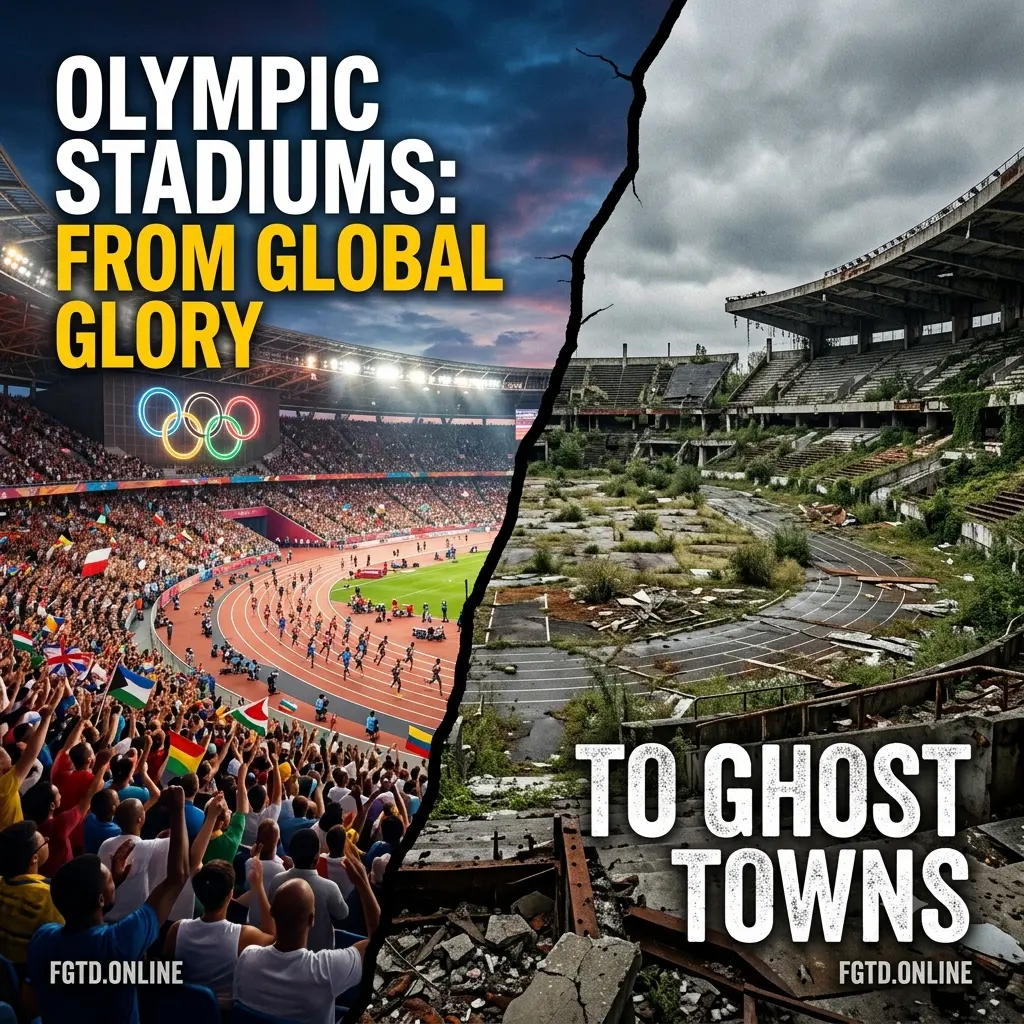
Olympic Stadiums: From Global Glory to Ghost Towns
Every two years, the eyes of the civilized world lock onto a single chosen metropolis. For sixteen high-intensity days, the Olympic Games transform a local city into the absolute epicenter of international culture, athletic achievement, and corporate entertainment. To secure this brief window of global prestige, host governments engage in aggressive bidding wars, unlocking billions of dollars in state reserves and structural capital. The centerpiece of this massive investment is always the stadium infrastructure—colossal architectural marvels engineered to host opening ceremonies, track-and-field milestones, and international broadcast feeds before hundreds of thousands of live spectators and billions of streaming viewers.
Yet, once the closing ceremonies conclude, the international delegations depart, and the corporate sponsor banners are dismantled, a brutal economic and architectural reality sets in.
Far too often, these multi-million-dollar monuments to global glory undergo a catastrophic structural decline, transforming rapidly into decaying, abandoned white elephants—literal modern ghost towns of concrete and rusted steel.
Continues after advertising
The structural trajectory of Olympic stadiums from active mega-venues to overgrown wasteland footprints represents an immense operational and financial crisis for modern urban centers.
Relying on short-term national pride without designing a highly liquid, long-term post-event reuse blueprint leaves municipalities saddled with massive, unhedged maintenance debts.
When a stadium lacks a sustainable tenant framework, local city budgets bleed millions of dollars annually just to stabilize a silent structure, choking urban resources and eroding civic infrastructure value.
To analyze this architectural lifecycle cleanly, explore the underlying economic variables, and uncover how progressive cities are transforming these spaces, this post bypasses emotional nostalgia to dissect the hard realities of Olympic real estate. Investigating these structural triumphs and failures provides an essential blueprint for modern urban planning and stadium architecture, offering valuable insights for the forward-looking digital properties and platform networks driving discussions across channels like fgtd.online.
1. The Economics of the Olympic Bid: Architectural Hyperinflation
To understand how an Olympic stadium transitions into a ghost town, one must first look at the financial mechanics behind the initial construction phase. The bidding process managed by the International Olympic Committee (IOC) historically favored cities that presented hyper-ambitious, iconic architectural blueprints designed to look spectacular on international television feeds.
This dynamic creates what economists call the Winner’s Curse. To beat out global rivals, host nations regularly commit to unhedged infrastructure budgets that carry massive cost-overrun risks.
Stadium construction is pushed through on absolute, unyielding deadlines, forcing developers to bypass standard competitive bidding loops and prioritize speed over long-term cost efficiency.
Furthermore, Olympic specifications demand highly specific, massive seating capacities—frequently requiring the main stadium to hold a minimum of 60,000 to 80,000 spectators.
While this scale is necessary to handle the massive influx of international tourists during the sixteen-day tournament, it routinely creates a severe oversupply of real estate once the event concludes.
Most host cities simply do not have a domestic sporting league, local football club, or consistent entertainment market capable of filling an 80,000-seat arena on a standard weekend, locking the asset into immediate structural underutilization from day one of its post-Olympic life.
2. Case Studies in Structural Decay: The White Elephants
The global landscape features several high-visibility warning signs where massive Olympic investments collapsed into absolute structural and social abandonment.
Athens 2004: The Cradle of Modern Abandonment
The 2004 Summer Games in Athens, Greece, stand as a primary case study in unhedged infrastructure failure. Driven by a desire to bring the games back to their historical birthplace, the Greek government spent an estimated $11 billion—a figure that vastly exceeded initial projections and severely burdened the nation’s sovereign debt profiles.
Following the games, the lack of a cohesive legacy master plan caused immediate asset stagnation. The specialized venues built for niche sports like softball, beach volleyball, and whitewater kayaking were abandoned almost overnight.
Today, the main Hellinikon Olympic complex sits largely in a state of advanced decomposition.
Rusted spectator gates, cracked concrete paths overtaken by weeds, and dry, trash-strewn aquatic channels serve as a stark visual reminder of what happens when massive state capital is funneled into singular, single-use real estate projects without local market integration.
Beijing 2008: The Brilliant Shell of the Bird’s Nest
Architecturally, the Beijing National Stadium—famously known as the “Bird’s Nest”—stands as one of the most iconic, innovative structures built in the modern era. Constructed from an intricate web of twisted structural steel lines at a cost of roughly $480 million, the arena served as the ultimate visual showcase for China’s economic emergence during the 2008 opening ceremonies.
Yet, despite its architectural fame and high volume of daily sightseers, the Bird’s Nest has historically struggled to find a consistent, high-yield operational identity.
With no primary local sports team requiring a venue of that massive scale, the stadium functioned for years as a high-cost tourist shell.
The annual maintenance costs required just to preserve the structural integrity of the steel frame and manage the massive interior space run into millions of dollars, demonstrating that even the most globally praised architectural achievements can become financial weights if they lack organic, daily commercial utility.
Rio de Janeiro 2016: The Rapid Decay of the Maracanã Perimeter
The 2016 Summer Games in Rio de Janeiro, Brazil, highlighted how quickly an Olympic infrastructure footprint can deteriorate when paired with localized economic volatility and political shifts. The iconic Maracanã Stadium underwent massive, high-dollar renovations to host the opening and closing ceremonies, while the nearby Olympic Park was pitched as a future master-planned community hub for the city’s residents.
Instead, the post-games reality was hit by immediate budget collapses and legal gridlock over venue management contracts.
Within a year of the closing ceremonies, the Maracanã suffered severe utility shutdowns due to unpaid electricity debts, the pristine turf pitch died and turned completely brown, and thousands of physical seats were ripped out and left to rot in stadium corridors.
The adjacent Olympic Park fields were closed to the public due to safety concerns, transforming a multi-million-dollar community asset into a secured, silent ghost town locked behind security wire fences.
3. The Structural Optimization Ledger: Success vs. Abandonment
Evaluating the operational parameters that separate long-term stadium viability from catastrophic structural abandonment highlights the critical importance of flexible urban integration.
- Legacy Management Model (Failed Paradigm): Focuses entirely on the 16-day Olympic event window, utilizes single-use rigid architectural designs, features massive fixed over-capacities, and isolates the venue from the local transit and residential matrix.
- Adaptive Urban Engineering (Successful Paradigm): Prioritizes post-event modular downsizing, builds flexible multi-sport multi-tenant layouts, scales capacity down to local market realities, and integrates the stadium straight into active public transit and commercial zones.
4. The Path to Salvation: Modular Design and Adaptive Reuse
To break this cycle of multi-billion-dollar waste, progressive architects and urban engineers are completely altering how Olympic venues are designed from the very first sketch. The modern mandate has shifted away from building permanent, monolithic monuments and focused entirely on modular flexibility, structural reduction, and long-term community integration.
London 2012: The Blueprint for Downsizing
The organizers of the 2012 London Olympic Games recognized the white elephant trap early and engineered a brilliant response with the London Olympic Stadium (now known as London Stadium). Instead of building a permanent 80,000-seat concrete bowl, engineers designed a highly innovative, modular hybrid structure.
The lower tier was sunk into the earth, while the massive upper tiers were constructed using lightweight, bolted steel scaffolding systems that could be systematically dismantled after the games.
Following the Olympics, the stadium underwent a planned structural conversion, scaling down its permanent capacity to align with a sustainable long-term tenant.
By securing West Ham United Football Club as a primary anchor tenant and modifying the seating arrays to transition smoothly between Premier League football matches, international athletics, and massive summer music concerts, London converted a potential fiscal drain into a highly active, self-sustaining commercial hub that actively anchors the broader regeneration of East London.
Paris 2024 & Los Angeles 2028: Embracing Existing and Temporary Infrastructures
The latest evolution in sustainable sports engineering permanently abandons the requirement to construct brand-new, hyper-expensive main stadiums altogether. The Paris games leaned heavily into utilizing historic, pre-existing city infrastructures and assembling temporary, drop-in spectator arenas around iconic cultural monuments that could be completely recycled within weeks of the event’s conclusion.
Following this trajectory, the upcoming Los Angeles games are explicitly built on a “No New Venues” platform.
By routing events across existing world-class commercial stadiums like SoFi Stadium and the LA Memorial Coliseum, the city eliminates the construction-phase cost inflation loop entirely.
The infrastructure strategy shifts from a risky real estate gamble into a software-like deployment puzzle—allocating spatial data packages, configuring temporary overlay networks, and routing consumer traffic across pre-existing, highly profitable urban matrices that carry zero risk of post-event abandonment.
5. Systemic Operations: Hardening the Management Core
Transitioning a massive civic facility from an international mega-event hub into a dynamic, daily multi-use commercial asset requires a highly optimized operational platform. When a stadium undergoes a transformation—shifting from a closed athletic track into a multi-tenant commercial district filled with retail shops, public parks, and tech hubs—the underlying facilities management matrix must scale gracefully to prevent operational friction.
To preserve these transformed real estate footprints, municipal planners and venue management syndicates deploy advanced building automation layers and infrastructure-as-code models.
These platforms monitor structural load indicators, real-time grid power distributions, and hyper-local security networks continuously across the entire arena perimeter.
By utilizing automated configuration sweeps and real-time sensor logging, engineering groups eliminate system drift, secure core utility response times, and maintain complete asset visibility without requiring massive, manual administrative overhead.
Securing this data perimeter is vital to safeguard asset value and protect public investments, ensuring that the physical facilities operate at peak efficiency across digital tracking systems and platform web properties like fgtd.online.
6. Regulatory Convergence: Adhering to Modern Sustainability Directives
Scaling a modern, international sports facility platform across contemporary borders requires strict alignment with evolving global environmental mandates, institutional governance codes, and green building standards.
- Leadership in Energy and Environmental Design (LEED): Contemporary venue financing structures demand that mega-scale construction projects secure top-tier green building certifications, verifying absolute compliance regarding energy conservation, water reclamation, and carbon footprint reduction throughout the asset lifecycle.
- The IOC Sustainability Strategy: International regulatory frameworks now explicitly mandate that prospective host cities present legally binding, verified environmental and structural legacy audits, blocking bids that rely on building single-use permanent infrastructures that risk long-term decay.
- Global Urban Governance Standards: Regional carbon tax structures and municipal zoning laws enforce strict financial penalties on real estate groups that allow massive industrial structures to sit unutilized and uninsulated, forcing asset pools to adopt active adaptive reuse paths to protect their underlying balance sheet allocations.
Read More👉 Neurotraining in Sports: Hacking the Athlete’s Brain
Conclusion: Engineering the Resilient Foundations for Civic Spaces
The evolution of Olympic stadiums from global glory to ghost towns is a powerful warning of what happens when massive capital investments are driven by short-term prestige rather than long-term data, flexible design, and true community integration. The historical approach of building single-use, permanent concrete monuments for a sixteen-day television window is an unsustainable model that modern urban economies can no longer afford to support.
The future of global sports infrastructure belongs entirely to the visionary cities, forward-looking architects, and adaptive platform networks that view a stadium not as a static physical monument, but as an elastic, multi-tenant urban resource.
By mastering modular assembly methods, secure building automation platforms, and unbundled post-event tenant models, modern urban planners transform potential fiscal drains into high-performance engines of long-term civic growth.
As long as the world continues to gather to celebrate elite human competition, our architectural solutions must evolve to ensure that our monuments to global unity remain active, vibrant anchors of human connection long after the flame has been extinguished.
Hosting computationally intensive urban planning models, validating real-time facility monitoring networks, processing high-throughput sensor telemetry pipelines, and managing ultra-secure asset management dashboards requires world-class, zero-downtime server infrastructure. Secure your organization’s digital data framework on an unassailable foundation by exploring the premium enterprise hosting configurations at fgtd.online.