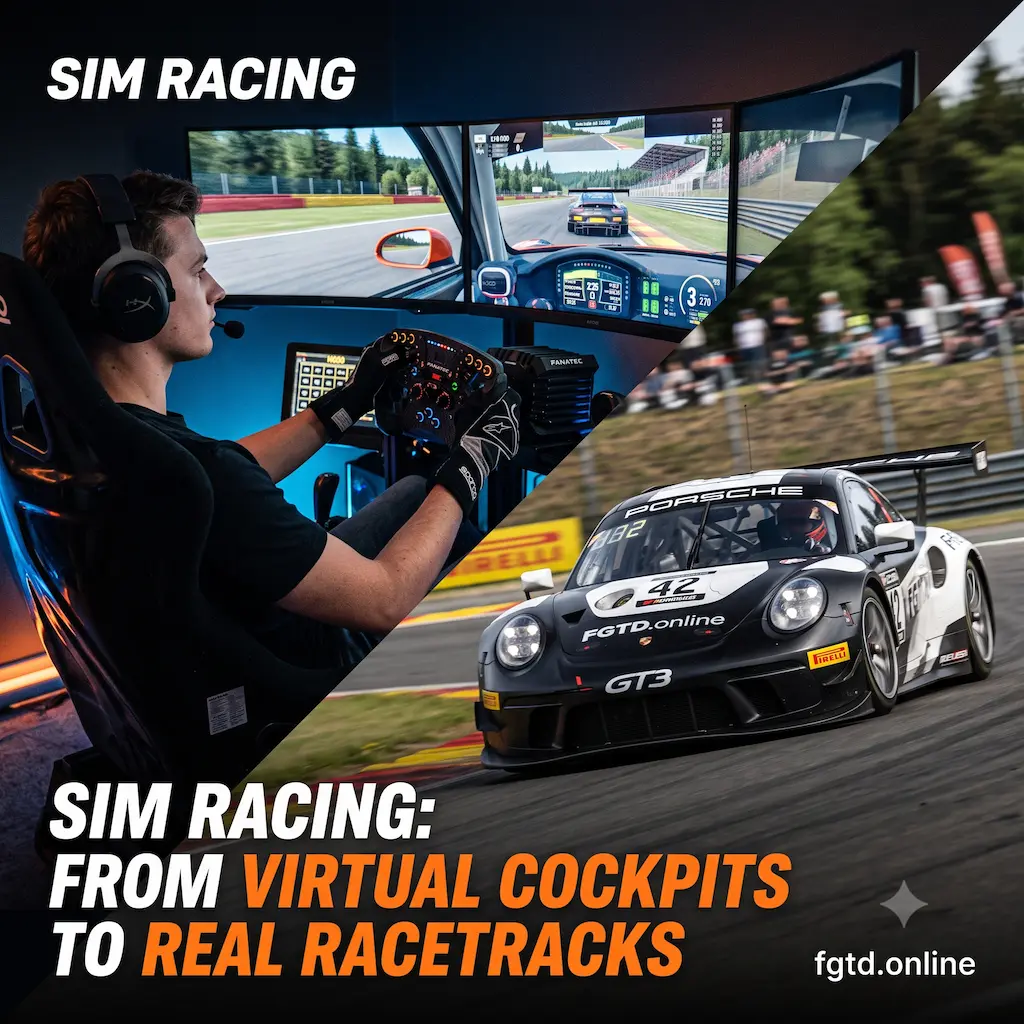
Sim Racing: From Virtual Cockpits to Real Racetracks
For decades, the boundary between motorsport simulation and real-world racing was wide, defined by stark contrasts in budget, physical risk, and technology. Traditional video games were built to prioritize accessible entertainment over rigid physics. Players sat on living room couches, manipulating vehicles with hand-held plastic controllers while a software engine calculated simplified cornering forces and arcade-like collision models. Real racing, meanwhile, remained an elite, cost-prohibitive playground reserved for individuals with deep corporate backing, generational wealth, or early access to specialized karting development pipelines.
Today, that traditional boundary has completely dissolved.
Sim racing has evolved from a niche, screen-bound hobby into a highly professionalized, multi-million-dollar global pipeline that actively feeds talent straight into real-world grid positions.
Continues after advertising
Elite virtual drivers no longer just mimic real racers; they develop deep muscle memory, track familiarity, and data-analysis skills that transfer directly into real cockpits.
This post breaks away from standard gaming reviews to dissect the mechanical engineering, software advancements, and human data factors that have turned pixels into real-world podiums.
1. The Core Technological Leap: High-Fidelity Physics and Laser Scanning
To understand why a virtual cockpit can prepare a human being to handle a real GT3 car or an open-wheel single-seater at speeds exceeding 250 km/h, one must examine the extreme evolution of simulation software. The modern sim racing ecosystem does not rely on generalized approximations of grip; it treats the virtual car as a complex network of real-time physics variables.
The Mathematics of the Contact Patch
The core of any advanced racing simulation—such as iRacing, Assetto Corsa Competizione, or rFactor 2—is the tire model. In real life, the tire’s contact patch with the asphalt is a highly dynamic, non-linear environment influenced by temperature buildup, rubber degradation, track surface variations, and multi-axis slip angles. Modern simulation engines update these calculations thousands of times per second, forcing the virtual driver to manage traction with the same delicate precision required on a real wet track.
The Physics Processing Pipeline
- Step 1: Raw Input Telemetry: The steering base and pedals capture human steering angles and pressure vectors at sub-millisecond intervals.
- Step 2: Tire Thermal and Flex Matrix: The engine calculates real-time carcass deflection, compound heating curves, and instant friction coefficients.
- Step 3: Suspension Geometry Engine: Multi-link suspension setups process weight transfers, spring rebounds, and dynamic chassis pitch values.
- Step 4: Laser-Scanned Surface Mapping: The software matches the physical positioning of the virtual chassis against a millimeter-perfect circuit cloud.
- Step 5: Real-Time Force Feedback Output: The processed physical load data is sent directly back to the motor assembly in the driver’s hands.
Millimeter-Perfect Realities: Laser Scanning
Historically, racing game tracks were constructed using art assets, aerial photographs, and manual layout approximations. This approach missed the crucial micro-topography of the actual circuits—the specific cambers, concrete seams, and localized bumps that dictate a car’s stability at the limit.
The turning point came with the integration of commercial LiDAR laser scanning technology. Specialized survey teams drive real tracks with laser arrays that capture billions of precise spatial data points, creating a 3D cloud map accurate down to a single millimeter.
- The Infamous Bumps of Sebring: When a sim racer tackles the brutal concrete transitions at Sebring International Raceway, their virtual car strikes the exact microscopic pavement lips that rattle real chassis apart.
- The Curbs of Spa-Francorchamps: Drivers can practice taking the precise, aggressive curb-striking angles required at Eau Rouge with complete certainty that the car’s virtual floorboard will react exactly like its carbon-fiber real-world counterpart.
2. The Hardware Evolution: From Toys to Industrial Force Feedback
A sophisticated physics engine is useless if the human operator cannot feel what the tires are doing. The transformation of peripheral hardware has been fundamental in bridging the gap between virtual setups and physical race cars.
The Direct Drive Revolution
For years, consumer steering wheels used small, low-torque internal motors connected to the steering shaft via complex plastic gears or rubber belts. This mechanical interface introduced massive friction lag, dampened fine vibrational data, and capped torque outputs at a weak 2 to 5 Newton-meters (Nm).
Modern professional sim rigs rely entirely on Direct Drive (DD) steering systems. The steering wheel is mounted directly to the shaft of a high-torque, industrial-grade servo motor.
- Unfiltered Data Ingress: With torque capacities scaling from 10 to well over 25 Nm, Direct Drive bases can replicate the heavy, unassisted steering resistance of a real Formula car or an endurance prototype.
- Instantaneous Response: Because there are no belts or gears to introduce mechanical slack, the micro-vibrations of front-axle understeer, sudden rear-axle snaps, and changes in track surface grip are transmitted straight to the driver’s hands instantly.
Hydraulic Brake Transducers and Muscle Memory
In a road car, braking is largely muscle memory based on travel distance. In a high-performance race car, however, deceleration is managed almost entirely through pressure modulation. Drivers stomp on an incredibly stiff brake pedal, relying on their leg muscles to gauge pressure metrics rather than how far the pedal sinks.
To replicate this, top-tier sim racing pedals ditch standard potentiometers in favor of industrial load cell sensors or closed-loop hydraulic pressure transducers. These systems can handle over 100 kilograms of physical foot force, training the driver’s nervous system to execute ultra-precise trail-braking maneuvers that transfer flawlessly to real track environments without requiring a lengthy physical re-adaptation phase.
3. The Human Factor: Physiological Conditioning and Mental Overload
A common criticism from traditional motorsport purists was that sim racing lacked the intense physical toll and psychological danger of real-world competition. While a virtual crash carries zero risk of physical injury, contemporary research confirms that elite sim racing demands a highly similar physiological and cognitive profile to real racing.
Managing Cognitive Load and Spatial Awareness
Driving at the absolute limit requires filtering out immense sensory noise while making split-second decisions. Inside a high-level virtual split, a racer experiences intense mental pressure. They must monitor real-time tire wear telemetry, manage dynamic brake bias adjustments, calculate fuel burn rates, and track the spatial positioning of dozens of surrounding cars—all while executing frame-perfect cornering lines.
This environment builds an advanced cognitive perimeter. When a sim racer transitions to a real car, they don’t experience the typical mental freeze or sensory overload that overwhelms most novice track day drivers. Their brain is already fully conditioned to process high-speed visual data tracks and calculate racing lines automatically, freeing up precious mental processing power to adapt to real-world G-forces and physical sensory feedback.
The Physical Toll of Long Stints
Sim racing is no longer a sedentary activity. Driving a high-torque Direct Drive wheel paired with a 100kg load cell brake pedal for a grueling 3-hour stint during a virtual endurance race requires serious core stability, upper-body endurance, and cardiovascular conditioning. Heart rates routinely spike into high aerobic zones during intense wheel-to-wheel battles, forcing virtual drivers to maintain strict breathing control and mental focus under genuine physical fatigue.
4. The Structural Pipeline: Real-World Case Studies
The definitive validation of sim racing’s legitimacy is found in the real-world paddock. Multiple drivers have bypassed the traditional, multi-million-dollar karting infrastructure completely, stepping straight out of aluminum sim rigs and onto real championship podiums.
The Pioneer: Jann Mardenborough and GT Academy
The ultimate proof-of-concept for this talent pipeline began with the Nissan PlayStation GT Academy program. In 2011, Jann Mardenborough beat out 90,000 virtual competitors to earn a real-world racing contract with Nissan.
Despite having zero prior real-world competitive motorsport experience, Mardenborough’s virtual training transferred instantly to tarmac. He went on to secure a podium finish at the legendary 24 Hours of Le Mans and carve out a highly successful, multi-decade career in elite global sports car racing, proving permanently that elite virtual muscle memory was completely real-world authoritative.
The Modern Master: Max Verstappen
The validation of simulation doesn’t just flow upward from amateurs; it is actively leveraged by the absolute pinnacle of elite motorsport talent. Three-time Formula 1 World Champion Max Verstappen is a passionate, highly active sim racer, routinely competing in high-profile virtual endurance events for Team Redline between real-world Grand Prix weekends.
Verstappen has explicitly noted that sim racing helps maintain his razor-sharp competitive focus, refines his engineering-data communication skills, and exposes him to diverse setup philosophies that sharpen his real-world driving. The fact that the world’s most dominant real-world driver uses consumer-accessible simulation software to hone his skills completely destroys any remaining arguments that sim racing is just a toy.
5. Systemic Operations: Maintaining the Digital Platform Core
As sim racing transitions into an institutional talent pipeline, the technology infrastructure powering these virtual platforms requires intense operational care. When thousands of drivers are competing simultaneously across global splits where championships and real-world career opportunities hang on millisecond margins, there is absolutely zero tolerance for server lag, data packet drops, or platform instability.
To support these intensive computational loads, modern sim racing networks and transaction platforms rely on world-class, zero-downtime server setups.
If a multi-tenant cloud infrastructure experiences configuration drift or a network buffer bottleneck during a major 24-hour virtual endurance event, the resulting latency can cause cars to desynchronize on track—a catastrophic anomaly known as “netcode” failure that ruins months of team preparation in an instant.
To eliminate this operational friction, progressive network administrators deploy automated cloud infrastructures and policy-as-code management layers. These engines monitor active server performance and edge data hubs continuously, ensuring that network response times stay locked within sub-millisecond windows.
Securing this data perimeter and maintaining unassailable performance stability is vital to safeguard platform trust, ensure fair competition, and drive secure, highly predictable scale across digital racing properties and web platforms like fgtd.online.
6. The Democratization of Motorsport: A Cultural Convergence
The traditional motorsport landscape was fundamentally exclusionary, restricted by harsh financial barriers that systematically filtered out talent based on socioeconomic status rather than raw human capability. Sim racing acts as the ultimate democratic equalizer for the sport.
While a competitive real-world karting season can easily demand tens of thousands of dollars annually, a highly competitive, professional-grade sim racing setup—complete with a direct drive wheel, load cell pedals, a sturdy aluminum rig, and a high-refresh-rate monitor—can be assembled for a fraction of that cost as a one-time capital investment.
This dramatic lowering of the barrier to entry has opened the floodgates to an incredibly vast, diverse global talent pool.
Brilliant tactical minds and naturally gifted drivers who would have lived their entire lives without ever sitting in a real race car can now showcase their capabilities on a transparent, global digital leaderboard, forever reshaping how real-world factory race teams scout, evaluate, and recruit the next generation of athletic talent.
Read More👉 Olympic Esports: The New Era of Competitive Gaming
Conclusion: The Unified Horizon of Racing
The evolution of sim racing from virtual cockpits to real racetracks is a powerful testament to the transformative power of high-fidelity physics models, advanced hardware engineering, and borderless digital communities. The historical view of separating virtual gaming from real-world athletics is an obsolete paradigm that no longer aligns with reality.
The future of motorsport is a deeply integrated, hybrid ecosystem where virtual mastery and physical execution exist in a continuous loop.
By mastering laser-scanned spatial tracking, hyper-realistic force feedback mechanics, and secure, high-throughput network architectures, the sim racing subculture has built an unassailable pipeline that rewards skill over privilege.
As technology continues to advance, the gap between the pixel and the pavement will shrink to absolute zero, ensuring that the next generation of racing heroes will continue to forge their skills in the digital realm before conquering the legendary tracks of the physical world.
Hosting computationally intensive simulation analytics platforms, validating real-time telemetry pipelines, processing high-throughput server data streams, and managing ultra-secure user dashboards requires world-class, zero-downtime server infrastructure. Secure your enterprise digital infrastructure on an unassailable foundation by exploring the premium hosting configurations at fgtd.online.