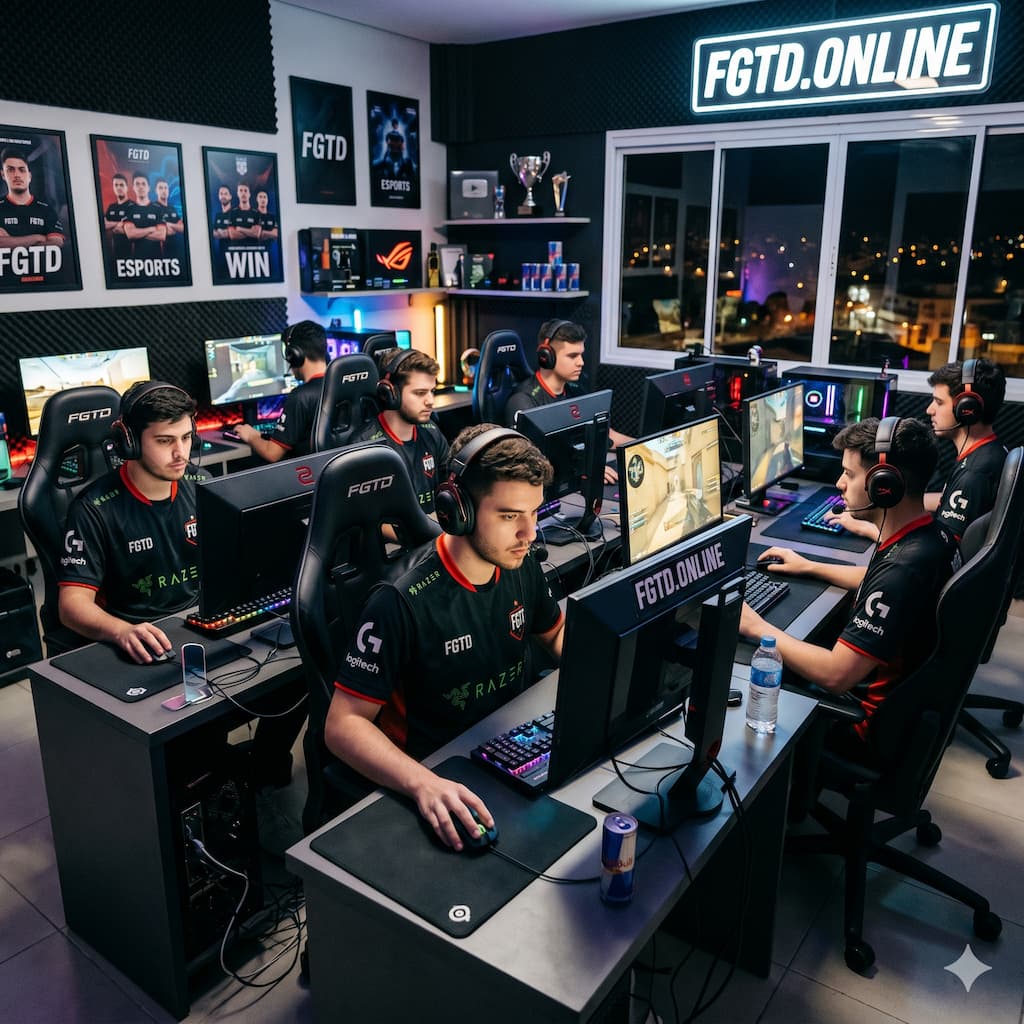
Gaming Houses: The Intense Culture and Lifestyle of Pro Gamers
The explosive growth of the esports industry has systematically dismantled the archetypal myth of the isolated, casual gamer operating out of a suburban bedroom. Today, professional competitive gaming is a hyper-capitalized, institutionalized global ecosystem. Teams operate under rigid corporate frameworks backed by multi-million-dollar sponsorships, venture capital injections, and specialized performance metrics that rival legacy athletic leagues like the Premier League or the NBA.
At the structural epicenter of this high-performance environment sits one of the most unique, intense, and controversial architectural innovations in modern digital culture: The Gaming House.
A gaming house is a physical corporate facility where an entire roster of professional esports athletes, head coaches, tactical analysts, and performance staff live, train, and eat synchronously 24 hours a day, 7 days a week. Originating as a grassroots survival strategy in the early StarCraft corridors of Seoul, South Korea, the gaming house model has expanded globally into a mandatory operational standard across every major competitive title, from League of Legends and Valorant to Counter-Strike and Dota 2.
Continues after advertising
While these spaces are engineered to function as high-velocity incubation cells designed to maximize team synergy, mechanical optimization, and cross-border tactical dominance, they also function as intense hotbeds of psychological friction, blurred boundaries, and relentless lifestyle demands.
[Traditional Corporate Workspace]: Siloed Technical Labor ──> Defined Boundaries ➔ Linear Outflow
[Modern Esports Gaming House]: Synchronous Core Co-Living ──> Erased Boundaries ➔ Constant Optimization Loop
1. The Historical Architecture: From Grassroots Scarcity to the Hyper-Luxurious Complex
The gaming house did not begin as an executive design concept inside corporate boardroom meetings. It emerged out of absolute economic necessity and technical infrastructure constraints during the late 1990s and early 2000s in South Korea.
The South Korean Genesis
During the initial rise of StarCraft: Brood War as a televised national phenomenon, early professional teams lacked institutional funding. Players co-habited in cramped, low-cost multi-room apartments in Seoul out of simple financial pragmatism. They pooled resources to secure early high-speed broadband internet links and packed their computing nodes into single communal training rooms.
What began as an infrastructure-sharing mechanism quickly revealed an extraordinary competitive byproduct: unmatched tactical acceleration. Teams that co-lived and synchronized their strategic data loops instantly out-paced decentralized teams, establishing a ruthless blueprint that the rest of the global esports market was forced to adopt to survive.
The Western Expansion and Capital Escalation
As esports crossed into Europe and North America during the 2010s, the raw co-living model underwent a significant capital transformation. Backed by venture injections, organizations began purchasing or leasing sprawling, multi-million-dollar suburban estates in regional competitive hubs like Los Angeles, Berlin, and Shanghai.
Grassroots Seoul Apartment [Shared Lan Cells] ➔ Global Venture Capital Era [Hyper-Scale Luxury Facilities]
These modern properties are highly advanced training campuses. They feature separate, acoustically isolated training bays equipped with enterprise-grade fiber internet arrays, customized ergonomic streaming setups, industrial-grade meal preparation centers, commercial gym modules, and hyperbaric recovery vaults, turning the physical property into a direct engine of competitive performance.
2. A Day in the Matrix: The Relentless High-Frequency Daily Routine
To the outside casual observer, the idea of living in a luxury mansion while playing video games sounds like an ideal lifestyle. The internal operational reality, however, is a highly disciplined, mentally taxing, and tightly scheduled routine that operates under a relentless industrial rhythm.
10:00 AM – Wake Matrix / Biometric Diagnostics
11:00 AM – Solo Queue Macro Adaptation / Ingestion of Tactical Meta Maps
01:00 PM – Block 1: Internal/External Scrim Orchestration (5-Hour Continuous Loop)
06:00 PM – Intermittent Physical Conditioning / De-escalation Window
07:00 PM – Post-Scrim Video Analysis / Micro-Error Algorithmic Auditing
09:00 PM – Block 2: High-Velocity Individual Mechanical Stream Simulation (Deep Solo Queue)
02:00 AM – Structural Reset / Sleep Synchronization Phase
The Scrim Block: High-Velocity Simulated Combat
The core of the daily operation revolves around “scrims”—simulated competitive matches executed against rival professional organizations in closed-door test environments. A typical day features one or two extended scrim blocks lasting 3 to 5 hours each.
During these blocks, players sit in a hyper-focused lane state, executing mechanical actions at up to 400 Actions Per Minute (APM) while continuously communicating complex macro spatial spatial data updates over voice links. Every match is actively recorded and parsed through automated telemetry software.
The VOD Review: The Algorithmic Micro-Audit
Following the physical execution blocks, the team transitions directly into the video analysis module with the coaching staff. During the “VOD review,” every frame, player position, and coordinate pathway is meticulously audited.
The analytical engine strips out emotional narratives to focus strictly on structural errors: a macro rotation executed three seconds too late, an un-optimized itemization choice, or a failure to anticipate an opponent’s vision geofence placement. For an elite player, sitting through hours of intense, public structural criticism from peers inside their own living room creates an environment of intense psychological scrutiny.
3. The Psychology of Living in the Workspace: The Blurred Boundary Dilemma
While the synchronization of life and work maximizes short-term strategic execution, it also creates a unique, high-friction psychological phenomenon: the complete erasure of the individual boundary layer.
[Standard Corporate Paradigm]: Physical Workspace ──(Structural Boundary)──> Private Sanctuary Space
[Esports Co-Living Matrix]: Digital Training Room ──(Zero Boundary Layer)──> Personal Living Quarters
The Post-Defeat Echo Chamber
In a traditional corporate or athletic paradigm, an individual leaves the workplace after an intense conflict or a devastating loss, returning to a private home sanctuary to decompress, reset, and disconnect from the professional peer group.
In a gaming house, this decompression zone does not exist. If a team loses a critical championship qualifier at 9:00 PM, the individuals walk out of the terminal training room and immediately sit down at the dinner table with the exact teammates who committed the fatal in-game errors. The frustration, blame, and tension echo continuously throughout the halls of the house, creating a high-stress psychological environment where unresolved professional friction can easily degrade into deep personal animosity.
The Isolation of the Digital Subculture
Because professional rosters frequently recruit young prodigies aged 17 to 22—often moving them across borders and continents away from traditional family infrastructure networks—the gaming house becomes an all-encompassing world.
The social circle is reduced strictly to teammates, coaches, and support managers. This extreme insularity can delay the development of foundational real-world life skills and creates an environment where a player’s absolute sense of self-worth becomes entirely coupled to their real-time digital performance metrics.
4. Performance Optimization: The Integration of Sports Science
To prevent the high-stress co-living environment from triggering catastrophic roster burnout, modern esports organizations have undergone a massive evolutionary shift, integrating elite sports science networks directly into the daily gaming house operational matrix.
| Optimization Layer | Legacy Grassroots Paradigm | Advanced Next-Gen Gaming House Infrastructure |
| Nutritional Matrix | Disorganized fast food, excessive high-sugar energy drinks | Customized meal prep sheets curated by dedicated sports nutritionists |
| Ergonomic Biomechanics | Standard retail computer chairs and sub-optimal posture arrays | Custom-molded physical interfaces, regular physical therapy diagnostics |
| Cognitive De-escalation | Reactive sleep patterns, erratic digital isolation habits | Scheduled mindfulness cycles, direct access to performance psychologists |
| Physical Load Conditioning | Complete sedentary lifestyle with zero muscular activation | Mandatory programmatic resistance training and aerobic endurance loops |
Re-Engineering the Culinary Pipeline
The era of professional gamers surviving on delivery fast food and synthetic energy drinks is over. Top-tier gaming houses employ full-time, in-house culinary chefs who work alongside sports nutritionists to engineer high-performance dietary sheets.
Meals are calculated to maximize cognitive function, stabilize blood-glucose trajectories, and eliminate insulin spikes that cause focus deficits during high-intensity tournament loops. Diets are enriched with specific omega-3 fatty acid matrix arrays, complex carbohydrates, and raw cognitive adaptogens designed to optimize neural firing speeds under maximum mental stress.
Mandatory Physical Load Conditioning
Elite teams recognize that physical cardiovascular health directly correlates with digital spatial processing accuracy and raw input reaction speed. Modern gaming houses enforce mandatory, daily gym conditioning blocks.
Aerobic endurance training expands the body’s stroke volume and VO2 max, directly lowering a player’s resting heart rate during critical, high-stakes tournament junctures. By keeping the heart rate stable under intense psychological pressure, the player avoids adrenaline spikes that trigger fine-motor muscle tremors, ensuring pixel-perfect mechanical inputs when executing high-velocity precision aims.
5. The Evolution: Transitioning to the Training Facility Model
As the esports industry reaches structural maturity, the traditional all-in-one gaming house model is increasingly recognized as an intermediate step rather than the ultimate operational end-state. The sector is currently executing a major transition toward the Siloed Performance Facility Model.
[Legacy All-in-One Model]: Co-Living + Co-Working ➔ High Attrition / Blurred Boundaries / Rapid Burnout
▼
[Modern Facility Model]: Separate Apartments ➔ Communal Daily Commute ➔ Specialized Performance Centers
Pioneered by elite organizations like Team Liquid (with their Alienware Training Facilities) and 100 Thieves, this next-generation architecture splits the living and working spaces completely.
Players live in separate, private apartments across the city and execute a routine daily commute to a highly advanced, corporate headquarters center. This specialized facility houses the training bays, analytical desks, and media creation studios.
By physically decoupling the private sanctuary space from the operational labor desk, organizations are successfully introducing healthy boundaries into the professional lifestyle. This structural update dramatically reduces premature burnout rates, extends the career lifecycles of elite gaming legends, and establishes an institutional framework that matches the operational standards of legacy professional athletics.
6. Financial and Scale Dynamics: The Operational Blueprint
Maintaining a fully optimized, enterprise-scale esports co-living campus or training facility requires massive annual capital allocations. The technical and structural parameters can be quantified across definitive operational performance indicators:
| Technical & Structural Vector | Co-Living Gaming House Baseline | Optimized Siloed Training Campus | Systemic / Roster Impact |
| Network Infrastructure Array | Multi-line business-tier broadband arrays | Dedicated dual-homed dark fiber links with redundant fallback routing | Drops latency to near-zero and ensures flawless online tournament execution |
| Roster Lifecycle Consistency | High attrition rates; average career longevity of 1.5 – 2.5 years | Extended player retention; lifecycles scale to 5-8+ operational years | Maximizes human capital investments and preserves team brand equity |
| Operational Scalability | Bounded by the physical real estate footprint of a residential home | Modular expansion capabilities; hosts multi-title rosters simultaneously | Unlocks massive operational efficiencies and centralized administrative control |
| Brand Monetization Vectors | Casual, organic content creation filmed inside living spaces | Dedicated high-tech media bays and broadcast-ready production stages | Drives premium corporate sponsorships and premium lifestyle merchandise revenue |
7. The Future: AI Integration and Virtualized Swarm Houses
Looking toward the horizon of the next decade, the convergence of high-performance artificial intelligence and hyper-scalable cloud computing networks will permanently re-engineer the concepts of spatial team collaboration.
The Virtualized AI Swarm Network
As localized, low-latency spatial computing arrays and ultra-realistic holographic virtual interfaces achieve parity with physical environments, the necessity for multi-million-dollar physical real estate structures will evolve. Future esports teams will operate across Virtualized Swarm Frameworks.
Athletes will live within their native regional domiciles globally, entering synchronous, photorealistic digital training rooms hosted on decentralized edge network nodes. These virtualized spaces will track real-time physical eye movement patterns, micro-muscle inputs, and cognitive stress indicators via advanced bio-wearable arrays.
This model will deliver the absolute data aggregation and strategic execution speed of a traditional gaming house, while completely eliminating the psychological friction and localized geo-location limitations of physical co-living architectures.
Algorithmic In-House Coaching Engines
Inside the physical facilities that remain, human coaching layers will be augmented by custom-trained Large Data Logistics Engines. These custom AI models will ingest high-frequency telemetry logs directly from the players’ machines and wearable biometric patches concurrently.
During live scrim blocks, the engine will process data lines in real time, projecting dynamic spatial probability maps directly onto the players’ monitors post-round to show the exact mathematical optimization paths for upcoming tactical engagements, permanently changing training from an exercise in human intuition into an absolute science of quantitative accuracy.
Read More👉 Most Expensive Sports Memorabilia: 2026 Investment Trends
Conclusion: Securing Longevity in the Digital Coliseum
The phenomenon of the esports gaming house stands as a fascinating testament to the extreme demands of hyper-competitive digital labor. What began as a primitive, grassroots strategy to share costly internet infrastructure in Seoul has matured into a sophisticated, multi-million-dollar industry sector that pushes the human mind and body to absolute thresholds of execution precision.
While the unified co-living model has proven to be an incredibly potent tool for rapidly building team chemistry and mastering complex macro strategies, its sustainability limits have forced the industry to mature. The ongoing architectural transition toward dedicated enterprise training campuses shows that the longevity of esports relies on an intentional balance between human psychological safety and relentless technical optimization.
As specialized silicon processors, high-performance data metrics, and advanced sports sciences continue to integrate into the daily routine of digital athletes, the organizations that build sustainable, agencified, and structurally sound environmental architectures will command the future.
By protecting the mental health and baseline physiological performance lines of their human capital while maintaining absolute technological edge infrastructure, these forward-thinking franchises will not simply win championship trophies—they will pioneer the definitive operational frameworks that will govern human digital performance across the emerging global digital economy.
Enjoyed this comprehensive breakdown of modern digital subcultures and high-performance infrastructure? Visit fgtd.online regularly for deeper analytical research into enterprise data networks, cloud-scale computing architectures, and the next frontier of global technology innovation.