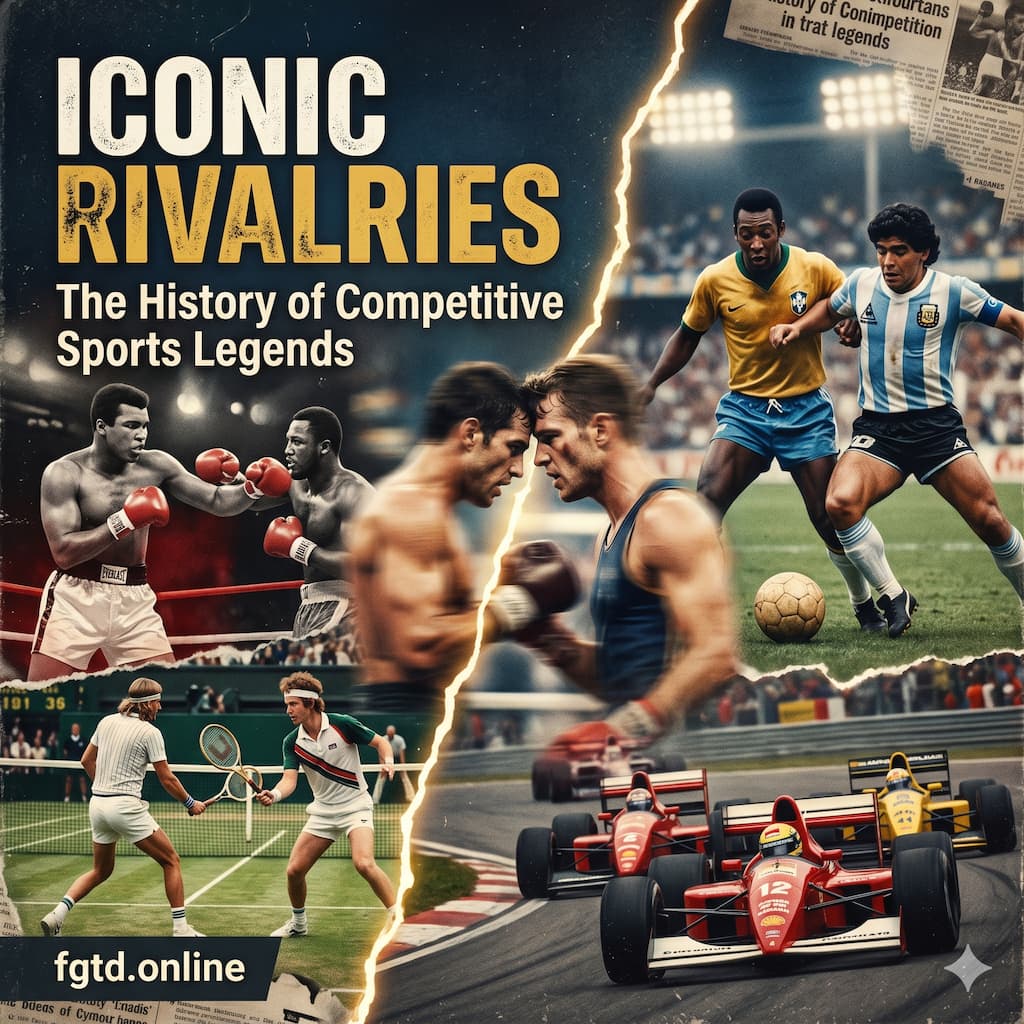
Iconic Rivalries: The History of Competitive Sports Legends
The essence of competitive sports does not reside in the sterile lines of record books, the cold precision of statistical metrics, or the glitter of trophies housed in glass display cases. While these parameters quantify achievement, they do not capture the human soul of athletics. The true heartbeat of sports history is found in conflict—specifically, in the transcendent, multi-decade personal and tactical wars known as iconic rivalries.
A truly legendary rivalry is much more than a recurring matchup between two elite athletes or franchises. It is a profound psychological framework, a cultural mirror, and an ideological clash. When two sporting titans whose styles, philosophies, and backgrounds stand in absolute opposition are driven by a mutual obsession to destroy each other’s supremacy, the sport itself breaks out of its conventional boundaries.
These rivalries do not simply entertain public audiences; they change the structural rules of their sports, elevate the cultural relevance of athletics globally, and force individual human beings to perform at a level of absolute physical and psychological perfection that they could never have achieved alone.
Continues after advertising
[Conventional Matchup]: Skill Variant A vs. Skill Variant B ──> Linear Achievement Optimization
[Iconic Legendary Rivalry]: Ideological Clash ──> Symbiotic Performance Acceleration ──> Cultural Transformation
1. The Anatomy of Transcendent Conflict: What Makes a Rivalry Iconic?
To understand how iconic rivalries reshape sports history, sports sociologists and historians look far beyond simple win-loss records. A matchup requires an intersection of distinct structural vectors to transform into a legendary, generation-defining rivalry.
Absolute Parity and Structural Stakes
A rivalry cannot exist in a vacuum of dominance. If one athlete consistently defeats the other, it is a narrative of supremacy, not a conflict. True rivalries require an exquisite, agonizing equilibrium of skill. Both parties must operate at the absolute peak of the global food chain, directly blocking each other from accessing ultimate validation—such as world titles, gold medals, or legacy immortality. The stakes must be absolute: for one to achieve their destiny, the other must experience destruction.
Diametrically Opposed Philosophies and Style Primaries
The most compelling rivalries feature a deep stylistic polarity. The conflict must personify a wider human debate. It is almost always a narrative battleground:
- The Natural Prodigy vs. The Stoic Engineer: Effortless, artistic genius clashing against meticulous, scientifically optimized work ethic.
- The Revolutionary Iconoclast vs. The Institutional Traditionalist: High-volume, charismatic counter-culture shattering the quiet, disciplined walls of established decorum.
Symbiotic Acceleration
The most fascinating paradox of sports legends is that rivals are fundamentally dependent on each other. An icon needs an equal opposite to push them past standard human limits. Without a terrifying antagonist threatening their supremacy, an athlete can become complacent, coasting on baseline genetic superiority. A legendary rival forces an opponent to re-engineer their diet, optimize their computational training pipelines, and develop an unyielding psychological resilience, turning the conflict into an accelerating cycle of performance excellence.
2. Muhammad Ali vs. Joe Frazier: The Brutal Architecture of Identity
No rivalry in the history of global athletics has carried a heavier socio-political burden or reached a more devastating level of physical intensity than the three-fight war between Muhammad Ali and Joe Frazier in the 1970s. This was not a mere sequence of heavyweight boxing matches; it was a profound, traumatic ideological battleground played out across a fractured global landscape.
[Muhammad Ali]: The Charismatic Radical ➔ Fluid Mobility ➔ Anti-Establishment Symbol
vs.
[Joe Frazier]: The Relentless Worker ➔ Unyielding Forward Pressure ➔ Working-Class Pragmatism
The Polarity of Meaning
When Muhammad Ali returned to boxing after a three-and-a-half-year exile caused by his refusal to be drafted into the Vietnam War, he was the symbol of counter-culture radicalism, anti-war sentiment, and Black empowerment. Joe Frazier, who had captured the heavyweight crown during Ali’s absence, was a quiet, deeply disciplined man of immense physical power who represented working-class pragmatism.
Ali, a master of psychological warfare and promotional narrative building, weaponized the media to frame Frazier as the institutional traditionalist, an avatar for the conservative establishment. This projection was deeply unfair to Frazier, who had structurally supported Ali financially during his exile, but it created an explosive cultural polarity that divided audiences globally.
The Tactical Dynamics: Immovable Object vs. Irresistible Force
Inside the ring, their physical styles created a flawless, terrifying synergy. Ali was the avatar of fluid kinetic movement, relying on unmatched foot speed, spatial manipulation, and long-range jab accuracy. Frazier was the ultimate practitioner of relentless, forward-pressure infighting. He operated with a low center of gravity, bobbing and weaving beneath head strikes to deliver devastating, high-velocity left hooks to the liver and jaw.
Ali’s Long-Range Spatial Mobility ──> Countered by ──> Frazier’s High-Velocity Lower Hook Pressure
The Trilogy of Trauma
Their three encounters—the 1971 “Fight of the Century” at Madison Square Garden, the 1974 non-title rematch, and the cataclysmic 1975 “Thrilla in Manila”—pushed the human body past known physiological boundaries. In Manila, fighting in oppressive tropical heat exceeding 100°F (38°C), both men traded hundreds of high-impact power punches across 14 rounds.
Ali’s long-range accuracy swelled Frazier’s eyes into complete blindness, while Frazier’s unyielding body assault left Ali on the brink of structural physical collapse. When Frazier’s trainer, Eddie Futch, stopped the fight before the 15th round to save his fighter’s life, Ali famously collapsed in his corner, stating that it was “the closest thing to dying” he had ever experienced.
The rivalry accelerated both men to athletic immortality, but it permanently consumed their physical prime, leaving both fighters structurally transformed by the raw violence of their symbiotic conflict.
3. Ayrton Senna vs. Alain Prost: The High-Velocity Silicon and Soul War
If Ali and Frazier mapped out the raw physical limitations of human conflict, the Formula 1 war between Ayrton Senna and Alain Prost during the late 1980s and early 1990s redefined the intersection of technological engineering and human psychology. It remains the definitive archetype of a clash between contrasting human operating systems.
[Alain Prost]: “The Professor” ➔ Mathematical Optimization ➔ Risk Minimization
vs.
[Ayrton Senna]: The Mystic Prodigy ➔ Absolute Emotional Intensity ➔ Transcendent Risk Exposure
The Analytical Mind vs. The Mystical Will
Alain Prost was nicknamed “The Professor” for a reason. His driving philosophy was built on mathematical optimization, mechanical empathy, and risk minimization. Prost did not care about flashy, high-risk qualifying laps; he calculated the exact minimum speed required to win a Grand Prix while preserving his brakes, tires, and fuel matrix, treating racing as a fluid thermodynamic equation.
Ayrton Senna was his absolute opposite. A deeply spiritual, mystic driver, Senna viewed racing as a transcendent act of self-discovery and absolute emotional expression. He chased the absolute limits of physical traction, driving with an aggressive style that accepted extreme risk exposure, particularly under low-grip, torrential rain conditions where his sensory intuition bypassed traditional mechanical telemetry lines.
The McLaren Intercom War
The rivalry turned volatile when they became teammates at McLaren-Honda in 1988 and 1989, a technological monopoly that won 15 out of 16 races in a single season. The garage fractured into two warring political camps.
Prost was furious at Senna’s willingness to violate unspoken team agreements and execute high-speed overtaking maneuvers that pushed both multi-million dollar carbon-fiber chassis to the brink of contact. Senna viewed Prost’s cautious, methodical style and deep political ties within the sport’s governing bodies as an institutional attempt to limit his natural superiority.
Prost’s Data-Driven Conservation ──(Internal Garage Friction)──> Senna’s High-Risk Boundary Push
The Suzuka Turning Points
The conflict reached its peak in consecutive championship-defining collisions at the Suzuka circuit in Japan. In 1989, Prost blocked Senna’s aggressive dive into the chicane, causing both cars to interlock wheels and securing Prost the World Title amid a cloud of political controversy.
In 1990, having migrated to Ferrari, Prost was victim to Senna’s uncompromising revenge: the Brazilian drove his McLaren directly into the back of Prost’s car at 160 mph (257 km/h) into Turn 1, taking both drivers out instantly and executing a cold, deliberate algorithmic securement of the championship.
This war pushed Formula 1 into the mainstream global media spotlight, forcing safety regulations to mature rapidly to keep pace with the terrifying intensity of their psychological warfare.
4. Roger Federer vs. Rafael Nadal: The Geometric Mastery of the Court
In the modern era of professional tennis, the aesthetic and physical debate between Roger Federer and Rafael Nadal built the foundation for the golden age of the sport. This rivalry completely re-mapped the geometric and tactical possibilities of the tennis court.
| Performance Attribute | Roger Federer | Rafael Nadal |
| Aesthetic Paradigm | Classical Elegance / Liquid Timing | Raw Athletic Intensity / Unyielding Torque |
| Primary Groundstroke | Flat, East-to-West Precision One-Handed Backhand | High-Looping, Extreme Topspin Heavy Western Forearm |
| Court Geometry Focus | Aggressive Base-Line Infiltration / Microsecond Net Attacks | Deep Baseline Structural Coverage / Angled Counter-Passing |
| Dominant Surface Canvas | Pristine Grass (Wimbledon Baseline Supremacy) | Red Clay (Roland Garros Absolute Monopoly) |
The Polarity of Style
Roger Federer operated on the court like a classical ballet dancer. His movement was built on liquid timing, economic footwork, and a flat, one-handed backhand that prioritized absolute precision over raw power. He sought to compress time for his opponent, stepping inside the baseline to terminate points with artistic efficiency.
Rafael Nadal arrived as the ultimate physical counter-force. Clad in sleeveless shirts and playing with an aggressive intensity, Nadal generated unprecedented levels of aerodynamic torque. His heavy Western forehand grip produced up to 4,900 RPM of forward topspin, causing the ball to explode off the court surface at unnatural heights.
Federer’s Low-Compression Fluid Timing ───> Deflected by ───> Nadal’s High-RPM Vertical Topspin
The Tactical Architecture: The Lefty Advantage
The tactical core of their rivalry was a brutal geometric trap engineered by Nadal’s left-handed physics orientation. Nadal’s cross-court forehand whipped directly into Federer’s one-handed backhand strike zone.
On the high-friction red clay of Roland Garros, this high-looping topspin forced Federer to continuously strike balls at shoulder height, completely stripping him of his leverage and liquid timing lines. This geometric imbalance allowed Nadal to build an absolute monopoly over the clay-court season.
The 2008 Wimbledon Catalyst
To validate his legacy, Nadal had to defeat Federer on the slick, low-bounce grass of Wimbledon—a surface where Federer’s low-slice precision had reigned supreme for five consecutive years.
The 2008 Wimbledon Final, played over 4 hours and 48 minutes amid fading light and rain delays, became the ultimate fixed-income epic of fixed-canvas athletics. Nadal adjusted his positioning, flattening out his groundstrokes to absorb Federer’s grass-court baseline infiltration.
By winning the final set 9-7 in near-total darkness, Nadal broke Federer’s grass-court hegemony. This symbiotic push forced Federer to completely re-engineer his game later in his career, switching to a larger racket frame to launch a late-career tactical counter-assault that prolonged both athletes’ supremacy at the top of the ATP rankings for a generation.
5. El Clásico: Cristiano Ronaldo vs. Lionel Messi and the Virtual Footprint
The intersection of individual rivalries and institutional franchise power reached its historical peak in the football war between Cristiano Ronaldo (Real Madrid) and Lionel Messi (FC Barcelona) during the Spanish La Liga era from 2009 to 2018. This conflict crossed the boundary of traditional sports to rewrite the digital, marketing, and data-tracking infrastructure of the global entertainment economy.
[Cristiano Ronaldo]: The Manufactured Cyborg ➔ Peak Biomechanical Power ➔ Obsessive Metric Engineering
vs.
[Lionel Messi]: The Spatial Alien ➔ Micro-Stride Low Center of Gravity ➔ Organic Geometric Intuition
The Cyborg vs. The Artist
Cristiano Ronaldo was the ultimate physical specimen—a manufactured cyborg of peak human performance. His game was built on elite biomechanical power, maximum vertical leap capabilities, explosive sprint velocity, and a relentless, obsessive work ethic that treated his body as a highly calibrated machine engine.
Lionel Messi was his pure, organic opposite. Standing at 5’7″ (1.70m), Messi possessed a low center of gravity and executed movements via micro-stride dribbling patterns. He moved through dense defensive arrays with a strange, quiet geometric intuition, slicing open tactical systems not through raw velocity, but through sub-second changes of direction and flawless processing of spatial metrics.
The Real-Time Statistical War
For nearly a decade, both athletes matched each other goal-for-goal, hat-trick for hat-trick, in a synchronized statistical escalation that defied historical regression models. If Ronaldo scored a hat-trick for Real Madrid on a Tuesday, Messi would answer with a four-goal masterclass for Barcelona on a Wednesday.
This tracking matrix can be analyzed across their peak structural deployment metrics:
[La Liga Gameweek] ➔ [Ronaldo: 60-Goal Season Trajectory] ➔ [Messi: 91-Goal Calendar Year Threshold]
This structural push resulted in Messi setting an unreplicable absolute benchmark of 91 goals in a single calendar year (2012), while Ronaldo engineered a sequence of three consecutive UEFA Champions League crowns. The rivalry forced global analytical systems to build entirely new high-frequency tracking software (such as expected goals – xG – and non-shot expected value maps) simply to quantify the historic output of their symbiotic performance loops.
6. Systemic Legacy: How Great Conflicts Reshape Sports Ecosystems
Iconic rivalries are not temporary phenomena that fade when the athletes retire; they function as structural turning points that permanently transform the operational architecture of their wider sports networks.
| Historical Rivalry | Core Tactical Innovation | Systemic Infrastructure Shift | Long-Term Cultural Impact |
| Ali vs. Frazier | Advanced strategic psychological warfare / High-volume heavy infighting | Modernization of global pay-per-view sports broadcasting frameworks | Elevated athletics into the central arena of international socio-political debate |
| Senna vs. Prost | Advanced boundary push of telemetry / High-speed passing risk profiling | Rapid acceleration of crash-test metrics and cockpit structural safety | Transformed motorsport from mechanical showcase to elite human operational battle |
| Federer vs. Nadal | Extreme vertical topspin generation / Geometric angle court exploitation | Development of specialized poly-string technology and variable speed courts | Built the golden financial and viewership era of global open tennis history |
| Ronaldo vs. Messi | Total conversion of wingers into hyper-efficient central target strikers | Transition of club branding into decentralized personal media monopolies | Re-engineered sports analytics around micro-spatial data and expected value metrics |
7. The Psychology of Obsession: The Dark Side of Greatness
While the public consumes iconic rivalries as inspiring narratives of human excellence, the internal psychological reality for the legends executing these wars is frequently dark, isolating, and built on obsessive psychological friction.
The Eradication of Empathy
To survive a multi-year war against an equal opposite, an athlete must systematically eradicate empathy for their competitor. A rival is not viewed as a peer; they are experienced as a permanent threat to one’s identity and life work.
Alain Prost frequently talked about how Ayrton Senna’s obsession with destroying him terrified him, as Senna viewed his racing dominance as a mandate from God, making him willing to risk catastrophic physical consequences to win a single corner. Joe Frazier carried the deep emotional scars of Muhammad Ali’s media insults for decades, refusing for a long time to forgive Ali until late in his life, proving that the competitive fires that forge sports legends can leave long-lasting psychological damage.
The Post-Rivalry Void
When an iconic rivalry abruptly terminates—either through retirement, injury, or death—the surviving legend frequently experiences a profound, structural existential crisis. When Alain Prost retired at the end of 1993, Ayrton Senna confessed to close friends that his primary source of motivation had vanished.
During the final race weekend of his life at Imola in 1994, Senna recorded a radio message directed to Prost, who was working in the commentary box, stating: “A special hello to my dear friend Alain. We all miss you, Alain.”
Without the equal opposite force balancing their psychological equation, the sporting titan finds themselves trapped in a quiet, un-calibrated void, proving that the antagonist they spent their entire life trying to erase was, in reality, the vital mirror that gave their greatness its ultimate meaning.
Read More👉 The Future of Esports Betting: Trends and Technologies for 2026
Conclusion: The Eternal Mirror of Silicon and Soul
Ultimately, the history of competitive sports legends shows that individual human potential is not a fixed, immutable line bounded by generic DNA templates. It is a highly elastic, adaptable frontier that requires extreme external energy to unlock. Iconic rivalries function as the ultimate high-velocity accelerator of human performance.
By forcing athletes to look into a mirror held up by an equal opposite who threatens to destroy their legacy, these great conflicts systematically strip away human weakness, complacency, and error.
The legendary rivalries of history did not simply deliver high-stakes entertainment value to generation after generation of global viewers. They re-engineered the tactical geometry of courts, rewrote the mechanical safety profiles of high-speed vehicles, built the data structures of modern sports analytics, and expanded our shared understanding of what the human body and mind can execute under maximum psychological pressure.
In a digital-first global economy increasingly optimized around artificial simulations and sterile predictive metrics, the raw, unscripted human conflict of iconic sports legends remains the definitive showcase of the unyielding, un-replicable heights of the human spirit.
Enjoyed this analytical exploration of sports history and human performance architecture? Visit fgtd.online regularly for deeper deep-dive research into global technology infrastructure trends, cloud-scale data engineering networks, and the future of enterprise innovation blueprints.