Smart Helmets: Sensor Telemetry and Concussion Prevention
For decades, protective headgear in contact sports and high-risk industries followed a single mechanical philosophy: passive impact attenuation. Helmets were constructed primarily of a rigid outer shell—typically polycarbonate or carbon-fiber composite—paired with an expanded polystyrene (EPS) or vinyl nitrile foam liner designed to absorb direct linear energy during a collision.
While conventional helmets successfully reduced catastrophic skull fractures and focal intracranial hemorrhages, they exhibited a critical vulnerability when confronting the most common and insidious form of brain trauma: mild traumatic brain injury (mTBI), widely known as a concussion.
Traumatic brain injury does not simply occur from direct blunt force against bone. Instead, it is predominantly driven by violent rotational acceleration and high-velocity shearing forces. When an athlete takes an angled hit to the facemask in American football, crashes at speed in motorsport, or falls on an alpine slope, the head rotates violently around the cervical axis. This rapid rotation causes deep brain tissues—including the delicate axonal pathways of the cerebrum and brainstem—to stretch and shear, triggering an acute neurochemical cascade of ionic flux, metabolic crisis, and microvascular damage.
Continues after advertising
Compounding this medical crisis is the invisible, subjective nature of concussion diagnosis. Historically, sideline medical staff relied on self-reported symptoms, rudimentary balance tests, or observable balance disturbances. Athletes frequently concealed disorientation to remain in the game, unwittingly exposing themselves to repetitive sub-concussive impacts and the life-threatening risks of Second-Impact Syndrome (SIS) and Chronic Traumatic Encephalopathy (CTE).
To solve this diagnostic blind spot, biomedical engineers, sports leagues, and industrial safety manufacturers have engineered a transformative technological solution: Smart Helmets powered by Sensor Telemetry.
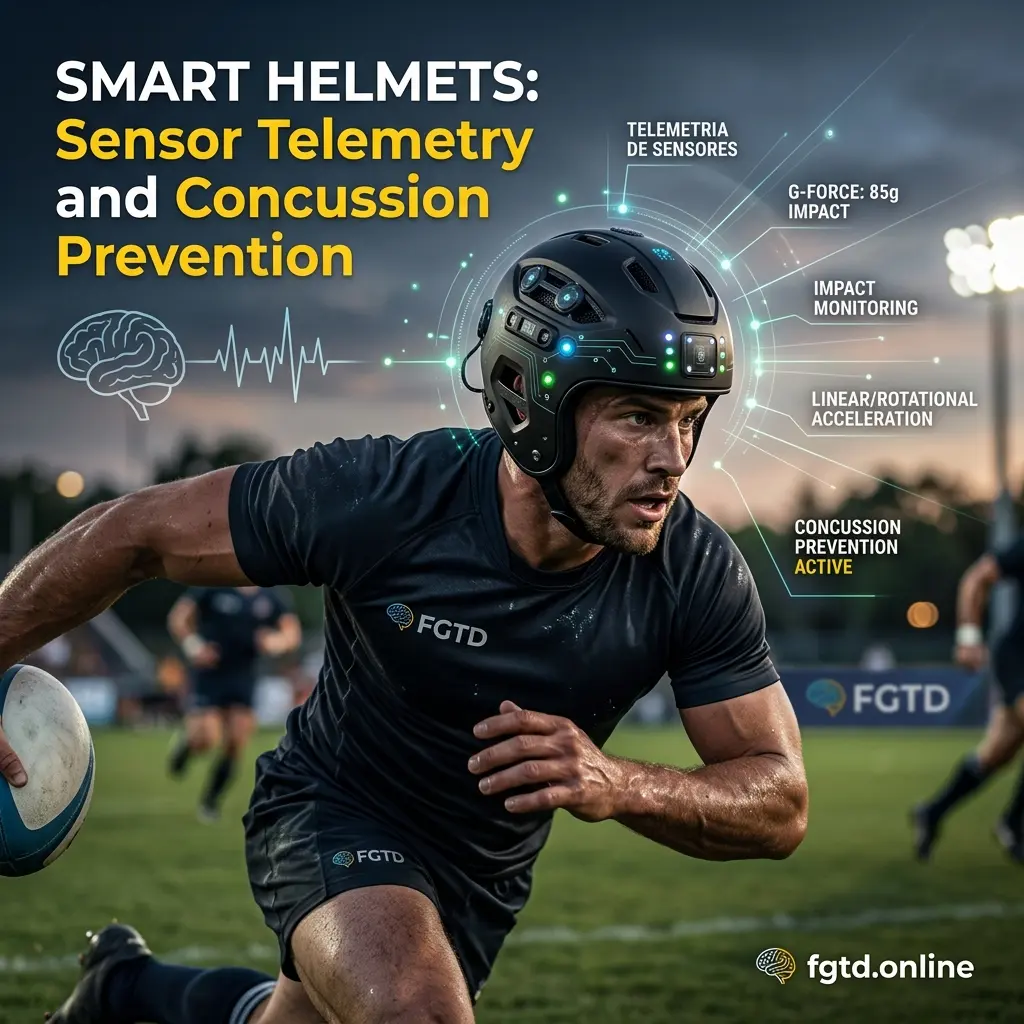
By integrating multi-axis inertial measurement units (IMUs), piezoresistive pressure sensors, dynamic force arrays, and low-latency wireless transmitters directly into the helmet’s structural liner, smart headgear converts protective equipment into real-time neurological monitoring platforms.
This post analyzes the biomechanics of concussive head impacts, deconstructs the multi-sensor telemetry pipelines inside modern smart helmets, compares traditional passive helmets with active sensor-equipped systems, and explores the operational future of sideline medical triage and injury prevention.
1. The Biomechanics of Concussion: Linear vs. Rotational Acceleration
To understand the engineering requirements of a smart helmet telemetry system, one must understand how mechanical impact forces translate into internal brain trauma:
- Linear Acceleration (measured in g): Direct, straight-line impact forces measured in multiples of Earth’s gravity (g). Linear forces primarily compress the brain against the skull wall (coup and contrecoup injury), causing localized contusions or skull fractures. Traditional foam liners were designed specifically to manage this linear energy.
- Rotational (Angular) Acceleration (measured in rad/s²): Angled, off-center impacts that generate rapid rotational twist. Because the human brain is composed of soft, fluid-saturated visco-elastic tissue with very low shear resistance, sudden rotational acceleration twists neural tissue within the cranium, stretching and tearing neuronal axons.
Biomedical consensus demonstrates that rotational acceleration is the primary mechanism of sports-related concussions and diffuse axonal injury.
Consequently, any intelligent monitoring system must be capable of calculating both linear and angular kinematics simultaneously across high-frequency sampling intervals.
2. Technical Blueprint: Inside the Sensor Telemetry Pipeline
A smart helmet is far more than a standard helmet with a microchip pasted inside; it is an integrated, ruggedized telemetry ecosystem engineered to survive bone-jarring kinetic shocks while streaming microsecond data payloads:
Multi-Axis Inertial Measurement Units (IMUs)
At the core of the sensor array are micro-electromechanical systems (MEMS):
- High-G Accelerometers: Standard consumer accelerometers clip out around ±16g. Smart helmets utilize specialized high-g tri-axial accelerometers capable of measuring transient peak shocks up to ±200g or even ±500g without signal saturation.
- Tri-Axial Angular Rate Gyroscopes: Measure rotational velocity along three distinct axes (X, Y, and Z) with dynamic ranges reaching thousands of degrees per second.
- Piezoresistive and Thin-Film Force Arrays: Embedded between the comfort padding and the protective liner to map the surface pressure distribution and contact location across the cranium.
Signal Processing and the Skull-Coupling Challenge
One of the primary engineering hurdles in helmet-based telemetry is chassis-to-skull slippage:
- A helmet can slide slightly on the hair and scalp during an impact, meaning the sensor array might record a violent helmet motion that does not perfectly match the acceleration experienced by the skull underneath.
- Smart helmets employ sophisticated filtering algorithms—such as Head Injury Criterion (HIC) and Brain Injury Criterion (BrIC) estimators—that filter out high-frequency mechanical vibration and decouple helmet shell displacement from true cranial kinematics.
- Modern systems increasingly pair helmet sensors with intra-oral mouthguard sensors or skin-adhered acoustic patches to achieve sub-millimeter kinematic cross-correlation.
Edge Computation and Low-Latency Wireless Backhaul
During an impact, an event trigger wakes the onboard microcontroller in fractions of a millisecond:
- The chip executes onboard algorithms to calculate peak linear acceleration, peak angular acceleration, impact duration, and vector direction.
- The system packages this data into a micro-telemetry packet and broadcasts it over low-power, robust wireless protocols (such as Bluetooth Low Energy, Ultra-Wideband, or proprietary sub-gigahertz mesh networks) directly to sideline tablets and medical monitoring stations.
3. Structural Comparison: Traditional Helmets vs. Telemetry-Enabled Smart Helmets
Evaluating the diagnostic, structural, and athletic distinctions between conventional protective equipment and smart telemetry helmets demonstrates why professional sports organizations are transitioning to sensor-driven systems:
Diagnostic Awareness
- Traditional Helmets: Zero situational data; sideline medical staff must rely entirely on visible player distress, referee observation, or athlete self-reporting.
- Smart Telemetry Helmets: Instant, objective metrics; provides sideline physicians with immediate notifications of impact severity, g-force vectors, and hit locations.
Sub-Concussive Load Tracking
- Traditional Helmets: Completely blind to cumulative trauma; repetitive, low-magnitude collisions that cause long-term neurodegenerative harm go unrecorded.
- Smart Telemetry Helmets: Comprehensive cumulative dosage tracking; logs every minor collision across practices and games, calculating seasonal cumulative strain on the brain.
Data Delivery Latency
- Traditional Helmets: Delayed or absent; concussions are often identified hours or days later after clinical symptoms (headaches, nausea, light sensitivity) manifest.
- Smart Telemetry Helmets: Real-time and sub-second; automated alarms ping sideline tablets within milliseconds of an impact exceeding pre-set kinetic thresholds.
Equipment Lifespan and Integrity Auditing
- Traditional Helmets: Visual inspection only; micro-fractures in the inner foam liner or internal resin decay remain undetected until catastrophic shell failure.
- Smart Telemetry Helmets: Continuous structural self-auditing; internal stress sensors alert equipment managers when structural foam has exhausted its energy-absorbing elasticity.
4. Sideline Triage: Translating Raw G-Forces into Clinical Decisions
Raw kinematic numbers alone cannot diagnose a concussion, as individual biological thresholds vary widely depending on athlete neck strength, hydration levels, previous concussion history, and genetic factors.
Instead, smart helmet telemetry empowers sideline medical staff through standardized algorithmic workflows:
- Threshold Alerting: When an impact exceeds a compound kinematic score (such as combining linear force over 80g with angular acceleration exceeding 4,500 rad/s²), a silent alert is dispatched immediately to the unaffiliated neurotrauma consultant (UNC) on the sideline.
- Video Review Synchronization: Telemetry timestamps synchronize with multi-angle broadcast camera feeds. Physicians can cross-reference the exact microsecond of the telemetry spike with video footage to evaluate the athlete’s immediate motor response (such as fencing response, vacant stare, or stumbling).
- Targeted Clinical Evaluation: The player is pulled from the field for mandatory protocol testing (e.g., SCAT6, eye-tracking saccade tests, and computerized cognitive screenings) before returning to play, preventing athletes from hiding acute symptoms.
5. Beyond the Field: Applications in Defense and Industry
The life-saving potential of smart helmets extends far beyond professional contact sports:
- Military and Defense (Blast Overpressure Telemetry): In combat environments, service members are routinely exposed to non-line-of-sight blast waves from improvised explosive devices (IEDs) and heavy artillery. Blast-gauge sensor arrays embedded in tactical combat helmets measure acoustic overpressure and impulse duration, detecting traumatic blast-induced brain injuries even when soldiers exhibit no visible external wounds.
- Industrial and Construction Safety: Construction workers, miners, and offshore energy technicians operate in hazardous overhead environments. Smart hard hats equipped with fall-detection telemetry and impact sensors automatically dispatch SOS signals and GPS coordinates when an industrial worker suffers a blunt-force collision or high-elevation fall.
- High-Speed Motorsports: Formula 1, MotoGP, and rally racing integrate high-precision micro-sensors into helmet shells to calculate deceleration loads during high-speed barrier impacts, guiding trackside extrication teams on cervical spine stabilization procedures.
Read More👉 VIP Sports Hospitality: Inside the Ultra-Luxury Paddock
Conclusion: The New Frontier of Neurological Protection
The transition from passive impact absorption to intelligent, active sensor telemetry represents an inevitable evolution in human protective engineering. The historical model of relying on subjective player honesty, delayed symptom observation, and unmeasured impact forces is no longer acceptable in an era where the neurological consequences of head trauma are clearly understood.
By turning protective headwear into real-time biomechanical telemetry devices, smart helmets illuminate the invisible forces acting on the human brain.
As sensor architectures shrink, battery efficiencies expand, and machine-learning models correlate impact vectors with neurological recovery markers, smart helmets will become standard equipment across all tiers of sports and industry—permanently establishing Smart Helmets: Sensor Telemetry and Concussion Prevention as an essential pillar of modern athlete welfare and traumatic injury defense.