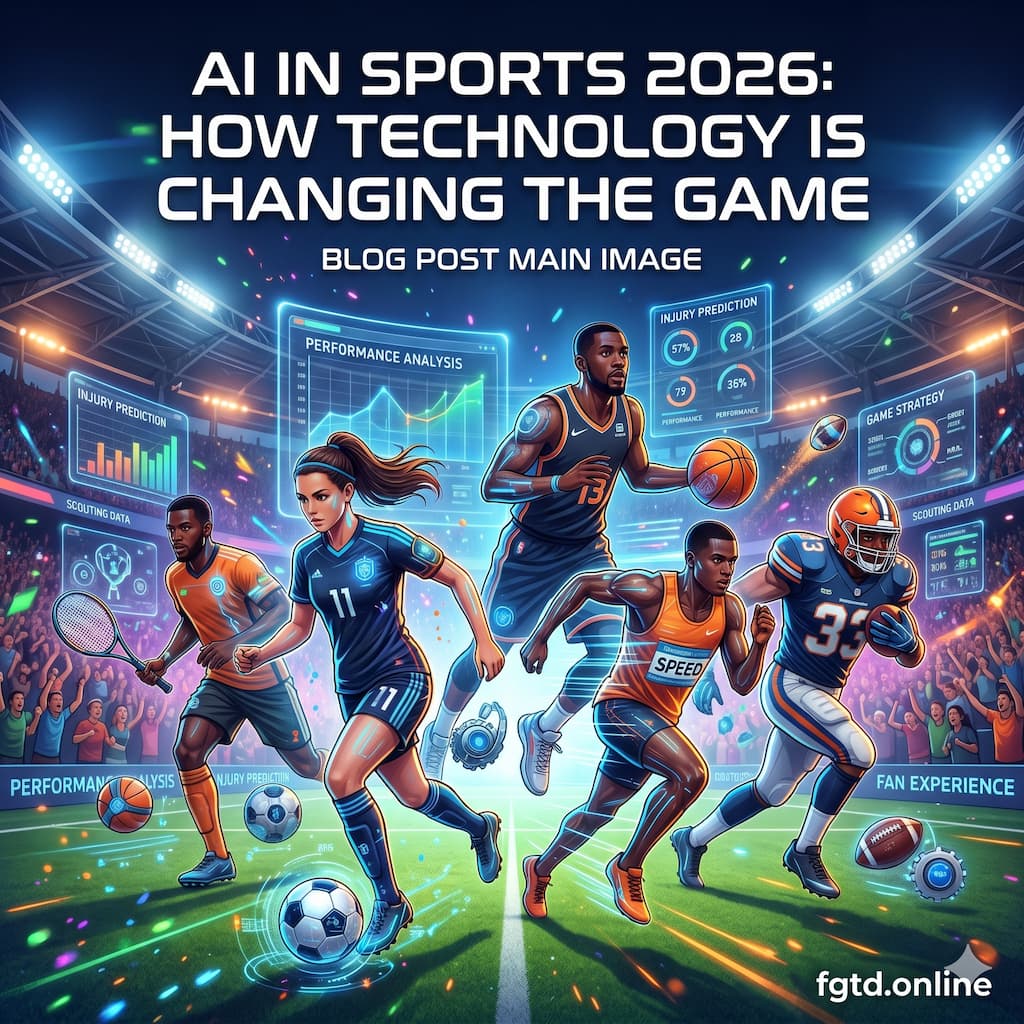
AI in Sports 2026: How Technology is Changing the Game
The world of sports has always been a theatre of human physical limits, grit, and split-second decision-making. However, as we move through 2026, the “human” element is being augmented by a digital revolution unlike anything we have seen before. Artificial Intelligence is no longer just a buzzword used by data scientists in the back office; it has become the central nervous system of global athletics.
From the way athletes prepare their bodies to how fans experience a live match in a “smarter” stadium, AI is redefining the boundaries of what is possible. In this deep dive, we explore the most significant shifts in the sports landscape this year and how technology is fundamentally changing the game.
1. The Era of the “AI Coach” and Hyper-Individualization
In 2026, the traditional “one-size-fits-all” training camp is officially dead. Elite organizations have moved toward Hyper-Individualization, powered by AI models that process “messy” biometric data into actionable insights in real-time.
Continues after advertising
Predictive Biomechanics and Injury Prevention
Wearable technology has evolved. We have moved past simple heart-rate monitors to integrated smart fabrics and skeletal tracking. Using 3D motion capture and AI pose estimation, teams can now dissect an athlete’s technique with millimeter-level precision without the need for bulky sensors.
- The Impact: By analyzing “movement profiling,” AI can detect micro-deviations in a player’s gait or jumping mechanics that indicate fatigue or a looming ACL injury. In 2026, coaches aren’t just reacting to injuries; they are preventing them weeks before they happen.
Tactical Periodization
AI now assists in “Tactical Periodization”—the balance between physical conditioning and tactical decision-making. AI simulators run millions of “What-If” scenarios, allowing coaches to adjust training intensity based on the specific tactical demands of the next opponent. If the AI predicts a high-pressing game from the opposition, the week’s training is autonomously adjusted to prepare the athletes for that specific physical load.
2. The Smart Stadium: Redefining Fan Engagement
For fans in 2026, the stadium is no longer just a place to sit and watch. It is a technological marvel designed to bridge the gap between the physical and digital worlds.
Shared Reality and Immersive Experiences
Capacity and accessibility remain barriers to live sports, but Shared Reality is the 2026 solution. Tech-forward clubs (like Manchester United and Atletico Madrid) are now using IMAX-integrated technology and AR (Augmented Reality) to replicate the sights, sounds, and atmosphere of their home stadiums for global fanbases.
- Prompt-Based Fan Engagement: Fans at home or in the stadium can now use “ChatGPT-style” prompts to interact with the game. Want to see a 360-degree replay of that goal from the striker’s perspective? Or get a real-time breakdown of the win probability after a red card? Just ask the stadium’s AI assistant.
The “You-First” Broadcast
The traditional “one-feed-for-all” broadcast is becoming a relic. In 2026, streaming platforms (led by giants like Amazon, Apple, and Netflix) offer Hyper-Personalized Feeds.
- Fans can choose their own camera angles, custom multilingual audio commentary (translated into 70+ languages in real-time by AI), and bespoke graphics that visualize the specific data points they care about—whether it’s betting odds, fantasy points, or deep tactical heatmaps.
3. Officiating and the Death of Controversy
Refereeing has always been the most contentious part of sports. In 2026, AI is finally bringing “objective truth” to the field, though not without its own set of debates.
Semi-Automated Decision Making
The 2026 World Cup is set to be the most AI-driven event in history. We have moved beyond basic VAR (Video Assistant Referee) to Computer Vision systems that can detect offsides, handballs, and ball-out-of-bounds violations in milliseconds.
- Transparency: To maintain fan trust, many leagues now project the AI’s “reasoning” and refereeing gestures directly onto stadium screens and broadcast overlays. This “Show Your Work” approach has significantly reduced game flow disruptions and subjective errors.
The Contact Interpretation Gap
While AI is perfect for “line-based” calls (out of bounds, offsides), the 2026 frontier is Contact Severity. Researchers are currently testing AI models that analyze the legitimacy and intensity of physical contact in sports like soccer and basketball. While not yet fully autonomous in professional categories, these tools provide referees with a “Contact Score” to help determine if a foul was a genuine attempt at the ball or a cynical play.
4. Scouting and the Democratization of Talent
AI has fundamentally changed the scouting landscape, making the “Moneyball” era look primitive.
Recruitment without Bias
Using AI-powered predictive modeling, clubs can analyze a player’s potential by stripping away the noise of the league they play in. A midfielder in a remote lower league in Brazil can now be identified as a top-tier talent because their “pressing intensity” and “pass completion under pressure” metrics—visible only to AI embedding models—match those of a world-class superstar.
- Market Value Prediction: AI platforms like Fanstake and Out2Win are also changing how brands and fans invest in athletes, using data to evaluate an athlete’s marketability and “NIL” (Name, Image, and Likeness) value with unprecedented accuracy.
5. 2026 Comparison: Human vs. AI-Augmented Sport
| Feature | Traditional Sport (Pre-2024) | AI-Augmented Sport (2026) |
| Training | General Team Sessions | Hyper-Individualized Biomechanics |
| Injuries | Reactive (Treating the injury) | Predictive (Detecting micro-risks) |
| Broadcasting | Linear “One-Way” Feed | Interactive “You-First” Feeds |
| Refereeing | Human Vision + Slow Replays | Semi-Automated Computer Vision |
| Scouting | In-person “Eye Test” | Global Predictive Data Modeling |
| Fan Experience | Passive Spectator | Immersive Participant (AR/Prompt-based) |
6. The Ethical Frontier: Where Do We Draw the Line?
As technology becomes more embedded, 2026 is also a year of intense ethical debate.
- The Privacy of the Body: Do clubs own the “biometric data” of their players? If an AI predicts an athlete has a 90% chance of a heart condition, can a club legally terminate their contract?
- Competitive Integrity: If one team has a superior “AI Coach” that can predict opponent moves before they happen, is it still a fair game?
- The “Human” Element: There is a growing movement of fans who miss the “beautiful mess” of sports—the human errors, the controversial calls, and the unpredictability that tech is slowly refining out of the game.
Read More👉 The Evolution of Fan Merchandise: From Scarves to NFTs
Conclusion: A New Chapter for fgtd.online Readers
The impact of AI in sports in 2026 is best described as an enhancement of the human spirit, not a replacement of it. Technology is allowing athletes to push their bodies further, referees to be fairer, and fans to be closer to the action than ever before.
As we look toward the 2026 World Cup and beyond, the message for everyone in the sports ecosystem—from club owners to amateur athletes—is clear: Adaptability is the only winning strategy. The game hasn’t changed its heart, but its brain is now digital.
Stay ahead of the curve. Whether you are managing a local team or just a passionate fan, the tools of 2026 are within your reach. From AI-coaching apps on your smartphone to immersive AR home setups, the future of sports is already here. How will you play?