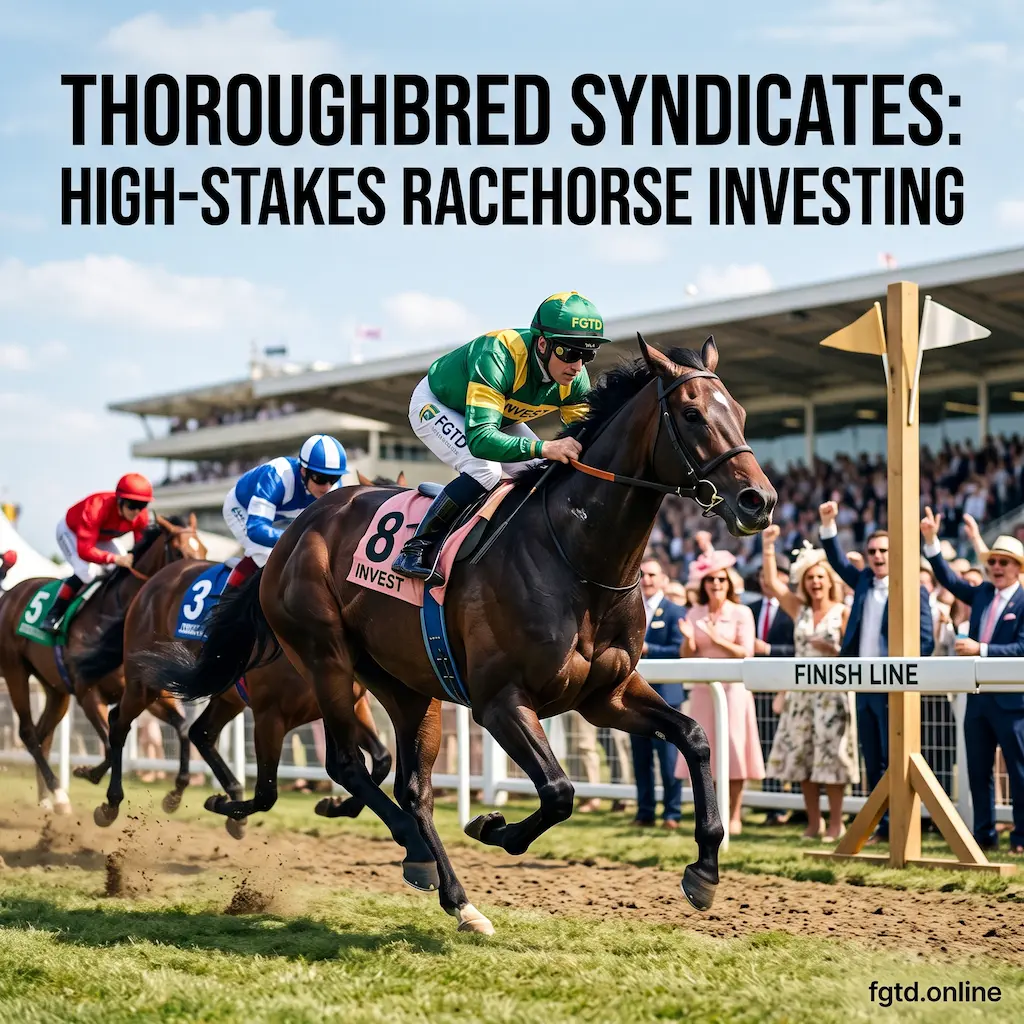
Thoroughbred Syndicates: High-Stakes Racehorse Investing
For centuries, thoroughbred racehorse ownership was known as the “Sport of Kings”—an exclusive, capital-intensive pursuit reserved almost entirely for European aristocracy, sovereign wealth funds, and multi-generational business dynasties. The barriers to entry were formidable: purchasing an untried yearling with a championship pedigree at elite sales like Keeneland or Tattersalls easily demands six or seven figures, accompanied by recurring monthly expenditures for specialized training, veterinary medicine, boarding, and international logistics.
In recent years, however, the financial architecture of bloodstock investing has undergone a profound transformation.
Driven by the rise of fractionalization, corporate syndication structures, and data-driven pedigree analytics, thoroughbred racehorse ownership has evolved into an institutionalized asset class. Known as Thoroughbred Syndicates, these collective investment vehicles pool capital from institutional funds, high-net-worth individuals, and passionate private investors to acquire, manage, and race elite bloodstock.
Continues after advertising
By distributing acquisition risk, sharing operating capital expenditures, and professionalizing the racing lifecycle, modern syndicates allow investors to participate in an alternative market where victorious campaigning on the track can unlock astronomical returns in the multi-billion-dollar global breeding shed.
This post examines the legal and financial mechanics of thoroughbred syndicates, analyzes the risk-return dynamics of bloodstock portfolios, compares sole ownership against fractional syndication, and details how investors navigate the high-stakes economy of elite horse racing.
1. Deconstructing the Syndicate Structure: How Fractional Bloodstock Works
At its core, a thoroughbred syndicate is an organized commercial vehicle designed to hold equity in one or more racehorses. Rather than an individual investor bearing 100% of the purchase price and ongoing maintenance, the horse’s legal ownership is divided into discrete fractional shares.
A professional syndicate typically operates through three primary layers:
The Syndicate Manager (General Partner)
The syndicate manager serves as the executive director and fiduciary lead. They possess deep industry connections, pedigree knowledge, and bloodstock acumen.
The manager coordinates:
- Identification and vetting of bloodstock alongside bloodstock agents, equine biomechanics analysts, and veterinary surgeons.
- Selection of elite racehorse trainers, jockeys, and training centers.
- Race campaigning strategy, entry decisions, and logistical transport.
- Investor communication, detailed financial accounting, insurance procurement, and dividend distributions.
Legal Structure and Shareholder Agreements
Most professional racing syndicates are incorporated as limited partnerships (LPs), limited liability companies (LLCs), or regulated unit trusts.
The syndicate agreement codifies:
- Pro-rata share allocations (e.g., 20 shares at 5% each, or 100 micro-shares at 1% each).
- Monthly training and veterinary cash-call schedules or prepaid operational reserves.
- Decision-making thresholds regarding private sale offers, retirement from racing, and commercial breeding terms.
- Rights of first refusal (ROFR) if an individual shareholder seeks secondary market liquidity before the horse’s retirement.
Capital Allocation: Single-Horse Syndicates vs. Multi-Horse Portfolios
Investors can allocate capital into two primary syndicate vehicles:
- Single-Horse Syndicates: Concentrated exposure to one high-profile yearling or ready-to-run 2-year-old. Offers the direct excitement of campaigning a specific athlete, though carries total exposure to the health and performance of that single individual.
- Portfolio / Racing Funds: Multi-horse diversified pools holding five to fifteen horses across varied age groups, genders, and distances. This diversifies injury risk and operational volatility, ensuring higher probability that at least one runner achieves black-type stakes success.
2. The Economics of Bloodstock: Where the Real Returns Are Made
A common misconception among casual observers is that racehorse investing revolves around purse money won on the track. While prestigious races like the Kentucky Derby, the Breeders’ Cup Classic, the Prix de l’Arc de Triomphe, or the Melbourne Cup award purses ranging from $2 million to over $20 million, purse earnings rarely justify the massive initial capital outlays on their own.
In high-stakes thoroughbred syndicates, the racing track is essentially an audition ground for the true financial catalyst: The Global Breeding Shed.
Stallion Syndication: The Multi-Million-Dollar Multiplier
When an exceptional colt demonstrates top-tier racing ability, exceptional physical conformation, and an impeccable sire line by winning Grade 1/Group 1 races, its commercial value transitions from an athletic asset to a perpetual intellectual property and reproductive royalty asset:
- Colt Valuation Surges: A yearling acquired by a syndicate for $500,000 that wins a classic race can suddenly command a stallion valuation between $20 million and $60 million from mega-stud farms (such as Coolmore, Darley, or Spendthrift).
- Breeding Rights & Stud Fees: A top-ranked stallion might command a stud fee of $50,000 to $250,000+ per live foal, covering 150 to 200 mares per breeding season in the Northern Hemisphere, followed by a Southern Hemisphere “shuttle” season in Australia or South America.
- Original syndicate members often retain lifetime breeding rights (annual guaranteed covers), creating decades of passive recurring revenue streams.
Broodmare Value and Commercial Foal Sales
Elite fillies and mares that capture prestigious stakes races hold immense residual equity as broodmares.
- Even after retiring from the track, a proven Group/Grade 1 winning mare can be sold at premier breeding stock auctions (like the Keeneland November or Fasig-Tipton Fall sales) for millions of dollars.
- Alternatively, syndicates can breed the mare to leading international stallions and sell her annual foals at commercial yearling auctions, realizing steady equity harvests.
3. Structural Comparison: Sole Ownership vs. Thoroughbred Syndicates
Evaluating the operational, financial, and strategic differences between traditional private ownership and professional syndication demonstrates why syndicated ownership has expanded across global racing:
Capital Entry Barrier
- Sole Private Ownership: High; requires absorbing 100% of purchase costs ($250,000 to $2,000,000+ for blue-blooded stock) along with full recurring carrying costs.
- Thoroughbred Syndicates: Flexible; fractional shares scale from accessible $5,000 stakes up to six-figure institutional allocations.
Ongoing Operational Downside Exposure
- Sole Private Ownership: Unhedged; the sole owner absorbs all monthly expenses ($4,000 to $7,000+ per horse/month) regardless of the horse’s performance or injury status.
- Thoroughbred Syndicates: Distributed; monthly training and veterinary costs are divided pro-rata, drastically dampening personal financial strain.
Portfolio Diversification
- Sole Private Ownership: Concentrated; capital is locked into a small handful of horses, exposing the investor to high single-event risk.
- Thoroughbred Syndicates: Broad; the same capital outlay can be deployed across a diversified portfolio of 10 to 20 well-bred horses across multiple trainers.
Management Overhead & Bloodstock Expertise
- Sole Private Ownership: Requires active personal involvement, specialized equine knowledge, and direct daily coordination with trainers and veterinarians.
- Thoroughbred Syndicates: Fully managed; a professional syndicate manager handles administrative compliance, training logistics, veterinary oversight, and race planning.
4. Managing Equine Risk: Biological Volatility and Capital Protection
Thoroughbred investing carries inherent biological and mechanical volatility. Racehorses are living, fragile athletes subject to soft-tissue injuries, respiratory challenges, bone remodeling issues, and unpredictable racecourse interference.
Professional syndicates mitigate these structural risks through rigorous underwriting practices:
- Veterinary Radiograph & Endoscopy Audits: Before bidding on any auction prospect, syndicate veterinarians scrutinize 30+ digital x-ray views of joints, sesamoids, and knees, paired with dynamic endoscopic evaluations of the upper airway to identify structural defects before purchasing.
- Equine Mortality & Infertility Insurance: Syndicates insure their bloodstock with specialized London and global equine underwriters. Standard policies include full mortality (covering accidental death or humane destruction) as well as Loss of Use, First Season Infertility, and Congenital Stallion Defect insurance.
- Biomechanics and Genetic Testing: Leading commercial syndicates utilize computational video motion analysis and cardiovascular DNA markers to identify stride efficiency and genetic heart capacity, tilting statistical probabilities in their favor.
Read More👉 Esports Cybersecurity: Defending Arenas from DDoS Attacks
Conclusion: The Modernization of the Sport of Kings
Thoroughbred syndicates have successfully democratized and institutionalized high-stakes racehorse investing. The antiquated dynamic of the lone sporting millionaire writing unchecked blank checks has been replaced by sophisticated investment syndicates powered by rigorous financial governance, shared operational costs, and comprehensive data analytics.
While the thrill of standing in the winner’s circle at Ascot, Saratoga, or Churchill Downs remains an emotional cornerstone, modern bloodstock syndication ensures that capital deployment is treated with the strategic rigor of an alternative asset portfolio.
By balancing the athletic upside of the racetrack with the lucrative long-term economics of the global breeding shed, fractional syndication allows modern investors to participate in one of the world’s most glamorous, high-risk, and potentially rewarding markets—permanently establishing Thoroughbred Syndicates: High-Stakes Racehorse Investing as a vibrant pillar of alternative wealth deployment.