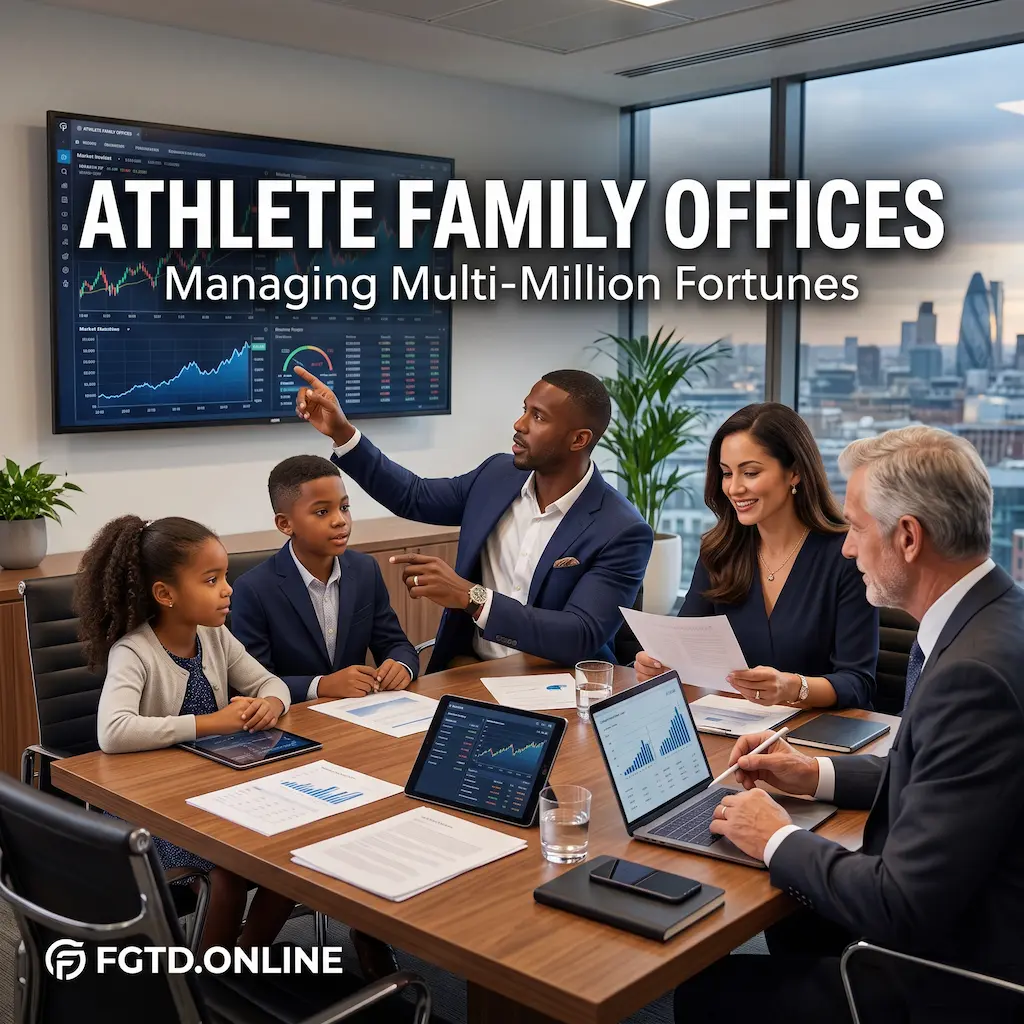
Athlete Family Offices: Managing Multi-Million Fortunes
For decades, the financial arc of professional athletes was defined by a notorious paradox: extraordinary earning power compressed into a fleeting career window, followed all too frequently by rapid financial distress. Multi-million-dollar playing contracts, lucrative global endorsement deals, and sudden public fame created immense liquidity surges for young competitors who often lacked formal financial literacy, governance structures, and conflict-free counsel. Historically dependent on predatory financial advisors, commission-driven brokers, and informal inner circles, many legendary sports figures watched generational wealth erode through misaligned incentives, aggressive tax liabilities, and ill-fated venture investments.
Today, elite sports stars are breaking that cycle.
Rather than functioning as passive clients of conventional wealth managers, top-tier athletes—from NBA icons and Premier League footballers to Formula 1 drivers and Grand Slam tennis champions—are restructuring their wealth management ecosystems. They are treating their personal athletic brands as multi-national commercial enterprises by establishing Dedicated Athlete Family Offices.
Continues after advertising
A family office is a private wealth management advisory firm established to manage the financial, legal, tax, philanthropic, and lifestyle affairs of ultra-high-net-worth individuals and families. By adopting this institutional model, professional athletes centralize their asset allocation, build enterprise-grade governance perimeters, and protect capital far beyond the final whistle of their playing careers.
This post examines the structural mechanics of modern athlete family offices, analyzes asset allocation and venture investment strategies, evaluates risk governance and tax optimization, and outlines how generational wealth is preserved across multiple decades.
1. The Unique Financial Biology of Professional Sports
Understanding why athletes require specialized family office structures begins with understanding the distinct financial vulnerabilities inherent in professional sports:
The Hyper-Compressed Earning Window
Unlike typical corporate executives whose compensation rises steadily until their fifties and sixties, professional athletes generate 80% to 90% of their lifetime labor income between the ages of 20 and 35. A career can end instantly through catastrophic injury, performance decline, or contract non-renewal. Consequently, the wealth accrued during this brief operational window must sustain forty to sixty years of post-retirement living standards, capital reinvestment, and family commitments.
Sudden Liquidity and Peer Pressure
Signing a $50 million rookie extension or a multi-year shoe deal injects massive liquid capital overnight. This sudden liquidity attracts unvetted private business pitches, excessive family financial demands, and predatory investment operators. Without an institutional buffer between the athlete and incoming financial solicitations, wealth leakage occurs rapidly.
The Agent-Advisor Conflict
Historically, an athlete’s sports agent focused on maximizing playing contract values and sponsorship commissions, leaving asset deployment to loosely affiliated third parties. These advisers frequently operated under broker-dealer rules rather than strict fiduciary standards, earning commissions by placing the athlete’s capital into high-fee, illiquid, or high-risk investment schemes.
An athlete family office resolves these systemic problems by replacing self-interested intermediaries with a dedicated, conflict-free team of fiduciary professionals whose sole legal duty is the preservation and compounding of the athlete’s personal balance sheet.
2. Structural Architecture: Single-Family vs. Multi-Family Offices
When structuring a family office, an athlete typically selects between two institutional archetypes:
Single-Family Office (SFO)
- Design: A bespoke, wholly owned legal entity serving exclusively one athlete and their immediate family.
- Capital Threshold: Typically requires a minimum liquid net worth of $50 million to $100 million due to substantial operating overhead (salaries for dedicated Chief Investment Officers, legal counsel, accountants, and lifestyle coordinators).
- Operational Profile: Provides absolute privacy, customized asset allocation, and total control over proprietary investment theses and private equity vehicles.
Multi-Family Office (MFO)
- Design: An independent wealth management firm serving a curated group of ultra-high-net-worth families, often with specialized divisions catering to elite athletes and entertainers.
- Capital Threshold: Accommodates net worths starting between $10 million and $50 million.
- Operational Profile: Delivers institutional investment access, co-investment deal flow, and seasoned compliance teams while distributing operating costs across multiple clients.
3. Core Operational Pillars of an Athlete Family Office
An effective athlete family office integrates multiple professional disciplines into a single coordinated command center:
1. Fiduciary Asset Allocation & Liquid Reserves
Preserving capital over sixty years requires disciplined portfolio construction:
- The Liquidity Moat: Establishing conservative cash and short-duration sovereign debt allocations to fund daily living expenses, real estate carry costs, and tax liabilities for several years, ensuring the athlete never liquidates long-term investments during market downturns.
- Core Institutional Beta: Allocating capital across global public equities, real estate investment trusts (REITs), and fixed-income assets to outpace inflation and compound quietly.
2. Direct Venture Capital & Private Equity Syndication
Modern athletes rarely settle for traditional endorsement deals that pay flat fees; they leverage their cultural cachet, social reach, and personal brands to demand equity compensation:
- Sweat Equity Integration: The family office structures contracts where the athlete promotes consumer brands, beverage companies, or digital wellness platforms in exchange for significant equity stakes.
- Direct Growth Investments: By creating an internal private equity arm, the family office directly reviews seed and Series A/B rounds, co-investing alongside top-tier institutional venture funds in sectors the athlete understands, such as sports technology, athletic apparel, and recovery tech.
3. Multi-Jurisdictional Tax Optimization
Elite athletes face the most complex tax environments in the global economy:
- The “Jock Tax”: In jurisdictions like the United States, professional athletes are taxed in every individual state and municipality where they play games or hold training camps.
- Global Tournaments: International football players, tennis champions, and golfers generate income across dozens of sovereign nations with competing tax treaties, withholding rates, and residency tests.
- Corporate IP Structuring: The family office sets up separate corporate entities to isolate athletic labor income from worldwide intellectual property, licensing, and image rights, minimizing double taxation and maintaining strict liability firewalls.
4. Risk Mitigation, Insurance, and Legal Governance
Wealth defense is as critical as capital appreciation:
- Disability & Career-Ending Insurance: Securing high-limit, custom disability policies that pay out substantial lump-sum capital if an injury abruptly ends the athlete’s career.
- Asset Protection Trusts: Utilizing domestic and offshore irrevocable trusts to insulate wealth from frivolous civil litigation, contract disputes, and divorce proceedings.
- Enterprise Budgeting & “The Buffer”: The family office acts as the diplomatic “bad cop.” When relatives or acquaintances approach the athlete with speculative business ideas, all proposals must pass through the formal investment committee of the family office, insulating personal relationships from financial stress.
4. Structural Comparison: Legacy Representation vs. Athlete Family Office
Evaluating the core operational differences between outdated representation models and modern family office governance highlights why institutional structures have become essential:
Primary Objective and Fiduciary Standard
- Legacy Representation: Transactional and short-term; driven by maximizing current contract volume and earning agent commissions.
- Athlete Family Office: Generational and long-term; dedicated fiduciary mandate prioritizing post-retirement preservation and capital durability.
Investment Deal Sourcing and Diligence
- Legacy Representation: Informal introductions to friends’ private projects, high-fee commercial real estate, and unvetted venture deals.
- Athlete Family Office: Institutional due diligence led by professional CIOs, objective risk modeling, and syndicated co-investments alongside elite private equity firms.
Brand Monetization Strategy
- Legacy Representation: Flat-fee endorsements and passive commercial appearance checks with zero long-term upside.
- Athlete Family Office: Strategic equity participation, cap-table ownership, corporate joint ventures, and athlete-owned commercial enterprises.
Cash Flow and Lifestyle Oversight
- Legacy Representation: Unmonitored personal bank accounts with ad-hoc spending and reactive year-end tax planning.
- Athlete Family Office: Algorithmic liquidity buffers, strict monthly corporate budgeting, multi-jurisdictional tax structuring, and dedicated asset protection trusts.
5. Philanthropy, Legacy, and Next-Generation Governance
True generational wealth transcends personal spending; it establishes enduring impact and prepares subsequent generations for stewardship.
Through dedicated philanthropic foundations, athlete family offices design structured charitable vehicles focused on community development, youth athletics, educational endowments, and social reform. Structuring these initiatives within the family office ensures that charitable capital is deployed with the same rigorous governance, transparent metrics, and tax efficiency as private market investments.
Furthermore, family offices implement comprehensive succession and governance protocols. Educating children and extended family on wealth preservation, financial literacy, and fiduciary responsibility ensures that the capital earned on the field survives long into the future.
Read More👉 Private Jets in Sports: The High-Stakes Charter Race
Conclusion: From Elite Competitor to Institutional Enterprise
The establishment of dedicated family offices signals a permanent paradigm shift in sports economics. The tragic narrative of the bankrupt retired superstar is being dismantled by a new generation of financially sophisticated athlete-entrepreneurs.
By moving beyond standard retail banking and commission-based advice, elite competitors are building institutional fortresses around their fortunes.
Unifying rigorous fiduciary management, direct private equity strategies, sophisticated cross-border tax architecture, and objective risk governance, the modern family office transforms temporary athletic success into self-sustaining, multi-generational commercial empires—permanently establishing Athlete Family Offices: Managing Multi-Million Fortunes as the definitive playbook for modern sports wealth.