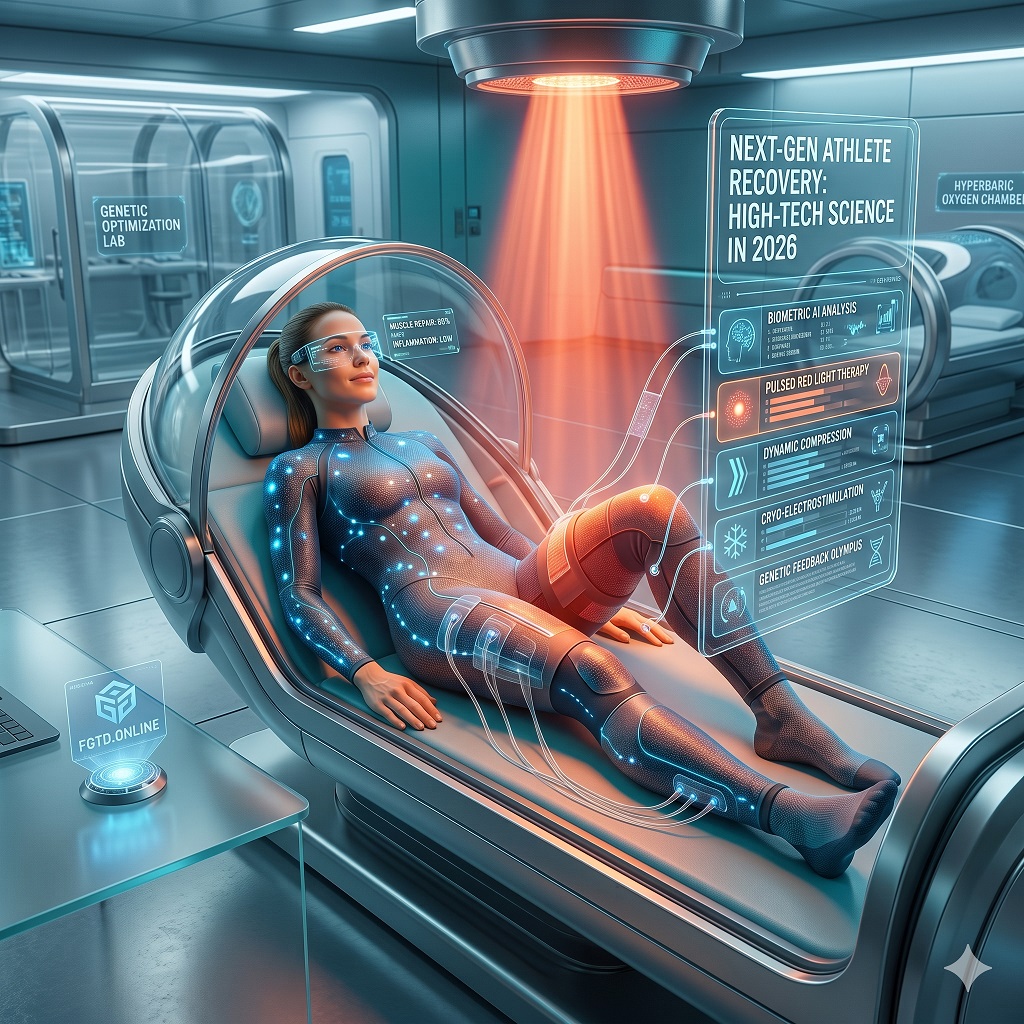
Next-Gen Athlete Recovery: High-Tech Science in 2026
The definition of “elite performance” has undergone a radical transformation. In the past, the difference between a gold medalist and a runner-up was often attributed to grit, training volume, or raw genetics. Today, in 2026, the battle for the podium is won during the hours when the athlete is not training. We have entered the era of Next-Gen Athlete Recovery, where biological recovery is treated with the same mathematical precision as a NASA rocket launch.
For the community at fgtd.online, staying abreast of these advancements is crucial. We are no longer talking about simple ice baths and foam rollers. The modern recovery suite is a high-tech sanctuary involving molecular monitoring, hyperbaric engineering, and AI-driven biological feedback loops. This is the science of 2026—where recovery is the new “unfair advantage.”
1. The Biometric Twin: Real-Time Recovery Modeling
The most significant shift in 2026 is the move from “general” recovery to “individualized” recovery. This is made possible by the Digital Twin concept. By utilizing internal sensors and continuous glucose monitors (CGMs), sports scientists create a real-time digital replica of an athlete’s physiological state.
Continues after advertising
Predictive Fatigue Analysis
Rather than waiting for an athlete to feel “sore,” AI algorithms analyze micro-fluctuations in heart rate variability (HRV), cortisol levels, and sleep architecture to predict muscle failure 24 to 48 hours before it occurs.
- The “Green-Light” Protocol: Coaches receive daily readiness scores. If the Digital Twin shows high systemic inflammation, the AI automatically adjusts the day’s training load, shifting the focus from high-intensity work to active recovery protocols.
- Metabolic Tracking: Continuous monitoring of biomarkers allows for immediate post-workout nutritional “reloading.” If an athlete’s glycogen stores are depleted beyond a specific threshold, a customized nutrient blend is synthesized in real-time to optimize the metabolic window.
2. Advanced Hyperbaric and Cryogenic Engineering
Environmental manipulation has reached new heights of sophistication. We have moved beyond basic temperature shifts to precise atmospheric control.
The Multi-Atmospheric Chamber
Traditional hyperbaric oxygen therapy (HBOT) has evolved into multi-chamber systems that cycle between high-pressure oxygenation and intermittent hypoxic (low oxygen) states.
- Enhanced Mitochondrial Biogenesis: By alternating oxygen levels, these chambers force the body to produce more efficient mitochondria—the powerhouses of the cell. This speeds up the repair of damaged muscle fibers and clears metabolic waste (like lactic acid) in minutes rather than hours.
- Neural Recovery: These chambers are now equipped with specific light frequencies (Photobiomodulation) that penetrate deep tissue to reduce systemic inflammation and accelerate the healing of micro-concussions—a major concern in contact sports.
Dry-Cryo Technology
The “wet” ice bath is becoming obsolete. Next-gen Dry-Cryo chambers use liquid nitrogen-cooled air at temperatures of -140°C, but without the moisture that can cause skin irritation or uneven cooling. This triggers a massive systemic anti-inflammatory response and a surge in endorphins, allowing for near-instant physical and mental resets.
3. Neuro-Sensing and Sleep Optimization
In 2026, we acknowledge that the brain is the organ that takes the longest to recover. Cognitive fatigue is as detrimental to performance as physical exhaustion.
AI-Managed Sleep Sanctuaries
Professional athletes now utilize “Sleep Pods” that act as total sensory deprivation chambers. These are not just beds; they are recovery computers.
- Thermal Regulation: The AI adjusts the mattress and air temperature in sync with the athlete’s REM and Deep Sleep cycles. A slight drop in temperature deepens the sleep state, while a gradual rise prepares the body for wakefulness.
- Neuro-Feedback: Wearable headbands track brainwave activity (Alpha, Beta, Delta). If the system detects a lack of restorative deep sleep, it emits specific “Pink Noise” or binaural beats to guide the brain into a more recuperative frequency.
4. Molecular Recovery: The Role of Peptides and Gene Expression
The most “borderline” frontier of 2026 involves the use of legal, bio-identical signaling molecules that tell the body to heal faster.
Targeted Peptide Therapy
Peptides like BPC-157 and TB-500, once the secret of the “underground,” are now routinely used under strict medical supervision in professional leagues. These molecules accelerate the repair of tendons, ligaments, and gut health.
- Localized Delivery: Using ultrasound-guided technology, medical teams can deliver these recovery signals directly to the site of an injury, bypassing the digestive system and ensuring 100% bioavailability.
- Epigenetic Modulation: We are seeing the rise of “Nutrigenomics,” where an athlete’s diet is tailored to turn “on” genes associated with tissue repair and turn “off” genes associated with chronic inflammation.
5. Wearable Soft-Robotics: The Active Recovery Suit
The traditional “compression sleeve” has been replaced by Soft-Robotic Exoskeletons. These garments use AI to provide “Sequential Pulse Pneumatic Compression.”
Intelligent Lymphatic Drainage
Instead of static pressure, these smart suits “massage” the limbs in a wave-like motion, mimicking the body’s natural lymphatic flow.
- Real-Time Adjustment: Sensors in the suit detect areas of high muscle density or localized edema (swelling) and increase pressure in those specific zones.
- Portability: Because these suits are made of lightweight, flexible polymers, athletes can wear them during travel on planes or buses, effectively turning “dead time” into high-level recovery time.
6. The Psychological Reset: VR and Floatation 2.0
Modern sports science recognizes that the “Central Governor” of the body—the mind—can prevent physical recovery if it remains in a state of high stress (Sympathetic Nervous System dominance).
VR Cognitive Decoupling
Athletes use Virtual Reality to “decouple” from the stress of competition. After a high-stakes game, an athlete might spend 20 minutes in a VR environment designed to induce a “Parasympathetic State” (rest and digest).
- Spatial Audio and Visual Cues: These environments use 360-degree immersive nature scenes and guided breathwork to lower the heart rate and reduce the production of stress hormones like adrenaline.
- Mental Rehearsal in a Relaxed State: Once the body is relaxed, the VR shifts to a “Flow State” visualization, allowing the athlete to review their performance without the associated physical stress response.
7. The Economic and Competitive “Arms Race”
As we’ve discussed on fgtd.online, this high-tech science has created a massive economic gap.
- The High Cost of Entry: A full “Next-Gen Recovery Suite” can cost upwards of $1 million. This has created a divide where “wealthy” teams have a massive advantage in “Game-Ready” availability compared to smaller market teams.
- The “Injury-Proof” Athlete: We are seeing the emergence of the “Injury-Proof” athlete—players who can play 80+ games a season at peak intensity because their recovery science is so advanced. This changes the way contracts are negotiated; a player with a “Proven Recovery Protocol” is now more valuable than a player with just raw talent.
8. Ethics and the Future of Human Performance
With technology moving so fast, 2026 faces a major question: Where does “Natural Recovery” end and “Bio-Hacking” begin?
- The WADA Paradox: Anti-doping agencies are struggling to keep up. If a hyperbaric chamber can stimulate the same red blood cell production as EPO (a banned substance), is the chamber “cheating”?
- Data Sovereignty: There is a growing debate over who owns the recovery data. If a team’s AI predicts an athlete’s knees will fail in two years due to “incomplete recovery,” do they have to share that information with the player?
Read More👉 The First Global Sports Stars – Before Television
Conclusion: The New Pillar of Excellence
In 2026, the mantra “No Pain, No Gain” is dead. It has been replaced by “Measure, Recover, Perform.” High-tech science has turned recovery into a quantifiable, repeatable, and scalable process.
For the athletes and professionals at fgtd.online, the takeaway is clear: the future of sports isn’t just about training harder—it’s about recovering smarter. The high-tech tools of 2026 allow us to push the boundaries of human performance while simultaneously protecting the human being.
As we look toward the 2028 Los Angeles Games, it won’t just be the strongest who win; it will be those whose bodies have been the most efficiently “reconstructed” in the quiet hours of the night.