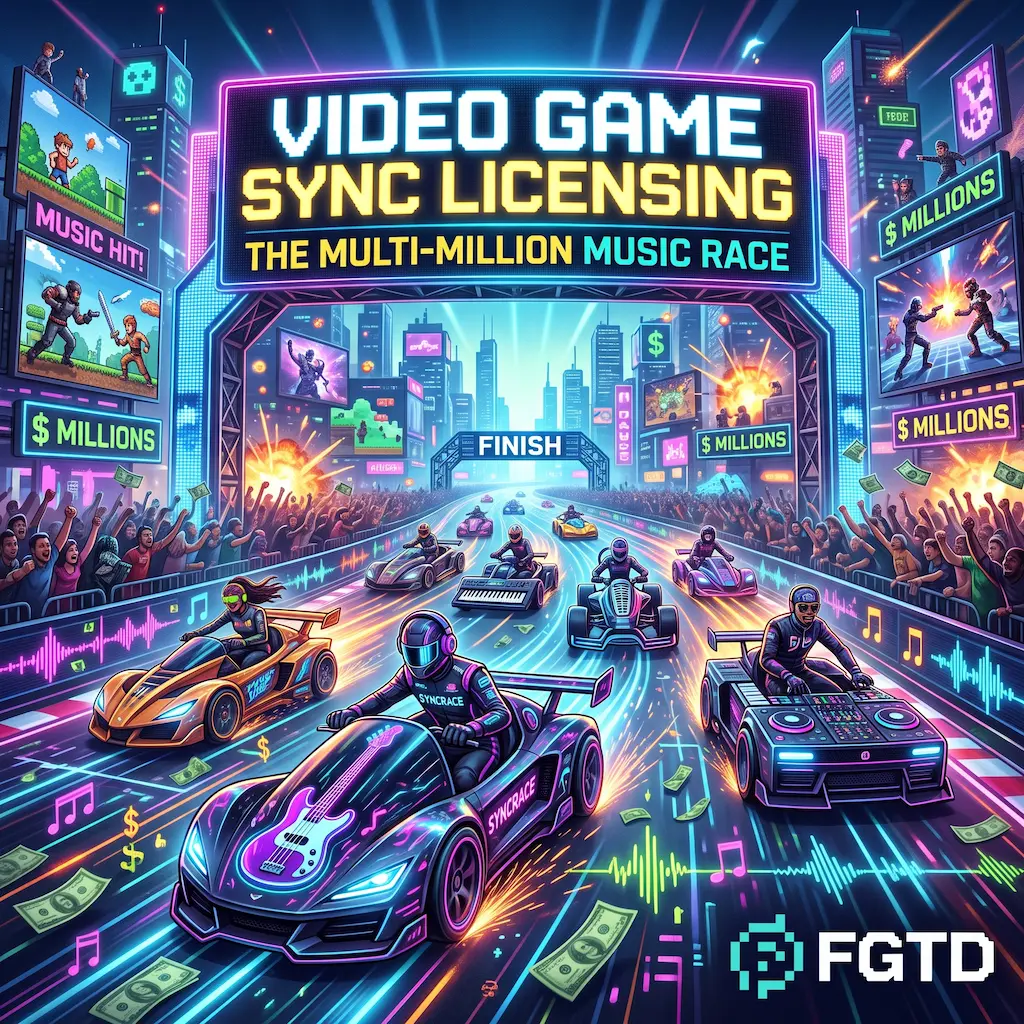
Video Game Sync Licensing: The Multi-Million Music Race
The global music industry has experienced several seismic revenue shifts over the past two decades. From the physical compact disc era through digital downloads to the multi-billion-dollar streaming streaming economy, rights holders—record labels, music publishers, and independent artists—have continuously searched for resilient, high-margin revenue streams.
While terrestrial radio play and digital streaming algorithms remain central to mass distribution, a powerhouse vertical has quietly emerged as one of the most lucrative and culturally impactful frontiers in modern entertainment: Video Game Synchronization (Sync) Licensing.
Sync licensing—the commercial pairing of musical compositions and master recordings with moving visual images—was historically dominated by Hollywood films, network television broadcasts, and Madison Avenue advertising campaigns.
Continues after advertising
However, the interactive entertainment sector has outpaced traditional media. With the global video game industry generating over $180 billion in annual revenue—surpassing the global box office and recorded music markets combined—game developers, AAA publishing houses, and esports platforms have become premier music commissioners and tastemakers.
Securing a sync placement inside a blockbuster video game is no longer a secondary promotional afterthought. It is a multi-million-dollar commercial battlefield that generates direct upfront synchronization fees, drives viral streaming surges on Spotify and Apple Music, fuels global social media trends, and creates lifelong brand associations among billions of engaged players worldwide.
This post analyzes the legal and corporate mechanics of video game sync licensing, examines the economics of interactive audio rights, contrasts traditional film/TV sync with gaming integration, and explores how artists and publishers capitalize on this modern entertainment gold rush.
1. The Legal Anatomy of a Video Game Sync Deal
To understand how money flows through the video game sync economy, one must dissect the dual-copyright framework of recorded music and the complex clearances required by interactive game engines:
The Dual Copyright Architecture
Every commercial music track contains two distinct legal copyrights that must be licensed simultaneously:
- The Master Rights (Sound Recording): Typically owned or controlled by the record label, distribution entity, or recording artist. This covers the specific sound recording asset.
- The Publishing Rights (Composition & Lyrics): Controlled by the songwriters, composers, and music publishers. This covers the underlying melody, chords, and lyrics.
For a game studio to legally incorporate a commercial track into an interactive title, it must execute two separate legal agreements: a Master Use License and a Synchronization License. If a track has five co-writers represented by four different publishing conglomerates, all entities must agree to the licensing terms and fee splits. A failure to clear even a 5% publishing share halts the entire integration.
Interactive vs. Linear Rights
Unlike a movie or a television commercial where a song plays over a fixed, linear scene that runs identically every time, video games are non-linear and interactive:
- In-Game Radio Stations: Ambient background tracks playing while an open-world character drives a vehicle (e.g., Grand Theft Auto or Cyberpunk 2077).
- Adaptive and Dynamic Audio: Music stems (drums, bass, synthesizers, orchestral layers) that dynamically fade in, accelerate, or transition based on a player’s real-time actions, combat intensity, or health status.
- Menu and Diegetic Sound: Audio tied to loading screens, user interfaces, or physical in-game environments like virtual nightclubs.
Consequently, gaming sync contracts require broad, interactive rights definitions that grant developers the legal right to loop, edit, cross-fade, and manipulate individual audio stems within the game’s dynamic engine without triggering copyright infringement claims.
2. Structural Comparison: Film & Television Sync vs. Video Game Sync
Evaluating the operational, legal, and economic differences between traditional Hollywood licensing and modern video game synchronization illustrates why the gaming sector has become so competitive:
Nature of Engagement and Consumption
- Traditional Film and Television Sync: Passive viewing; audiences listen to a track playing behind dialogue or during credits, usually hearing it once or twice.
- Video Game Sync Licensing: Active immersion; players hear the song repeatedly across tens or hundreds of hours of gameplay, forming intense psychological associations with specific gameplay triumphs.
Rights Term and Buyout Dynamics
- Traditional Film and Television Sync: Often structured with upfront synchronization fees plus recurring broadcast performance royalties collected via Performance Rights Organizations (PROs).
- Video Game Sync Licensing: Primarily flat-fee, worldwide “in perpetuity” or long-term buyout licenses (5 to 10 years), driven by the reality that games cannot easily strip music once physical discs ship or digital stores deploy downloads.
Algorithmic Streaming Discovery
- Traditional Film and Television Sync: Moderate bump; viewers occasionally use audio identification apps during credits or pivotal scenes.
- Video Game Sync Licensing: Massive streaming velocity; highly engaged gaming communities assemble dedicated in-game soundtrack playlists on DSPs, generating hundreds of millions of external streams.
Derivative Streaming and Creator Content
- Traditional Film and Television Sync: Minimal secondary broadcast exposure outside cable, streaming platforms, and syndication.
- Video Game Sync Licensing: Exponential amplification; gameplay footage is streamed live and archived across platforms like Twitch, YouTube Gaming, and TikTok by millions of content creators.
3. The Financial Spectrum: Upfront Sync Fees and In-Game Economies
The compensation structures for video game sync placements vary widely depending on the scale of the game studio, the prominence of the music placement, and the stature of the recording artist:
Upfront Flat Licensing Fees
- Indie Game Studios: Typically pay between $1,000 and $5,000 per side ($2,000 to $10,000 total for master and publishing) for niche or emerging artists.
- Mid-Tier & AA Titles: Range from $10,000 to $30,000 per side for recognized tracks or specialized genre curation.
- AAA Blockbuster Franchises: Global titles (such as EA Sports FC, Madden, Call of Duty, or Grand Theft Auto) routinely pay between $50,000 and over $150,000 per side for marquee tracks, with legendary heritage artists commanding even higher guaranteed minimums.
Trailer and Promotional Placements
Music utilized in theatrical game trailers, reveal teasers, and high-impact marketing campaigns at gaming conventions often commands separate, lucrative fees:
- A high-energy trailer placement for a major holiday release can command between $50,000 and $200,000+ for a 90-second promotional sync, functioning essentially as a premier global television commercial.
The Problem of In-Game Public Performance Royalties
One unique financial challenge in video game sync is the relative lack of ongoing public performance royalties:
- In traditional television and cinema in many international territories, PROs (such as ASCAP, BMI, PRS, and SACEM) collect backend performance royalties whenever an episode airs.
- In video games, consoles and PCs are generally not legally classified as public performance broadcasters in major jurisdictions like the United States.
- As a result, the upfront buyout fee agreed upon during initial clearance represents the lion’s share of direct sync compensation, making aggressive upfront negotiations critical for rights holders.
4. The Halo Effect: Beyond the Synchronization Check
The true long-term enterprise value of a gaming sync deal extends far beyond the initial check issued by the studio’s accounting department:
The Streaming Catalyst
When a song is featured in a high-profile game, it enters the daily lifestyle routine of a passionate, tech-savvy audience:
- Players actively seek out official game soundtracks on Spotify, Apple Music, and Amazon Music.
- Classic examples—from Tony Hawk’s Pro Skater defining 1990s punk-rock tastes to FIFA soundtracks breaking global indie and afrobeats acts—demonstrate that gaming placements can permanently alter an artist’s monthly streaming listener base, generating recurring mechanical and performance royalties for years.
The Creator Economy and DMCA Challenges
As video game streaming on Twitch and YouTube grew into a global industry, sync licensing faced a major friction point: Digital Millennium Copyright Act (DMCA) strikes:
- When content creators stream gameplay containing copyrighted commercial music, automated detection bots issue copyright strikes or mute the creator’s video archives.
- To prevent this friction, modern game publishers now negotiate comprehensive streamer-safe licenses or embed “Streamer Mode” audio toggles in game settings, allowing streamers to mute commercial songs and replace them with original instrumental tracks.
5. Original Game Scoring vs. Commercial Catalog Licensing
The video game music race is split between two distinct creative and financial pathways:
- Bespoke Original Scoring: Studios hire dedicated film and video game composers (such as Mick Gordon for DOOM or Gustavo Santaolalla for The Last of Us) to write tailor-made symphonic, ambient, or electronic scores. The studio typically commissions these under “work-for-hire” contracts, retaining full ownership of the intellectual property while paying composers substantial six-figure commissioning fees and backend soundtrack royalties.
- Curated Commercial Soundtracks: Studios hire specialized music supervisors to curate licensed commercial catalogs that reflect youth culture, urban street racing, or period-specific historical settings.
Today, leading publishers increasingly blend both worlds—commissioning global superstars to write exclusive, custom tracks specifically for game universes (such as Imagine Dragons writing music for League of Legends or Health scoring Max Payne 3).
Read More👉 Superyacht Regattas: The Ultra-Luxury World of Sailing
Conclusion: The New Soundstage of Global Music
Video game sync licensing has evolved from an obscure niche into the premier cultural bridge connecting the music industry with digital youth culture.
The historical days when record executives viewed games merely as promotional toys for adolescent audiences are gone. In an era where streaming service payouts remain fractional and physical sales are specialized collector items, interactive video games offer what the music industry craves most: substantial upfront capital, deep emotional engagement, and unprecedented global scale.
For songwriters, record labels, and music publishers, the race to secure placement on the next gaming soundtrack is not simply a business transaction—it is the definitive springboard to multi-million-dollar catalog appreciation and global cultural relevance.