Computer Vision in Sports: Real-Time Biomechanics Tech
For decades, quantitative athletic performance analysis relied on cumbersome, laboratory-bound technologies. Sports scientists, physical therapists, and performance coaches who sought to measure joint angles, ground reaction forces, and movement kinetics were forced to attach retroreflective markers to an athlete’s skin, place them on specialized treadmills or force plates, and capture their motion with multi-camera infrared optoelectronic systems.
While optical motion capture remains an established gold standard in clinical settings, its structural limitations severely restricted real-world utility:
- The “Hawthorne Effect” of the Lab: Athletes rarely move, react, or exert force in a clinical laboratory setting with the same ferocity and uninhibited instincts they exhibit during live competition.
- Physical Impedance: Affixing dozens of physical markers, harness rigs, and wearable inertial measurement units (IMUs) creates tactile drag, altering an elite athlete’s natural mechanics and movement patterns.
- Prohibitive Latency: Traditional biomechanical motion analysis required hours of manual post-processing, marker labeling, and computational reconstruction before a coach received actionable feedback.
Today, advances in deep learning, edge computing, and high-frequency optical sensors have unlocked a transformative breakthrough: Markerless Computer Vision in Real-Time Biomechanics.
Continues after advertising
By training convolutional neural networks (CNNs), spatial-temporal graph convolutional networks (ST-GCNs), and transformer-based pose estimation architectures on millions of annotated human movement frames, computer vision platforms can now extract sub-millimeter three-dimensional kinematic skeletons directly from standard video feeds.
From analyzing pitching mechanics in Major League Baseball and identifying subtle knee valgus angles during NBA fast breaks to automating offside reviews in world soccer, real-time computer vision is bringing laboratory-grade biomechanical telemetry straight onto the field of play.
This post examines the deep learning frameworks behind markerless pose estimation, analyzes real-time kinematic data pipelines, compares legacy motion capture with vision-based biomechanics, and explores the operational future of injury prevention and performance optimization.
1. Technical Mechanics: From Raw Pixels to 3D Skeletal Kinematics
Modern computer vision systems do not view an athlete as a flat image; they deconstruct dynamic human motion through a multi-stage deep learning pipeline:
1. 2D Keypoint Detection
The process begins by ingesting synchronous, high-frame-rate (120 to 500+ frames per second) video streams across multiple calibrated camera angles around a stadium or training facility:
- Top-Down Approaches: An object detection model (such as a YOLO-variant) first identifies and isolates each athlete with a bounding box, after which a deep neural network predicts the coordinates of key anatomical landmarks (e.g., ankles, knees, hip centers, shoulders, elbows, wrists, and cervical spine nodes).
- Bottom-Up Approaches: The network simultaneously identifies all anatomical keypoints in the frame and groups them into individual skeletal structures using Part Affinity Fields (PAFs), maintaining high computational throughput even in crowded athletic environments.
2. Multi-View Geometry and 3D Triangulation
Single-camera 2D pose estimation suffers from depth ambiguity and optical occlusion (e.g., when an opposing defender blocks the camera’s view of an athlete’s pivot foot).
To resolve this, multi-camera arrays feed into calibrated stereoscopic and epipolar geometry algorithms. By calculating the intersection of lines of sight from multiple optical angles, the system mathematically reconstructs true 3D spatial coordinates (X, Y, Z) for every anatomical joint in real time.
3. Inverse Kinematics and Biomechanical Filtering
Raw visual keypoint data can contain micro-jitter and optical noise. Real-time vision engines pass these raw coordinates through specialized physics and biomechanical layers:
- Constrained Skeletal Models: The software maps keypoint data onto rigid-body anatomical segment models, enforcing physical human limits (e.g., a human elbow cannot hyper-extend past anatomical ranges of motion, and bone lengths remain constant).
- Extended Kalman Filtering (EKF): Advanced state-estimation filters smooth out high-frequency sensor noise and predict joint positions through momentary visual occlusions without introducing algorithmic lag.
2. Structural Comparison: Laboratory Motion Capture vs. Real-Time Computer Vision
Evaluating the operational, environmental, and financial differences between legacy motion capture labs and modern computer vision systems demonstrates why professional sports franchises are investing heavily in vision technology:
Environmental Authenticity
- Laboratory Motion Capture (Mocap): Confined to artificial lab settings; athletes execute simulated movements on fixed force plates and indoor runways.
- Computer Vision Biomechanics: Operates natively in natural competition environments (stadiums, outdoor pitches, hardwood courts) during high-stakes competitive matches.
Equipment Intrusion and Athlete Wearables
- Laboratory Motion Capture (Mocap): High interference; requires skin-tight suits, sticky reflective markers, or strapped IMU sensors that irritate athletes.
- Computer Vision Biomechanics: Zero intrusion; 100% contactless optical tracking utilizing existing stadium broadcast cameras or high-speed fieldside lenses.
Data Processing Latency
- Laboratory Motion Capture (Mocap): Post-hoc; requires manual marker re-labeling and multi-hour or multi-day computational cleanup.
- Computer Vision Biomechanics: Real-time / Sub-second; live telemetry processed on local edge GPUs, streaming kinematic angles directly to dugout tablets within milliseconds.
Scalability and Capital Expense
- Laboratory Motion Capture (Mocap): Extremely limited; can only analyze one athlete at a time inside an expensive, dedicated indoor facility.
- Computer Vision Biomechanics: High scalability; tracks entire teams and opposing squads simultaneously across every fixture on the sporting calendar.
3. High-Impact Applications Across Elite Sports
The integration of real-time computer vision is fundamentally changing tactical strategy, player development, and sports medicine:
Baseball: Kinetic Chain Sequencing and Pitch Design
In Major League Baseball (MLB), optical tracking platforms (such as Hawk-Eye) track pitching and batting mechanics at 300 fps:
- Kinetic Chain Timing: Vision systems measure the rotational timing and energy transfer from pelvis rotation to thoracic spine snap, shoulder external rotation, and final wrist release.
- Ulnar Collateral Ligament (UCL) Stress Indicators: By tracking subtle changes in elbow extension angles and release velocity deviations over a 90-pitch workload, pitching coaches detect mechanical fatigue that correlates with elevated Tommy John surgery risk before the pitcher feels pain.
Basketball and Soccer: Real-Time Knee Valgus and ACL Defense
Non-contact anterior cruciate ligament (ACL) tears typically occur during rapid deceleration, cutting maneuvers, or landing from jumps.
- Computer vision algorithms monitor lower-limb mechanics in real time, identifying high-risk dynamic knee valgus (inward collapsing of the knee joint relative to the hip and ankle).
- Sports science staffs track mechanical degradation throughout the course of a match: as fatigue sets in, if an athlete’s landing mechanics deteriorate, bench tablets flag the athletic training staff to consider tactical substitutions or immediate rest protocols.
Track and Field: Sprint Acceleration and Stride Symmetry
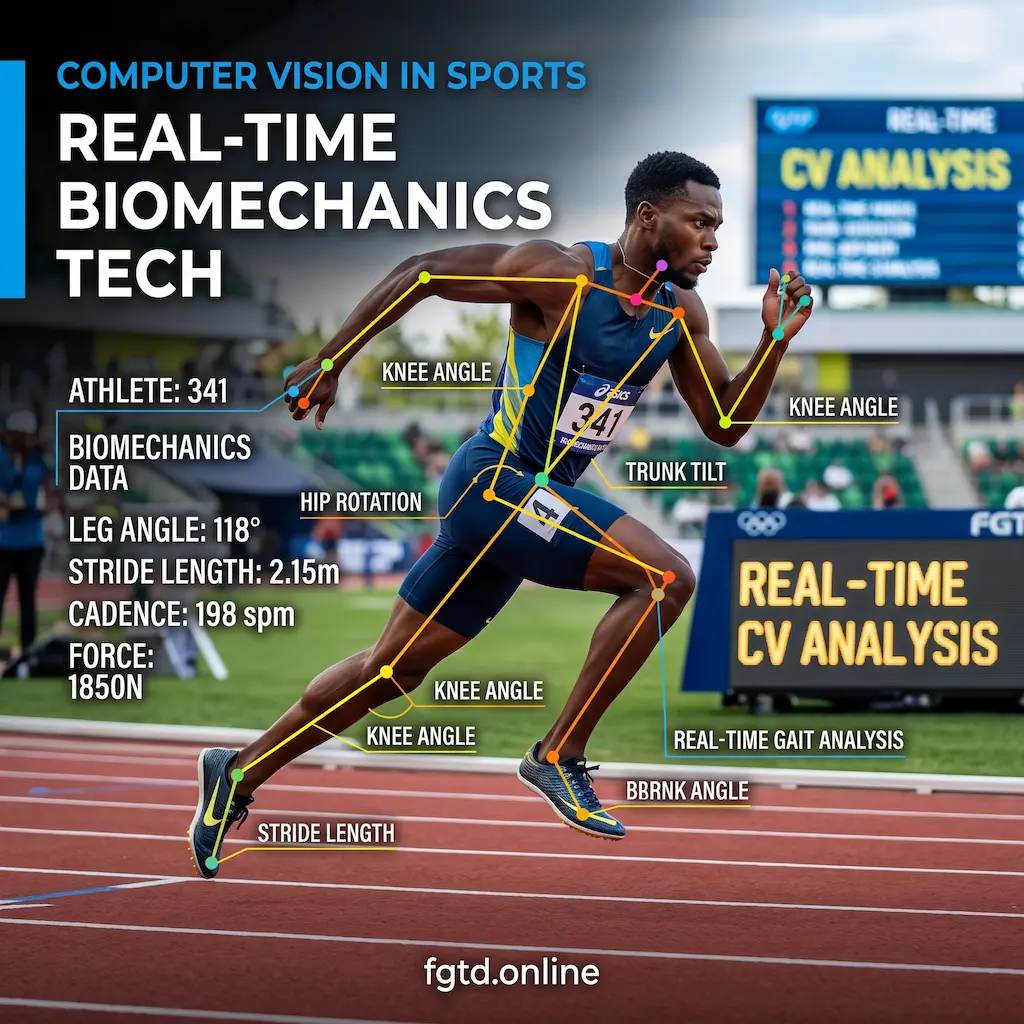
Sprinting performance is a game of millimeters and milliseconds. Vision-based kinematic systems quantify ground contact times, horizontal braking forces, hip extension angles, and vertical oscillation across every meter of a 100m sprint. Coaches immediately identify bilateral asymmetries between an athlete’s left and right stride, correcting mechanical flaws that cause hamstring pulls.
4. The Edge Computing Backbone: Overcoming Latency Bottlenecks
Real-time biomechanics cannot tolerate the latency of uploading massive, uncompressed 4K 240 fps video streams to centralized cloud data centers for analysis.
To deliver actionable feedback in live sporting scenarios, modern sports organizations deploy Edge AI Architectures:
- On-Premise GPU Clusters: High-density edge computing appliances (powered by industrial GPU acceleration) sit directly inside stadium broadcast compounds and training arenas.
- Hardware-Accelerated Inference: Quantized neural network models (utilizing FP16 or INT8 precision pipelines) process multiple concurrent 4K camera feeds with single-digit millisecond latency.
- Direct Telemetry APIs: Extracted joint coordinates, velocity vectors, and stress metrics are packaged into lightweight JSON payloads and transmitted via local 5G or Wi-Fi 6 networks directly to coaching dashboards, electronic medical records (EMR), and tactical broadcast graphics.
Read More👉 Brain-Computer Interfaces: The Next Frontier in Gaming
Conclusion: The Era of Transparent Human Optimization
Markerless Computer Vision represents a permanent, irreversible leap forward in human athletic performance and sports medicine. The historical era of confining biomechanical analysis to sterile laboratories and strapping restrictive sensors onto athletes is rapidly concluding.
By combining high-speed optical capture, multi-view 3D deep learning, and real-time edge processing, sports scientists can now observe the human body moving at maximum physical limits in its native environment.
As algorithms become faster, occlusion-handling becomes more robust, and hardware footprints shrink, contactless biomechanics will become standard across every tier of global athletics—permanently establishing Computer Vision in Sports: Real-Time Biomechanics Tech as the definitive technological engine protecting athletes, optimizing performance, and unlocking the next generation of athletic excellence.