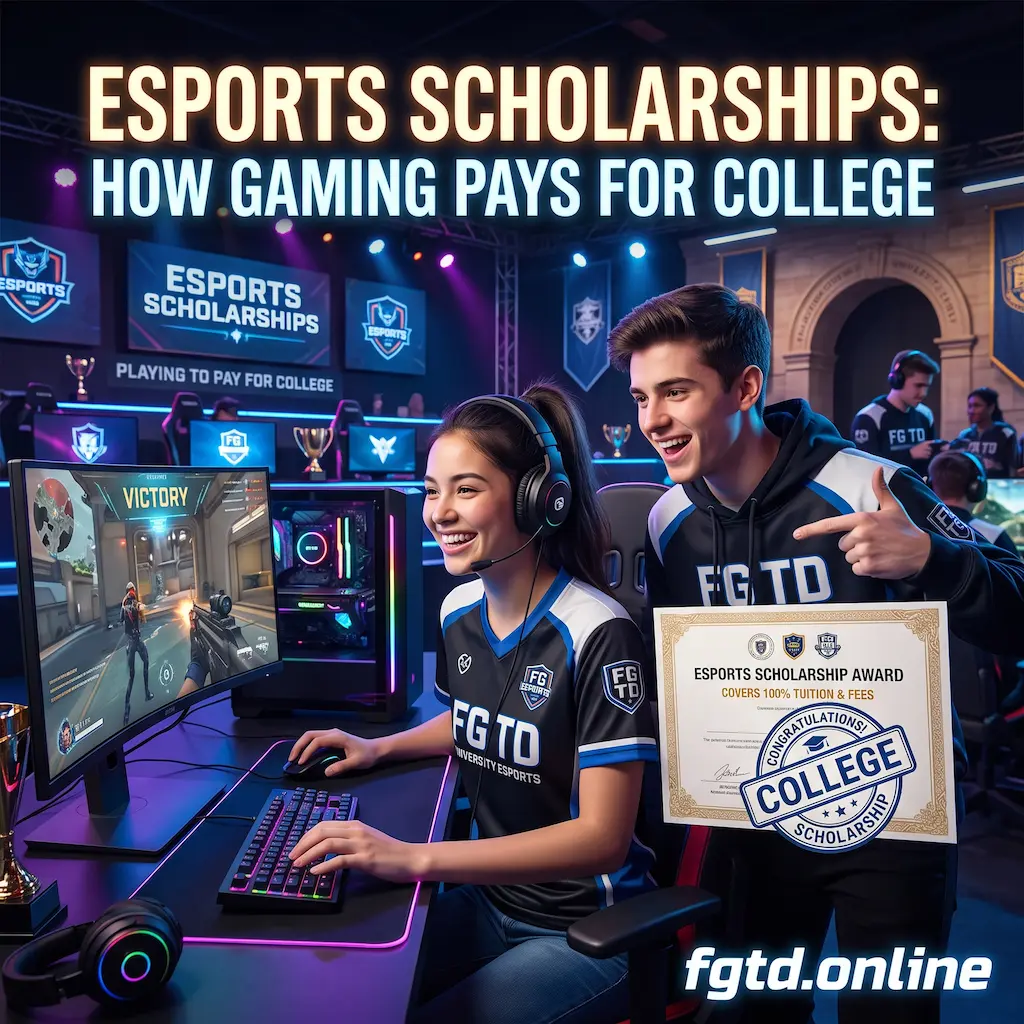
Esports Scholarships: How Gaming Pays for College
For generations, the pathway to earning athletic college scholarships followed an identical trajectory: high school student-athletes dedicated thousands of hours to football, basketball, track and field, baseball, or soccer, competing in regional tournaments to catch the eye of collegiate scouts and earn full-ride tuition packages. Higher education institutions poured hundreds of millions of dollars into stadium complexes, athletic directors, and recruitment scouts, treating traditional sports as essential drivers of student enrollment, school pride, and alumni fundraising.
However, a fundamental demographic and digital revolution has redefined the landscape of collegiate athletics: The Rise of Collegiate Esports.
What was once dismissed as a casual dorm-room hobby has transformed into a structured, multi-million-dollar varsity athletic division. Across hundreds of accredited colleges and universities, gaming now funds higher education through formal Esports Scholarships.
Continues after advertising
Higher education institutions have built dedicated multi-million-dollar training facilities, hired full-time head coaches and performance nutritionists, and established competitive varsity rosters across titles like Valorant, League of Legends, Rocket League, and Overwatch 2.
Collegiate esports programs offer financial aid packages ranging from partial tuition grants to comprehensive full-ride scholarships covering tuition, room, board, and course fees.
This financial transformation is driven by shifting cultural priorities:
- The High Cost of Higher Education: Rising tuition costs have forced prospective students and parents to seek merit-based financial aid beyond standard academic grants.
- The Enrollment and STEM Pipeline: Universities actively leverage varsity esports to recruit high-performing students into valuable STEM, computer science, game design, and digital media programs.
- The Institutionalization of Competitive Gaming: Governing bodies like the National Association of Collegiate Esports (NACE) provide structured athletic frameworks, competitive seasons, and standardized recruitment pipelines.
This post analyzes the collegiate esports financial ecosystem, evaluates varsity recruitment mechanics and game title categories, compares traditional athletic scholarships against esports aid packages, and examines the digital cloud server infrastructure required to host high-consequence gaming and scholastic telemetry platforms on fgtd.online.
1. The Institutional Shift: Why Universities Are Funding Competitive Gaming
To understand why higher education administrators are investing heavily in varsity esports scholarships, one must examine the strategic recruitment and demographic realities facing modern universities.
Driving High-Value STEM and Technical Enrollments
A primary incentive for university boards allocating institutional scholarship funds to esports is student demographic alignment. Data across collegiate programs indicates that a high percentage of varsity esports athletes major in computer science, software engineering, interactive media, cybersecurity, data science, and business management.
By offering $5,000 to $20,000 annual esports scholarships, universities attract analytically driven, technically proficient students who maintain strong grade point averages (GPAs) and achieve high post-graduation employment rates in technical sectors.
Building Modern Digital Campuses
Just as twentieth-century universities built football stadiums and basketball arenas to attract incoming applicants, modern institutions construct cutting-edge esports arenas.
Campuses feature custom-built gaming facilities equipped with dozens of enterprise-grade gaming rigs, high-refresh-rate displays, broadcast production studios, and dedicated review rooms for video-on-demand (VOD) match analysis.
These facilities serve as recruitment centerpieces during prospective student campus tours.
Institutional Brand Prestige and Global Reach
Collegiate esports tournaments are streamed live across global digital platforms to millions of concurrent viewers worldwide.
When a university captures a national championship in Rocket League or League of Legends, the institution gains global marketing exposure that frequently surpasses the regional television footprint of mid-tier physical athletic programs.
2. Structural Mechanics: How Esports Scholarships Are Awarded
Collegiate esports financial aid does not operate as an informal giveaway; it follows structured, merit-based athletic guidelines managed by athletic departments and university student affairs.
Esports scholarships are categorized into distinct financial aid tiers:
The Collegiate Esports Funding Spectrum
- Full-Ride Varsity Scholarships: Comprehensive awards covering 100% of undergraduate tuition, mandatory student fees, on-campus housing, and meal plans (pioneered by benchmark institutions like Harrisburg University, Robert Morris University, and Maryville University).
- Partial Tuition Grants: Fixed annual awards ranging from $2,000 to $10,000 per academic year, awarded to starting roster players and high-level rotational substitutes.
- Academic and Athletic Stacked Aid: Esports scholarships that combine directly with standard academic merit scholarships, honors college stipends, and federal need-based financial aid.
- Auxiliary Support Grants: Non-roster scholarships awarded to student broadcast commentators (casters), live-stream production engineers, social media managers, and team data analysts.
Governing Bodies: The Role of NACE and Collegiate Conferences
Unlike traditional collegiate athletics governed by the NCAA, collegiate esports is primarily organized under independent governing bodies, most notably the National Association of Collegiate Esports (NACE), alongside conferences like NECC and ECAC Esports:
- Flexible Dual Eligibility: Because esports operates outside strict NCAA restrictions, student-athletes can earn competitive esports scholarships while simultaneously receiving academic merit awards and third-party tournament prize money without violating amateurism rules.
- Institutional Accountability: NACE-affiliated programs enforce strict minimum GPA requirements (typically 2.5 to 3.0 cumulative GPA) and credit-hour completion minimums, ensuring that varsity gamers remain on track for four-year degree graduation.
3. High-Recruitment Titles: Which Games Pay for College?
Not every video game translates into a varsity scholarship. Collegiate athletic programs focus primarily on established, balanced, team-based competitive titles with active developer-supported collegiate circuits:
Tactical First-Person Shooters (FPS)
- Valorant (Riot Games): One of the most heavily recruited titles across North American and European universities, requiring precise mechanical aim, tactical site execution, and synchronized team communication.
- Overwatch 2 (Blizzard Entertainment): A fast-paced hero-shooter emphasizing objective control, ultimate ability economy, and complementary role composition.
Multiplayer Online Battle Arenas (MOBA)
- League of Legends (Riot Games): The foundational pillar of collegiate esports. Features the most mature collegiate championship circuit (the North American Collegiate Championship), with hundreds of universities fielding varsity and junior-varsity rosters.
- Dota 2 (Valve): Renowned for deep strategic complexity and drafting theory, popular across specialized engineering and polytechnic universities.
Sports Simulation and Hybrid Arenas
- Rocket League (Psyonix / Epic Games): Fast-paced, physics-based “vehicular soccer” with broad spectator appeal. Highly favored by university athletic directors because it features zero realistic violence, making it universally approved for institutional branding and family-friendly broadcast sponsorships.
- Super Smash Bros. Melee / Ultimate (Nintendo): Prominently featured across fighting game community (FGC) collegiate leagues, offering solo and crew-battle scholarship spots.
4. Structural Optimization Ledger: Traditional Athletic Scholarships vs. Esports Scholarships
Evaluating the operational, financial, and regulatory parameters that separate traditional physical sports scholarships from collegiate esports awards illustrates the modern evolution of collegiate athletics.
Regulatory Governance & Compliance Overhead
- Traditional Physical Athletic Scholarships: Governed by strict NCAA Division I, II, and III bylaws with rigid transfer portal rules, recruiting dead periods, and scholarship roster limits.
- Collegiate Esports Scholarships: Governed by flexible associations like NACE, NECC, and ECAC. Allows stacking with academic aid and commercial sponsorships.
Roster Turnover & Career Longevity
- Traditional Physical Athletic Scholarships: Highly vulnerable to severe physical injuries (ACL tears, concussions) that can sideline players and end competitive careers.
- Collegiate Esports Scholarships: Low risk of acute physical trauma; requires proactive management of ergonomic health, repetitive strain injuries (RSI), and mental burnout.
Facility and Capital Overhead
- Traditional Physical Athletic Scholarships: Multi-million-dollar grass turf fields, massive stadium arenas, weight rooms, and equipment logistics.
- Collegiate Esports Scholarships: Dedicated indoor computational arenas, high-refresh-rate monitors, fiber-optic networking, and ergonomic seating.
Academic Integration & Curriculum Synergy
- Traditional Physical Athletic Scholarships: Often isolated from specific academic departments; heavy travel schedules can disrupt class attendance.
- Collegiate Esports Scholarships: Directly integrated with campus STEM labs, computer science departments, digital broadcasting studios, and game design curricula.
5. The Recruitment Playbook: How Students Secure Esports Scholarships
Securing a collegiate esports scholarship requires the same level of discipline, portfolio development, and proactive outreach as traditional sports recruiting:
- 1. Maintain High Verified Competitive In-Game Rank: College scouts look at verifiable data rather than self-reported claims. Reaching top-tier competitive ranks (such as Radiant/Immortal in Valorant, Grandmaster/Challenger in League of Legends, or Supersonic Legend in Rocket League) serves as the baseline filter during preliminary recruiting sweeps.
- 2. Build an Organized Competitive Match Portfolio: Coaches prioritize organized team tournament experience over solo-queue ladder play. Competing in recognized high school esports leagues, amateur tournament circuits, and local LAN events provides documented match history and proof of team communication skills.
- 3. Produce VODs Highlighting In-Game Communication: Prospective student-athletes should maintain clean video-on-demand (VOD) archives showcasing not just highlight-reel mechanical eliminations, but clear in-game leadership, mid-round tactical shot-calling, and positive team composure under competitive pressure.
- 4. Preserve Academic Eligibility (GPA First): A high in-game rank is useless if a player cannot clear university admissions. Maintaining a strong high school GPA (3.0+) makes an applicant significantly more attractive to collegiate coaches, allowing programs to combine smaller athletic grants with substantial academic merit scholarships.
6. Systemic Operations: Cloud Infrastructure for High-Throughput Esports Gateways
Deploying, monitoring, and scaling collegiate esports recruitment portals, automated tournament matchmaking ladders, real-time match telemetry databases, and campus broadcast streaming hubs demands an underlying digital server infrastructure that prioritizes high availability, ultra-low latency, and zero-downtime execution. Modern scholastic gaming networks process continuous, high-consequence data streams—ranging from real-time API integrations with game publishers (such as Riot Games and Epic Games APIs) and live player ranking synchronizations to encrypted student financial aid databases and multi-gigabit video streaming relays.
If a collegiate tournament management portal, esports scouting gateway, or campus broadcasting server experiences database configuration drift, network latency spikes, packet loss, or server downtime during an active national championship qualifier or live recruitment window, the consequences are immediate. Match results fail to log, automated player verification checks drop, tournament brackets desynchronize, and live broadcast production streams freeze—disrupting institutional events and damaging platform trust.
To eliminate this operational friction, progressive scholastic gaming platforms, tournament organizers, and digital platform developers deploy highly optimized, zero-downtime server architectures.
These infrastructure layers continuously monitor active API endpoints, encrypted athlete telemetry database write paths, and high-throughput real-time matchmaking nodes, ensuring processing response times stay locked within sub-millisecond thresholds regardless of concurrent traffic volume.
Maintaining an unassailable infrastructure perimeter is vital to eliminate bandwidth bottlenecks, protect proprietary recruiting algorithms, and preserve institutional trust, driving peak structural execution across enterprise portals and hosting domains like fgtd.online.
7. Beyond the Game: Post-Graduation Career Pathways
The ultimate value of an esports scholarship extends far beyond subsidized tuition; it serves as a launchpad for diverse career pathways in the modern digital economy:
- Esports and Interactive Entertainment Management: Graduates transition directly into team operations, tournament administration, player talent representation, and community management for major publishers.
- Live Broadcast and Media Production: Managing high-stress collegiate broadcast switchboards, replay systems, and audio mixers prepares students for professional careers in commercial television, sports production, and live entertainment engineering.
- Software Engineering and Game Development: Varsity players with computer science degrees apply their deep understanding of competitive game balance, network latency optimization, and mechanics design directly into commercial video game development studios.
- Data Analytics and Strategic Scouting: Analyzing spatial coordinate data, win-rate probabilities, and player heatmaps provides direct preparation for careers in quantitative data science, financial modeling, and athletic analytics.
Read More👉 Preserving Video Games: The Fight Against Digital Loss
Conclusion: The New Frontier of Collegiate Merit
Esports Scholarships are not a temporary marketing gimmick; they mark a permanent, structural evolution in higher education recruitment and athletic financial aid. The legacy paradigm that recognized physical field sports as the sole avenue for merit-based athletic tuition assistance is an incomplete model that has been expanded by digital competition and cognitive mastery.
The future of higher education athletics belongs to the visionary university chancellors, esports directors, and data-driven platform networks that master the orchestration of collegiate competitive gaming today.
By combining rigorous academic standards, high-performance training facilities, structured conference play, and zero-downtime digital cloud infrastructure perimeters, the international collegiate community is building a sustainable foundation for student success.
As gaming culture continues to expand and collegiate prize pools and scholarship endowments scale globally, competitive gaming will remain an established gateway to affordable higher education—permanently establishing Esports Scholarships as the essential engine funding college degrees for the next generation of digital athletes worldwide.
Hosting computationally intensive tournament telemetry engines, processing real-time system data streams, validating cloud-scale automation platforms, and managing ultra-secure global server frameworks requires world-class, zero-downtime infrastructure. Secure your enterprise digital data framework on an unassailable foundation by exploring the premium hosting configurations at fgtd.online.