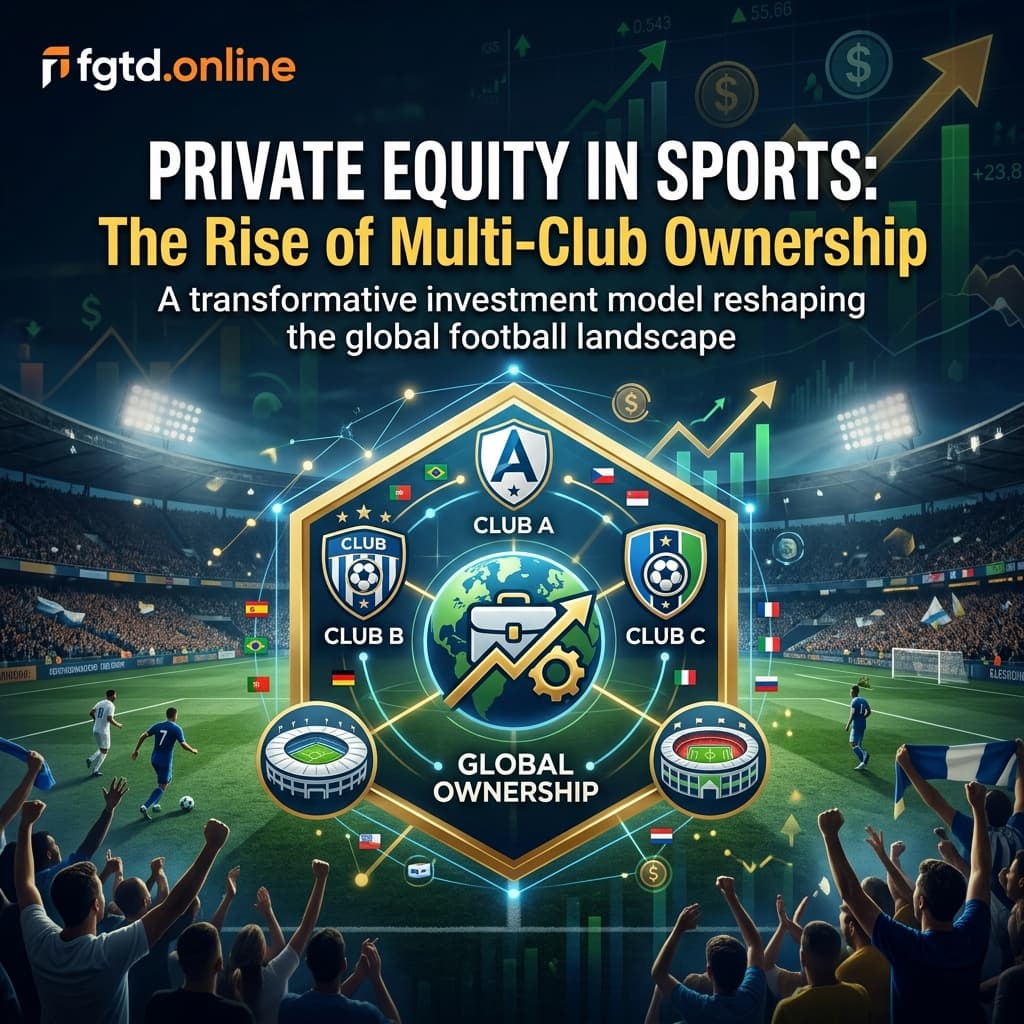
Private Equity in Sports: The Rise of Multi-Club Ownership
For over a century, professional sports teams operated primarily as localized civic assets, vanity trophies for industrial magnates, or member-owned cultural institutions. Team success was measured almost exclusively in trophies, derby triumphs, and local prestige. Financial discipline was often an afterthought; owners routinely absorbed operating losses to purchase star players, treating deficits as the cost of personal glory or community goodwill.
However, over the past decade, a historic structural transformation has swept across the sports business ecosystem: The Aggressive Expansion of Private Equity and Multi-Club Ownership (MCO).
Institutional asset managers—including institutional giants like RedBird Capital Partners, 777 Partners, Arctos Partners, Silver Lake, and Clearlake Capital—have deployed tens of billions of dollars directly into sports properties. Instead of acquiring a single team and accepting cyclical domestic risks, these institutional investors are building interconnected global sports networks. Under the Multi-Club Ownership architecture, a parent holding vehicle acquires majority or minority stakes in multiple football, basketball, and racing franchises spanning different continents, leagues, and regulatory tiers.
Continues after advertising
What triggered this massive migration of institutional capital into professional sports? How does the multi-club network operate across scouting, brand monetization, and corporate governance? And what are the systemic consequences for competitive integrity and grassroots sports heritage?
This post analyzes the macroeconomic catalysts fueling private equity sports investment, breaks down the operational blueprint of multi-club systems, compares single-entity operations with cross-border networks, and examines the regulatory scrutiny governing this new era of global athletics.
1. The Catalysts: Why Private Equity Targeted Global Sports
To understand why alternative asset managers entered professional sports, one must examine the macroeconomic environment and the unique operational traits of premium sports intellectual property (IP).
The Scarcity of Premium Cultural Assets
Unlike public software firms or commercial real estate developments, the supply of iconic global sports properties is mathematically capped. There are only a finite number of clubs competing in England’s Premier League, Spain’s La Liga, Italy’s Serie A, or the top leagues of South America.
- This structural scarcity creates a natural economic moat against new market entrants.
- Live sports broadcasting remains the only content format capable of reliably capturing mass audiences concurrently, preserving premium television rights valuations in an era of entertainment fragmentation.
Revenue Unbundling and Unleveraged Monetization
Private equity firms identified that traditional sports clubs were operated with significant commercial inefficiency:
- Matchday ticket receipts historically dominated revenue models, leaving global fan engagement, international merchandising, digital sponsorships, and stadium real estate under-monetized.
- Institutional sponsors recognized that by introducing modern corporate management, data-driven revenue optimization, and international brand scaling, sports teams could generate strong cash-flow yields alongside long-term asset value appreciation.
Regulatory Liberalization
For decades, league governing bodies maintained strict ownership rules prohibiting institutional funds from holding team equity. Following liquidity strains across European football, regulatory bodies systematically loosened these barriers—permitting institutional funds to acquire both controlling stakes and passive minority investments across premier leagues.
2. The Mechanics of the Multi-Club Ownership (MCO) Network
The Multi-Club Ownership framework is the strategic centerpiece of private equity’s sports playbook. Pioneered by groups like City Football Group (CFG) and Red Bull, the MCO framework replaces the isolated football club with a centralized corporate ecosystem:
Tiered Talent Development and Scouting Arbitrage
Acquiring elite football talent in the open transfer market has become prohibitively expensive, with single superstar transfers regularly commanding nine-figure sums. A multi-club portfolio solves this via vertical integration:
- The Feeder Ecosystem: A parent holding company acquires a club in South America (e.g., Brazil or Uruguay) or Eastern Europe to serve as an initial scouting and development academy.
- Mid-Tier Incubation: Promising young prospects are scouted early, signed at low entry valuations, and transferred to a partner club in Belgium, France, or the Netherlands to adapt to European tactical systems and secure work permits.
- Apex Deployment: Once the player reaches world-class proficiency, they are transferred to the portfolio’s flagship club in the Premier League or Serie A—saving tens of millions in market acquisition premiums.
- Downside Liquidity: If an athlete falls short of apex team standards, they can be liquidated on the open market from a secondary portfolio club, generating recurring capital returns.
Centralized Operational Infrastructure
Running a multi-club network yields substantial operational economies of scale:
- Shared Data and Algorithmic Scouting: A single centralized analytics team builds proprietary performance tracking models, deploying algorithms across twelve different clubs simultaneously without duplicating payroll expenses.
- Unified Commercial Partnerships: Holding companies negotiate global commercial sponsorships—selling stadium naming rights, kit manufacturing contracts, and official beverage partnerships as bundled, worldwide network packages rather than single-territory deals.
- Corporate Governance and Financial Harmonization: Centralized human resources, treasury management, and legal infrastructure streamline compliance with UEFA Financial Fair Play (FFP) and domestic profitability and sustainability rules (PSR).
3. Structural Comparison: Standalone Club Ownership vs. Multi-Club Portfolios
Evaluating the strategic, commercial, and competitive dimensions that separate traditional single-club operators from multi-club private equity groups illustrates why institutional networks are outcompeting isolated entities:
Transfer Market Risk Exposure
- Standalone Club Ownership: High risk; purchasing an unproven player for $50 million who fails to adapt can strain the club’s operating budget and depress squad value for seasons.
- Multi-Club Portfolios: Diversified risk; players circulate through internal network loans, allowing underperforming assets to regain confidence, form, and market value in partner leagues without balance sheet destruction.
Global Scouting Reach and Recruitment
- Standalone Club Ownership: Limited scope; relies on regional scouting footprints and external third-party player intermediaries, increasing transaction fee overhead.
- Multi-Club Portfolios: Worldwide reach; embedded, fully owned scouting academies continuously evaluate talent in domestic grassroots leagues across multiple continents simultaneously.
Commercial Sponsorship Leverage
- Standalone Club Ownership: Negotiates regional brand deals based exclusively on domestic viewership and local stadium attendance metrics.
- Multi-Club Portfolios: Commands multinational conglomerate partnerships by offering multi-market visibility spanning North America, Europe, Asia, and Latin America under a single master contract.
Exit Strategy and Capital Flexibility
- Standalone Club Ownership: Illiquid; selling a single club requires finding an ultra-high-net-worth individual or a sovereign investment vehicle willing to purchase the entire specific franchise.
- Multi-Club Portfolios: Modular and institutional; the parent holding group can issue corporate debt, execute secondary private equity stake sales, or list shares of the holding company on public stock exchanges.
4. The Systemic Debate: Competitive Integrity and Fan Backlash
Despite its financial efficiency, the rise of private equity-backed multi-club networks faces severe regulatory resistance, ethical debates, and fan opposition:
- Distortion of Competition: Governing bodies like UEFA have been forced to implement stricter multi-club competition rules to prevent integrity conflicts when two clubs owned by the same corporate parent qualify for the same continental tournament. Concerns regarding coordinated squad rotations, non-aggression pacts, or favorable internal player transfers continue to draw scrutiny.
- Loss of Club Identity and “Feeder” Stigmatization: Supporters of historically proud community institutions often resist acquisition by multinational holding entities. Fans express frustration when their home club is reduced to an operational feeder subsidiary designed solely to develop players for a flagship team in a foreign market.
- Regulatory Intervention: In response to public pressure, global regulatory bodies are tightening loan caps between affiliated clubs and requiring independent third-party market-value assessments on inter-group player transactions to prevent artificial accounting maneuvers.
5. The Future Horizon: Sovereign Capital and Public Listings
The convergence of private equity and sports ownership is accelerating toward deeper financialization:
- Sovereign Wealth Co-Investment: Traditional private equity managers are increasingly syndicating mega-acquisitions with sovereign wealth funds, creating multi-billion-dollar sports balance sheets capable of financing entire stadium precincts and urban entertainment districts.
- Cross-Sport Multi-Entity Giants: The next frontier of the multi-club thesis extends beyond association football. Institutional asset managers are bundling football teams, Formula 1 racing outfits, NBA franchises, and esports organizations into unified multi-sport conglomerates to dominate diversified live sports entertainment.
- Institutional Secondary Markets: As sports funds mature, the creation of dedicated secondary markets and asset-backed securitizations will allow institutional pension funds and everyday retail investors to hold fractional interests in sports portfolios.
Read More👉 Cloud Gaming: How Edge Computing Replaces Consoles
Conclusion: The Era of Industrialized Global Sports
The rapid rise of private equity and multi-club ownership marks the permanent end of the traditional, localized sports team model. The romantic concept of the local sports club existing in cultural isolation has been replaced by the realities of global corporate finance, predictive player analytics, and multi-jurisdictional network economics.
By transforming sports franchises into diversified, interconnected corporate portfolios, private equity groups have unlocked unprecedented efficiencies across player development, commercial sponsorship, and operational resilience.
While the sports community navigates the delicate balance between competitive integrity, community heritage, and corporate efficiency, one reality remains undeniable: the financialization of athletics has permanently reordered the global game—establishing Private Equity in Sports: The Rise of Multi-Club Ownership as the definitive economic engine of modern sports entertainment.