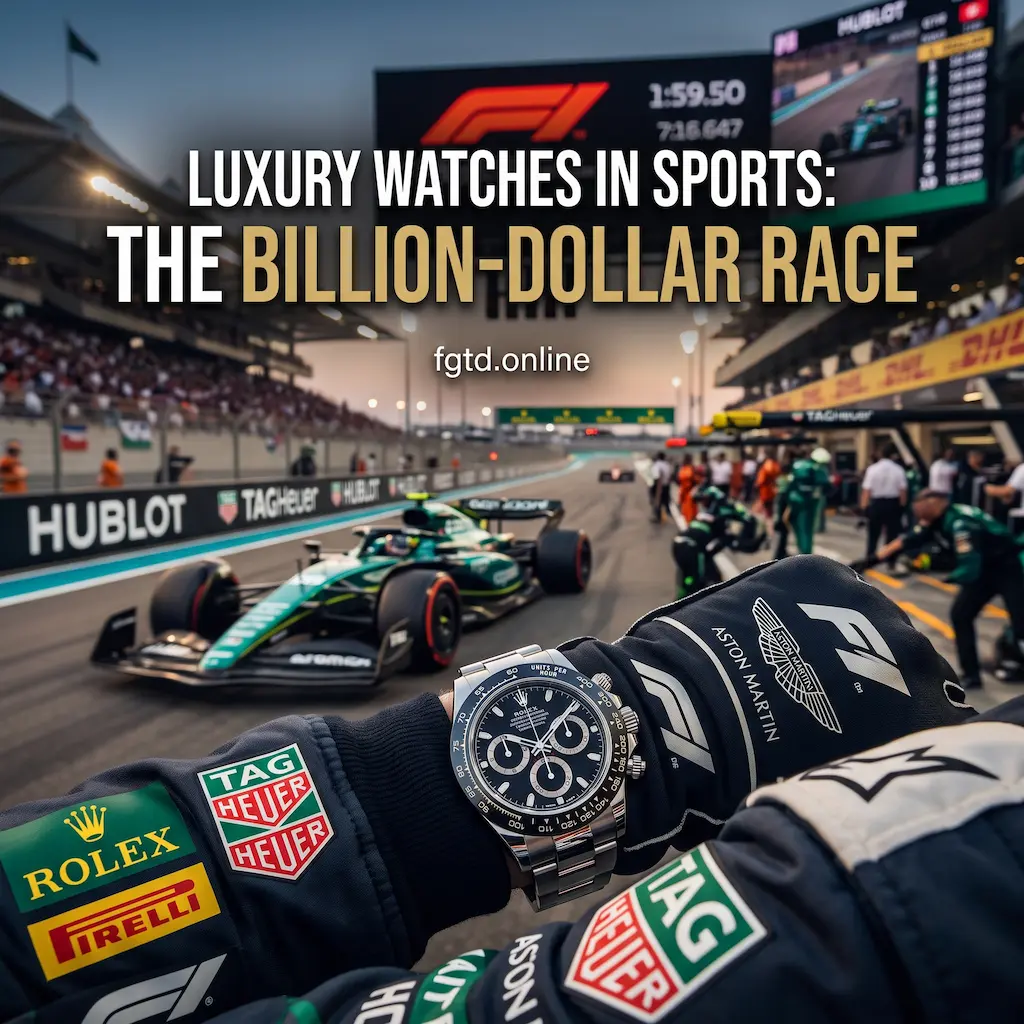
Luxury Watches in Sports: The Billion-Dollar Race
For generations, professional athletic apparel sponsorships were defined by rubber, nylon, and moisture-wicking synthetic fabrics. Sports marketing was dominated by legacy sportswear brands competing to plaster their logos across track jerseys, tennis shorts, basketball shoes, and racing overalls. The guiding commercial principle was mass utility: sell accessible sports shoes and affordable cotton activewear to millions of global spectators.
Yet, over the past three decades, a profound commercial luxury inversion has transformed athletic sidelines, podium ceremonies, and pit lanes: The Multi-Billion-Dollar Race for Luxury Sports Horology.
Today, the most fiercely contested piece of real estate in modern sports is no longer the front of a soccer kit or the wing of a Formula 1 racing car. It is the athlete’s wrist.
Continues after advertising
From the clay courts of Roland-Garros and the emerald grass of Wimbledon to the hyper-exclusive paddock clubs of the Monaco Grand Prix, Swiss horological powerhouses and independent haute horlogerie ateliers are pouring hundreds of millions of dollars into sports sponsorships. Legacy names like Rolex, Omega, and TAG Heuer, alongside avant-garde watchmakers like Richard Mille, Audemars Piguet, and Hublot, view elite athletics as the ultimate arena to prove precision mechanical mastery, showcase space-age composite engineering, and project ultimate social status.
The convergence of high-performance athletics and mechanical watchmaking has evolved from simple billboard advertising into an integrated, multi-billion-dollar ecosystem. Today, luxury timepieces walk right onto active playing fields, withstanding brutal g-forces, explosive tennis racquet impacts, and deep underwater pressures—cementing the mechanical watch as the definitive symbol of elite athletic prestige.
This post analyzes the historical evolution of sports timekeeping, evaluates the shift from passive timing partners to active on-field competition assets, compares classical legacy watchmakers against modern technical avant-garde brands, and explores the cultural and financial dynamics of luxury watches in contemporary athletics.
1. The Heritage Chronicle: From Sideline Stopwatches to Global Prestige
To understand the massive financial scale of contemporary watch sponsorships, one must trace how mechanical watchmakers originally entered the sporting arena out of genuine functional necessity.
The Precision Timing Era (Omega and the Olympic Games)
Before high-speed digital transponders and laser photoelectric sensors, athletic times were captured by mechanical stopwatches.
In 1932, Omega dispatched a single watchmaker equipped with 30 high-precision split-second chronographs to Los Angeles to serve as the Official Timekeeper of the Olympic Games.
At the time, mechanical chronographs calibrated to a tenth of a second represented cutting-edge athletic measurement technology:
- For watchmakers, proving that a mechanical escapement could reliably record Olympic sprint finishes with zero variance was the ultimate validation of horological quality.
- Omega built an association with Olympic athletic glory that has spanned nearly a century, transforming an operational logistics task into one of the longest-running, most prestigious partnerships in global corporate history.
The Wilderness Tests (Rolex and Extreme Exploration)
Concurrently, Rolex founder Hans Wilsdorf understood that the best way to convince consumers of a watch’s waterproof durability was to subject it to extreme, public athletic challenges:
- In 1927, British swimmer Mercedes Gleitze swam the freezing waters of the English Channel wearing a waterproof Rolex Oyster around her neck; the watch emerged after ten hours in salt water in perfect working order.
- In 1953, Sir John Hunt’s expedition conquered the summit of Mount Everest, with Sir Edmund Hillary and Tenzing Norgay carrying Rolex chronometers to the roof of the world, directly birthing the iconic Rolex Explorer.
By the 1960s, motorsport chronographs like the Rolex Daytona, the TAG Heuer Carrera, and the Heuer Monaco (cemented in cinema history by Steve McQueen in Le Mans) linked mechanical chronographs to the daring glamour of high-speed racing.
2. The Great Paradigm Shift: From the Trophy Ceremony to the Playing Field
Historically, sports sponsorships adhered to a rigid, unspoken rule: athletes competed bare-wristed to avoid added weight or mechanical damage, slipping on a gold dress watch only after the final whistle during the trophy ceremony or press conference.
That dynamic was shattered at the turn of the millennium:
Richard Mille and the Extremes of On-Field Shock Resistance
Founded in 2001, independent Swiss watchmaker Richard Mille rejected the idea that a high-complication mechanical watch had to be fragile, heavy, and confined to velvet jewelry boxes. Mille envisioned his timepieces as high-performance racing machines for the wrist:
- In 2010, Richard Mille partnered with Spanish tennis legend Rafael Nadal.
- Nadal was skeptical, noting that high-velocity forehands generate violent rotational shocks and that traditional heavy watches would throw off his stroke balance.
- Mille responded by engineering the RM 027 Tourbillon—a mechanical tourbillon weighing less than 20 grams, utilizing aerospace-grade carbon nanotubes, titanium, and LITAL alloys.
Nadal wore the watch during every match of his Grand Slam campaigns. The timepiece was subjected to violent 130 mph racquet swings and continuous shock loads exceeding 5,000 to 12,000 g’s, functioning without missing a beat.
By taking a six-figure mechanical tourbillon onto clay and grass courts, Richard Mille proved that luxury watches could survive at the extreme limits of professional athletic competition.
The Evolution of Sports Horology
- Phase 1: Functional Timing Utility — Practical track and pool measurement led by Omega at the 1932 Olympics and Heuer mechanical stopwatches on rally courses.
- Phase 2: Sideline and Podium Endorsements — Prestigious ambassador roles focused on post-match trophy presentations and paddock club visibility.
- Phase 3: Active On-Field Engineering — Ultra-lightweight shockproof mechanics exemplified by Richard Mille on Rafael Nadal’s wrist and titanium tourbillons in Formula 1 cockpits.
- Phase 4: Cultural and Financial Status Symbols — High-impact lifestyle curation across pre-game tunnel walks, private athlete collections, and secondary market investments.
Formula 1: The Apex Battleground of Horological Tech
Nowhere is the competition among luxury watchmakers more concentrated than in Formula 1. Every team on the grid maintains a high-tier watch partner:
- Ferrari: Richard Mille
- Mercedes-AMG: IWC Schaffhausen
- Red Bull Racing: TAG Heuer
- McLaren: Richard Mille
- Aston Martin: Girard-Perregaux
- Stake F1 Team: Rebellion Timepieces
Watch designers collaborate directly with F1 aerodynamicists and composite engineers, borrowing materials developed for ground-effect chassis—such as Carbon TPT (Thin Ply Technology), graphene, and cermet composites—to build ultra-lightweight watch cases.
When an F1 driver pulls 5g through the swimming pool chicane at Monaco, the watch strapped to their wrist is not decorative jewelry; it is a mechanical showcase of extreme lightweight structural rigidity.
3. Structural Optimization Ledger: Traditional Horology Heritage vs. Modern Avant-Garde Sports Watches
Evaluating the engineering, aesthetic, and cultural parameters that separate classical heritage timepieces from modern avant-garde sports watches illustrates why both categories command massive commercial interest in sports marketing.
Core Design Philosophy
- Traditional Heritage Sports Horology (Rolex, Omega, TAG Heuer): Understated tool-watch evolution, timeless steel or precious metal aesthetics, classic legibility, and decades of unchanged iconic silhouettes.
- Modern Avant-Garde Sports Horology (Richard Mille, Hublot, Audemars Piguet Offshore): Deconstructive open-worked skeletonization, high-visibility tonneau and angular cases, architectural three-dimensional mechanics, and vivid color palettes.
Materials Science and Metallurgy
- Traditional Heritage Sports Horology: 904L surgical stainless steel (Oystersteel), proprietary gold alloys (Sedna Gold, Everose), and scratch-proof ceramic bezels.
- Modern Avant-Garde Sports Horology: Grade 5 titanium, forged carbon, Quartz TPT, sapphire crystal cases, and proprietary ceramic-metal composites.
Shock Resistance and G-Force Tolerance
- Traditional Heritage Sports Horology: Engineered to withstand 1,000 to 5,000 g’s; standard mechanical drop testing suitable for golf, sailing, and equestrian pursuits.
- Modern Avant-Garde Sports Horology: Engineered to survive 10,000 to 14,000+ g’s; suspended movement baseplates utilizing miniature braided steel cable suspension systems.
Primary Cultural Placement in Sports
- Traditional Heritage Sports Horology: Official tournament timing partnerships (Rolex at Wimbledon, Omega at the Olympics, Longines in equestrian derbies).
- Modern Avant-Garde Sports Horology: Direct personal partnerships with elite, dynamic athletes who wear timepieces during live competitive action (F1 cockpits, track sprints, NBA games).
4. The Modern NBA and European Football “Tunnel Walk” Effect
Over the past decade, the venue for luxury watch marketing expanded far beyond official television commercial slots. It moved into the stadium pre-game arrival corridor: The Pre-Game Tunnel Walk.
In the NBA, the English Premier League, and the NFL, pre-game arrivals have evolved into runways for high-fashion self-expression:
- Star athletes like LeBron James, Cristiano Ronaldo, Erling Haaland, and Lewis Hamilton treat arena hallways as stages for luxury curation.
- When LeBron James arrives wearing an off-catalog, factory-gem-set Audemars Piguet Royal Oak Concept, or Cristiano Ronaldo steps off a team bus sporting a bespoke Jacob & Co. timepiece encrusted with hundreds of baguette diamonds, the image spreads across Instagram, TikTok, and lifestyle publications within minutes.
- This organic celebrity exposure bypasses traditional print advertising entirely, communicating wealth, taste, and cultural relevance directly to younger, digital-native audiences.
The athlete has become the ultimate lifestyle tastemaker. In the modern luxury market, seeing a watch on the wrist of a world champion carries far more cultural currency than a static glossy magazine spread ever could.
5. The Financialization of Sports Horology: Secondary Market Speculation
The intense media exposure generated by sports sponsorships has directly fueled multi-billion-dollar global secondary watch markets:
- The “Waitlist Economy”: Iconic steel sports watches associated with legendary sporting arenas—such as the Rolex Cosmograph Daytona, Patek Philippe Aquanaut, and Audemars Piguet Royal Oak—frequently command multi-year waiting lists at authorized retailers, with secondary market premiums trading at two to three times original retail prices.
- Collectible Athlete Limited Editions: Watch houses release highly limited, numbered editions honoring specific sporting icons (such as the Hublot Big Bang Usain Bolt, or the Audemars Piguet Royal Oak Leo Messi). These limited production runs turn mechanical timepieces into appreciating alternative assets traded on platforms like Chrono24 and Watchfinder.
- Auction House Records: Historic sports-associated watches command extraordinary sums at luxury auction houses. When the Rolex Daytona originally owned by motorsport icon Paul Newman was auctioned by Phillips in New York, it hammered down for an astonishing $17.75 million—establishing sports provenance as the ultimate multiplier of horological value.
Read More👉 Sub-2-Hour Marathon: The Science of Human Speed
Conclusion: The Timeless Synergy of Human Excellence
The multi-billion-dollar race for luxury watches in sports is not a superficial sponsorship bubble; it represents a natural, enduring union between two disciplines obsessed with the exact same currency: time.
In high-performance athletics, time is the ultimate adversary. A gold medal, a world record, or a championship trophy is won or lost by fractions of a second.
For Swiss watchmakers, mastering that same fraction of a second through intricate gears, balance wheels, and synthetic sapphire jewels is the defining mission of their art.
As long as athletes push the biological frontiers of speed, strength, and precision, the world’s premier watchmakers will stand beside them—engineering timepieces capable of surviving the journey, celebrating every milestone, and proving that in both sports and horology, absolute perfection is the only standard that matters.