Cloud Gaming: How Edge Computing Replaces Consoles
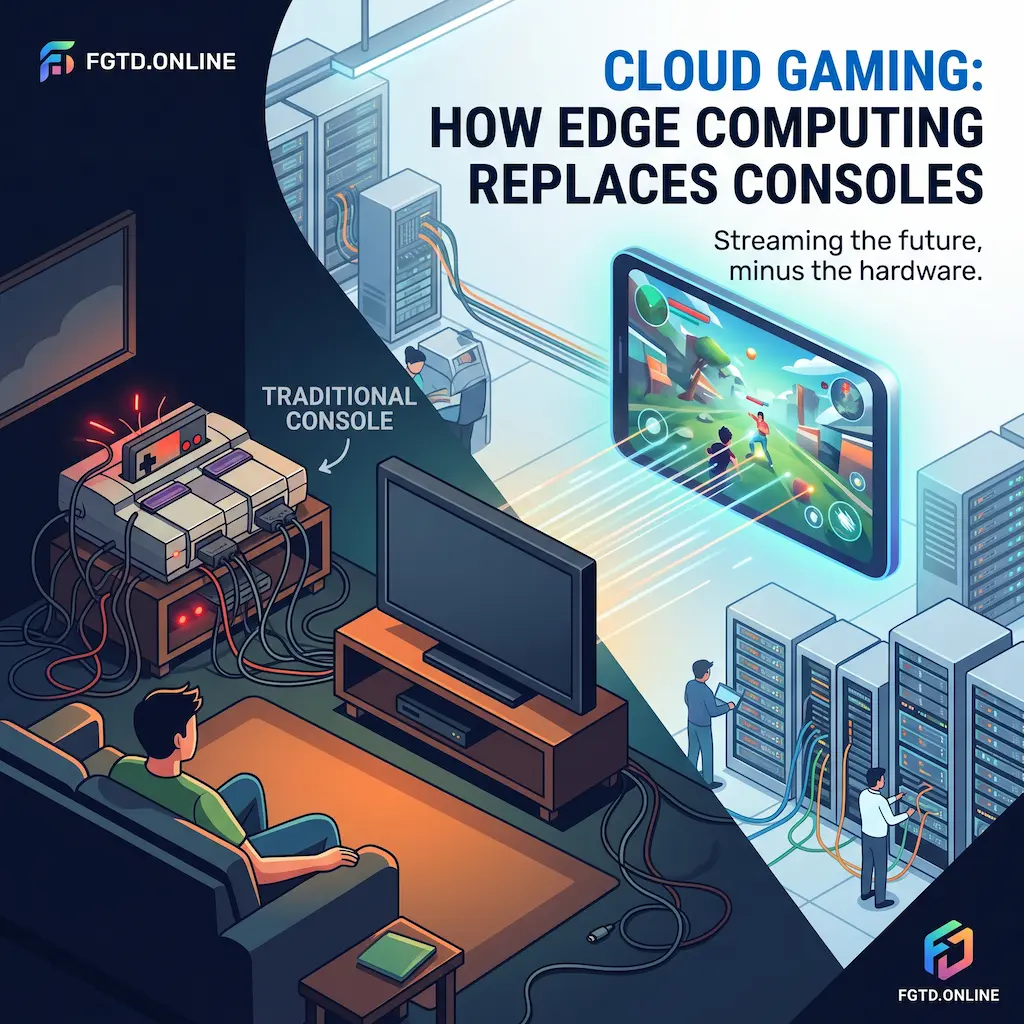
For nearly five decades, the video game industry followed a rigid hardware cycle. Every six to seven years, console manufacturers released specialized, dedicated hardware boxes designed to sit beneath a living room television or inside a desktop computer tower. Whether playing on an early 8-bit home system or a modern multi-teraflop machine, the computational paradigm remained unchanged: games were rendered, processed, and stored locally on proprietary physical chips.
However, the rapid maturation of decentralized network architecture and low-latency network protocols is driving a massive industry transition: Cloud Gaming Powered by Edge Computing.
Historically, early attempts at streaming games from remote data centers failed due to high network latency, packet loss, and video compression artifacts. Moving an interactive game across hundreds of miles of public internet introduced input lag that made fast-paced competitive titles virtually unplayable.
Continues after advertising
By decentralizing server infrastructure and moving game rendering from distant centralized hyperscale facilities to local edge nodes located within miles of the end user, edge computing has eliminated the latency barrier. High-end, photorealistic gaming is transforming from a hardware-dependent luxury into an on-demand, platform-agnostic digital service.
This post analyzes the mechanics of cloud gaming and edge compute networks, breaks down the end-to-end streaming pipeline, compares dedicated local consoles against edge-streamed platforms, and explores how edge computing is dismantling the traditional console generation cycle.
1. The Latency Problem: Why Early Cloud Gaming Stumbled
To understand why edge computing is essential to the success of cloud gaming, one must look at the performance failures of early game streaming services in the late 2000s and 2010s.
Video Streaming vs. Interactive Media
Streaming pre-recorded video on platforms like Netflix or YouTube is an asynchronous, one-way process. When a user presses play, the video player buffers tens of seconds of footage ahead of time. Network jitter or brief packet drops go completely unnoticed by the viewer because the local buffer absorbs the delay.
Interactive gaming cannot be buffered:
- When a player presses the jump button, that physical input must register instantly.
- If the time between pressing a button and seeing the character move on screen exceeds 50 to 80 milliseconds, the human brain perceives a noticeable delay known as input latency.
- In fast-paced competitive esports titles, players demand a total round-trip latency of under 30 milliseconds.
The Centralized Data Center Bottleneck
First-generation cloud gaming platforms hosted game servers inside a handful of centralized, hyperscale data centers. If a player in Atlanta connected to a server facility located in Northern Virginia, the data had to travel hundreds of miles through multiple internet service provider (ISP) peering points, router hops, and public network switches.
This long physical round-trip introduced 60 to 100+ milliseconds of network travel time alone, entirely separate from the time required to render and encode the game frame. As a result, early cloud services developed a reputation for sluggish, unresponsive controls and muddy video compression.
2. Structural Mechanics: The Edge Computing Revolution
Edge computing resolves the round-trip distance problem by shifting computational rendering from centralized cloud facilities to micro-data centers situated at the literal “edge” of the network—often colocated directly within regional telecom central offices and 5G cellular base stations.
The End-to-End Edge Streaming Pipeline
- Input Capture & Transmission: The player presses a trigger on their controller. The input signal is captured by a client device (smart TV, smartphone, tablet, or lightweight laptop) and transmitted over local Wi-Fi or 5G as an encrypted UDP packet.
- Edge Ingestion: The input arrives at a local edge server located less than 50 miles away, often within 2 to 5 milliseconds of network transmission.
- High-Throughput GPU Rendering: Enterprise-grade GPUs at the edge node simulate the game physics and render the frame at 120 or 240 frames per second at 4K resolution.
- Hardware-Accelerated Video Encoding: Specialized hardware encoding chips compress the uncompressed frame into next-generation video formats (such as AV1 or HEVC) in under 2 to 4 milliseconds.
- Stream Delivery & Client Decoding: The compressed video packet travels back to the player’s screen, where lightweight hardware decoders unpackage the visual feed with virtually zero perceptual delay.
By reducing the physical distance between the gamer and the rendering silicon, edge architectures drop network transit times down to single-digit milliseconds, delivering an experience indistinguishable from a local console sitting under the television.
3. Structural Optimization Ledger: Local Dedicated Consoles vs. Edge Cloud Gaming
Evaluating the technical, financial, and operational differences separating traditional physical consoles from edge-streamed gaming platforms illustrates why the industry is moving toward cloud-first distribution.
Upfront Consumer Hardware Cost
- Dedicated Physical Consoles: High barrier to entry. Consumers must invest $500 to $600 upfront every few years for proprietary hardware boxes, plus external storage expansions.
- Edge-Powered Cloud Gaming: Zero dedicated hardware requirement. Runs natively on hardware users already own, including smart TVs, smartphones, budget laptops, and low-cost streaming dongles.
Hardware Obsolescence & Upgrade Cycles
- Dedicated Physical Consoles: Static silicon. Fixed hardware capabilities age over a six-to-seven-year console lifespan, requiring mid-generation hardware refreshes to run demanding graphics engines.
- Edge-Powered Cloud Gaming: Continuous server-side evolution. Infrastructure operators update GPU blades, ray-tracing hardware, and RAM server-side without requiring consumer purchases.
Storage Management & Installation Overhead
- Dedicated Physical Consoles: Heavy friction. Modern games require 100 to 200 GB of storage space, forcing players to manage local drive space and wait hours for multi-gigabyte patches to download.
- Edge-Powered Cloud Gaming: Instant access. Games launch in seconds directly from edge server arrays; updates and patches apply seamlessly on the server side without user intervention.
Energy Consumption & Thermal Footprint
- Dedicated Physical Consoles: Continuous 150 to 250-watt power draw, producing heat, fan noise, and household energy consumption.
- Edge-Powered Cloud Gaming: Ultra-low local power consumption. The client device consumes only 5 to 15 watts of battery or electrical power to decode a video stream.
4. Market Catalysts: 5G, Fiber Expansion, and AV1 Encoding
Three technological developments have converged to make edge cloud gaming commercially viable:
- 5G Ultra-Wideband & Fixed Wireless Access: Modern 5G cellular standards feature native mobile edge computing (MEC) integration, delivering sub-10-millisecond air-interface latencies and multi-hundred-megabit bandwidth directly to mobile handsets.
- Widespread Fiber-to-the-Home (FTTH) Rollouts: The global expansion of residential symmetrical fiber-optic internet provides the stable, unjittered bandwidth necessary to sustain continuous, uncompressed 4K 120 FPS visual streams.
- Advanced AV1 Codec Compression: The open-source AV1 video codec offers significantly higher compression efficiency compared to older H.264 formats, preserving sharp image clarity, shadow detail, and high frame rates at lower bitrates without visual compression banding.
5. The Demise of the Traditional Console War
For decades, the gaming landscape was defined by tribal “console wars” between Sony, Microsoft, and Nintendo. Platform holders locked blockbuster games behind proprietary plastic hardware boxes to drive hardware unit sales.
Cloud gaming dissolves these artificial walls:
- Major publishers are shifting toward subscription ecosystems (such as Xbox Cloud Gaming, GeForce NOW, and PlayStation Plus cloud streaming), treating their platforms as software applications available on any screen.
- Independent and developing gaming markets—such as Southeast Asia, Latin America, and India—are largely skipping the traditional home console generation entirely, transitioning directly from mobile gaming to cloud-streamed blockbuster titles on smartphones.
- Developers are freed from the memory limits and thermal envelopes of home hardware boxes, enabling game worlds featuring massive player counts, advanced physics simulations, and photorealistic ray-tracing computed entirely in the cloud.
Read More👉 The Art of Shoutcasting: How Commentators Built Esports
Conclusion: The Era of Screen-Agnostic Gaming
The transition from dedicated home consoles to edge-powered cloud gaming is not a fleeting technological experiment; it represents the inevitable structural evolution of interactive entertainment. Just as streaming rendered physical vinyl records, DVDs, and dedicated MP3 players obsolete for mainstream audiences, edge networks are turning the physical home game console into a relic of computing history.
By shifting heavy graphical processing to distributed edge nodes and delivering instant, low-latency streams across public fiber and 5G connections, technology providers are democratizing access to high-end interactive entertainment.
The future of gaming will not be defined by the plastic box sitting beneath the television, but by the invisible, powerful edge computing networks delivering experiences to any screen on Earth.