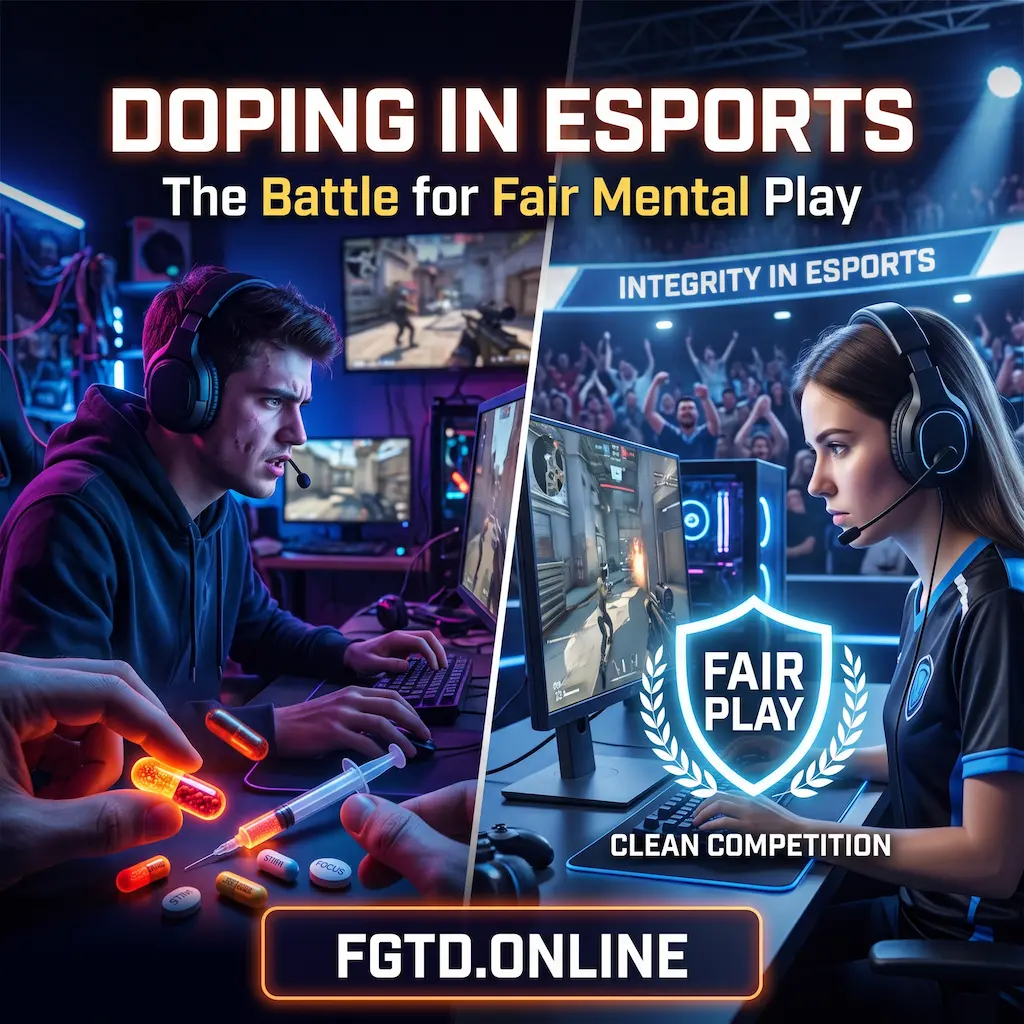
Doping in Esports: The Battle for Fair Mental Play
For decades, the public perception of competitive sports doping was framed entirely around physical power and endurance. When international scandals made front-page news across cycling, track and field, weightlifting, or baseball, the banned substances were almost always anabolic steroids, human growth hormone (HGH), or blood-boosting agents like erythropoietin (EPO). The goal in traditional athletics was simple: build muscle mass faster, delay cardiovascular exhaustion, and accelerate tissue recovery between grueling physical training sessions.
However, as the global sporting landscape expanded into high-stakes competitive gaming, the nature of performance enhancement underwent a radical cognitive evolution: Doping in Esports.
In modern multi-million-dollar esports arenas, competitors are not sprinting across grass pitches or lifting barbells. They sit in ergonomic chairs, their hands resting on precision mechanical keyboards, high-DPI optical mice, and custom gamepads. Yet, the physiological and mental demands placed upon their bodies during competitive play are astonishing:
Continues after advertising
- Hyper-Fast Reflexes: Decision-making windows and micro-flicks measured in 150 to 200 milliseconds.
- Extreme Mechanical Actions: Executing 300 to 500 Actions Per Minute (APM) with surgical keyboard and mouse precision.
- Sustained Neural Endurance: Maintaining hyper-focused mental concentration across five-game series lasting up to six continuous hours.
- Elevated Cardiovascular Strain: Heart rates hovering at 140 to 180 beats per minute during clutch rounds, matching the cardiovascular output of marathon runners.
When a single split-second hesitation or microsecond lapse in focus can mean the difference between hoisting a championship trophy with a multi-million-dollar first-place prize or suffering immediate elimination, the temptation to artificially enhance human cognition becomes immense.
To safeguard competitive integrity and protect player health, tournament organizers, players associations, and global anti-doping authorities are locked in an urgent campaign: the battle for fair mental play.
This post analyzes the pharmaceutical mechanics of cognitive doping in competitive gaming, evaluates the shift from informal open secrets to formal drug testing, examines the ethical and physiological ramifications on young digital athletes, and explores the future of fair play in professional esports.
1. The Cognitive Battlefield: The Rise of Neuro-Enhancing Pharmaceuticals
To understand why doping in esports is so prevalent, one must examine the specific class of substances involved: central nervous system (CNS) stimulants and nootropics.
Unlike traditional athletes seeking muscular hypertrophy, esports players seek chemical agents that enhance focus, eliminate mental fatigue, sharpen vigilance, and accelerate reaction times under pressure.
The Prescription Stimulant Epidemic: Adderall and Ritalin
The primary substances of concern in professional esports are prescription psychostimulants, most notably:
- Adderall (a combination of amphetamine and dextroamphetamine salts)
- Ritalin / Concerta (methylphenidate)
Originally formulated and medically prescribed to treat Attention Deficit Hyperactivity Disorder (ADHD) and narcolepsy, these medications act by dramatically increasing the concentration of dopamine and norepinephrine in the prefrontal cortex—the brain region responsible for executive functioning, impulse control, working memory, and sustained attention.
For an esports competitor competing in a high-speed tactical shooter like Counter-Strike or Valorant, an amphetamine-boosted state offers profound competitive advantages:
- It produces a state of intense, tunnel-vision concentration, allowing players to maintain visual discipline on crosshair angles for hours without drifting.
- It temporarily masks mental and physical fatigue, keeping reaction speeds consistent during marathon best-of-five grand finals.
- It boosts confidence and suppresses the paralyzing physiological effects of performance anxiety on stage.
Beyond Amphetamines: Beta-Blockers and Modafinil
The pharmacological spectrum extends beyond ADHD medications:
- Modafinil: A wakefulness-promoting agent designed for sleep-disorder management that provides sustained alertness without the erratic jitteriness or harsh crashes associated with high-dose caffeine or amphetamines.
- Beta-Blockers (e.g., Propranolol): Widely banned in shooting and archery sports, beta-blockers suppress adrenaline and lower resting heart rates. In precision gaming titles, they eliminate microscopic hand tremors caused by stage nerves, allowing snipers to hold steady reticles under extreme competitive pressure.
2. The Awakening: From Open Secret to Institutional Regulation
For the first fifteen years of professional esports, competitive gaming existed in an unregulated grey zone. Rumors of widespread prescription drug abuse circulated through LAN tournament hotel lobbies, Discord servers, and team houses, but tournament organizers largely turned a blind eye.
The 2015 Kory Friesen Confession
The turning point for the industry occurred in July 2015, during an interview with professional Counter-Strike: Global Offensive player Kory “SEMPHIS” Friesen.
Speaking casually on camera about his team’s performance during an ESL One tournament in Poland, Friesen openly stated:
“We were all on Adderall. I don’t give a f***. It was pretty obvious if you listened to the team comms.”
The interview detonated across mainstream sports and technology media. The open secret of the competitive gaming circuit had been laid bare on video, forcing global esports organizers to confront the reality that their championship events were being contested under the influence of unprescribed controlled substances.
The Establishment of ESIC and WADA Alignment
Within weeks of the confession, major tournament organizer ESL announced an immediate partnership with the National Anti-Doping Agency of Germany (NADA) and began drafting formal drug policies.
In 2016, the Esports Integrity Commission (ESIC) was founded to establish a standardized, transparent integrity framework across competitive gaming. ESIC partnered directly with the World Anti-Doping Agency (WADA) framework, adopting its Prohibited List and introducing:
- Mandatory pre-tournament player declarations for legitimate prescription medications (Therapeutic Use Exemptions, or TUEs).
- Randomized on-site salivary and oral-fluid drug screenings at premier LAN championships.
- Severe disciplinary penalties, including multi-year competitive bans, loss of tournament prize money, and public forfeiture of titles for positive tests.
3. Structural Optimization Ledger: Traditional Sports Doping vs. Esports Doping
Evaluating the operational, biochemical, and cultural differences separating traditional athletic doping from mental esports doping illustrates why policing virtual competition requires a distinct regulatory approach.
Primary Physiological Target
- Traditional Athletic Doping: Musculoskeletal system, cardiovascular oxygen capacity, and muscular recovery pathways.
- Esports Mental Doping: Neurochemical neurotransmitters (dopamine, norepinephrine, and acetylcholine) in the prefrontal cortex.
Primary Substances of Abuse
- Traditional Athletic Doping: Anabolic-androgenic steroids, synthetic testosterone, growth hormones, and EPO blood-doping transfusions.
- Esports Mental Doping: Prescription psychostimulants (Adderall, Ritalin), wakefulness agents (Modafinil), and cardiac beta-blockers.
Testing Window & Detection Challenge
- Traditional Athletic Doping: Continuous year-round out-of-competition testing; biological passports track systemic hormonal markers over months.
- Esports Mental Doping: Primarily in-competition testing; short biological half-lives of stimulants make detection difficult without immediate matchday testing.
Legitimate Medical Overlap (TUE Friction)
- Traditional Athletic Doping: Rare in young athletes; therapeutic exemptions for steroids or EPO face rigorous medical scrutiny.
- Esports Mental Doping: High rate of legitimate ADHD diagnoses among computer-native youth demographics, complicating the verification of genuine medical need versus performance enhancement.
4. The Human Cost: Health Risks Behind the Chemical Edge
The normalization of cognitive doping poses severe psychological and physical hazards to an exceptionally young demographic of competitors, many of whom begin their competitive careers in their mid-teens:
- Cardiovascular Strain: Chronic stimulant use elevates resting heart rates and constricts blood vessels. When paired with high-stress tournament environments, excessive energy drink consumption, and poor sleep hygiene, players face heightened risks of arrhythmias and acute cardiovascular episodes.
- Psychological Dependency and Burnout: Reliance on chemical stimulants to perform creates severe mental fragility. Players develop debilitating “imposter syndrome,” believing they cannot win without chemical assistance. Long-term use leads to chronic insomnia, clinical anxiety, severe depression, and early career retirement before the age of twenty-five.
- The Black Market and Counterfeit Hazards: Young amateur players striving to break into tier-one professional circuits often turn to unregulated online black markets and illicit websites to purchase unverified smart drugs, exposing themselves to contaminated pharmaceuticals and legal jeopardy.
5. Beyond the Pill: The Rise of Cognitive Tech and Neuro-Athletics
As drug enforcement tightens across professional esports, the industry is pioneering healthy, non-pharmaceutical methods to unlock mental performance:
- Professional Performance Coaching: Top-tier esports organizations (such as Team Liquid, Cloud9, and Fnatic) now employ full-time physical trainers, sports psychologists, and nutritionists. Teams enforce structured physical gym workouts, healthy diets, and strict sleep schedules—proven natural drivers of cognitive sharpness.
- Cognitive Neuro-Feedback and Vision Training: Athletes utilize specialized perceptual training software and stroboscopic eyewear to train visual tracking speeds and spatial peripheral reaction times naturally, building neural pathways through structured practice rather than pharmaceutical stimulants.
- Ethical Ergonomics and Breathwork: Incorporating mindfulness, regulated breathing exercises, and heart-rate variability (HRV) biofeedback allows competitors to control stage anxiety and prevent adrenaline spikes naturally during high-pressure clutch situations.
Read More👉 Sim Racing: From Virtual Cockpits to Real Racetracks
Conclusion: Securing the Soul of Digital Competition
The battle against doping in esports represents a defining crossroad for modern competitive gaming. The legacy era of viewing video games as consequence-free virtual pastimes has been permanently superseded by a professionalized athletic reality where competitive integrity, fair play, and athlete welfare must be defended with rigorous discipline.
True esports greatness is not defined by who has access to the strongest pharmaceutical prescription. It is forged through thousands of hours of dedicated team scrims, tactical ingenuity, disciplined physical conditioning, and resilient mental fortitude under stadium spotlights.
By enforcing robust anti-doping protocols, transparent therapeutic standards, and comprehensive player health education, the global esports community is preserving the fundamental spirit of fair play—ensuring that digital competition remains an authentic, inspiring celebration of unenhanced human skill and intellect worldwide.