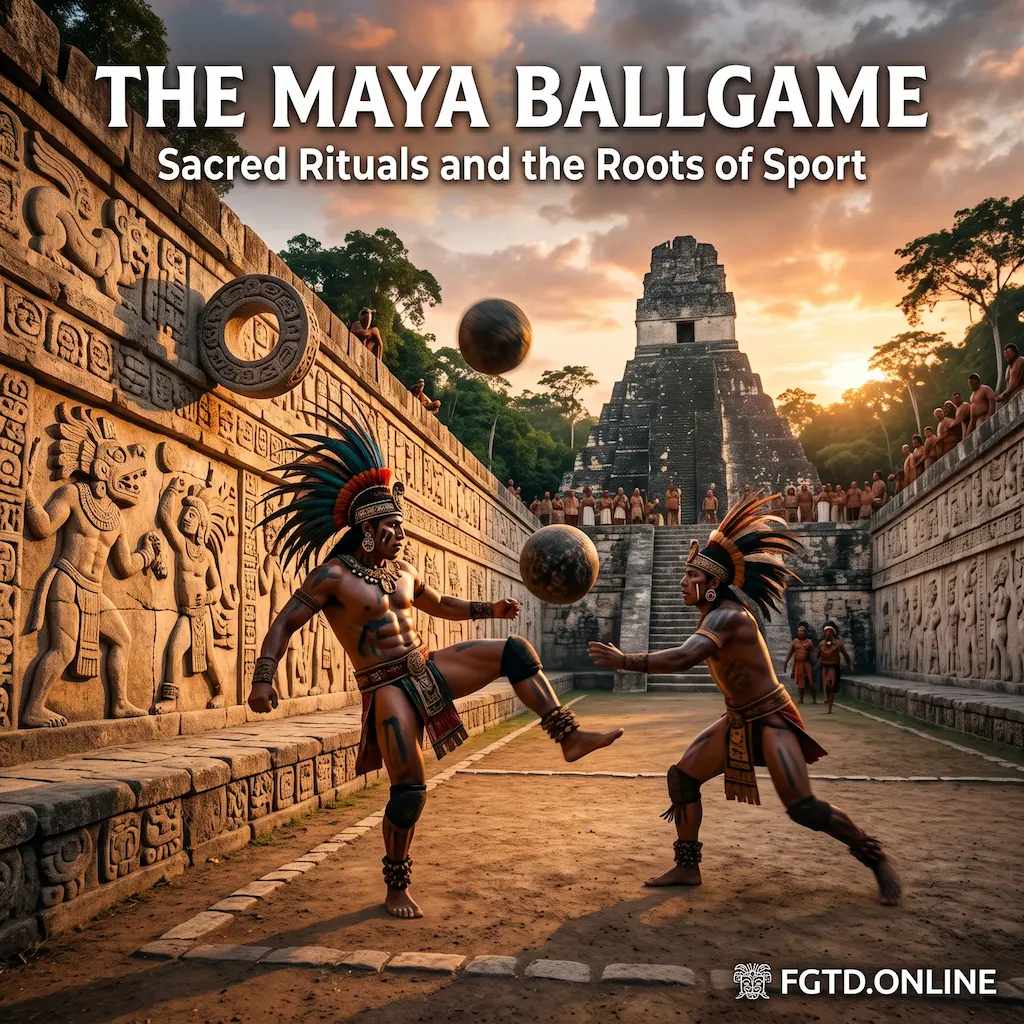
The Maya Ballgame: Sacred Rituals and the Roots of Sport
In modern society, sport is predominantly experienced through the lens of secular entertainment, commercial athletic spectacles, and multi-billion-dollar media rights. Athletes step onto manicured stadiums and courts to compete for championships, lucrative player contracts, and international prestige, while millions of fans watch from home or fill grandstands for leisurely recreation.
Yet, millennia before modern team sports codified their rulebooks in industrial Europe and North America, athletic competition served a profoundly distinct, metaphysical purpose across ancient Mesoamerica: The Maya Ballgame (known anciently as pitz in Classic Maya, or ōllamaliztli among the later Nahuatl-speaking Mexica/Aztecs).
Spanning over three thousand years across present-day Mexico, Guatemala, Belize, and Honduras, the Maya ballgame was not merely a physical contest of athleticism. It was an earth-shattering religious ritual, a cosmic reenactment of solar cycles, an arena for political diplomacy and conflict resolution, and the ancestral cradle of team sports played with a bouncing rubber ball.
Continues after advertising
On stone courts built at the sacred hearts of grand ceremonial cities like Tikal, Copán, Palenque, and Chichén Itzá, athletes manipulated a heavy solid rubber sphere under strict rules of engagement—competing at the precarious intersection of life, death, divine destiny, and planetary balance.
This post analyzes the historical dynamics of the Maya ballgame, examines its profound cosmological and mythological foundations, evaluates the physical mechanics and athletic gear of the ritual sport, and explores its enduring legacy on the evolution of global athletic culture.
1. The Mythological Underpinning: The Popol Vuh and the Cosmic Battle
To comprehend why the Maya dedicated monumental architecture, precious resources, and human devotion to a ballgame, one must examine the foundational Maya creation narrative preserved in the sacred K’iche’ Maya text: the Popol Vuh.
In Maya mythology, the ballgame was not invented by mortal humans; it was an ancient cosmic ceremony inherited directly from the gods:
- The Descent of the Hero Twins: The divine narrative recounts the legendary brothers Hun-Hunahpú and Vucub-Hunahpú playing the ballgame loudly on Earth. The heavy pounding of their rubber ball disturbed the dark lords of Xibalba—the watery, subterranean Maya underworld.
- The Trials of Xibalba: Summoned to the underworld, the elder twins were deceived, defeated, and decapitated by the death deities, with Hun-Hunahpú’s head placed in a calabash tree. His saliva miraculously impregnated the underworld princess Xquic, who escaped to the surface and gave birth to the second-generation Hero Twins: Hunahpú and Xbalanqué.
- Cosmic Rebirth and Celestial Ascent: Gifted with supernatural cunning and supreme athletic prowess, the young Hero Twins descended back into Xibalba to avenge their father. In a series of high-stakes ballgame matches against the underworld lords, the twins outwitted the death gods, decapitated their demonic foes, and resurrected their father as the Maize God. The twins then ascended into the sky to become the Sun and the Moon.
For every Maya civilization that followed, stepping onto the stone ballcourt was a direct, living reenactment of this cosmic struggle. The moving ball represented the celestial transit of the sun, moon, and stars across the underworld, and the physical contest represented the perpetual balance between light and darkness, agricultural fertility and drought, life and mortality.
2. Structural Architecture: The Anatomy of the Mesoamerican Ballcourt
Unlike modern sports fields that occupy open turf or wooden courts, the Maya ballcourt (pok-ta-pok or pitz) was a monumental architectural centerpiece integrated directly into the city’s ceremonial acropolis:
- The Distinct “I-Shaped” Geometry: Traditional Maya courts featured a long, narrow central playing alley flanked on both sides by sloping or vertical stone masonry ramps, terminating in perpendicular transverse end-zones that formed a distinctive capital letter “I” or double-T layout.
- Sloping Walls and Rebound Dynamics: The flanking walls were often angled at 30 to 45 degrees, covered in smooth, burnished stucco. Players used these sloping banks to ricochet the ball back into play, demanding lightning-fast reflexes and geometric predictive awareness.
- The Introduction of the Stone Ring: In the Terminal Classic and Postclassic periods—most spectacularly seen at the Great Ball Court of Chichén Itzá, the largest surviving court in Mesoamerica measuring 168 meters (551 feet) in length—carved vertical stone rings (tlachtemalacatl) were mounted high on the vertical walls, up to six meters above the court floor. Propelling a dense, bouncing ball through this narrow stone aperture was an extraordinary athletic feat that often signaled immediate victory.
3. Physical Mechanics and Athletic Equipment: Mastering the Heavy Rubber
The technological foundation of the Maya ballgame rested on a remarkable Mesoamerican material innovation: vulcanized natural rubber.
Centuries before Charles Goodyear patented chemical vulcanization in the 1840s, indigenous Mesoamericans were harvesting natural latex sap from the Castilla elastica rubber tree and mixing it with the acidic juice of the morning glory vine (Ipomoea alba). This biochemical process cross-linked the polymer chains, transforming brittle, sticky liquid sap into durable, resilient, and remarkably elastic solid rubber.
The physical reality of handling this ball demanded specialized protective gear:
- The Weight of the Ball: Unlike modern inflated, hollow basketballs or soccer balls, the Maya ball was solid, heavy rubber, typically weighing between 3 and 4 kilograms (6 to 9 pounds), roughly the size of a modern human skull or bowling ball.
- Strict Bodily Constraints: While regional variations existed across different epochs, the primary rules of the Classic game strictly prohibited players from using their hands or feet to strike the ball. Instead, athletes were required to propel the heavy sphere using only their hips, buttocks, pelvis, and elbows.
- Protective Leather Armor (Yugos and Hachas): Striking a four-kilogram solid rubber ball at high speed against the human pelvis without protection would fracture bone and cause internal organ hemorrhaging. Maya ballplayers wore thick protective belts carved from heavy hide or padded wood, known to archaeologists as yokes (yugos), alongside knee pads, leather shin wraps, and chest palmas to absorb the blunt-force impact.
4. The Ritual Dimension: Warfare, Diplomacy, and the Question of Sacrifice
The modern narrative often sensationalizes the Maya ballgame as a bloodthirsty gladiatorial death match where the losing team was routinely slaughtered. The historical and archaeological record presents a far more nuanced, multi-layered social reality:
- Secular Sport and Daily Recreation: Across hundreds of excavated Mesoamerican courts, the vast majority of matches were non-lethal community competitions, inter-city athletic exhibitions, and opportunities for civic celebration, wagering, and athletic prestige.
- Political Dispute Resolution: The ballcourt functioned as a formal diplomatic alternative to full-scale territorial warfare. Competing Maya city-states—such as rival dynasties between Tikal and Calakmul—frequently utilized high-stakes ballgame matches between royal representatives to settle border disputes, tributary taxation agreements, and regional trade routes without destroying urban centers.
- Sacred Royal Ceremonial Sacrifice: In specific, high-consequence state rituals following military conquests, captured enemy rulers and noble warriors were forced onto the court to play ritual matches against the reigning dynastic kings. In these solemn cosmological reenactments, sacrifice (typically decapitation) was indeed practiced, mirroring the mythic beheading of the underworld lords in the Popol Vuh. To the Maya, this sacrifice was not punitive cruelty, but a sacred offering of vital life-force to nourish the Maize God and guarantee seasonal rains and agricultural abundance for the entire empire.
5. The Living Legacy: From Ancient Rites to Modern Global Athletics
The Maya ballgame is not a dead, forgotten artifact of antiquity; it is the direct ancestor of modern ball sports.
When Spanish conquistadors first observed indigenous Mesoamerican ball games in the early 1500s, European observers were astounded. At the time, Europeans played games using hard, stuffed leather bags or wooden spheres that possessed zero natural rebound elasticity.
The introduction of Mesoamerican vulcanized rubber back to Europe revolutionized global athletic culture, directly birthing the bouncing balls that define soccer, basketball, tennis, baseball, and volleyball today.
Furthermore, the game never truly died in Mesoamerica. In indigenous communities across northwestern Mexico (particularly in Sinaloa), a modern descendant of the ancient game, known as Ulama, is still actively played today. Athletes don traditional leather hip guards, maintain strict ancestral court boundaries, and strike solid rubber balls with their hips—preserving a three-thousand-year-old unbroken chain of athletic heritage.
Read More👉 Olympic Stadiums: From Global Glory to Ghost Towns
Conclusion: The Sacred Origin of Athletic Competition
The Maya Ballgame stands as one of the most magnificent cultural and athletic achievements in human history. It demonstrated that sports can be far more than trivial diversions or commercial commodities; in its purest origin, athletic competition was a sacred bridge between the earthly and the divine, a dramatic physical testament to cosmic survival, and an enduring celebration of human vitality.
By transforming a tree’s natural sap into a high-bouncing sphere and turning stone plazas into cosmic battlegrounds, ancient Maya ballplayers laid the foundational roots of modern team sports.
Centuries after the great stone courts were reclaimed by tropical jungle canopies, the echoing bounce of the rubber ball continues to reverberate across the sporting world—permanently honoring the Maya Ballgame as the sacred origin of athletic competition worldwide.