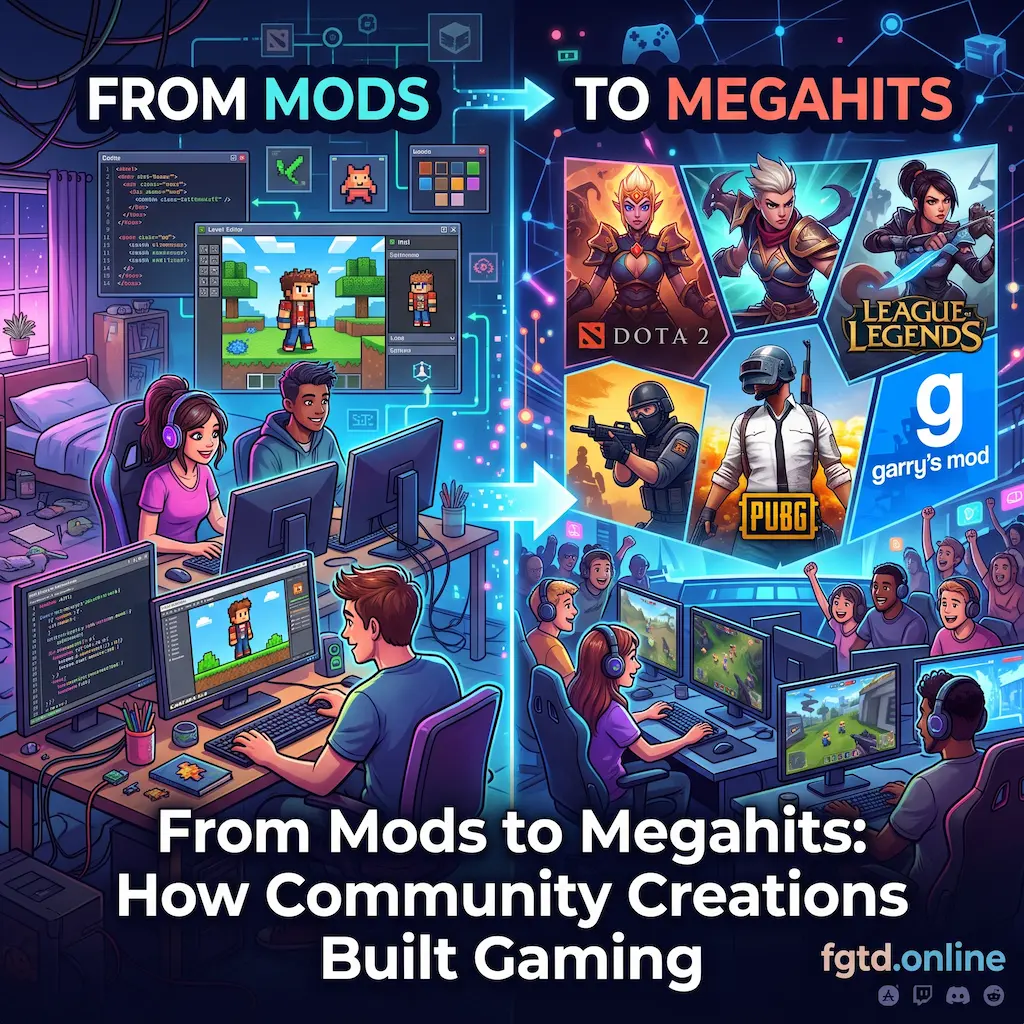
From Mods to Megahits: How Community Creations Built Gaming
For decades, the mainstream commercial narrative of the video game industry mirrored Hollywood filmmaking: major studios deployed multi-million-dollar budgets, commanded armies of specialized software engineers, and produced packaged, polished interactive experiences for consumers to play passively. In this traditional top-down model, the creative direction flowed in a single direction—from the executive boardrooms and lead game designers down to the purchasing audience.
However, beneath this polished corporate veneer, the most disruptive and lucrative revolutions in gaming history did not originate inside corporate think tanks or focus groups. They emerged from bedrooms, university dorms, and open-source internet forums: The World of Video Game Modding.
Modding—the act of altering, remixing, or completely rebuilding the code, art assets, and gameplay systems of existing commercial video games—has evolved from an obscure technical hobby into the primary incubator of modern gaming culture. Today, the world’s most dominant gaming genres, biggest esports spectacles, and multi-billion-dollar live-service ecosystems trace their genesis directly back to free community modifications.
Continues after advertising
From tactical shooters to tactical battle arenas, community creators have consistently demonstrated that when game developers release modular software toolkits, the players themselves will inevitably invent the future of interactive entertainment.
This post analyzes the historical mechanics of community modding, traces how hobbyist projects transformed into industry-defining megahits, compares traditional studio development against player-driven innovation, and examines the cultural legacy of user-generated gaming.
1. The Open Silicon Foundation: The Genesis of Modern Mod Culture
To understand how community creations came to dominate modern entertainment, one must examine the early PC computing philosophy that empowered players to tamper with commercial software.
The id Software Revolution: DOOM and WADs
In 1993, when id Software released DOOM, programmer John Carmack made a radical architectural decision. Rather than locking down the game’s core assets into an impenetrable executable file, Carmack deliberately decoupled the underlying game engine from the graphical and level data:
- The Engine vs. The Data: The engine ran the rendering and physics math, while all levels, textures, sound effects, and monster sprites were stored in external data packages known as WADs (“Where’s All the Data?”).
- Empowering the Community: By releasing documentation and level editors, id Software enabled enthusiastic players to build custom levels, change sound bites, and design entirely new weapons.
Instead of treating player tampering as software piracy or copyright infringement, id Software recognized that community creation drastically extended the commercial lifespan of their product. Players were no longer just consumers; they were active co-creators.
The Half-Life Engine and the Valve Philosophy
In 1998, Valve Corporation took this philosophy a step further with the release of Half-Life. Built on a heavily modified version of the Quake engine (GoldSrc), Valve packaged its proprietary world editor, Worldcraft (later the Valve Hammer Editor), directly with the game.
Valve founder Gabe Newell understood an essential truth about software development: an open community of thousands of passionate amateur modders would collectively explore game mechanics, design permutations, and experimental ideas far faster than any internal development studio ever could.
That realization ignited the golden age of community-driven innovation.
2. The Legendary Transformations: How Mods Redefined Global Gaming
The history of competitive gaming is essentially the history of community modifications achieving critical mass and becoming standalone cultural phenomena.
Counter-Strike: The Mod That Built Competitive Esports
In 1999, two university students, Minh Le (“Gooseman”) and Jess Cliffe, were dissatisfied with the prevailing “arena shooter” mechanics of games like Quake and Unreal Tournament, which prioritized lightning-fast movement, rocket jumping, and futuristic plasma guns.
Using Valve’s free Half-Life Software Development Kit (SDK), they set out to create a realistic, tactical military shooter:
- They introduced round-based economic systems where players earned cash for objectives to buy real-world weaponry.
- They focused on team-based bomb defusal and hostage rescue mechanics with permadeath per round.
The mod, titled Counter-Strike, spread rapidly across global LAN cafes. Within months, more people were playing this free community mod than Half-Life itself.
Valve quickly recognized the project’s genius, acquiring the intellectual property and hiring Le and Cliffe. Today, Counter-Strike stands as the cornerstone of global competitive first-person esports, sustaining millions of concurrent players and filling international sports arenas.
Defense of the Ancients (DotA): Creating the MOBA Genre
In 2002, Blizzard Entertainment shipped the “World Editor” with Warcraft III: Reign of Chaos. Intended merely for creating custom strategy maps, the tool gave community modders access to custom scripting, triggers, and character models.
A modder named Kyle Sommer (“Eul”) designed a custom scenario called Defense of the Ancients (DotA), inspired by an earlier StarCraft map known as Aeon of Strife.
Instead of managing armies, resource bases, and gold mines like a traditional real-time strategy (RTS) game, players controlled a single powerful “Hero” character, cooperating with four teammates to push automated creep waves and destroy the opposing team’s ancient structure.
The project was subsequently refined by successive modders, most notably “Guinsoo” and the enigmatic “IceFrog”:
- League of Legends: Guinsoo joined forces with startup developer Riot Games to build a standalone, accessible iteration of the mod, launching League of Legends in 2009—which grew into the most-watched esports title on the planet.
- Dota 2: IceFrog partnered with Valve to construct Dota 2, a direct, faithful fidelity upgrade of the original mod that established multi-million-dollar championship prize pools like The International.
A single community map editor inside Warcraft III accidentally created the entire Multiplayer Online Battle Arena (MOBA) industry, generating tens of billions of dollars in enterprise value.
PlayerUnknown’s Battlegrounds (PUBG): The Battle Royale Genesis
Before Fortnite became an omnipresent pop-culture phenomenon, the Battle Royale genre did not exist inside corporate studio roadmaps. It was forged inside military simulation mods.
Brendan Greene (“PlayerUnknown”), an Irish photographer and graphic designer, spent his free time modding ARMA 2 and DayZ:
- Inspired by the Japanese dystopian film Battle Royale and The Hunger Games, Greene stripped away traditional respawns and symmetrical team deathmatches.
- He placed 100 unarmed players on a massive, deserted island, forced them to scavenge for weapons in abandoned buildings, and added a contracting electrical circle that forced survivors into lethal confrontations until only one player stood victorious.
Greene’s concepts were licensed into H1Z1 before he directed PlayerUnknown’s Battlegrounds (PUBG) in 2017. PUBG broke all-time Steam concurrent player records and established the Battle Royale blueprint that epic gaming franchises like Fortnite and Call of Duty: Warzone replicate today.
3. Structural Optimization Ledger: Corporate Game Design vs. Community Modding
Evaluating the organizational, creative, and financial differences between corporate studio pipelines and community-led modding illustrates why grassroots players consistently out-innovate corporate development teams.
Creative Risk & Development Freedom
- Corporate Studio Development: Risk-averse. Constrained by executive oversight, quarterly earnings calls, marketing mandates, and focus testing that discourages experimental mechanics.
- Community Modding Ecosystem: Fearless experimentation. Hobbyist developers build purely for fun and peer respect, creating bizarre, unproven, and radically novel gameplay loops without fear of financial failure.
Player Feedback Loops & Iteration Speed
- Corporate Studio Development: Slow and rigid. Changes require corporate approval chains, sprint planning, quality assurance testing, and formal patch releases.
- Community Modding Ecosystem: Rapid and organic. Modders interact directly with fellow players in Discord servers and forums, releasing daily tweaks and evolving game balance in real time.
Commercial Motivation vs. Passion Alignment
- Corporate Studio Development: Driven by monetization strategies, season passes, retention metrics, and microtransaction conversion rates.
- Community Modding Ecosystem: Driven by organic player passion, competitive balance, and an uncompromising desire to fix gameplay frustrations.
4. The Modern Frontier: User-Generated Platforms as the New Normal
The boundary between commercial video games and modding software has dissolved into a unified paradigm: User-Generated Content (UGC) Platforms.
Leading entertainment platforms like Roblox, Minecraft, Fortnite Creative, and Grand Theft Auto Roleplay (GTA RP) are no longer static games; they are decentralized creative toolsets:
- Roblox: Millions of young developers program custom games using the Lua scripting language, earning hundreds of millions of dollars collectively through integrated digital micro-economies.
- GTA RP (FiveM): Community-run multiplayer roleplay servers breathed a decade of fresh commercial life into Grand Theft Auto V, driving hundreds of millions of stream hours on Twitch and prompting Rockstar Games to acquire the mod development team (Cfx.re) outright.
The industry has acknowledged that players are not merely an audience to be marketed to; they are an inexhaustible, highly creative developer workforce capable of building the next global phenomenon.
Read More👉 The Weapon Skin Economy: Why Pixels Are Worth Millions
Conclusion: The Player as the Ultimate Architect
From the claustrophobic corridors of DOOM to the multi-billion-dollar arenas of modern esports, community modifications have served as the true lifeblood of interactive entertainment. When gaming companies locked their doors and treated player creativity as a threat, they stagnated. When they provided open tools, modular code, and creative freedom, their communities built empires.
Every major competitive genre dominating the gaming landscape today—tactical team shooters, MOBAs, auto-battlers, survival sandboxes, and battle royales—was conceived not by a corporate executive, but by passionate players asking a simple question: “What if the game worked like this?”
As user-generated content engines expand and development tools democratize globally, the next revolutionary video game will not emerge from a corporate presentation deck. It is being compiled right now, quietly and passionately, by an amateur creator on an open-source modding forum.