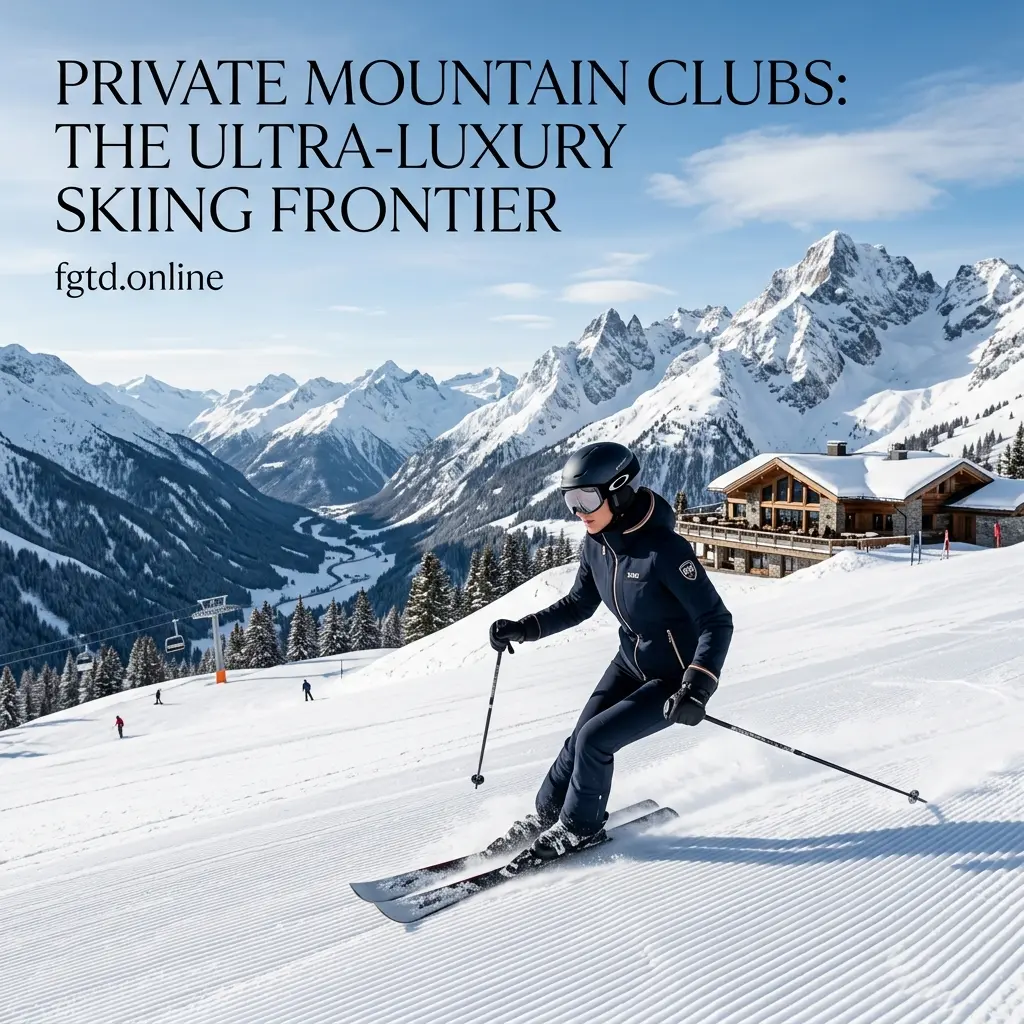
Private Mountain Clubs: The Ultra-Luxury Skiing Frontier
For generations, premier alpine recreation followed a well-established luxury rhythm. High-net-worth winter sports enthusiasts acquired slopeside chalets or penthouses in iconic public resort enclaves such as Vail, Aspen, St. Moritz, Courchevel, and Zermatt. These storied destinations offered world-class lift infrastructure, Michelin-starred gastronomy, and vibrant post-ski culture.
Yet, over the past decade, the macro-landscape of destination skiing has shifted dramatically.
The widespread consolidation of public ski resorts under corporate multi-resort season passes has driven unprecedented foot traffic onto once-exclusive mountain peaks. Today, peak-season mornings at premier public ski resorts frequently involve congested mountain access roads, 45-minute lift lines at mid-mountain terminals, tracked-out powder within minutes of the morning rope drop, and overcrowded alpine lodges.
Continues after advertising
For ultra-high-net-worth individuals, institutional executives, and private family offices, time, privacy, and personal safety are non-negotiable assets. As public ski resorts grow denser, elite winter travelers are redefining alpine leisure by withdrawing into an ultra-exclusive lifestyle enclave: Private Mountain Clubs.
Private ski and mountain clubs represent a completely secluded frontier in alpine lifestyle real estate. By strictly capping member capacity, privatizing thousands of vertical skiable acres, and integrating five-star residential hospitality behind guarded security perimeters, these private sanctuaries eliminate the frictions of public mountain tourism.
This post examines the architectural and economic mechanics of private mountain clubs, explores the dynamics of membership exclusivity, contrasts public mega-resorts with private ski enclaves, and analyzes how these sanctuaries preserve generational real estate value.
1. The Anatomy of an Exclusive Mountain Enclave
To understand the appeal of private mountain clubs, one must examine their foundational structural blueprint, pioneered by iconic destinations such as the Yellowstone Club in Big Sky, Montana, and emerging private developments across the Rocky Mountains and the European Alps:
1. Controlled Mountain Capacity and Private Terrain
The central value proposition of a private ski club is mountain solitude:
- At a public resort, a powder day often means sharing 3,000 acres with 10,000 to 15,000 skiers.
- In contrast, a private mountain club might pair 2,500 skiable acres, private high-speed chairlifts, and untracked backcountry bowls with a strict limit of a few hundred member families.
- Skiers routinely spend an entire morning cruising groomed corduroy runs or untracked alpine glades without passing another person on the slope.
- Lift lines are virtually non-existent; chairlifts operate on continuous circuits waiting for members, not the other way around.
2. High Barriers to Entry: Capital and Social Vetting
Acquiring access to a private ski mountain requires far more than writing a check for an annual pass. The governance architecture is designed to maintain absolute privacy and cultural harmony:
- Real Estate Ownership Prerequisite: In premier clubs like the Yellowstone Club or Wasatch Peaks Ranch, membership is fundamentally tied to real estate acquisition within the gated property boundary. An aspiring member must purchase a homesite or custom alpine lodge, with property valuations routinely starting in the eight-figure range ($10 million to over $30 million+).
- Significant Initiation Fees: Beyond the underlying property investment, members pay upfront, non-refundable initiation fees that scale from $250,000 to well over $500,000, accompanied by hefty annual operating dues.
- Strict Social Vetting and Sponsorship: Capital alone does not guarantee admission. Prospective candidates must undergo comprehensive background audits, submit personal sponsorship letters from existing members, and pass unanimous approval votes by an admissions committee to ensure alignment with club community standards.
2. Structural Comparison: Public Mega-Resorts vs. Private Mountain Clubs
Evaluating the operational, lifestyle, and security distinctions between corporate-owned public resorts and private mountain clubs illustrates why ultra-wealthy families are permanently relocating their winter seasons:
On-Mountain Skier Density and Wait Times
- Public Mega-Resorts: High congestion; thousands of season pass holders generate significant lift bottlenecks, crowded choke points, and rapidly deteriorating snow quality.
- Private Mountain Clubs: Virtually zero density; terrain is reserved exclusively for a strictly limited membership base, preserving pristine, untracked powder for days after a storm.
Access Control and Privacy Perimeter
- Public Mega-Resorts: Unrestricted public spaces; open streets, shared base lodges, and public base villages offer minimal personal privacy or security buffers for high-profile figures.
- Private Mountain Clubs: Fully private and gated; multi-tier perimeter security teams, access-controlled gates, and discreet transit hubs insulate members and their families from public visibility.
Aviation and Transit Logistics
- Public Mega-Resorts: Standard commercial or regional flight hubs; travelers face congested highway corridors and long mountain road transfers during severe winter storms.
- Private Mountain Clubs: Private aviation integration; proximity to dedicated Fixed Base Operators (FBOs) capable of handling heavy private jets, paired with dedicated club transport or on-site helipads.
Amenity Infrastructure and Concierge Depth
- Public Mega-Resorts: Commercial restaurants, crowded shared day lodges, and generalized third-party ski schools with limited personalized continuity.
- Private Mountain Clubs: Comprehensive private clubhouses, customized family wellness centers, personalized boot and ski lockers, and dedicated private instructors for member children.
3. Beyond the Slopes: Year-Round Multi-Generational Living
While premier skiing serves as the winter anchor, private mountain clubs are not merely seasonal retreats; they are master-planned as year-round legacy family compounds.
Modern private clubs design four-season operational programs to maximize family engagement throughout every quarter of the calendar:
- Championship Summer Golf: Signature 18-hole mountain courses designed by renowned golf architects (such as Tom Fazio or Jack Nicklaus) provide uncrowded tee times across crisp alpine terrain.
- Private Water and Equestrian Sports: Dedicated blue-ribbon fly-fishing reserves, guided backcountry equestrian trails, and private mountain lake clubs featuring watercraft fleets and paddleboard docks.
- High-Altitude Wellness and Longevity: Expansive clubhouse facilities featuring hyperbaric chambers, infrared saunas, cryotherapy pods, and customized recovery suites staffed by performance physical therapists and elite personal trainers.
- Comprehensive Family Programming: Outdoor adventure camps, supervised teen climbing excursions, and youth naturalist programs designed to keep multiple generations engaged together within a protected mountain environment.
4. Real Estate Dynamics: Capital Preservation in Scarcity Assets
Investing in a private mountain club home represents an alternative asset allocation characterized by intense supply constraints and strong capital preservation dynamics:
Structural Supply Caps
Unlike suburban residential developments that can expand outward, private mountain clubs are geographically and legally finite:
- Securing contiguous thousands of acres of private, high-elevation alpine land with permitted water rights for snowmaking and lift installation is an exceedingly rare development achievement.
- Once the master plan’s homesites are surveyed and deeded, no additional plots can be created.
- This structural scarcity creates a natural pricing floor: as global wealth expands among ultra-high-net-worth families, the limited supply of private ski-in/ski-out lots drives enduring asset appreciation.
Shielded from Broad Economic Volatility
Because members must be fully capitalized to acquire property and fund annual club reserves, home transactions inside private mountain clubs rarely experience forced liquidations during broader market contractions:
- The buyer pool operates largely without traditional retail mortgage financing, insulating club real estate values from interest rate shocks and lending freezes.
- Properties frequently trade via off-market, member-to-member private transfers, preserving pricing discretion and price stability across the enclave.
Read More👉 Sports Longevity Clinics: The Rise of Elite Biohacking
Conclusion: The Ultimate Alpine Sanctuary
The emergence of the private mountain club represents a profound evolution in modern luxury living. What began as a reaction against the commercialization and overcrowding of public ski resorts has matured into an independent, thriving real estate and lifestyle category.
By combining uncrowded private slopes, multi-generational outdoor amenities, discreet residential security, and structural asset scarcity, these enclaves deliver the ultimate luxury: complete peace of mind, unhurried time with family, and pristine alpine wilderness.
As public ski destinations continue to prioritize volume and mass access, the demand for privacy, safety, and exclusivity will only accelerate—permanently establishing Private Mountain Clubs: The Ultra-Luxury Skiing Frontier as the gold standard of alpine property ownership.