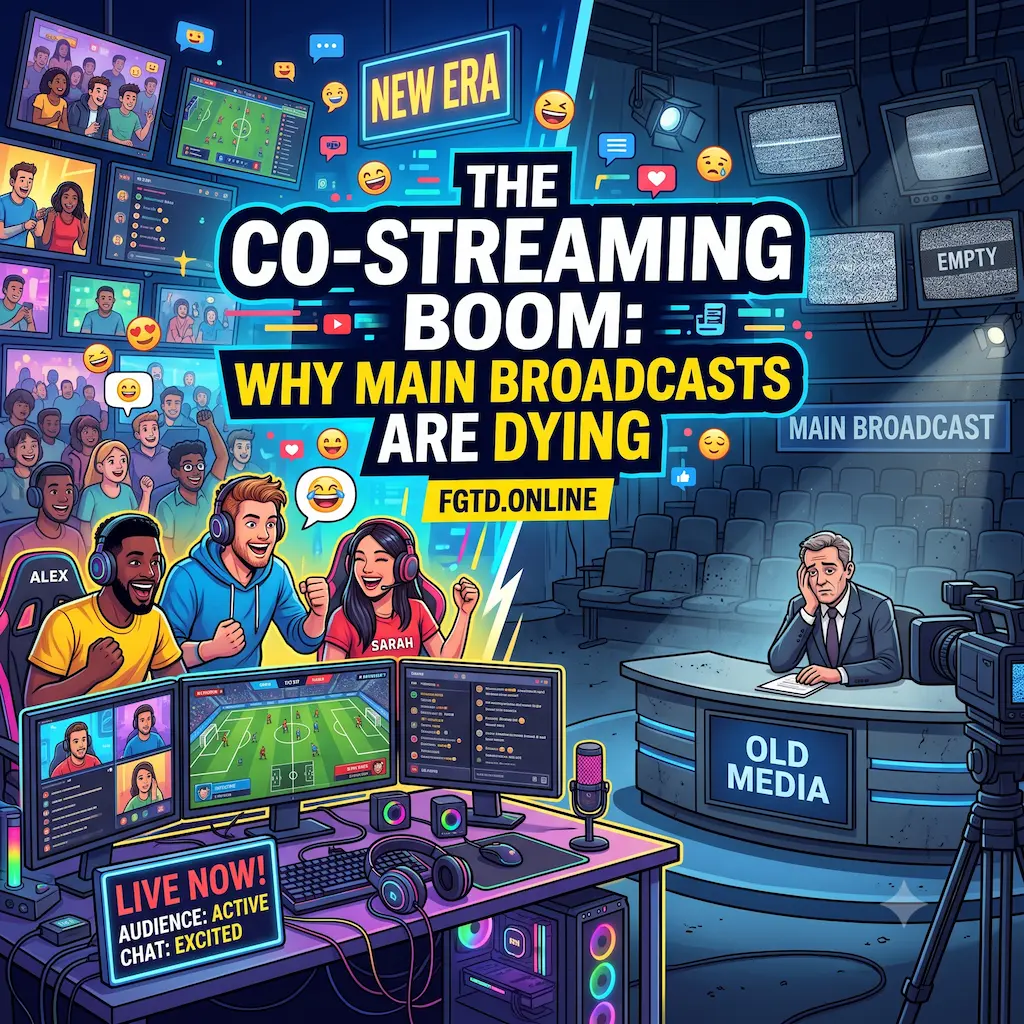
The Co-Streaming Boom: Why Main Broadcasts Are Dying
The global architecture governing sports broadcasting, digital media syndication, and live entertainment distribution is locked in a massive structural disruption. For over seven decades, enterprise media networks, international athletic organizations, and broadcasting engineering rested on a deeply centralized, linear execution template. Main broadcasts operated as monolithic, one-size-fits-all production loops. Traditional media networks controlled the entire narrative perimeter: a single commentary team, a fixed audio mix, and a standard, highly sanitized presentation style were broadcast simultaneously across millions of passive consumer screens worldwide.
While this rigid, top-down broadcasting infrastructure provided immense commercial stability during the golden era of cable television, it has hit a definitive technological, demographic, and behavioral wall inside today’s hyper-connected, high-velocity digital landscape.
Modern digital natives, gaming enthusiasts, and immersive-tech consumers no longer tolerate passive consumption. They reject the unvetted, overly corporate commentary styles of legacy sports networks, demanding deep community interaction, authentic real-time engagement, and creator-driven personalization.
Continues after advertising
Forcing these highly active, conversational global audience pools through a single, legacy linear feed creates a severe engagement bottleneck, driving younger demographics completely away from mainstream media portals.
Relying on traditional brute-force broadcast methods or generic multi-language audio toggles under this shifting reality exposes media organizations to catastrophic tracking dropouts, diminishing subscriber numbers, and structural balance-sheet erosion. The strategic threat facing entertainment networks is no longer the physical quality of the video capture; it is the absolute death of cultural resonance within centralized main broadcasts. Watching an elite esports tournament or a professional athletic match via a sterile corporate channel fails to capture the participatory energy of modern internet communities, leading to immediate platform abandonment and lost advertising conversions.
To dissolve these engagement blockages, maximize viewer retention, and secure an unassailable digital distribution moat, progressive media executives are completely overhauling their application perimeters. They are moving past restrictive linear streams and embedding an integrated, automated Intelligent Co-Streaming Orchestration, Live Telemetry Aggregation, and Creator-Led Media Plane straight into their core delivery networks.
Far from a casual experiment or a minor community patch, constructing a production-grade enterprise co-streaming infrastructure combines high-throughput multi-feed video syndication, automated policy-as-code digital rights validation layers, software-defined regional edge distribution topologies, and hardware-insulated confidential computing data perimeters directly into the core matrix of digital network hubs like fgtd.online.
1. The Core Paradigm Shift: From Monolithic Corporate Feeds to Creator-Led Decentralization
To forge a highly resilient media distribution framework capable of maximizing consumer engagement safely across international network pipelines, media infrastructure teams and digital platform engineers must fundamentally transform their core management philosophy. The entertainment grid must migrate away from passive, studio-driven broadcasting arrays and focus entirely on decentralized multi-stream syndication, real-time community engagement tracking, and elastic creator access.
Legacy Main Broadcasting Pipeline
- Phase 1: Centralized corporate production capturing a single, rigid commentary and video mix.
- Phase 2: Fixed distribution across closed, linear satellite or cable networks to passive screens.
- Phase 3: Complete audience passivity with zero options for community interaction or perspective customization.
Active Co-Streaming Syndication Fabric
- Phase 1: Clean, high-throughput master clean-feed generation unbundled from localized commentary.
- Phase 2: Automated, real-time secure distribution to thousands of independent, whitelisted creator nodes.
- Phase 3: Decentralized interactive execution where creator commentary, live chat, and unique overlays drive hyper-targeted viewer engagement.
Legacy broadcasting systems function within a highly restrictive, low-frequency framework. Under those obsolete conditions, networks controlled match narratives through exclusive contracts, forcing diverse global populations to listen to identical corporate commentary teams that often felt disconnected from the modern subcultures surrounding the sport or game.
The automated co-streaming syndication fabric reconfigures this media paradigm completely. It treats the main live video feed as an open, accessible API layer rather than a finalized consumer product. By establishing secure, low-latency creator access networks and cloud-native video distribution meshes, the system enables individual internet personalities, analytical experts, and community figures to layer their unique commentary and interactive overlays on top of the raw action simultaneously. The broadcast moves past its historical role as a rigid television program and becomes an active, multi-tenant digital lounge engineered to foster communal engagement, increase watch-time metrics up to 300%, and capture highly targeted global monetization pools.
2. Core Pillars of an Institutional Co-Streaming Infrastructure
Constructing an enterprise-grade spatial media orchestration and co-streaming distribution platform capable of scaling safely across thousands of independent content creators, multiple geographic cloud regions, and millions of concurrent viewers requires a robust technology layer anchored by four foundational engineering pillars.
Pillar I: High-Throughput Video Telemetry and Clean-Feed Ingest Engines
The absolute technical precision and execution safety of any advanced co-streaming platform depend entirely on moving past delayed public restream lines and utilizing real-time, event-driven video ingestion architectures.
Systems engineers deploy decentralized, low-latency live video streaming fabrics paired with optimized WebRTC or SRT protocols to capture raw clean-feeds straight from live tournament venues and matching engines simultaneously.
The ingestion factory normalizes unstructured, multi-format media telemetry—including sub-second uncompressed video frames, spatial match metadata coordinates, audio channel sub-mixes, and localized clock synchronization logs—into a standardized, low-latency digital data schema. This continuous video harvest feeds a centralized, enterprise-grade Live Media Feature Store that unifies raw broadcast events into a single source of truth for both online real-time creator syndication loops and offline playback optimization engines, completely preventing video alignment skews.
Pillar II: Automated Policy-as-Code Digital Rights Management and Whitelist Registries
Modern multi-tenant digital media operations require navigating an intricate maze of overlapping international copyright laws, complex creator licensing agreements, and volatile digital rights management (DRM) constraints that change dynamically across regional borders.
Performance technology teams deploy optimized Automated Policy-as-Code Whitelist Registries paired with real-time audio-visual fingerprinting models. The governance core monitors active creator co-stream lines continuously, validating that only authorized, verified creator nodes are re-transmitting live broadcast assets. If the verification core isolates an unauthorized stream hijack or an un-whitelisted domain broadcast, it triggers an immediate response: the platform programmatically revokes the channel’s secure streaming ingestion token, issues automated digital rights notices, and logs the event inside an immutable access record, securing critical intellectual property fields without requiring manual oversight queues.
Pillar III: Software-Defined Dynamic Edge Distribution and Ping Optimization Fabrics
Maintaining a seamless viewing experience across geographically fragmented consumer groups requires the platform to continuously evaluate its systemic resilience against network packet drops and regional latency variances.
Enterprise technology teams deploy optimized Software-Defined Dynamic Edge Distribution Fabrics paired with high-bandwidth content delivery network (CDN) meshes. The networking core utilizes centralized controllers running policy-as-code configurations to dynamically spin up localized live-video caching containers at the regional network edge based on the physical concentration of active creator community nodes. Concurrently, the distribution matrix applies advanced optimization paths to minimize packet transit lag, ensuring that the delay between the main match event and a creator’s reactive live stream is slashed down to milliseconds, systematically eliminating the spoiler anomaly and ensuring smooth playback consistency across all connected devices.
Pillar IV: Stochastic Audience Demand Simulators and Capacity Scale Engines
Waiting for traditional manual server configuration adjustments or lagging human infrastructure provisioning to manage massive organic traffic surges during historic competitive events exposes the media network to catastrophic stream crashes and severe buffering stalls.
Operations groups deploy advanced Stochastic Audience Demand Simulators connected directly to live platform infrastructure metrics, creator subscriber registries, and real-time network load logging platforms. The system models millions of concurrent viewer arrivals, potential flash-crowd surges from creator raid actions, and regional edge data center failures against severe resource limitations. If a simulation indicates that an upcoming creator co-stream event risks pushing local computing nodes or network pipelines past critical safety thresholds, the platform automatically triggers an elastic scale playbook, provisioning clean virtual instance extensions to absorb the computing weight seamlessly.
3. High-Performance Optimization: The Broadcast Architecture Ledger
Transitioning an enterprise media framework from traditional centralized flat broadcasting infrastructures to an automated, scaled corporate distributed co-streaming architecture fundamentally redefines an organization’s administrative efficiency and structural data resilience metrics.
| Performance Parameter | Centralized Monolithic Main Broadcasts | Scaled Distributed Co-Streaming Fabrics |
| Audience Agency Layer | Rigid; zero user control over presentation or tone | Absolute; fluid user-controlled creator perspective selection |
| Viewer Retention Latency | High; unvetted corporate commentary drives churn loops | Ultra-low; personalized community chat groups maximize hold |
| Blast Radius Exposure | Total; single control room failures crash the global feed | Isolated; independent creator node drops keep grid alive |
| Data Ingestion Overhead | Opaque; lacks granular telemetry across remote networks | Total; real-time streaming media and analytical feature stores |
| Monetization Granularity | Low; broad, un-targeted commercial TV blocks | High; tailored digital ad insertions per creator demographic |
4. Real-World Applications: Co-Streaming Fabrics in Active Media Realms
Evaluating how advanced co-streaming engines, real-time media orchestration fabrics, and automated policy-as-code data pipelines perform under complex, real-world corporate technology scenarios highlights their vital importance in preserving institutional trust and protecting core data assets.
Defusing Systemic Network Congestion in Hyper-Scale Esports Tournament Broadcasts
Consider a premier international digital media network, streaming content provider, and high-velocity digital clearinghouse that coordinates multi-tenant live broadcast processing pipelines, real-time interactive fan applications, and localized subscription management frameworks serving millions of global consumers simultaneously across diverse regional environments. The underlying software infrastructure processes millions of system verification checks per second and handles massive transaction loads under strict compliance and service level agreements. During an intense global esports championship match, a sudden, non-linear surge in global consumer connection velocities across thousands of popular creator channels floods the media network edge, threatening to trigger severe packet routing lags and buffer stalls across approximately 60 active digital broadcast sectors, including the infrastructure pipelines optimization layouts tracking performance variables for global enterprise web platforms like fgtd.online.
Under traditional, centralized streaming architecture configurations, this sudden traffic spike quickly exhausts the application’s shared network bandwidth pool. The delayed video data packets cause deep rendering queues, resulting in widespread streaming freezes, lost ad-revenue conversions, and immediate balance-sheet margin erosion.
The technology enterprise completely neutralizes this catastrophic risk by anchoring its core delivery infrastructure to an automated, distributed media orchestration plane. The system monitors edge data metrics, user connection states, and local viewport database write flows continuously.
The moment the traffic surge hits the streaming gateway, the real-time processing engine flags the anomaly instantly and activates its automated optimization playbook.
The platform programmatically executes an automated API command to shift live video data paths to alternative low-latency routing channels, updates background data compression rules to protect streaming quality, and dynamically scales up transient edge-processing nodes to offload computational weights automatically. This sub-second response completely prevents streaming downtime, preserves premium ad-delivery channels, and keeps live content running seamlessly, protecting investor capital and safeguarding franchise value during high-traffic global events.
Eradicating Strategic Configuration Drift Across Distributed Corporate Media Node Pools
A hyper-scale systematic media network and automated tournament archive operator manages thousands of active server configurations, distributed database synchronization loops, and international metadata transaction registers across multi-tenant cloud networks to serve educational and entertainment institutions globally. To maintain peak performance and prevent tracking errors across its ecosystem, the firm’s operations division requires its remote processing infrastructure to continuously execute fast database optimizations, automated compliance sweeps, and real-time digital configuration changes across its active administrative properties.
The technology corporation stabilizes its server performance perimeter and eliminates processing bottlenecks by anchoring its administrative network to an automated cloud infrastructure and policy-as-code management layer. The automated network protection engine monitors active multi-cloud environments and localized edge data hubs continuously, comparing live configuration profiles against baseline system definitions. During an extensive content expansion wave, an unauthorized software script or a manual update inadvertently alters an edge database’s data ingress limits, creating an unexpected data latency lag that threatens to slow down transaction processing across approximately 60 active regional media ingestion nodes.
The automated protection plane identifies the unauthorized configuration drift instantly as a policy violation and executes an automated remediation playbook: it programmatically overrides the unapproved settings, resets the deployment microservice back to its optimized policy-as-code blueprint, and scales up transient edge-processing instances to offload computational weights automatically. This real-time defense prevents further network degradation, secures core transaction response times, and maintains unassailable platform visibility without requiring manual engineering code cleanups, ensuring that operational frameworks remain completely aligned with global asset protection codes.
5. Security Architecture for Hardened Co-Streaming Control Planes
Centralizing global video distribution configurations, integrating live infrastructure-as-code (IaC) deployment pipelines, tracking predictive evaluation metrics, and automating API-driven media routing pathways introduces intense data privacy and data infrastructure security requirements. Because a centralized co-streaming automation platform commands the absolute administrative authority to manage million-dollar broadcast structures, alter data routing networks, and interface with sensitive client logs, the automation control framework represents a high-value target for advanced persistent threat networks, malicious software syndicates, and corporate espionage operations.
Implementing Anonymized Telemetry Tokenization across Media Ingestion Pipelines
To train predictive streaming models, evaluate application factor analysis, and execute large-scale lookalike resource usage clustering safely without violating global data privacy directives (such as GDPR or CCPA) or exposing proprietary corporate trade secrets to public network observers, organizations must implement a robust data perimeter.
Systems architects deploy an automated data tokenization proxy directly at the front edge of the viewer and transactional data ingestion pipelines. Before any viewer log, account statement, or transaction record is written to the central predictive data lakehouse, all sensitive personal details, private consumer IDs, and internal corporate IP addresses are automatically extracted, cryptographically hashed, and replaced with secure tokens. The quantitative models and graph mining engines execute their pattern-recognition calculations over completely anonymized operational metadata, maintaining total monitoring utility while ensuring absolute corporate data privacy across all regional entities.
Hardening the Processing Core via Zero-Trust Isolation and Confidential Enclaves
Because the centralized media orchestration and security optimization core commands the absolute authority to analyze code vulnerabilities, modify routing policies, alter automation thresholds, and execute automated configuration changes via API links, accessing this administrative engine requires extreme security constraints.
- Zero-Trust Network Access (ZTNA): Isolate the entire streaming management plane, container registries, configuration dashboards, and continuous integration/continuous deployment (CI/CD) pipelines inside a strict Zero-Trust Network Access envelope. Every developer account, system administrator terminal, and internal software integration must undergo continuous multi-factor authentication, rigorous automated behavioral risk screening, and endpoint device posture assessments before gaining access to the platform interface.
- Confidential Computing Enclaves: Critical data processing loops, local cryptographic token generation tasks, and policy-as-code evaluation engines at the server node must execute exclusively within hardware-isolated Confidential Computing Enclaves equipped with hardware-level memory encryption. This architectural environment keeps your underlying proprietary software blueprints, edge configuration logs, and cryptographic access keys completely insulated from host-level interception, internal insider threats, or external data exploitation throughout the execution lifecycle.
6. Structural Convergence: Adhering to Global Telecommunication Standards
Scaling a comprehensive automated co-streaming architecture and multi-tenant distributed spatial media platform across international borders requires absolute compliance with an evolving web of international legislative frameworks, corporate governance parameters, and information security standards.
- The AICPA Trust Services Criteria (SOC 2 Type II): Rigorous international information security auditing frameworks demand that high-growth digital organizations, distributed edge networks, and cloud service networks implement and present verifiable operational safety metrics, continuous log tracking pipelines, and automated access governance histories across all active computing environments.
- ISO/IEC 27001 Information Security Management: Renowned international standardization benchmarks require global technology corporations to establish and maintain comprehensive information security management systems (ISMS), mandate strict access isolation controls across distributed data domains, and enforce documented asset management procedures across all data processing hubs.
- Global Consumer Privacy and Content Regulations: Hardening regional data isolation acts enforce strict penalties on global enterprise corporations that allow user viewing histories or private transactional metadata to cross national borders without maintaining strict cryptographic compliance controls, forcing media architectures to deploy highly secure, multi-region database clusters operating under strict policy-as-code control models to ensure that regional customer metrics are processed strictly within regional boundaries.
Read More👉 Next-Gen Stadiums: The Modern Tech in Live Sports Arenas
Conclusion: Fabricating the Unassailable Content Delivery Moat
The deployment and scaling of a modern, data-driven co-streaming architecture and enterprise creator-led distribution platform is not an optional technology update for modern entertainment organizations or enterprise media networks; it is a fundamental technological requirement to achieve long-term corporate resilience, data infrastructure integrity, and continuous operational uptime through changing consumer eras. The historical strategy of managing multi-region cloud software portfolios through slow, human-centric validation gates and trailing centralized data pipelines—while tolerating severe calculation latencies, configuration drift exposures, and high network bandwidth infrastructure costs—is an unsafe operational approach that invites market displacement, massive system outages, and balance-sheet erosion.
By engineering an integrated, forward-looking software fabric built on high-throughput real-time telemetry ingestion pipelines, domain-isolated database topologies, software-defined policy-as-code micro-segmentation controls, and autonomous edge containerization playbooks, progressive enterprise leaders transform their engineering centers from a compliance cost center into a high-performance strategic weapon.
Ultimately, the definitive advantage in the global digital ecosystem belongs entirely to the visionary enterprises that can compile code, optimize systems, and deploy secure application environments as fast as the market moves—mastering advanced distributed edge computing frameworks to drive secure, highly predictable, and market-leading global scale across any operational horizon.
Hosting computationally intensive media orchestration platforms, processing high-throughput real-time video data ingestion pipelines, validating real-time policy-as-code compliance layers, and managing ultra-secure confidential computing build enclaves requires world-class, zero-downtime server infrastructure. Secure your company’s distributed co-streaming architecture on an unassailable infrastructure foundation by exploring the premium enterprise hosting configurations at fgtd.online.