Smart Stadiums 2026: The Tech Redefining the Fan Experience
The era of simply “going to the game” is officially over. In 2026, professional sports have moved beyond the physical boundaries of the pitch or court, transforming stadiums into massive, living centers of hyper-connected entertainment. We have entered the age of the Smart Stadium, where Artificial Intelligence, 6G connectivity, and Augmented Reality (AR) converge to create a seamless, frictionless, and deeply personalized fan experience.
For the audience at fgtd.online, understanding this shift is crucial. We aren’t just talking about faster Wi-Fi or bigger screens. We are talking about a total re-engineering of the fan journey, from the moment you leave your house to the moment you return. In 2026, the stadium knows who you are, what you want to eat, and which replays you want to see before you even ask.
1. Frictionless Entry: The End of the Queue
The most significant pain point of the traditional sporting event has always been the wait. In 2026, biometric technology and computer vision have virtually eliminated the “gate.”
Continues after advertising
Biometric Ticketing and Facial Recognition
Through partnerships with platforms like Amazon’s “Just Walk Out” technology and advanced biometric security, fans at modern smart stadiums no longer need to fumble with paper tickets or QR codes on their phones.
- Identity as a Ticket: Using “Face-to-Gate” technology, high-resolution cameras identify fans as they approach. If the biometric signature matches the digital ticket on file, the turnstiles open automatically.
- Security at Scale: This isn’t just about convenience; it’s about safety. AI-driven security systems can scan thousands of faces per minute, identifying banned individuals or security threats in real-time without slowing down the flow of the crowd.
2. Augmented Reality (AR) and the “Second Screen” Experience
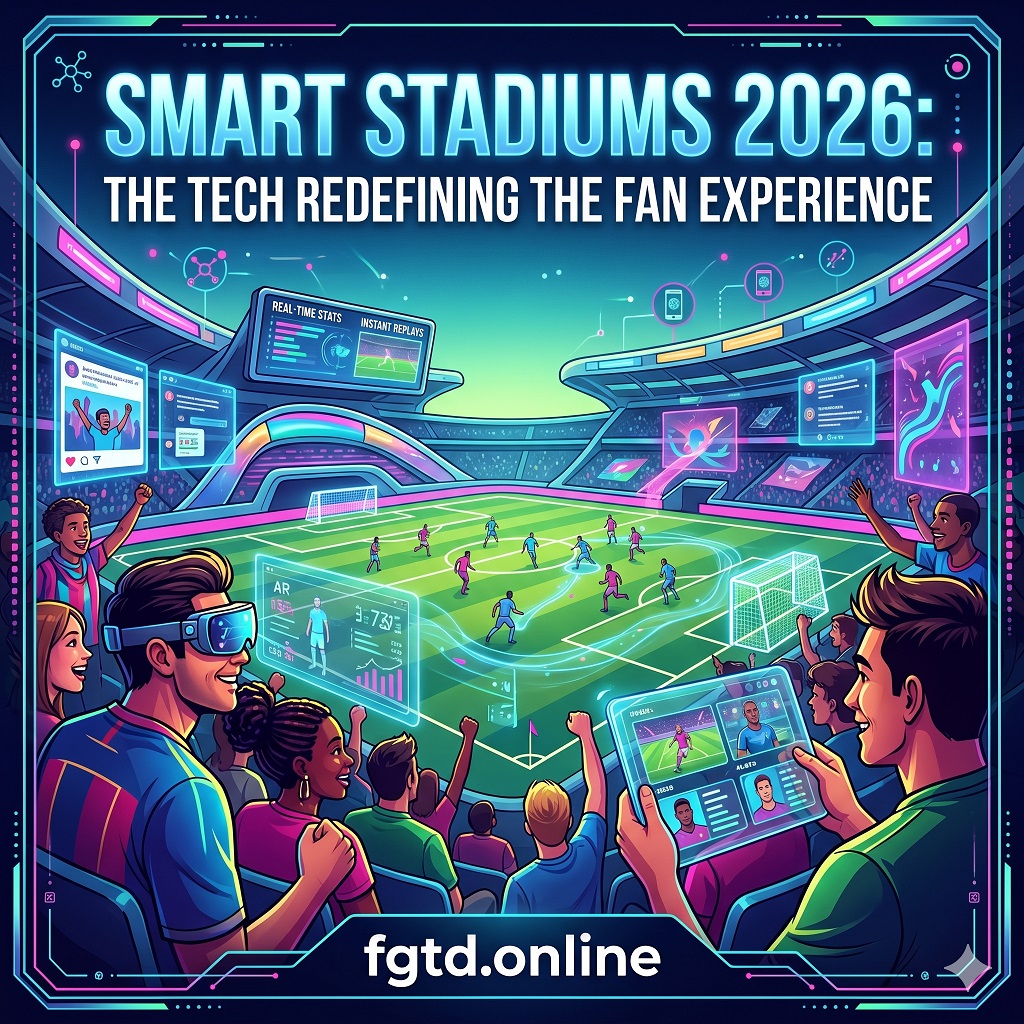
While the action happens on the field, the modern fan is increasingly looking for deeper data and interactivity. In 2026, the physical and digital worlds have merged through Smart Glasses and AR-enhanced mobile apps.
Real-Time Data Overlays
Imagine looking at a striker during a football match and seeing their live top speed, heart rate, and “Expected Goals” (xG) probability floating above their head.
- The Immersive Playback: Using AR, fans can “rewind” a play on their mobile device or glasses while still watching the live action.
- Gamified Fan Zones: Fans can participate in real-time “predictive” games. If you predict the next goal-scorer correctly via the stadium app, the system can instantly send a digital coupon or a “VIP Upgrade” notification to your seat.
3. The “Just Walk Out” Concession Model
In 2026, the “halftime rush” has been tamed. Smart stadiums have adopted the autonomous retail model across their food and beverage outlets.
Computer Vision and Sensor Fusion
Fans can walk into a concession stand, grab a drink and a hot dog, and simply walk out.
- Seamless Payments: A network of cameras and shelf sensors tracks which items are taken. Payment is automatically processed through the fan’s pre-registered biometric profile or mobile wallet.
- Predictive Inventory: The stadium’s AI predicts demand surges based on the game’s clock and score. If the game is tied going into the fourth quarter, the AI alerts staff to prep extra supplies at specific zones where fan “exit probability” is highest.
4. Personalized Seat Delivery and Concierge AI
The seat is no longer just a place to sit; it is a service hub. In 2026, In-Seat Delivery has reached peak efficiency through the use of small-scale robotics and specialized routing.
AI-Driven Logistics
If you prefer not to leave your seat, the stadium app uses ultra-wideband (UWB) positioning to find you.
- Smart Order Routing: The AI calculates the fastest delivery path, whether via a human runner or a small autonomous delivery bot navigating the service aisles.
- The Virtual Concierge: Every fan has access to an AI assistant via the stadium app. “Where is the nearest bathroom with the shortest line?” or “Which exit has the least traffic right now?” The AI provides real-time answers based on live sensor data throughout the building.
5. 6G Connectivity and the Private Network
To power thousands of AR devices, biometric scanners, and high-definition video streams simultaneously, 2026 stadiums rely on private 6G and Wi-Fi 7 networks.
Ultra-Low Latency
The lag between the live action and the digital replay has been reduced to milliseconds. This allows for:
- Multi-Angle Viewing: Fans can choose between 20 different camera angles on their devices, including “Player-Cam” views from cameras mounted on the athletes’ jerseys.
- Live Global Interaction: A fan in the stadium can “share” their exact AR view with a friend watching at home in VR, creating a shared experience that transcends geography.
6. Sustainability and the “Green” Stadium
In 2026, being “Smart” also means being “Sustainable.” Technology is the primary tool used to minimize the environmental footprint of these massive structures.
AI Energy Management
Smart stadiums use AI to manage energy consumption with surgical precision.
- Occupancy Sensing: Lighting and climate control are adjusted in real-time based on the occupancy of specific sections. If a suite is empty, it enters a “Deep Sleep” energy mode.
- Waste Analytics: AI-powered waste bins sort recyclables from trash automatically, and the stadium’s “Circular Economy” dashboard provides a live update on the event’s total carbon footprint to the public.
7. The VIP Experience: Hyper-Exclusivity through Tech
For premium ticket holders, the tech is even more sophisticated.
Interactive Luxury Suites
In the executive boxes, the glass windows are actually Transparent OLED screens.
- The Digital Glass: These screens can display replays, tactical breakdowns, and betting odds directly on the window while the fans watch the live game through the glass.
- Haptic Feedback: Some premium seats now include haptic feedback motors that vibrate in sync with the roar of the crowd or the impact of a tackle, providing a “physical” connection to the game.
8. Post-Game: The Smart Exit
The experience doesn’t end with the final whistle. Smart stadiums are integrated with the city’s Smart Grid and Transportation systems.
Traffic and Transit Coordination
The stadium AI communicates with the city’s traffic management system to optimize the flow of fans leaving the venue.
- Dynamic Transit Scheduling: Based on the number of fans who used public transit to arrive, the city can automatically deploy extra “Autonomous Shuttles” or trains to meet the exact demand.
- Personalized Exit Routes: The stadium app sends a notification to each fan: “Wait 10 minutes in the fan zone for a free coffee, and you’ll save 20 minutes in traffic,” or “Your Uber is waiting at Zone B; take Exit 4 for the fastest path.”
Read More👉 The Return of LAN Parties – Nostalgia Meets Competition
Conclusion: The Stadium as an Ecosystem
The Smart Stadium of 2026 is a testament to the power of integration. It is no longer a collection of disconnected parts (ticketing, food, game, exit) but a single, intelligent ecosystem designed to maximize joy and minimize friction.
At fgtd.online, we believe that this technology is doing something profound: it is returning the focus to the game. By automating the administrative and logistical “noise” of attending a major event, tech allows us to be more present, more informed, and more connected to the sport we love.
The future of the fan experience is here. It is fast, it is digital, and it is tailored specifically to you. Welcome to the new era of the beautiful game.