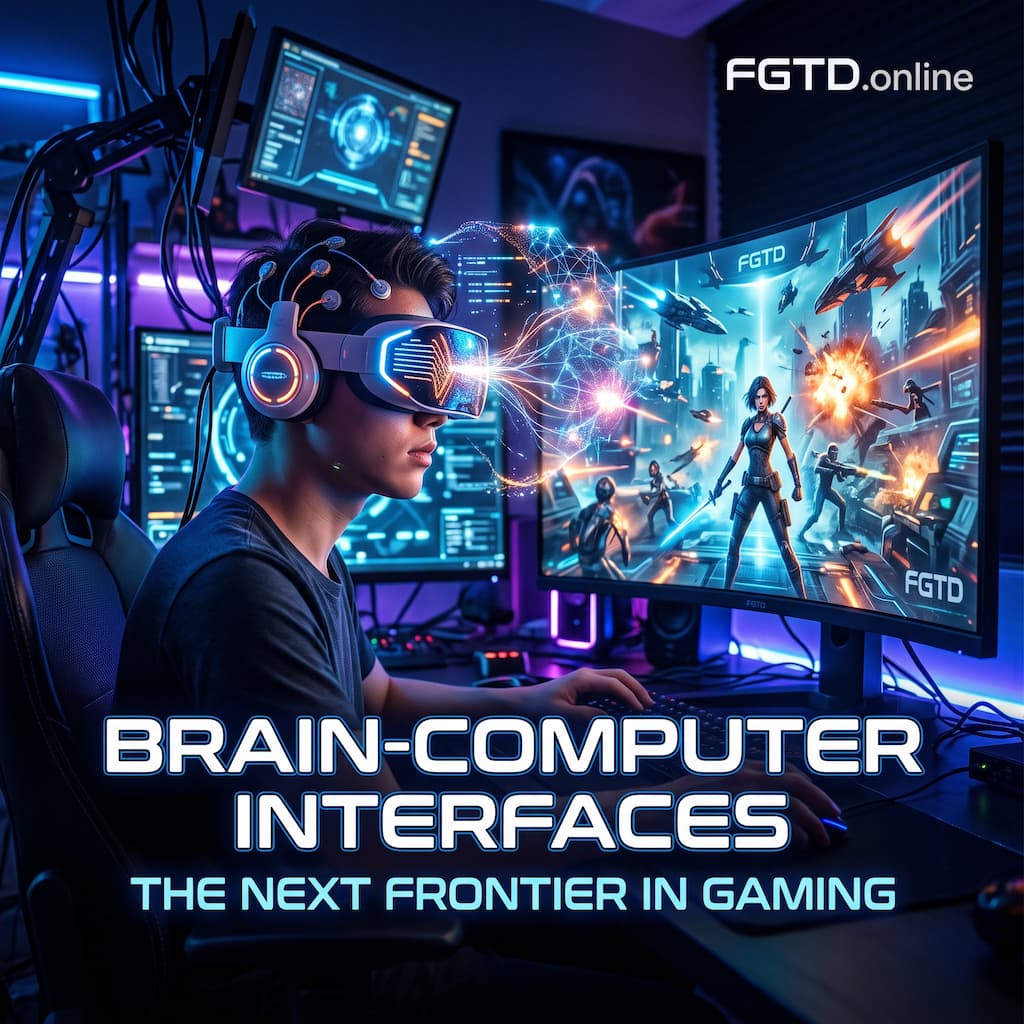
Brain-Computer Interfaces: The Next Frontier in Gaming
For over half a century, the relationship between players and video games has been mediated by mechanical hardware. From early arcade joysticks and coin-operated buttons to multi-button gamepads, mechanical keyboards, optical mice, and spatial motion controllers, every digital action has required a physical proxy. Players conceptualize an intent in the mind, translate that impulse into a physical motor command through hands and fingers, and wait for external plastic switches to register the input.
However, the rapid maturation of neurotechnology, bio-signal processing, and machine learning is dismantling this physical bottleneck: Brain-Computer Interfaces (BCIs) in Gaming.
By measuring, decoding, and translating neural activity directly into digital game inputs, brain-computer interfaces bypass the peripheral nervous system and mechanical controllers entirely. What originated in clinical neurology laboratories as assistive technology for motor rehabilitation is rapidly transforming into the ultimate frontier of interactive entertainment.
Continues after advertising
The implications for gaming are profound. BCIs enable sub-millisecond reaction times that surpass the biological limits of human finger movement, create adaptive games that dynamically reshape horror levels based on real-time fear levels, and pave the way for true hands-free digital immersion.
This post analyzes the neurotechnological mechanics of gaming BCIs, breaks down the shift from passive neuro-feedback to active neural control, compares traditional mechanical inputs with direct neural interfaces, and explores how brain-computer systems will redefine the future of interactive entertainment and competitive esports.
1. The Input Latency Ceiling: The Physical Limit of Human Hands
To understand why neurotechnology represents the next major paradigm shift in gaming, one must examine the physiological latency inherent to conventional human-computer interaction.
The Biological Signal Chain
Under traditional mechanical gaming setups, executing a fast-twitch reaction—such as dodging an incoming projectile or hitting a precision sniper shot—involves a sequential biological pathway:
- Visual Perception: Photons hit the retina, converting light into electrochemical signals transmitted to the visual cortex.
- Cognitive Processing & Decision-Making: The brain identifies the target, calculates spatial trajectories, and selects an appropriate physical reaction within the motor cortex.
- Peripheral Transmission: Motor impulses travel down the spinal cord, pass through peripheral nerves, and contract the muscle fibers of the hand and fingers.
- Mechanical Actuation: The physical finger depresses a mechanical switch, overcoming switch pre-travel, tactile resistance, and mechanical debounce delays before sending a USB packet to the PC.
Even among elite esports athletes, this human mechanical chain introduces 150 to 250 milliseconds of total biological delay.
Eliminating the Mechanical Bottleneck
A brain-computer interface intercepts the intention directly at the source. By recording motor imagery signals directly from the motor cortex—the precise moment the brain intends to move—a BCI can register an in-game action 50 to 100 milliseconds before the physical finger could ever depress a plastic switch.
In competitive gaming environments where victory is decided by single frames, direct neural actuation fundamentally redefines human reaction speed.
2. Structural Mechanics: Non-Invasive vs. Invasive Neural Architectures
The deployment of BCIs in interactive entertainment relies on two distinct scientific approaches, each presenting unique engineering trade-offs:
Non-Invasive Consumer EEG and EMG
For mainstream commercial gaming, non-invasive systems dominate current hardware roadmaps:
- Electroencephalography (EEG): Headbands, audio headsets, and VR head-straps embedded with dry-contact micro-sensors measure macroscopic voltage fluctuations generated by millions of synchronized neurons firing in the cerebral cortex.
- Surface Electromyography (sEMG): Neural wristbands (such as Meta’s neural interface technology) detect minute motor nerve signals traveling down the wrist to the fingers. Even if a player merely twitches their tendon or visualizes a click without moving, the wristband decodes the intention and fires the digital command.
- Machine Learning Signal Decoding: Raw brainwaves are notoriously noisy, obscured by muscle movement, eye blinks, and ambient electrical hum. Modern gaming BCIs utilize deep neural networks trained to filter through electrical artifacts and isolate deliberate cognitive states in real time.
Invasive Intracortical Implants (The High-Fidelity Horizon)
Pioneered by biomedical firms like Neuralink, Synchron, and Blackrock Neurotech, invasive interfaces place micro-electrode arrays directly beneath the skull:
- Direct Single-Neuron Resolution: By resting directly on or inside the cerebral cortex, these threads capture high-fidelity action potentials from individual neurons with virtually zero background noise.
- High-Bandwidth Control: Paralyzed clinical trial patients using direct neural implants have demonstrated the ability to play competitive strategy titles, move mouse cursors across multi-monitor setups, and play first-person games using thought alone.
While surgical implants remain reserved for medical applications today, their rapid development outlines the long-term future of seamless human-machine symbiosis.
3. Structural Comparison: Mechanical Controllers vs. Brain-Computer Interfaces
Evaluating the operational, physiological, and technical parameters that separate traditional mechanical input devices from neural interfaces highlights why the gaming industry is investing heavily in neurotech:
Input Transmission Speed
- Mechanical Controllers (Mouse/Keyboard/Gamepad): 150 to 250 ms total latency; constrained by biological nerve conduction, muscle contraction, and mechanical switch pre-travel.
- Brain-Computer Interfaces (BCI): Sub-100 ms latency; decodes cognitive intent and motor imagery directly from the cortex prior to physical muscle actuation.
Accessibility and Physical Ergonomics
- Mechanical Controllers: Relies entirely on unimpaired fine-motor hand and finger agility; introduces long-term repetitive strain injuries (RSI), carpal tunnel syndrome, and tendonitis.
- Brain-Computer Interfaces: Universally accessible; empowers gamers with quadriplegia, ALS, or motor disabilities to compete on an equal playing field using pure thought or subtle facial micro-signals.
Dynamic Emotional and Affective Gameplay
- Mechanical Controllers: One-way communication; the game engine remains blind to the player’s internal emotional, stress, or cognitive load states unless inferred from heart-rate monitors.
- Brain-Computer Interfaces: Bi-directional passive feedback; the game reads real-time player focus, panic, boredom, or cognitive fatigue, dynamically altering environmental lighting, difficulty, or audio cues on the fly.
Hardware Form Factor & Friction
- Mechanical Controllers: Plug-and-play simplicity; standardized, inexpensive, and requires zero user calibration.
- Brain-Computer Interfaces: Requires close sensor contact with the scalp or skin; sensitive to hair interference, head movement, and requires ongoing software calibration profiles for individual brain rhythms.
4. Passive BCIs: Games That Read Your Mind in Real Time
The most immediate gaming revolution driven by neurotech does not involve replacing the gamepad entirely, but augmenting it through Passive BCIs. In this hybrid setup, players still hold a controller, but a lightweight neural headset passively reads their emotional and cognitive state:
- Adaptive Horror and Dynamic Tension: In psychological horror games, a passive BCI monitors the player’s theta and beta brainwave activity. If the game senses that the player is calm and composed, it triggers an intense jump scare or ambushes them with enemies. Conversely, if the system detects overwhelming panic or elevated heart rate, it builds subtle atmospheric dread, keeping the player suspended at the psychological threshold of tension.
- Dynamic Difficulty Adjustment (DDA): Instead of forcing players to manually select easy, medium, or hard difficulty modes, games monitor cognitive load and frustration levels. If a player becomes overwhelmed during a complex boss encounter, the game subtly adjusts enemy aggression or provides subtle visual cues without breaking immersion.
- Immersion-Driven Environments: Virtual reality worlds can shift color palettes, audio clarity, and atmospheric weather dynamically based on whether the player is meditating, focused, or distracted.
5. The Competitive Esports Frontier: Neural Training and Fair Play
As brain-computer interfaces integrate into high-stakes esports circuits, they will fundamentally alter how professional digital athletes train and compete:
- Neuro-Feedback Training: Just as traditional athletes use heart-rate zones and biomechanical video reviews, professional esports teams use real-time EEG telemetry to train their mental focus. Players learn through biofeedback how to intentionally enter high-focus “flow states” and rapidly reset their nervous systems after stressful in-game blunders.
- Cognitive Fatigue Tracking: Coaches monitor live neural workload metrics during marathon tournament matches, determining the optimal time to call tactical timeouts before mental exhaustion leads to mechanical errors.
- The Integrity Dilemma: The advent of active BCI control introduces unprecedented regulatory questions for tournament organizers. If a competitor can execute actions using neural anticipation faster than humanly possible on a physical mouse, should neural interfaces be banned as an unfair advantage, or celebrated as the ultimate expression of human-computer mastery?
6. The Ethical Frontier: Cognitive Privacy and Neuro-Data Protection
Because brain-computer interfaces measure the direct electrical output of the human mind, their commercialization introduces significant ethical and privacy challenges:
- Neuro-Data Monetization: Brainwaves reveal intimately private information—subconscious reactions, emotional vulnerabilities, attention spans, and neurological health conditions. Gaming companies must establish strict data governance policies preventing the commercial sale or advertising exploitation of raw user cognitive data.
- Cognitive Privacy and Encryption: Neural data streams transmitted from gaming headsets to cloud platforms require end-to-end cryptographic protection to prevent malicious actors from intercepting personal bio-signals.
- Mental Fatigue and Burnout: Because BCIs allow continuous mental interaction without physical hand fatigue, game developers must design ethical gameplay loops that prevent extreme cognitive exhaustion and protect mental health.
Read More👉 Sim Racing to Real Track: Virtual Drivers in Motorsport
Conclusion: The Direct Link Between Mind and Virtual Worlds
Brain-Computer Interfaces are not a distant science-fiction fantasy; they represent the inevitable evolutionary destination of human-computer interaction. The physical controller, for all its historic triumphs, has always been an imperfect, mechanical bridge between human imagination and digital reality.
By decoding the raw language of neurons, BCIs eliminate the physical barrier separating the mind from the machine. From empowering disabled gamers with complete digital autonomy to creating living virtual worlds that react dynamically to human emotion, neurotechnology is transforming interactive entertainment into a seamless extension of human consciousness.
As machine-learning decoders sharpen and consumer neural sensors become as invisible as standard headphones, the screen and the controller will dissolve—permanently cementing Brain-Computer Interfaces: The Next Frontier in Gaming as the ultimate revolution in interactive entertainment.