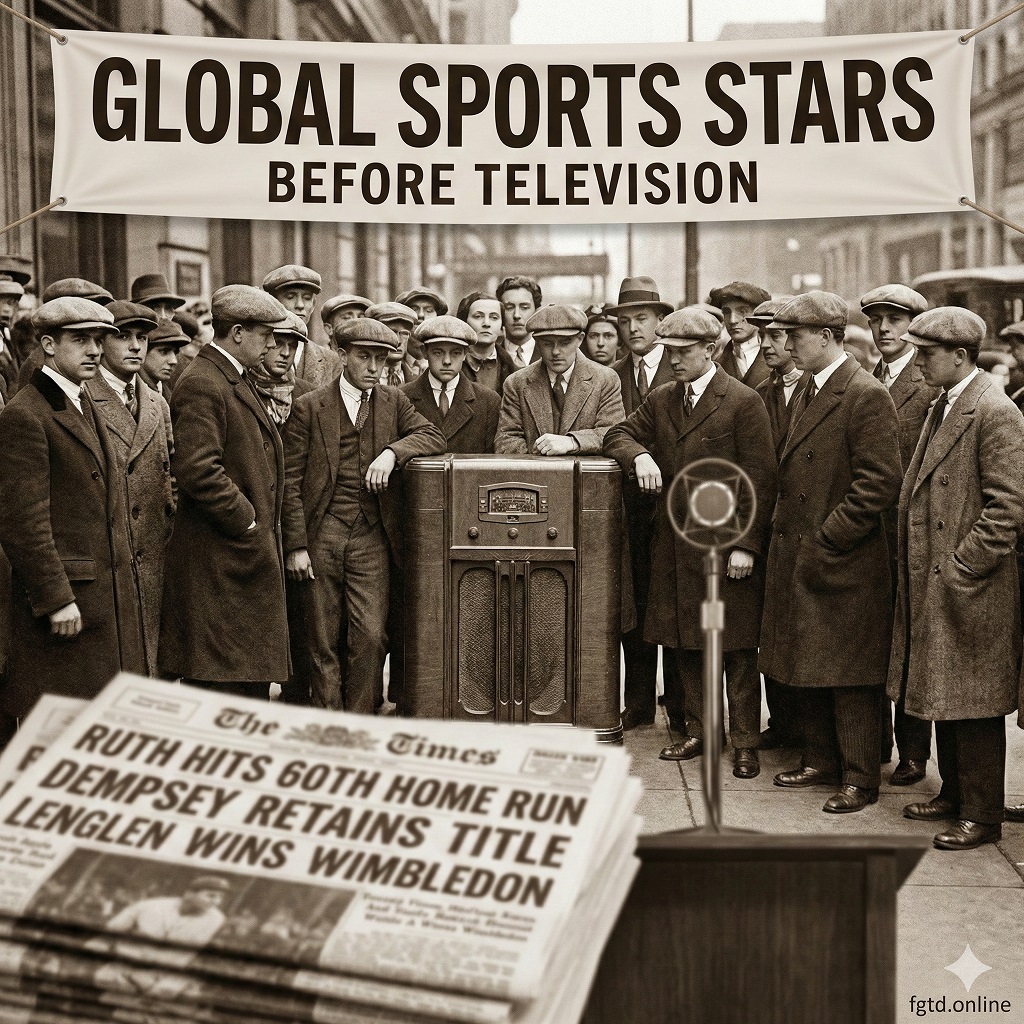
The First Global Sports Stars – Before Television
The Era of Invisible Giants
In the modern era, fame is high-definition. We see the sweat on a footballer’s brow in 4K resolution; we analyze a tennis player’s micro-expressions in super-slow motion; we consume their daily lives through 15-second Instagram stories. The modern athlete is hyper-visible, stripped of mystery, and consumed instantly.
But before the glowing cathode ray tube found its way into living rooms in the 1950s, fame looked—and felt—very different.
There was a time when the most famous people on the planet were individuals most of the world had never actually seen in motion. Between the late 19th century and the outbreak of World War II, a specific breed of “Global Superstar” emerged. These figures were not built on 24-hour news cycles or viral clips. They were built on something far more powerful: imagination, telegraph wires, and the written word.
Continues after advertising
To understand the history of global media, we must look at the “Pre-TV Titans”—Babe Ruth, Jack Dempsey, Suzanne Lenglen, and others. These were the first humans to conquer the world not through conquest or politics, but through play. This is the story of how technology and mythology combined to create the first gods of the arena.
I. The Infrastructure of Myth: How Fame Traveled
To understand how a boxer in 1920 could be famous in New York, London, and Tokyo simultaneously without satellite feeds, we have to look at the “internet” of the Victorian and Edwardian ages: The Telegraph and the Printing Press.
Before television, sport was a literary experience. The primary medium for consuming sports was the newspaper. This gave rise to the “Golden Age of Sportswriting.” Writers like Grantland Rice and Damon Runyon didn’t just report scores; they wrote epics. Because readers couldn’t see the game, writers had to paint it. They used hyperbole, metaphor, and grandiloquence. A baseball player wasn’t just a man hitting a ball; he was “The Sultan of Swat.” A football backfield wasn’t just four fast runners; they were the “Four Horsemen of the Apocalypse.”
- The Telegraph: Scores traveled via undersea cables. A knockout in Chicago would be reported in the morning papers in Paris. The speed of information was fast, but the visual was missing. This gap was crucial.
- The Radio (The Voice of God): By the 1920s, radio brought the sound of the stadium into the home. Listening to a match required active visualization. The announcer became the eyes of the world. When millions listened to a heavyweight bout, they were collectively hallucinating the action, building an image of the athletes that was often larger than life.
- The Newsreel: The only time people saw these stars move was in cinemas. Before the main feature, a 2-minute “Pathé News” reel would play. These clips were sped-up, grainy, and edited for drama. They didn’t show the athlete resting or failing; they only showed the knockout, the home run, the sprint.
This technological constraint created a specific psychological effect: The Mythological Gap. Because audiences rarely saw the athletes’ flaws, they became infallible gods in the public imagination.
II. The Heavyweights: The First True Global Celebrities
If there is one sport that drove the early globalization of fame, it was Boxing. It required no translation. Two men entered, one left.
Jack Johnson: The Most Hated (and Famous) Man on Earth In the early 1900s, Jack Johnson became the first African American World Heavyweight Champion. His fame was driven by the racial politics of the era. The search for a “Great White Hope” to defeat him made his matches global geopolitical events. When he fought Jim Jeffries in 1910, the result was telegraphed to every major city on Earth. He was arguably the most famous face on the planet, despite most people only seeing that face in static black-and-white photographs.
Jack Dempsey: The Manassa Mauler A decade later, Jack Dempsey became the first superstar of the “Roaring Twenties.” Dempsey was an icon of violence. He didn’t just box; he destroyed. His fight against Georges Carpentier in 1921 was the first “Million Dollar Gate.” It was attended by 80,000 people, but millions “watched” it by crowding around newspaper offices where updates were shouted through megaphones. Dempsey proves that you didn’t need to be seen to be felt; his aura was transmitted through the sheer brutality of the descriptions of his fights.
III. The American Export: Babe Ruth
Baseball is a uniquely American sport, yet George Herman “Babe” Ruth became a figure recognized from Japan to Europe. Why? Because Ruth was the first athlete to transcend his sport to become a brand.
Ruth arrived just as the mass media machine was maturing in the 1920s. He was photogenic, he was loud, and he performed feats that seemed statistically impossible (hitting more home runs personally than entire rival teams combined).
Ruth’s fame was solidified by Barnstorming. Since TV couldn’t bring Ruth to the world, Ruth went to the world. He traveled on exhibition tours, playing in rural American towns and eventually going to Japan in 1934. In Tokyo, hundreds of thousands of Japanese fans lined the streets just to glimpse him. They didn’t care about the New York Yankees; they cared about the legend of the Babe.
Ruth was the prototype for the modern influencer. He endorsed sodas, cars, and clothes. He proved that an athlete could be an economic entity. He was a creature of the newsreel—his choppy, trot-around-the-bases became the signature visual of 1920s America.
IV. The Diva of the Court: Suzanne Lenglen
While men dominated the headlines, a French tennis player shattered the glass ceiling of sports celebrity. Suzanne Lenglen was not just a tennis player; she was the first female sports diva.
Playing at Wimbledon in the early 1920s, she shocked the Victorian sensibilities of the crowd. She abandoned the corset, played with bare arms, and wore skirts cut just above the calf. She sipped cognac during changeovers to calm her nerves. She was prone to emotional outbursts and theatrical weeping.
Lenglen was the first athlete to merge Sports and Fashion. The press didn’t just cover her backhand; they covered her wardrobe. She was the first global star to understand that “personality” was a commodity. Without a single live television broadcast, she became the most famous woman in Europe. Her fame was carried by the society pages and the gossip columns, proving that sports stars were now entering the realm of high society.
V. The Dark Side of Radio: The 1936 Olympics
The apex of pre-television sports fame occurred in Berlin, 1936. These Olympics were the first to be televised, but only via closed-circuit to viewing halls in Berlin. For the rest of the world, it was a radio event.
This event highlighted the duality of the era: Jesse Owens vs. The Nazi Propaganda Machine.
Jesse Owens, a Black American, won four gold medals in the heart of Hitler’s Germany. The story of Owens is a testament to the power of the narrative. The image of Owens on the podium is one of the most famous photos in history, but at the time, his fame was driven by the radio announcers describing the frustration of the Nazi leadership as Owens sprinted past their “Aryans.”
Because the world couldn’t see the nuance, the story became binary: Good vs. Evil. Democracy vs. Fascism. Owens became a symbol, a vessel for the world’s hopes, in a way that might have been diluted by the visual distraction of modern TV commentary. The lack of visuals sharpened the ideological focus.
VI. The Commonwealth God: Don Bradman
To Americans, he is unknown. To the rest of the English-speaking world (England, Australia, India), he is the greatest sportsman who ever lived. Sir Donald Bradman, the Australian cricketer, boasts a statistic that is widely considered the greatest outlier in sports history: a batting average of 99.94. (The next best is around 60).
Bradman played in the 1930s and 40s. For Australians suffering through the Great Depression, Bradman was not just an athlete; he was the national identity. When the English team developed a dangerous tactic called “Bodyline” (bowling at the body instead of the wickets) to stop him, it caused a genuine diplomatic incident between Australia and Britain.
Bradman’s fame traveled via the “ticker.” People would stand in the streets of Sydney or London, watching mechanical boards update the score. The delay created tension. The waiting created longing. Bradman shows that in the pre-TV era, scarcity created value. Because you couldn’t watch him every week on ESPN, the rare chance to see him play, or even to hear a description of his play, was a religious experience.
VII. What We Lost When We Gained the Picture
Television arrived in earnest in the 1950s. The coronation of Queen Elizabeth II and the 1954 World Cup helped push TV sets into millions of homes. Suddenly, the gods were revealed to be men.
We saw them spit. We saw them get tired. We saw that they were shorter than we imagined, or that they had bad skin. The high-definition lens brought intimacy, but it killed mythology.
The stars of the pre-TV era—Ruth, Dempsey, Lenglen, Owens—occupy a space in history that Lebron James or Lionel Messi never can. Because their exploits were written rather than filmed, they reside in the realm of folklore. We remember them not as they were, but as they were described to us by the best writers of a generation.
Read More👉 The Rise of Mobile Esports: Can Your Phone Be the Next Arena?
Conclusion
The “First Global Sports Stars” were the pioneers of a new kind of human experience: the shared global moment. They proved that a person hitting a ball or throwing a punch could capture the attention of millions across different languages and time zones.
They built the infrastructure of fandom that the modern industry sits upon. Today, we have the luxury of seeing everything, everywhere, all at once. But there is a certain romance to the era of the radio crackle and the morning paper, where a fan had to close their eyes and imagine the greatness of their heroes. In that darkness, those stars shone brighter than any 4K screen ever could.