AI Game Masters: Matches Where the Rules Change in Real Time
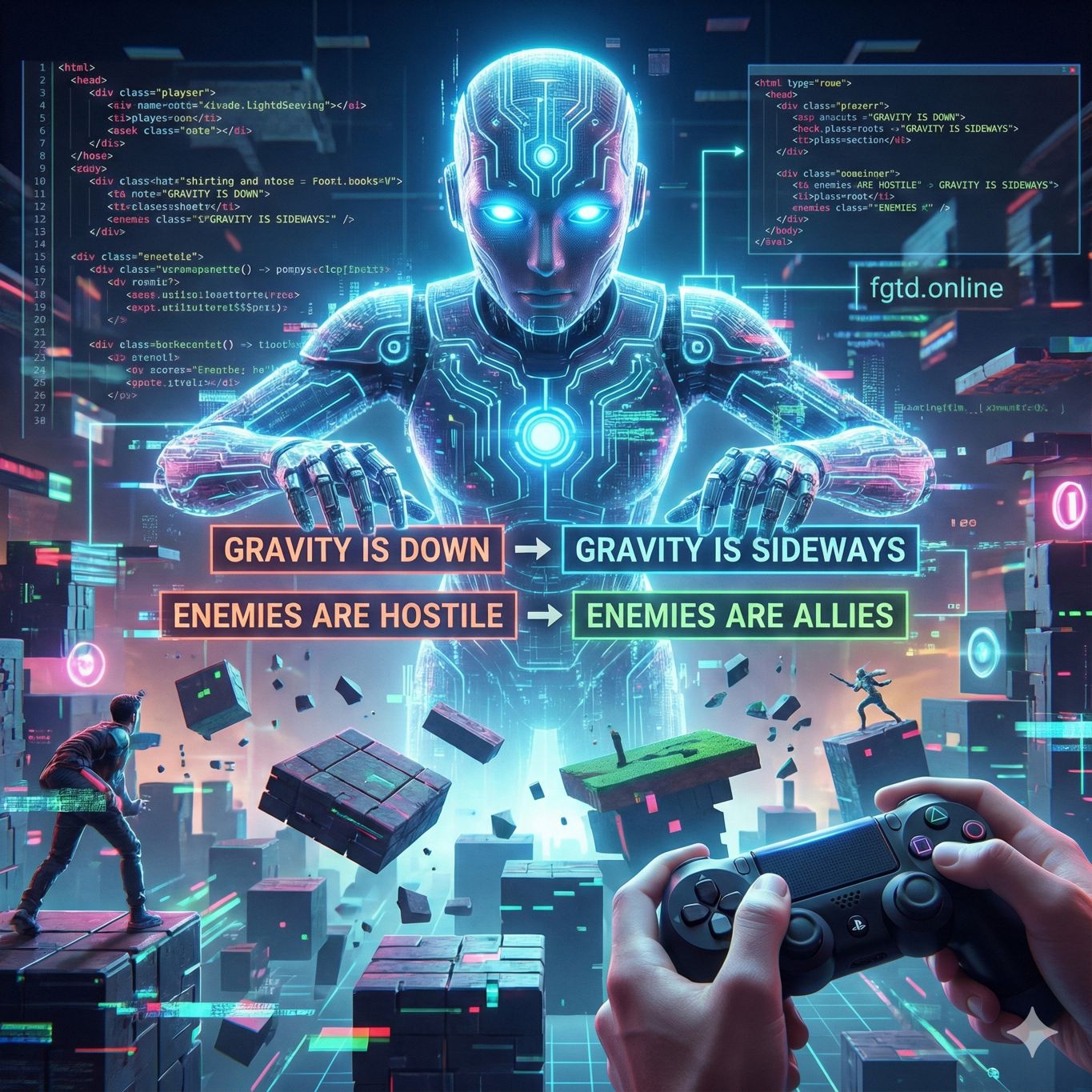
Imagine you are playing a competitive shooter. You are pinned down, ammo is low, and the enemy team is closing in. Suddenly, the gravity in the level shifts. The floor becomes the ceiling. Your standard assault rifle dissolves into a grappling hook, and the objective changes from “Capture the Flag” to “Escape the Rising Lava.” This wasn’t a scripted event by a level designer; it was a decision made milliseconds ago by an Artificial Intelligence that realized the match was becoming stagnant.
Welcome to the era of the AI Game Master.
For decades, video games have been defined by static rules. The code is the law. Players memorize mechanics, master fixed systems, and exploit predictable loops. But a new paradigm is emerging—one where the software isn’t just a referee, but an improvisational jazz musician, rewriting the laws of physics and logic in real-time to suit the emotional state of the player. This is not just about making enemies have more health or aiming better. It is about an AI that has deep access to the game engine’s very soul, capable of “hot-swapping” mechanics, altering win conditions, and generating entirely new gameplay loops on the fly.
Continues after advertising
In this deep dive, we will explore the technical architecture, design philosophy, and psychological implications of AI Game Masters. We will look at how we are moving from the “Director” systems of the past to the Neuro-symbolic AI of the future, and what happens when the game you are playing decides to change the rules.
The Evolution of the Invisible Hand: From Scripting to Directors
To understand where we are going, we must appreciate where we started. The concept of an AI monitoring the player’s state is not entirely new, but its scope has been severely limited.
- The AI Director (Left 4 Dead): Perhaps the most famous early example. Valve’s Left 4 Dead (2008) featured an “AI Director” that monitored players’ “stress levels.” If the team was taking too much damage or moving too slowly, the Director would withhold enemy spawns to give them a breather. If they were breezing through, it would trigger a horde. However, this was not changing the rules; it was merely adjusting the pacing of pre-existing assets. The zombies were always zombies; the guns were always guns.
- The Stalkers (Alien: Isolation & Resident Evil 2): In Alien: Isolation, the Xenomorph used a dual-brain system: one “Director” AI that knew exactly where you were and gave vague hints to the “Alien” AI, which then had to hunt you down using simulated senses. This created an illusion of a living, learning predator. Yet, the Alien could not decide to suddenly start setting traps or turn off the gravity. It was bound by the physics of the game.
These systems were reactive. They adjusted variables within a closed system. The next generation of AI Game Masters is generative and structural. They don’t just turn the volume knob; they change the song entirely.
When the Mechanics Are the Puzzle: The Design Goal
Before we discuss how an AI can change rules, we need to look at what that looks like. There are existing games that treat rules as fluid objects, and these serve as the perfect training data for future AI systems.
- Baba Is You: This puzzle game is the “Hello World” of dynamic rule generation. In Baba Is You, the rules of the game are physical blocks in the world. Pushing the block “Wall” away from “Stop” effectively deletes the collision physics for walls. An AI Game Master would essentially be playing a meta-game of Baba Is You in the background of a standard game. It could logically deduce: “The player is bored with shooting. I will disconnect the ‘Gun is Shoot’ logic and connect ‘Gun is Teleport’.”
- Inscryption & Pony Island: These games (by Daniel Mullins) are masterclasses in subverting expectations. They actively break the “fourth wall” and change genres—from a card game to an RPG, to a file-management puzzle. Currently, these shifts are hard-coded by a human genius. The goal of AI research is to have a system that can design these shifts procedurally.
The Technical Architecture: How Do You Rewrite Code at Runtime?
This is the biggest hurdle. Most game engines (Unity, Unreal Engine 5) are designed to “bake” logic before the game ships. Code is compiled. Physics engines are optimized for specific constants. Changing the fundamental rules of how an object interacts with the world usually requires stopping the game and rewriting the script. So, how does an AI do it live?
- Neuro-Symbolic AI: Pure machine learning (like ChatGPT or Midjourney) is “dream-like.” It hallucinates. You cannot have an AI hallucinate game code, or the player will fall through the floor, or the game will crash. This is where Neuro-Symbolic AI comes in. It combines the learning capabilities of neural networks (to read player emotion and strategy) with the logic of symbolic AI (formal rules).
- The Neural part sees you are frustrated because you keep dying to a sniper.
- The Symbolic part understands the rule set:
Sniper_Damage = 100. It doesn’t just change the number; it might reason,IF Player_Frustration > 80% THEN Grant_Ability(Reflect_Projectiles). It understands the logic of the code, not just the text.
- Runtime Script Injection (Lua/Python Integration): To make this work, modern experimental engines are embedding interpreted languages (like Lua or Python) deeper into the core loop. The AI doesn’t rewrite the C++ source code of the engine; it writes a script that the engine interprets on the next frame.
- Example: The AI generates a JSON file describing a new weapon. The game engine reads this file at runtime and assembles the weapon from existing assets, assigning it new behaviors (e.g., “Bullets heal enemies” instead of “Bullets hurt enemies”).
- The “Hot-Swap” Architecture: We are seeing a move towards “Component-Based Architecture” where behaviors are not hard-coded into the player character but are “cards” that can be equipped or unequipped by the system.
- Standard Game:
Player.Jump()is a permanent function. - AI-Driven Game: The Player is an empty container. The AI attaches a
Jumpcomponent. Later, it might detachJumpand attachJetpack_HoverorGravity_Reverse. The game engine is built to expect these components to vanish or appear instantly without crashing.
- Standard Game:
The Psychology of Chaos: Fairness vs. Fun
The technical challenge is solvable. The design challenge is massive. Players hate unfairness.
If you are winning a match of Counter-Strike and the AI suddenly decides to give the losing team a tank, you will feel cheated. This is the “Blue Shell” problem (from Mario Kart) applied to serious gaming.
- The Flow State: The goal of the AI Game Master is to keep the player in the “Flow” channel—the zone between Boredom and Anxiety.
- Too Easy -> Boredom: The AI introduces a rule change that disrupts your dominant strategy. (e.g., “You are using the sniper rifle too much. Now, sniper scopes are blurry unless you move constantly.”)
- Too Hard -> Anxiety: The AI introduces a “Helpful Glitch.” (e.g., “The system is ‘corrupted.’ Enemies now move at 50% speed for 10 seconds.”)
- Transparency and Narrative: To make this acceptable, the AI must “diegeticize” the changes. It cannot just be a random variable change. It needs a narrative reason.
- Bad AI: “Enemy health increased by 200%.” (Feels like cheating).
- Good AI: The AI triggers a dynamic event: “Nanobot swarm detected. Enemies are now armored.” (Feels like a challenge).
Case Study: The “Dungeon Master” LLM
We are already seeing the first prototypes of this with Large Language Models (LLMs). Developers are hooking up GPT-4 to Skyrim mods and text adventures.
In a recent experiment, a modder connected ChatGPT to a stealth game. The AI was given control over the NPC guards’ “awareness” and “dialogue.”
- Scenario: The player knocks over a vase.
- Standard AI: Guard hears noise -> Goes to noise -> Returns to patrol.
- AI Game Master: The Guard (powered by LLM) hears the noise. It checks the player’s history. It realizes the player has been very aggressive. The Guard yells, “I know you’re there! Lock down the sector!” and actually triggers a code function that locks the digital doors in the level. The AI didn’t just play a sound file; it changed the state of the level based on a logical deduction.
The Future: Procedural Mechanics and “The Infinite Game”
Where does this lead in 5 or 10 years?
- Personalized Genres: The game starts as a platformer. The AI realizes you are bad at jumping but great at puzzle-solving. Slowly, the platforms stop requiring reflexes and start requiring logic. By hour 10, you are playing a completely different game than your friend, who is playing a high-speed action game in the same world. The AI has redesigned the genre around your cognitive strengths.
- The End of the “Meta”: In competitive gaming (Esports), the “Meta” is the most effective tactic available. Players copy the pros, and the game becomes stale. An AI Game Master destroys the Meta. If 80% of players start using Weapon X, the AI actively evolves the game world to render Weapon X less effective, forcing players to adapt in real-time. The best player is no longer the one who memorized the spray pattern, but the one who can adapt fastest to changing rules.
- Ethical/Safety Layers: We will need “AI Safety” layers not just for hate speech, but for game design. An AI that wants to “maximize engagement” might realize that making the player incredibly angry keeps them playing (rage-queuing). Developers will need to code “Kindness Constraints” to ensure the AI Game Master doesn’t become a psychological tormentor.
Read More👉 Fan Culture Around the World: Passion Beyond the Pitch
Conclusion
The AI Game Master represents the shift from games as products to games as services of experience. We are moving away from the “choose your own adventure” book (where the paths are pre-written) to a Dungeons & Dragons session where the Dungeon Master is a supercomputer capable of calculating physics, emotion, and narrative simultaneously.
This technology promises to solve the problem of replayability forever. Why would you ever stop playing a game that grows, learns, and changes with you? The next time you feel a sudden, unexpected shift in your favorite game—a door opening where there was a wall, or a weapon behaving strangely—don’t check the patch notes. It might just be the machine, watching you, and deciding it’s time to make things interesting.
Video of AI Game Master concept
This video features a discussion on the future of AI in game development, specifically touching on how “Game Master” AI concepts could evolve from static rules to improvisational, participatory media where the system plays back with the user. It helps visualize the transition from traditional game design to the dynamic future discussed in the post.