Concours d’Elegance: Investing in Historic Race Cars
High-net-worth investors and automotive connoisseurs increasingly turn to blue-chip passion assets to diversify capital away from volatile equities. Historic competition automobiles represent an extraordinary intersection of mechanical artistry, cultural significance, and finite historical supply. Entering vehicles into prestigious international Concours d’Elegance events elevates collector status while systematically amplifying long-term investment valuations for rare racing machinery.
Historically, classic car ownership functioned primarily as a private, informal passion pursuit centered around regional rallies, unverified restorations, and personal garage preservation. Today, institutional wealth managers, family offices, and dedicated investment funds view authenticated competition cars as durable alternative capital assets. Winning top concours honors fundamentally transforms vintage racing vehicles into verified, liquid historical treasures.
The Confluence of Motorsport Heritage and Capital Preservation
Unlike standard road-going luxury automobiles, which naturally suffer from continuous mechanical depreciation and production line ubiquity, genuine historic competition cars operate under absolute scarcity. A vintage sports racing prototype constructed by Scuderia Ferrari, Porsche Motorsport, Aston Martin, or Alfa Romeo for the 24 Hours of Le Mans, Mille Miglia, or Monaco Grand Prix cannot be manufactured again.
Continues after advertising
However, the classic car marketplace has matured beyond sentimental attachment. Buyers in the multi-million-dollar arena demand verifiable provenance, uncompromised mechanical originality, and third-party institutional validation.
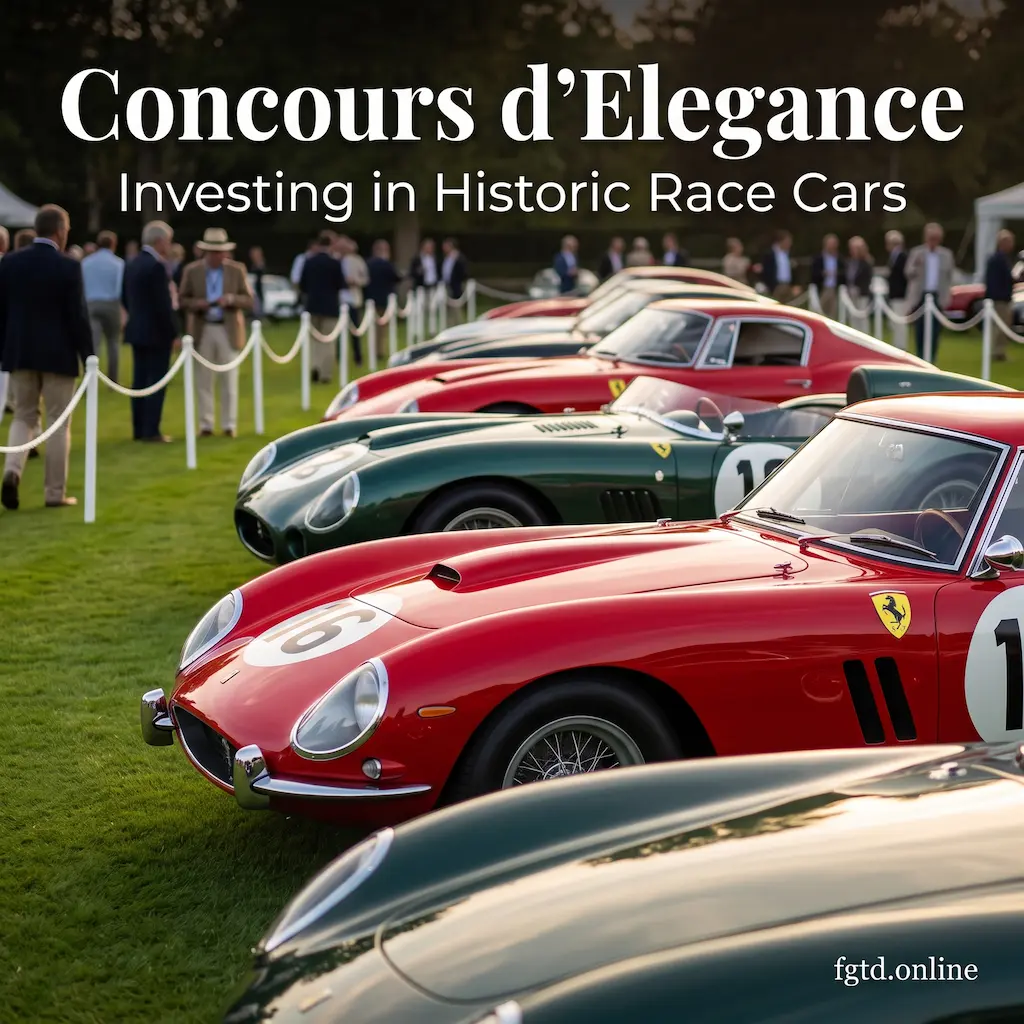
This is where the international Concours d’Elegance (a French term translating to “competition of elegance”) serves as the primary arbiter of value. Events such as the Pebble Beach Concours d’Elegance in California, the Concorso d’Eleganza Villa d’Este on Lake Como, and the Hampton Court Concours in the United Kingdom serve as the elite exhibition grounds where historic racing machinery is scientifically judged, historically ratified, and financially elevated.
By positioning rare motorsport assets under international scrutiny, Concours d’Elegance: Investing in Historic Race Cars transforms extraordinary engineering into an appreciating alternative asset class.
Key Valuation Drivers for Competition Provenance
When evaluating a competition automobile as a capital investment, collectors and forensic historians analyze five interconnected attributes:
1. Documented Period Racing Pedigree
The foundation of a historic race car’s value is its verified competition log:
- Race Victories: Did the chassis win outright at an iconic event like the 24 Hours of Le Mans, Sebring 12 Hours, or Targa Florio, or was it merely an entrant?
- Iconic Drivers: Was the steering wheel piloted by racing legends such as Juan Manuel Fangio, Sir Stirling Moss, Carroll Shelby, or Mario Andretti?
- Works Team vs. Privateer: Factory “works” entries built and supported directly by the manufacturer’s racing division consistently command substantial pricing premiums over privateer customer chassis.
2. Forensic Provenance and Continuous History
An unbroken chain of ownership from the day the car rolled out of the factory racing department to the present is essential:
- Continuous ownership documentation prevents identity confusion, which occasionally arises when surviving spare chassis or rebuilt test mules claim the identity of famous cars.
- Historical scrutineering stamps, period race photography, and original team logbooks serve as forensic proof of historical authenticity.
3. Numbers-Matching Originality vs. Period Modification
Historic race cars endured severe mechanical trauma during their active service lives. Engines blew, gearboxes shattered, and body panels crumpled in high-speed accidents.
- While standard collector road cars demand completely original, unmolested factory components, historic racing machinery is judged on period correctness.
- Retaining the original factory chassis stamping, original chassis tag, and numbers-matching engine block represents the gold standard. Where components were replaced in period by the factory race team, comprehensive documentation preserves asset integrity.
Structural Comparison: Road-Going Supercars vs. Concours-Grade Historic Race Cars
Evaluating the investment, operational, and valuation distinctions between modern limited-run supercars and concours-grade historic competition vehicles illustrates the distinct characteristics of vintage racing assets:
Asset Scarcity and Reproducibility
- Modern Road-Going Supercars: Relative scarcity; manufacturers produce hundreds or thousands of units, with newer generations continuously superseding performance figures.
- Concours Historic Race Cars: Absolute scarcity; limited build runs (often fewer than five to ten surviving chassis) with non-replicable period competition history.
Market Liquidity and Auction Dynamics
- Modern Road-Going Supercars: High transaction frequency; readily traded via standard luxury exotic brokerages and online platforms with price sensitivity to mileage.
- Concours Historic Race Cars: Institutional liquidity; private treaty brokerage and headline evening slots at blue-chip auction houses (Gooding & Company, RM Sotheby’s, Bonhams).
Valuation Driver
- Modern Road-Going Supercars: Factory options, zero-mile storage preservation, and short-term speculative hype cycles.
- Concours Historic Race Cars: Irreplaceable cultural provenance, competition victories, mechanical authenticity, and international concours ribbons.
Operational Utility and Event Access
- Modern Road-Going Supercars: Restricted street driving, casual track days, and commercial brand rallies.
- Concours Historic Race Cars: Exclusive invitations to historic motorsport events (Goodwood Revival, Le Mans Classic, Rolex Monterey Motorsports Reunion) and world-tier concours lawns.
The Concours Multiplier: How Rosettes Drive Realized Returns
Entering an elite historic race car into a premier concours is not merely a social gathering; it is a meticulous financial underwriting process.
- Class Wins and Best of Show Status: Achieving a class victory or capturing the coveted “Best of Show” trophy at an event like Pebble Beach or Villa d’Este immediately adds measurable liquidity and a tangible price premium to the underlying chassis. The vehicle enters an elite catalog of historically certified masterpieces.
- Rigorous Scrutineering as Institutional Audit: Concours judges are world-renowned historians, engineers, and marque specialists. Their inspection acts as a formal audit of chassis numbers, period-correct coachwork rivets, engine casting marks, and livery accuracy.
- Global Exposure to Institutional Buyers: Premier concours events assemble the highest concentration of private collectors, museum curators, and sovereign wealth representatives in the world. Exposing a vehicle on the concours lawn serves as premier marketing ahead of private off-market transactions.
Mitigating Risk: Restoration, Maintenance, and Certification
Investing in historic competition machinery requires careful risk management:
- Conservation vs. Over-Restoration: Modern concours judging panels increasingly penalize cars that are “over-restored” with glossy modern clearcoats and flawless body gaps that never existed in the racing pits. Preserving authentic period patina and original battle scars yields higher scores and greater historical value.
- Factory Heritage Certification: Leading manufacturers now operate in-house heritage departments (such as Ferrari Classiche, Porsche Classic, and Lamborghini Polo Storico). Securing a factory-issued certificate of authenticity binds the vehicle to official archives, permanently validating the asset against counterfeit disputes.
Read More👉 Computer Vision in Sports: Real-Time Biomechanics Tech
Conclusion: Tangible History as an Enduring Asset Class
Historic competition automobiles sit at the absolute pinnacle of alternative tangible investments. While financial markets fluctuate and monetary currencies experience inflationary pressure, museum-grade historic race cars retain enduring appeal as mechanical sculptures that triumphed in motorsport history.
By pairing meticulous forensic documentation and factory heritage authentication with strategic entries at international Concours d’Elegance events, sophisticated investors safeguard automotive history while capturing long-term capital preservation.
As global wealth continues to seek finite, verifiable, and culturally significant assets, historic racing machines will maintain their extraordinary desirability—permanently establishing Concours d’Elegance: Investing in Historic Race Cars as a premier discipline in alternative wealth management.