Virtual Production: How Game Engines Reshape Cinema
For more than a century, cinematic production operated within a rigid, sequential pipeline. A film project progressed linearly from pre-production to principal photography, followed by an extensive post-production phase where visual effects (VFX) artists worked for months in isolation to composite digital backgrounds, adjust color balance, and clean up footage. During production on soundstages, directors and actors were surrounded by monochromatic green and blue screens, forcing performers to imagine alien worlds, epic landscapes, and complex set pieces without any visual context.
However, the rapid convergence of real-time computer graphics, high-density LED hardware, and camera tracking systems has triggered a fundamental paradigm shift: Virtual Production Powered by Real-Time Game Engines.
Advanced software engines originally engineered for interactive gaming—most notably Epic Games’ Unreal Engine—have moved directly onto major Hollywood soundstages. Rather than deferring world-building and composite rendering to post-production workstations months after cameras stop rolling, filmmakers can now render photorealistic, dynamic digital environments in real time on massive LED volumes.
Continues after advertising
This transformation eliminates the guesswork of green-screen filmmaking, bridges physical set construction with boundless digital realities, and permanently dismantles the century-old boundary separating video game technology from blockbuster cinema.
This post analyzes the technological mechanics of in-camera visual effects (ICVFX), evaluates the operational transformation of modern film sets, compares traditional green screens with LED volumes, and explores how real-time rendering is redefining the future of storytelling.
1. The Green-Screen Dilemma: The Latency of Traditional Filmmaking
To understand why leading directors and cinematographers are abandoning traditional green screens, one must examine the creative, optical, and financial friction of legacy VFX workflows.
Optical Spill and Color Contamination
One of the most persistent technical headaches of green-screen stages is chroma key spill:
- Intense green light bounces off the studio cyclorama wall and spills onto the physical set, actors’ costumes, hair, skin tones, and reflective props.
- Post-production artists must spend thousands of hours manually rotoscoping edges, suppressing green fringing, and painting out reflection artifacts on metallic surfaces or glass.
- In extreme cases, costume designers are forbidden from using green or blue fabrics entirely, restricting artistic wardrobe choices.
The Imaginative Disconnect for Actors and Directors
Acting against a blank green void imposes a heavy psychological tax on performers. Actors have to deliver authentic emotional reactions toward imaginary monsters represented by a tennis ball on a stick, or navigate digital corridors without spatial depth cues.
Directors and cinematographers faced an identical creative void:
- Cinematographers had to light an actor with physical studio lamps while guessing the lighting angles, shadows, and color temperatures of a digital background that would not be designed for another six months.
- If a director realized in the edit bay that a camera angle did not match the scale of the digital city, fixing the discrepancy required costly reshoots or compromised framing.
2. Structural Mechanics: The LED Volume and ICVFX Pipeline
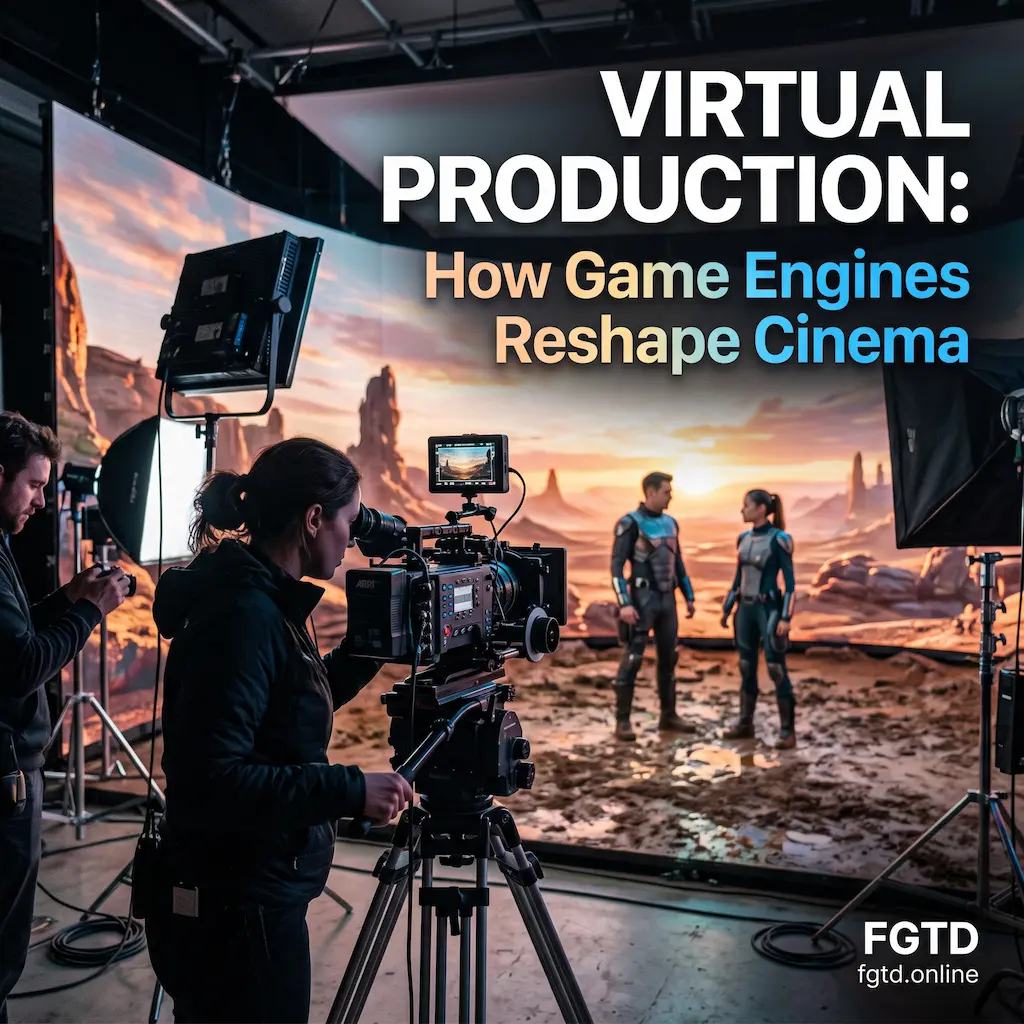
Virtual production replaces green cloth with an immersive enclosed space known as an LED volume (pioneered on productions like The Mandalorian through StageCraft technology).
The real-time in-camera visual effects (ICVFX) pipeline operates through synchronized hardware and software layers:
The Real-Time Virtual Production Workflow
- Layer 1: The Massive LED Matrix: Curved wall arrays and overhead LED ceiling panels display ultra-high-resolution, color-accurate digital backgrounds and realistic ambient lighting.
- Layer 2: Real-Time Game Engine Rendering: Engines like Unreal Engine generate three-dimensional photorealistic environments—calculating dynamic lighting, shadows, atmospheric fog, and ray-traced reflections on the fly at film-standard frame rates (24 or 48 FPS).
- Layer 3: Sub-Millimeter Camera Tracking: High-speed optical or radio-frequency tracking sensors mounted on the physical camera track its exact three-dimensional coordinates, pan, tilt, lens focal length, and focus distance in real time.
- Layer 4: Dynamic Parallax Generation: As the physical camera moves on a dolly, crane, or steadicam, the game engine updates the perspective rendered on the LED wall behind the physical set, producing accurate optical parallax and realistic depth of field through the camera lens.
By rendering the digital background through the camera’s precise optical perspective, the physical set props and the digital background merge seamlessly into a single in-camera capture.
3. Structural Optimization Ledger: Green Screen vs. In-Camera Virtual Production
Evaluating the optical, operational, and financial dimensions that separate traditional chroma key shoots from real-time LED volume stages illustrates why major studios are investing heavily in virtual stages.
Natural Lighting and Photorealistic Reflections
- Traditional Green Screen: Artificial flat lighting required; shiny, reflective surfaces (such as chrome armor, glass, or wet asphalt) must be replaced or painted out digitally.
- Real-Time LED Volume (ICVFX): The LED panels emit natural, image-based lighting directly onto actors and physical props, capturing authentic specular highlights and reflections on glass, chrome, and water instantly in-camera.
Post-Production VFX Timelines
- Traditional Green Screen: Heavy post-production pipeline; weeks or months spent on rotoscoping, chroma-key pulling, edge feathering, and synthetic compositing.
- Real-Time LED Volume (ICVFX): “Final-pixel” imagery captured live on set; significantly reduces post-production turnaround times and accelerates editorial delivery.
Iterative Creative Decision-Making
- Traditional Green Screen: Linear and delayed; final visual effects decisions are deferred to post-production teams after principal photography has wrapped.
- Real-Time LED Volume (ICVFX): Collaborative and instantaneous; directors, directors of photography (DPs), and production designers adjust sun angles, weather patterns, and terrain geometry live on set with a few keystrokes.
Location Travel & Logistics Overhead
- Traditional Green Screen: Requires flying massive cast and crew contingents to global locations, dealing with weather delays, permits, and equipment transport.
- Real-Time LED Volume (ICVFX): The world comes to the stage; a production can film a sunrise in the Sahara desert in the morning and a twilight scene in Tokyo that afternoon within the same physical soundstage.
4. The Golden Hour at Will: Real-Time Environmental Control
In traditional location filming, directors are at the mercy of unpredictable weather patterns and daylight cycles. The coveted “golden hour”—the brief window of soft, warm sunlight just after sunrise or right before sunset—lasts only twenty to thirty minutes per day, forcing production crews into frantic, rushed setups across multiple consecutive days.
Virtual production eliminates the tyranny of time:
- Inside an LED volume, the game engine can freeze the virtual sun at a precise three-degree angle above the horizon indefinitely.
- Cinematographers can shoot complex dramatic scenes with consistent golden-hour lighting across twelve straight hours.
- If a director wants clouds to part, fog to roll in, or the camera angle to feature a mountain peak instead of an open field, an operator shifts the digital terrain asset in real time on a workstation console.
5. The Democratization of World-Building: Indie Cinema and Beyond
While early iterations of virtual production required multi-million-dollar studio footprints, the technology is democratizing rapidly:
- Accessible Software Toolkits: Game engines and spatial tracking plugins are freely available or operate on low-cost licensing models, enabling independent filmmakers to access the exact same rendering toolkits used on blockbuster franchises.
- Modular Micro-Volumes: Production companies are constructing modular, compact LED setups for mid-budget films, music videos, and commercial advertisements, reducing production costs by shooting entirely within local facilities.
- Digital Location Scouting: Directors and production heads can put on virtual reality (VR) headsets during pre-production to scout photorealistic digital locations together remotely, blocking out camera lenses, lighting rigs, and shot lists before building physical stage pieces.
Read More👉 The Esports Winter: Surviving the Tech and Media Crunch
Conclusion: The Convergence of Interactive Silicon and Celluloid Art
Virtual production is not merely a technical substitute for green cloth; it is the most significant creative evolution in motion picture production since the transition from black-and-white film to color. The historical model that separated the spontaneous energy of the physical film set from the meticulous craftsmanship of digital visual effects has been dismantled by real-time computational rendering.
By placing high-performance game engines at the heart of cinematic soundstages, filmmakers have regained the ability to collaborate organically, make creative decisions in the moment, and capture photorealistic visual magic directly through the camera lens.
As game engine physics grow more sophisticated and LED panel resolutions sharpen worldwide, the line between the physical world and digital imagination will disappear entirely—permanently establishing Virtual Production as the transformative engine reshaping modern cinema worldwide.