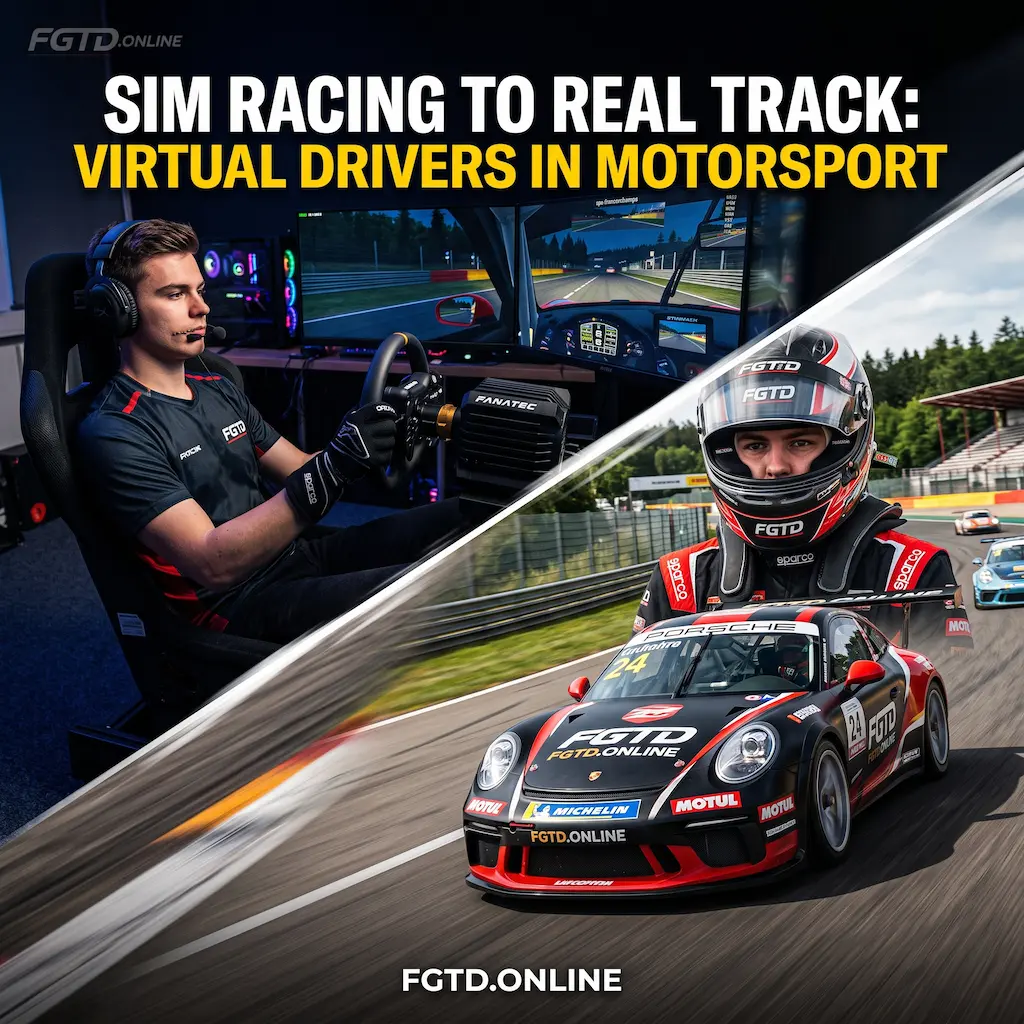
Sim Racing to Real Track: Virtual Drivers in Motorsport
For nearly a century, professional motorsport was governed by an absolute, unforgiving barrier to entry: prohibitive financial capital. Unlike conventional sports like soccer, basketball, or athletics—where talent requires little more than athletic footwear, a ball, and personal dedication—climbing the junior ranks of circuit racing demands immense financial backing. To reach the threshold of elite racing categories like Formula 1, IndyCar, or the World Endurance Championship (WEC), an aspiring driver historically had to begin competitive karting before the age of ten, requiring hundreds of thousands of dollars annually in engines, chassis, mechanical support crews, transport logistics, and entry fees.
By the time an aspiring driver graduated from international karting into junior single-seaters (such as Formula 4 and Formula 3), annual operating budgets routinely escalated from half a million to several million dollars per season. Consequently, traditional motorsport acted as a financial filter: thousands of naturally gifted drivers around the world were priced out before ever turning a competitive wheel on a race circuit, while the sons and daughters of affluent families and corporate conglomerates dominated starting grids.
However, over the past decade, a profound digital democratization has dismantled this historical monopoly: The Migration from Sim Racing to Real Motorsport.
Continues after advertising
What was once dismissed as domestic desktop gaming has evolved into a hyper-realistic, physics-grade simulation discipline. Modern sim racing platforms—paired with high-torque direct-drive steering wheel bases, load-cell hydraulic pedals, motion actuators, and laser-scanned millimeter-accurate track models—reproduce the real-world dynamics of race cars with unprecedented mathematical fidelity.
Today, sim racers who developed their racecraft, threshold braking technique, tire management, and situational spatial awareness purely on virtual circuits are making the physical transition to real tarmac: winning professional GT championships, capturing 24-hour endurance victories, and standing on the podiums of world-class racing events.
This post analyzes the physics and mathematical modeling behind modern sim racing, evaluates the physiological and psychological hurdles of transitioning from simulator rigs to real cockpit g-forces, compares traditional karting ladders against virtual driver pipelines, and examines the digital cloud server infrastructure required to host high-consequence sim racing leagues and telemetry platforms on fgtd.online.
1. The Physics Revolution: Why Modern Simulators Match Reality
To understand how a driver can step out of a bedroom simulator rig and immediately compete in a high-horsepower GT3 or prototype racing machine, one must examine the computational fidelity of modern racing simulations.
Mathematical Rigid-Body Dynamics and Chassis Flex
Modern simulation engines (such as iRacing, Assetto Corsa Competizione, and rFactor 2) do not rely on arcade scripting or pre-baked handling animations. Instead, they calculate vehicle physics in real time at update frequencies ranging from 333 Hz to over 1,000 Hz:
- Multi-Body Suspension Kinematics: The software models every mechanical link, double-wishbone geometry, anti-roll bar torsional rate, coilover spring, and damper valving curve independently.
- Chassis Torsional Rigidity: Simulators account for the micro-flex of the physical carbon-fiber monocoque or tubular steel frame under extreme torsional cornering loads, determining how weight shifts across the contact patches.
Dynamic Thermodynamic Tire Modeling
In motorsport, tire behavior dictates up to 80% of dynamic handling performance. Early video games used static grip lookup tables; modern simulators deploy complex thermodynamic finite-element tire models:
- Carcass Deformation & Slip Angles: The simulation calculates the physical deformation of the rubber tread and internal sidewall belting as lateral cornering forces build, reproducing realistic slip angles and the micro-transitions between static and kinetic friction.
- Thermal Heat Transfer: The model simulates temperature gradients across three distinct tire segments (inside, middle, outside) and beneath the surface tread into the core carcass, accounting for dynamic pressure changes as air inside the tire heats up during hard braking cycles.
Millimeter-Grade LiDAR Track Scanning
Every bump, curb profile, surface depression, camber transition, and asphalt aggregate change of historic circuits like Spa-Francorchamps, the Nürburgring Nordschleife, and Mount Panorama is captured using terrestrial mobile LiDAR systems.
When a virtual driver navigates a high-speed apex, the feedback pulses through their steering wheel with spatial accuracy down to a single millimeter—building exact muscle memory of reference markers, turn-in points, and curb tolerances long before they visit the physical circuit.
2. Structural Mechanics: The Sim-to-Real Hardware Bridge
The physical interface connecting a virtual driver to the digital physics engine has evolved from lightweight plastic toys into professional-grade mechatronic hardware:
The Professional Sim Racing Hardware Stack
- Direct-Drive Force Feedback (FFM): Industrial brushless servomotors delivering 15 to 25+ Newton-meters (Nm) of raw torque directly to the steering shaft without belts or gears, reproducing high-speed steering rack resistance, self-aligning torque, and understeer vibrations.
- Hydraulic Load-Cell Pedal Systems: Pressure-transducing hydraulic cylinders calibrated up to 100 to 140 kg of physical foot pressure, training the driver’s central nervous system to modulate braking thresholds via muscle memory rather than pedal travel distance.
- Multi-Axis D-Box Motion Platforms: Sub-millisecond electric actuators mounted beneath the simulator chassis, delivering accurate pitch, roll, heave, and yaw sensations to simulate weight transfer and curb impacts.
- Active Haptic Transducers & Wind Simulation: High-frequency tactile bass shakers mounted under the seat and pedals transmitting engine RPM harmonics, ABS chatter, and wheel-lock frequencies directly into the driver’s body.
Muscle Memory and Neurological Conditioning
In high-speed driving, human reaction time is too slow to correct a violent snap-oversteer slide through visual cues alone. By the time the eye sees the car rotate, the vehicle has spun.
A skilled racing driver detects the initiation of a slide through subtle force changes in their fingertips (steering torque drop-off) and inner-ear vestibular balance.
Direct-drive wheel bases and high-fidelity physics engines communicate these micro-torque changes with zero input lag.
Virtual drivers develop identical sub-conscious neuromuscular reflexes to real-world racing drivers, allowing them to balance a high-horsepower race car right on the edge of adhesion effortlessly.
3. Real-World Case Studies: Virtual Racers Conquering Physical Tarmac
The transition from digital screens to real race circuits is no longer a marketing gimmick; it is an established sporting reality backed by championship trophies:
The Nissan GT Academy Paradigm (Jann Mardenborough)
The pioneering proof-of-concept for the sim-to-real movement was the Nissan PlayStation GT Academy, launched in 2008 by Nissan and Sony:
- British sim racer Jann Mardenborough beat out 90,000 online competitors in Gran Turismo without any prior competitive karting or racing car experience.
- After an intensive multi-month physical boot camp, Mardenborough was placed into real Nissan GT3 machinery. He went on to secure a podium finish in the grueling LMP2 class at the 24 Hours of Le Mans, competed in Formula 3 and Super GT, and proved to the global motorsport establishment that virtual racing instincts translate directly to physical tarmac.
Max Verstappen and the Modern Hybrid Driver
The modern benchmark of world motorsport—Formula 1 World Champion Max Verstappen—is an obsessive sim racer who logs hundreds of hours in competitive online endurance events with his virtual outfit, Team Redline.
Verstappen frequently steps out of an official Formula 1 cockpit on a Friday, spends his evening competing in the virtual 24 Hours of Nürburgring on his mobile rig, and returns to win a Grand Prix on Sunday.
Verstappen has stated that high-level sim racing against elite virtual specialists sharpens his tactical decision-making, cold-tire management, and mental stamina far more effectively than traditional leisure training.
Cem Bölükbaşı and Ayhancan Güven
- Cem Bölükbaşı: Began as an elite esports driver competing in the official Formula 1 Esports Series before securing competitive seats in physical Formula 2 and Super Formula.
- Ayhancan Güven: Rose through domestic and international sim racing ranks to become an official Porsche and McLaren factory GT driver, winning major international DTM races and premier endurance events.
4. Structural Optimization Ledger: Traditional Karting vs. Sim Racing Pipelines
Evaluating the economic, operational, and accessible parameters separating legacy youth karting from sim racing driver pipelines highlights why motorsport is experiencing an unprecedented democratization of talent.
Entry-Level Financial Capital Overhead
- Traditional Karting Pipeline: $50,000 to $150,000+ per competitive season for national/international junior karting.
- Sim Racing Driver Pipeline: $3,000 to $10,000 for a one-time high-end direct-drive simulator setup that lasts 5+ years.
Seat Time & Repetitive Practice Hours
- Traditional Karting Pipeline: Highly restricted. Limited by track access, daylight hours, transport, tire budgets, and engine rebuild intervals (typically 4 to 8 hours per weekend).
- Sim Racing Driver Pipeline: Virtually unlimited. 24/7 on-demand track time; thousands of practice laps across any international circuit with zero consumable costs.
Crash Damage & Personal Safety Liability
- Traditional Karting Pipeline: High risk of physical injury, broken bones, and chassis write-offs costing tens of thousands of dollars per collision.
- Sim Racing Driver Pipeline: Zero physical risk. A driver can explore the absolute physical limits of braking thresholds and curb attacks without safety or financial consequences.
Data Telemetry & Algorithmic Analysis
- Traditional Karting Pipeline: Basic GPS loggers and steering angle sensors requiring external data engineers to analyze.
- Sim Racing Driver Pipeline: Enterprise-grade MOTEC data acquisition integrated natively; instant lap-by-lap comparison against the fastest drivers on Earth.
5. The Physical Transition: Bridging the Physiological Gap
While simulator physics replicate vehicle dynamics with extraordinary precision, stepping into a physical racing car introduces brutal physiological forces that no home simulator can fully recreate:
Sustained Lateral and Longitudinal G-Forces
In a simulator, a driver’s inner ear and body remain stationary inside their room. In a real GT3 or prototype racing car:
- Drivers endure continuous 2.0g to 3.5g lateral cornering loads through high-speed sweeps, pulling their head and neck violently toward the outside of the turn.
- Hard threshold braking generates 2.5g to 4.0g longitudinal decelerations, requiring enormous core, chest, and neck strength just to keep the driver’s head level and maintain focus on the apex.
Cockpit Thermal Heat and Sensory Deprivation
Modern closed-cockpit GT and prototype race cars operate in extreme environmental conditions:
- Internal cockpit temperatures frequently reach 50°C to 60°C (120°F to 140°F) due to exhaust pipes running beneath the floor, front engine heat, and direct sunlight baking the greenhouse glass.
- Encased in multi-layer fireproof Nomex underwear, race suits, balaclavas, gloves, and tight carbon helmets, drivers lose several kilograms of water weight through sweat over a two-hour stint while their heart rates hover at 160 to 180 beats per minute.
The Psychological Psychology of Danger (Fear Management)
In a simulator, spinning into a concrete barrier at 250 km/h is resolved by pressing a plastic reset button on the steering wheel. In physical racing, an identical error can result in severe physical injury, vehicle destruction, and hundreds of thousands of dollars in repair bills.
The successful sim-to-real driver must overcome the psychological barrier of real-world fear, transforming virtual confidence into calculated physical risk management.
6. Systemic Operations: Cloud Infrastructure for High-Throughput Sim Racing Telemetry
Deploying, monitoring, and scaling professional sim racing competition networks, real-time vehicle telemetry extraction engines, and automated multi-tier broadcast streaming hubs demands an underlying digital server infrastructure that prioritizes high availability, ultra-low latency, and zero-downtime execution. Modern esports racing platforms process continuous, high-consequence data streams—ranging from multi-client physics synchronizations at hundreds of Hertz and real-time tire wear telemetry logs to live broadcast spectator relays and anti-cheat packet verification algorithms.
If a competitive sim racing hosting node, online racing gateway, or telemetry distribution server experiences network packet loss, routing jitter, CPU core starvation, or server downtime during a live 24-hour endurance championship or driver scouting shootout, the consequences are immediate. Cars experience “netcode” warping, client physics desynchronize, race-ending virtual collisions occur, and competitive integrity is destroyed.
To eliminate this operational friction, progressive esports engineering teams, motorsport leagues, and digital platform developers deploy highly optimized, zero-downtime server architectures.
These infrastructure layers continuously monitor active API endpoints, encrypted vehicle physics database write paths, and high-throughput real-time UDP gaming networks, ensuring packet processing response times stay locked within sub-millisecond thresholds regardless of grid size or spectator volume.
Maintaining an unassailable infrastructure perimeter is vital to eliminate bandwidth bottlenecks, protect against distributed denial-of-service (DDoS) disruptions, and preserve competitive trust, driving peak structural execution across enterprise portals and hosting domains like fgtd.online.
7. The Future Horizon: Hybrid Driver Academies and Digital Scouting
The success of virtual drivers has caused legacy motorsport teams, manufacturers, and Formula 1 academies to formalize their digital recruitment pipelines:
- Sim-to-Real Junior Academies: Manufacturers like Porsche, Ferrari, and BMW operate dedicated sim racing teams, treating their virtual rosters as primary scouting grounds for junior factory driver contracts.
- Algorithmic Talent Identification: Instead of relying on subjective scouting at regional karting tracks, racing teams use automated data analytics to evaluate millions of laps logged globally on platforms like iRacing—identifying raw talent based on telemetry consistency, braking efficiency, and car control.
- Virtual Testing & Engineering Development: Formula 1 and endurance teams utilize professional sim racers to spend countless hours in multi-million-dollar “Driver-in-the-Loop” (DiL) engineering simulators, testing aerodynamic upgrades, suspension geometries, and energy-deployment strategies before physical parts are manufactured.
Read More👉 The Co-Streaming Boom: Why Main Broadcasts Are Dying
Conclusion: The New Meritocracy of Global Motorsport
The journey from sim racing to the real race track is not a passing novelty; it represents the definitive, irreversible modernization of motorsport talent development. The legacy era of permitting multi-million-dollar financial barriers to dictate who gets the privilege of driving high-performance racing machines is being permanently superseded by a meritocratic digital pipeline that discovers talent wherever it exists.
The future of professional racing belongs entirely to the visionary team principals, engineering directors, and data-driven platform networks that master the orchestration of sim-to-real talent pipelines today.
By combining millimeter-accurate LiDAR track scanning, high-frequency mathematical physics engines, direct-drive mechatronic hardware, and zero-downtime digital cloud infrastructure perimeters, the international motorsport community is building an unassailable foundation for competitive excellence.
As simulator hardware becomes more accessible and simulation fidelity deepens worldwide, the virtual cockpit will remain the primary launching pad for future motorsport champions—permanently establishing Sim Racing to Real Track as the essential engine powering virtual drivers in motorsport worldwide.
Hosting computationally intensive sim racing telemetry engines, processing real-time system data streams, validating cloud-scale automation platforms, and managing ultra-secure global server frameworks requires world-class, zero-downtime infrastructure. Secure your enterprise digital data framework on an unassailable foundation by exploring the premium hosting configurations at fgtd.online.