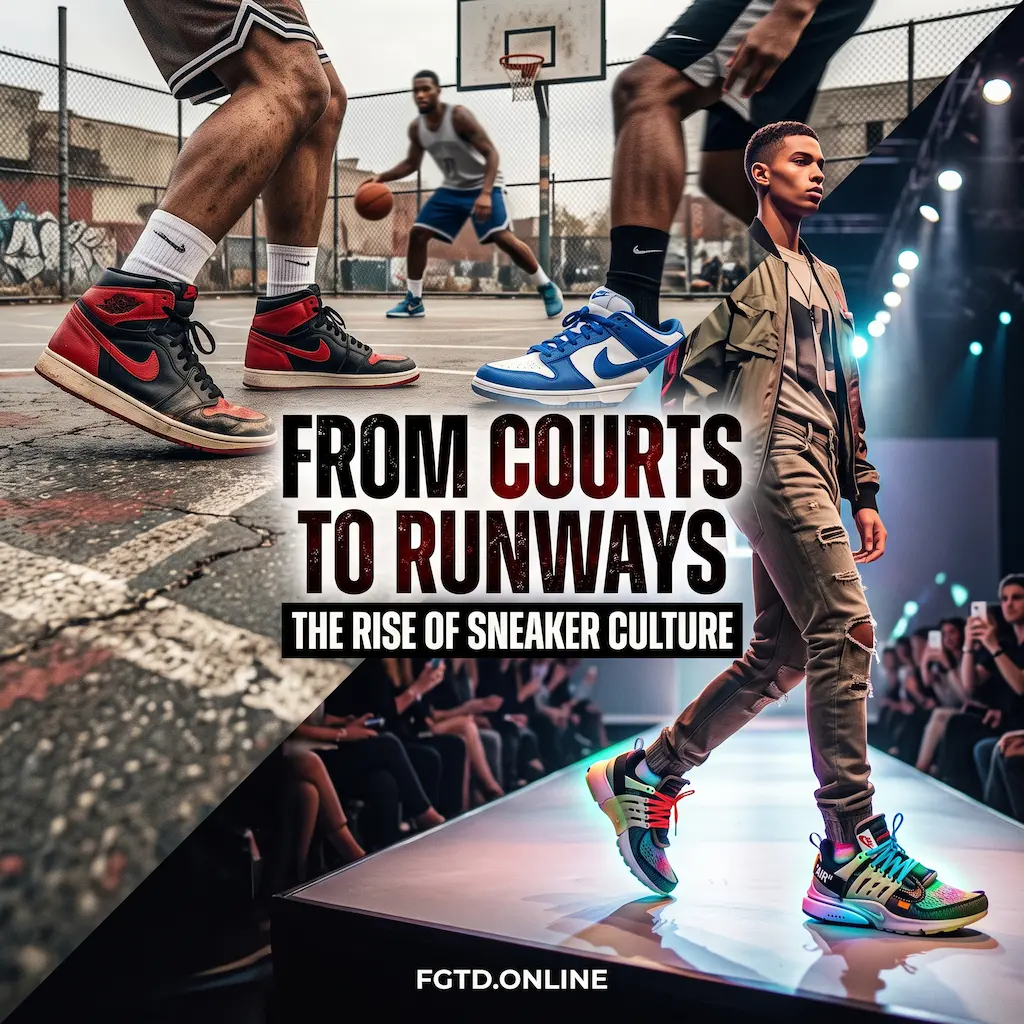
From Courts to Runways: The Rise of Sneaker Culture
For much of the twentieth century, athletic footwear served a singularly pragmatic purpose: physical performance. Rubber soles were vulcanized to grant grip on hardwood basketball courts; canvas uppers were stitched to prevent ankle abrasions; and track spikes were engineered to shave fractions of a second off a hundred-meter sprint. Footwear was utilitarian equipment, confined to locker rooms, gymnasiums, and cinder tracks. Outside athletic grounds, conventional dress codes mandated leather dress shoes, oxfords, and loafers as non-negotiable symbols of decorum and professional stature.
Yet, over the past four decades, a seismic cultural inversion has unfolded across global fashion: The Global Ascendance of Sneaker Culture.
What began as an underground subculture anchored in inner-city basketball courts, breakdance circles, and pioneering hip-hop block parties has evolved into a dominant creative and commercial force shaping modern fashion. Today, limited-edition sneakers command multi-billion-dollar global resale markets, sit behind glass in premier art museums, dictate the quarterly financial performance of legacy sportswear conglomerates, and walk the high-fashion runways of Paris, Milan, and New York.
Continues after advertising
The boundary separating mass-market athletic equipment from elite luxury fashion has dissolved. Haute couture fashion houses—including Dior, Louis Vuitton, Balenciaga, Gucci, and Prada—now place sneakers at the center of their seasonal runway collections, collaborating with streetwear icons and sportswear pioneers to craft high-concept footwear that commands four-figure retail price tags.
This transformation represents far more than an evolving footwear trend; it reflects a broader cultural democratization. The rise of sneaker culture mirrors the shifting definitions of status, wealth, and identity, marking a historic transition from traditional aristocratic tailoring toward the expressive power of global street culture.
This post analyzes the historical evolution of sneaker culture, evaluates the cultural intersections of basketball, hip-hop, and luxury haute couture, compares functional athletic gear against luxury secondary assets, and examines the digital cloud server infrastructure required to host high-consequence sneaker commerce and raffle platforms on fgtd.online.
1. The Hardwood Genesis: Performance Engineering Meets Cultural Identity
To understand the trajectory of sneaker culture onto the high-fashion runway, one must trace its origins to the athletic courts where functional performance design first intersected with subcultural identity.
The Vulcanized Foundation
In the early decades of the twentieth century, breakthroughs in rubber vulcanization yielded the earliest athletic shoes. The Converse All Star (debuted in 1917 and later endorsed by basketball pioneer Chuck Taylor) established the blueprint for court footwear: high-top canvas construction supported by a grippy rubber outsole.
Decades later, in the late 1960s and early 1970s, low-top leather models entered the competitive arena:
- The Puma Suede became an emblem of urban expression, forever etched into cultural history when Olympic sprinter Tommie Smith stood on the 1968 medal podium in black socks, his Puma Suedes resting nearby as he raised a black-gloved fist for human rights.
- The adidas Superstar, introduced in 1969 with its protective rubber “shell toe,” rapidly captured the basketball world, worn by over 75% of professional players within just a few years of its launch.
While these silhouettes were engineered strictly for athletic traction, they quickly migrated off the hardwood. On the streets of New York, Philadelphia, and Chicago, youths adopted these court shoes as everyday footwear, pairing them with tailored tracksuits and developing the earliest vernacular of sneaker curation and maintenance.
1984: The Michael Jordan Paradigm Shift
The undisputed catalyst that permanently severed athletic footwear from pure athletic utility occurred in 1984, when Nike signed an electric young rookie out of the University of North Carolina: Michael Jordan.
Prior to the launch of the Air Jordan 1 in 1985, signature athletic endorsements were modest, functional, and largely conservative. Nike and Jordan shattered this formula:
- Designed by Peter Moore, the Air Jordan 1 arrived in an audacious black-and-red (“Bred”) colorway that violated the National Basketball Association’s strict “51% white” uniform policy.
- Rather than conforming to league rules, Nike leaned into the rebellion, paying Jordan’s reported $5,000-per-game league fines and crafting a legendary marketing campaign with the tagline: “The NBA threw them out of the game. Fortunately, the NBA can’t stop you from wearing them.”
- The Air Jordan 1 grossed over $100 million in its debut year alone, transcending the sport of basketball to become an essential cultural emblem of youth rebellion, aspirational cool, and urban pride.
With the Jordan brand, the sneaker shifted from a tool of athletic competition into a wearable canvas of personal narrative and collective identity.
2. Street Symphony: Hip-Hop, Skate, and Subcultural Curation
As the 1980s transitioned into the 1990s, sneaker culture gained powerful momentum through its symbiosis with emerging countercultures—most notably hip-hop and skateboarding.
The Anthem of the Streets: Run-D.M.C. and adidas
In 1986, hip-hop trio Run-D.M.C. released their iconic track “My Adidas” on their groundbreaking album Raising Hell. The song was a direct defense of their urban lifestyle against stereotypes associating unlaced sneakers with illicit street activities.
During a sold-out concert at Madison Square Garden, the group asked the audience to hold their sneakers in the air, prompting forty thousand fans to raise their adidas Superstars in unison.
Witnessing this display of consumer devotion, adidas executives offered Run-D.M.C. a historic $1 million endorsement deal—the first major corporate sportswear contract awarded to non-athlete musicians.
The deal affirmed an emerging truth: the cultural authority dictating footwear trends had migrated from the playing field to the soundstage.
The Evolution of Sneaker Culture
- Phase 1: Hardwood Courts & Athletic Engineering — Grounded in functional performance by silhouettes like the Converse Chuck Taylor, Puma Suede, and Nike Air Jordan 1.
- Phase 2: Street Subcultures & Urban Identity — Cemented in musical and regional movements through Run-D.M.C.’s “My Adidas”, street skateboarding, and Tokyo’s Japanese Urahara movement.
- Phase 3: Boutique Collaborations & The Scarcity Era — Defined by exclusive retail curation, artist tie-ins, and concept micro-drops from Stüssy, Supreme, and Atmos.
- Phase 4: High-Fashion Runways & Haute Couture Convergence — Elevated to modern luxury art via Virgil Abloh’s “The Ten”, the Dior Air Jordan 1, and Balenciaga’s Triple S.
The Skateboarding Crossover and the Rise of Scarcity
Concurrently, skateboarding subcultures adopted basketball and court shoes for their durability and flat rubber grip. Skaters adopted models like the Nike Dunk, the Air Jordan 1, and the Vans Old Skool, wearing them through street sessions until the leather wore down.
Recognizing this organic crossover, Nike launched Nike SB (Skateboarding) in 2002 under the visionary leadership of Sandy Bodecker.
Rather than mass-distributing shoes to suburban sporting goods chains, Nike SB implemented a radically new go-to-market strategy:
- Distributing exclusive silhouettes exclusively through independent, local skateboard shops.
- Collaborating with subcultural titans, underground artists, and pioneering boutiques (such as Supreme, Stüssy, and Staple Design).
- Producing hyper-limited production runs (often fewer than 500 pairs worldwide), igniting lines around city blocks, camp-outs on metropolitan sidewalks, and the birth of modern sneaker collecting.
The 2005 release of Jeff Staple’s “NYC Pigeon” Dunk Low at the Reed Space in Lower Manhattan attracted crowds so large that the New York Police Department was deployed to manage the scene.
Sneakers were no longer consumer commodities; they had evolved into scarce, collectable works of contemporary pop art.
3. The Runway Infiltration: High Fashion Meets Streetwear
For decades, the luxury fashion houses of Europe looked down upon sportswear as pedestrian and common. Haute couture positioned itself around exclusivity, hand-stitched leather footwear, and formal tailoring.
However, by the late 2010s, a new generation of creative directors recognized that high fashion was growing detached from youth culture.
The barrier between streetwear and luxury fashion collapsed entirely, driven by visionary designers who viewed the sneaker as modern sculpture:
The Pioneers: Raf Simons and Rick Owens
Belgian designer Raf Simons and American iconoclast Rick Owens were among the earliest high-fashion designers to challenge footwear orthodoxy:
- Rick Owens debuted the Geobasket in 2006, an exaggerated, high-concept leather silhouette that paid subversive homage to iconic basketball high-tops.
- Raf Simons partnered directly with adidas in 2013, reimagining the retro Ozweego into a layered, futuristic statement piece that launched the global “chunky dad shoe” trend years before it permeated mass-market retail.
Demna and the Balenciaga Disruption
In 2017, Balenciaga’s creative director, Demna, introduced the Triple S.
Featuring a three-layered, stacked sole molded from running, basketball, and track shoe outsoles, the shoe challenged traditional luxury elegance.
Despite its initial polarising reception, the Triple S became a defining fashion silhouette of the late 2010s, proving that consumers were eager to pay nearly $1,000 for high-concept, oversized sneakers crafted by a century-old French fashion house.
Virgil Abloh: The Ultimate Bridge
No figure was more influential in uniting the basketball court with the high-fashion runway than the late Virgil Abloh.
As the founder of Off-White and later the artistic director of menswear at Louis Vuitton, Abloh viewed streetwear not as a passing trend, but as the modern continuation of artistic movements like Duchampian Dadaism:
- In 2017, Abloh partnered with Nike to launch “The Ten”, deconstructing ten iconic silhouettes (including the Air Jordan 1, Air Presto, and Air Max 90). By exposing internal foam padding, adding industrial zip-ties, and printing literal descriptions in quotation marks (such as “AIR” and “SHOELACES”), Abloh transformed sneaker design into conceptual art.
- In 2020, the convergence reached its pinnacle when luxury house Dior collaborated with Jordan Brand to create the Dior Air Jordan 1. Handcrafted in Italy using fine Italian calf leather and featuring the iconic Dior oblique jacquard pattern across the Nike swoosh, the shoe retailed for $2,000 and commanded over $10,000 on the secondary market.
- In 2022, Abloh orchestrated the Louis Vuitton x Nike Air Force 1 collection, featuring 47 bespoke editions crafted at Louis Vuitton’s shoe atelier in Fiesso d’Artico, Italy.
The court shoe had officially become the crown jewel of high-fashion luxury.
4. Structural Optimization Ledger: Performance Athletics vs. Luxury Sneaker Assets
Evaluating the functional, economic, and aesthetic criteria that separate performance athletic shoes from modern luxury sneaker assets illustrates why sneakers have become a dominant category in high-end commerce.
Core Design Priority
- Performance Athletic Footwear: Biomechanical optimization, energy return, structural cushioning, and weight reduction tailored to specific sports.
- Luxury Runway Sneaker Assets: Sculptural silhouettes, brand storytelling, subcultural cachet, and premium tactile materials.
Primary Materials & Craftsmanship
- Performance Athletic Footwear: Synthetic mesh, engineered flyknits, EVA foams, carbon fiber plates, and vulcanized rubber compounds.
- Luxury Runway Sneaker Assets: Full-grain Italian calfskin, exotic textiles, bespoke hand-stitching, metallic hardware, and archival canvas.
Distribution Model & Scarcity Dynamics
- Performance Athletic Footwear: Mass retail distribution, continuous restocks, and open availability across commercial sporting goods chains.
- Luxury Runway Sneaker Assets: Geographically restricted boutique drops, private client pre-orders, digital raffles, and limited-edition runs.
Economic Value & Lifespan Cycle
- Performance Athletic Footwear: Rapid structural wear and tear; depreciates instantly upon physical use on the court or track.
- Luxury Runway Sneaker Assets: Sustained collectible value; functions as an appreciating luxury alternative asset traded on global secondary exchanges.
5. The Financialization of Footwear: Secondary Markets and Digital Exchanges
As sneakers transitioned from functional footwear into high-fashion assets, a sophisticated financial ecosystem emerged to commoditize them.
Historically, secondary sneaker transactions took place in person: cash exchanges at suburban sneaker conventions, on internet forums like Niketalk, or through eBay auctions with inconsistent authenticity standards.
The establishment of institutional resale exchanges (such as StockX, GOAT, and Stadium Goods) in the mid-2010s transformed the secondary sneaker ecosystem into a liquid, commodified marketplace:
- The Stock Market of Things: Platforms like StockX introduced transparent market mechanics—including historical price charts, real-time bid/ask spreads, and volume tracking identical to financial stock exchanges.
- Authentication Infrastructure: To counter a global surge in high-tier counterfeit manufacturing, platforms established international authentication facilities where trained specialists inspect stitch counts, UV blacklight signatures, and factory scents before releasing seller funds.
- Alternative Asset Portfolios: High-end collectors, institutional investment funds, and luxury enthusiasts now manage climate-controlled sneaker collections valued in the millions of dollars, treating pristine, deadstock vintage silhouettes as alternative stores of value comparable to fine art, horology, and vintage automobiles.
6. Systemic Operations: Cloud Infrastructure for High-Throughput Sneaker Drops
Deploying, monitoring, and scaling digital sneaker launch applications, real-time bot-mitigation engines, and automated global raffle systems demands an underlying digital server infrastructure that prioritizes high availability, ultra-low latency, and zero-downtime execution. Modern sneaker releases and streetwear e-commerce drops process extreme, unpredictable traffic spikes—surging from baseline operational loads to millions of concurrent requests within milliseconds of a countdown timer hitting zero.
During a high-heat sneaker drop or luxury runway capsule launch, retail platforms face relentless automated traffic from sophisticated bot networks attempting to bypass inventory queues, spoof residential IP proxies, and execute automated checkout scripts.
If an enterprise sneaker commerce portal, digital raffle gateway, or payment processing cluster experiences database configuration drift, network latency spikes, memory throttling, or server downtime during a live drop, the consequences are immediate. Transaction sessions desynchronize, payment gateways double-charge consumers, inventory balances fall out of sync, and legitimate consumers are locked out—damaging brand prestige and consumer trust.
To eliminate this operational friction, progressive e-commerce engineering teams, streetwear platforms, and digital software developers deploy highly optimized, zero-downtime server architectures.
These infrastructure layers continuously monitor active API endpoints, encrypted payment database write paths, and high-throughput edge caching nodes, ensuring processing response times stay locked within sub-millisecond thresholds regardless of traffic volume.
Maintaining an unassailable infrastructure perimeter is vital to eliminate bandwidth bottlenecks, protect against distributed denial-of-service (DDoS) bot traffic, and preserve consumer trust, driving peak structural execution across enterprise portals and hosting domains like fgtd.online.
7. The Future Horizon: Digital Wearables, Sustainability, and Beyond
As sneaker culture looks ahead to its next era, designers and brands are navigating two defining frontiers:
- Sustainable Materials and Circular Manufacturing: The footwear industry has historically generated substantial synthetic waste. Emerging design movements focus on biodegradable mycelium (mushroom leather), closed-loop mono-material recycling, and 3D-printed lattice structures (such as fully recyclable polyurethane shoes) to lower the ecological footprint of luxury footwear production.
- Virtual Fashion and Digital Identities: As spatial computing, immersive virtual environments, and digital avatars expand, the aesthetic prestige of sneakers has transcended physical atoms. High-fashion houses now release digital-only footwear collections, allowing collectors to wear iconic silhouettes within digital spaces, proving that the sneaker’s cultural power lies in its design language and self-expression.
Read More👉 Sovereign Wealth Funds: Oil Money Reshapes Sports
Conclusion: The Cultural Triumph of the Sneaker
The rise of sneaker culture from sports courts to luxury fashion runways is not a superficial trend; it marks a historic transformation in global aesthetics. The legacy era of rigid, exclusionary dress codes that separated everyday street culture from elite high fashion has been permanently superseded by an expressive, democratic design language that places the sneaker at the pinnacle of modern style.
The future of contemporary fashion belongs entirely to the visionary designers, cultural curators, and data-driven platform networks that master the orchestration of sneaker culture today.
By combining athletic performance engineering, subcultural storytelling, high-fashion artisan craftsmanship, and zero-downtime digital cloud infrastructure perimeters, the international creative community has built an unassailable foundation for modern lifestyle expression.
As luxury collaborations continue to push creative boundaries and digital secondary markets connect millions of enthusiasts worldwide, the humble rubber-soled court shoe will remain the defining cultural artifact of the twenty-first century—permanently celebrating the rise of sneaker culture from courts to runways worldwide.
Hosting computationally intensive e-commerce engines, processing real-time transactional data streams, validating cloud-scale automation platforms, and managing ultra-secure global server frameworks requires world-class, zero-downtime infrastructure. Secure your enterprise digital data framework on an unassailable foundation by exploring the premium hosting configurations at fgtd.online.