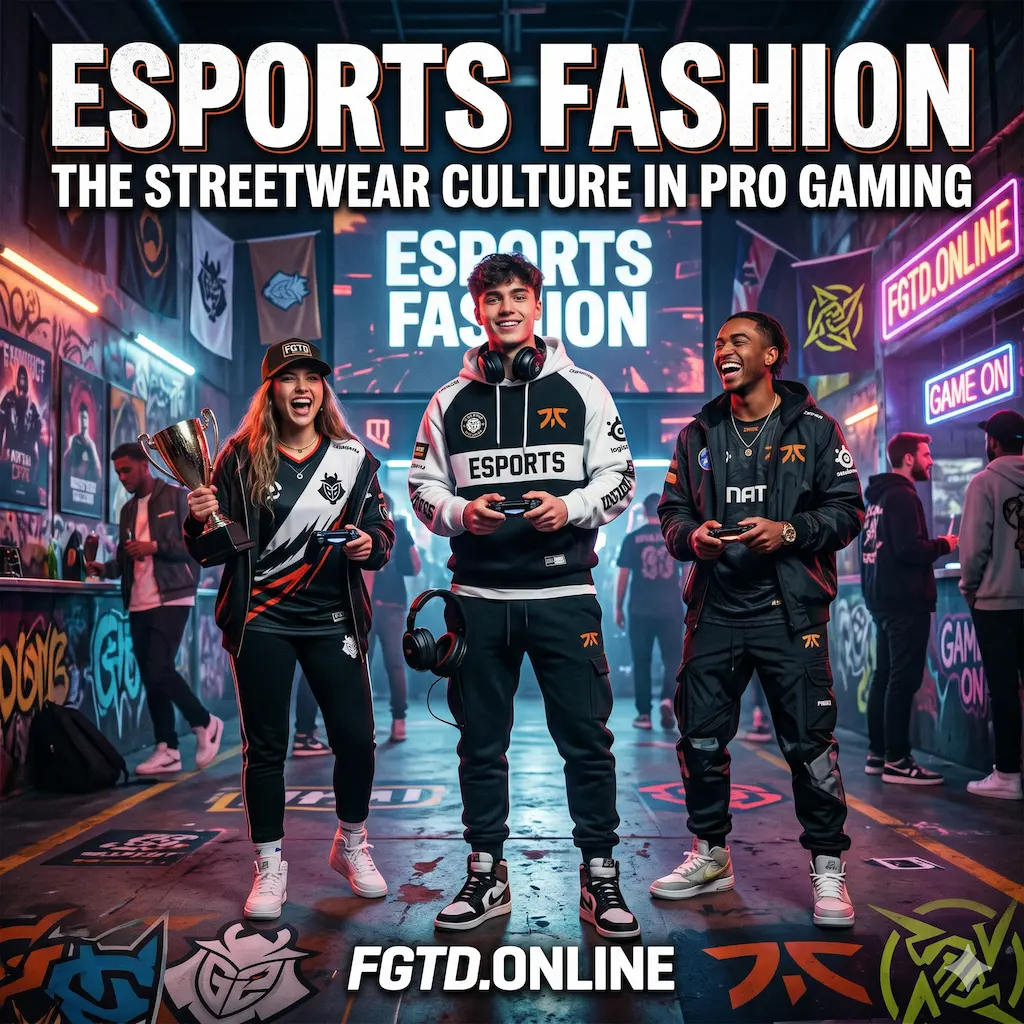
Esports Fashion: The Streetwear Culture in Pro Gaming
The visual landscape of professional competitive gaming has undergone a profound structural metamorphosis. In the early eras of localized LAN parties and primordial arena brackets, player apparel was treated as a low-priority afterthought. Teams took the field wearing ill-fitting, polyester athletic jerseys heavily saturated with corporate tech logos—clunky, non-endemic hardware branding plastered across loud, bright colorways that mirrored legacy motorsport uniforms. It was a sterile, utilitarian design philosophy that viewed the professional gamer purely as a walking advertising billboard for microchip processors, energy drinks, and peripheral manufacturing networks.
Today, that legacy aesthetic has been completely dismantled. As esports matured into a dominant pillar of global pop culture—merging with hip-hop music, streaming media ecosystems, and high-end lifestyle design lines—the uniform underwent a radical, high-velocity evolution. The catalyst for this transformation is streetwear culture.
Professional esports organizations are systematically shedding their legacy athletic skins to function as high-concept streetwear labels and lifestyle design matrices.
Continues after advertising
From limited-edition drops and premium capsule collections to historic collaborations with luxury heritage fashion houses, esports apparel is no longer just a uniform. It is a highly strategic vehicle for cultural normalization, community identity engineering, and premium direct-to-consumer lifestyle monetization.
Here is the definitive technical, cultural, and architectural breakdown of how streetwear has permanently rewritten the visual DNA of professional gaming.
[Legacy Apparel Paradigm]: Polyester Team Jerseys ──> Saturation of Tech Logos ➔ Utility Advertising
[Modern Streetwear Paradigm]: Limited Capsule Drops ──> Luxury/Hypebeast Aesthetics ➔ Premium Lifestyle Brand.
1. The Cultural Convergence: Why Gaming and Streetwear Formed a Unified Matrix
To understand the structural synergy between streetwear and competitive gaming, fashion sociologists look directly at the shifting demographics of the global internet economy. Streetwear and esports share identical behavioral, psychological, and consumption primitives.
The Shared DNA of Subcultural Identity
Both movements were birthed as disruptive, rebellious, counter-culture phenomena operating on the fringes of traditional high-society validation. Streetwear emerged out of the gritty skate and surf subcultures of California and Tokyo in the 1980s and 1990s, built on a foundation of DIY graphic T-shirts, structural anonymity, and localized exclusivity.
Esports parallelly evolved inside smoke-filled arcade networks and dark PC-Bang cafes, fueled by a generation of digital enthusiasts who rejected legacy corporate sports frameworks. When these two subcultures achieved mass economic scale in the 2010s, their convergence was mathematically inevitable. Both communities speak the fluent, non-linear language of internet hype, cryptographic authenticity, and peer-to-peer aesthetic validation.
The Vaporization of the Nerd Archetype
The contemporary professional gamer or streaming personality is no longer confined to the outdated, anti-social stereotype of the past. Today’s top-tier esports athletes—such as League of Legends master Faker or Valorant icons—and macro-influencers function as the definitive tastemakers of the Gen Z and Millennial digital landscape. They are hypebeasts, sneakerheads, and digital collectors.
Because pro gamers spend hours streaming in front of high-definition webcams, their upper-body apparel footprint serves as prime real estate for high-visibility visual branding. Streetwear—with its focus on relaxed oversized silhouettes, boxy drop-shoulder hoodies, bold typography, and technical cargo garments—fits the ergonomic, sedentary physical lifestyle of the digital athlete perfectly, while projecting a highly curated, culturally relevant edge to millions of concurrent viewers.
2. The Pioneers: Re-Engineering the Esports Brand Lifecycle
The structural pivot from “gaming team” to “lifestyle apparel brand” was built on a precise operational blueprint engineered by a handful of visionary Western and Eastern organizations.
Traditional Roster Management ➔ Structural Pivot ➔ [E-Commerce Drop Matrix + Content Engine] ➔ High-Margin Brand Entity
100 Thieves and the Hypebeast Blueprint
Founded in Los Angeles by former Call of Duty champion Matthew “Nadeshot” Haag, 100 Thieves was explicitly engineered from its inception to function as a premium apparel brand first and an esports organization second. Instead of offering a permanent catalog of generic team merchandise, 100 Thieves implemented the classic streetwear “Drop Model.”
[Scarcity Manufacturing] ➔ Algorithmic Social Teasing ➔ Limited Window Drop ➔ Instant Inventory Liquidation
Collections were manufactured in strictly limited quantities, teased for weeks via highly cinematic content lookbooks, and launched during precise, high-friction e-commerce windows. The result was structural hysteria: apparel drops sold out completely within minutes, crashing server lines and generating massive secondary-market resale value on platforms like StockX. 100 Thieves proved that a gaming entity could command the exact same consumer scarcity mechanics as legendary streetwear powerhouses like Supreme or Palace.
FaZe Clan and the Mainstream Hype Integration
FaZe Clan weaponized the intersection of competitive gaming, streetwear, and mainstream hip-hop culture. By recruiting traditional athletes, musical artists, and skate personalities into their content matrix, FaZe transformed their iconic interlocking red-and-black logo into a universal badge of digital lifestyle authority.
Their apparel strategy expanded far past the boundaries of standard fan gear to include heavy, high-ounce loopback cotton hoodies, distressed skate denim, and customized tactical outerwear. This lifestyle positioning culminated in historic, cross-industry retail collaborations, including limited-edition drops with Champion, Takashi Murakami, and Manchester City FC, validating the brand across diverse cultural ecosystems.
3. The Luxury Cross-Over: High Fashion Enters the Digital Coliseum
As the economic valuation and cultural influence of esports scaled globally, it caught the attention of the ultimate gatekeepers of global taste: the heritage luxury fashion houses of Paris, Milan, and New York. These institutional entities recognized that traditional media channels were failing to reach younger affluent consumers, turning to esports as a vital, high-throughput digital interface pipeline.
Heritage Luxury House ──(Creative Capital Exchange)──> Esports Elite ➔ Unified Physical/Digital Capsule
Louis Vuitton x League of Legends (2019)
The definitive watermark event for the institutional validation of esports fashion occurred during the 2019 League of Legends World Championship. Under the creative direction of Nicolas Ghesquière, Louis Vuitton partnered with Riot Games to execute a multi-tiered, physical-to-digital luxury integration.
- The Physical Capsule Collection: Louis Vuitton designed a high-end, bespoke streetwear capsule featuring custom monogrammed leather jackets, technical cycling shorts, luxury footwear, and statement luggage accessories, pricing items at traditional luxury tranches.
- The Digital Skin Matrix: Concurrently, Ghesquière designed custom, in-game prestige cosmetic skins for characters like Qiyana and Senna. This convergence allowed players to unlock luxury branding within the virtual coliseum itself, creating a multi-layered ecosystem where virtual identity directly mirrored real-world luxury aspiration.
Gucci, Balenciaga, and the Virtual Runway
Following the Louis Vuitton blueprint, the luxury cross-over accelerated rapidly:
- Fnatic x Gucci (2020): Elite European organization Fnatic partnered with Gucci to launch a limited-edition diving watch styled directly around Fnatic’s iconic orange-and-black color palette, selling out instantly to affluent global collectors.
- T1 x Ralph Lauren: South Korea’s most decorated franchise, T1, partnered with Ralph Lauren, dressing legendary player Faker and his roster in pristine, tailored luxury preppy aesthetics for high-profile international media appearances, completely erasing the legacy casual gaming aesthetic.
4. Technical Innovation: The Rise of Techwear and Ergonomic Performance Fashion
Esports fashion is not merely an exercise in graphic aesthetics; it is increasingly defined by Techwear—a highly functional branch of streetwear focused on advanced material science, modular structural mechanics, and technical utility performance.
Material Architecture: Optimizing for the Digital Arena
When an athlete executes high-velocity inputs over a 12-hour training block in a gaming house or under intense stadium stage lighting arrays, traditional fabrics present performance limitations. Streetwear-driven techwear brands design custom textiles engineered specifically for the sedentary, high-stress profile of the pro gamer:
- Thermo-Regulating Soft Knits: Utilizing advanced spacer fabrics and hollow-core fibers that trap micro-climates of air to insulate the body against cold arena drafts, keeping arm muscles warm to preserve sub-millisecond reaction speeds.
- Static-Reduction Textiles: Integrating microscopic carbon-fiber or silver-ion grids into the weave to dissipate surface static charges, preventing minor electrical interference or fabric friction loops between the player’s sleeve and the tracking surface of the mousepad.
- Ergonomic Panel Engineering: Replacing traditional seams with continuous, sonic-welded flatlock stitch lines mapped out through 3D motion-capture data, ensuring zero friction points across the underarm and shoulder during high-velocity mouse swipes.
5. Strategic Operational Metrics: The Fashion-to-Esports ROI
Shifting from standard merchandise liquidation to an authentic streetwear drop model transforms the fundamental balance sheet metrics of a modern esports franchise. The financial advantages can be tracked across distinct operational vectors:
| Monetization Attribute | Legacy Merchandise Framework | Streetwear Drop Architecture | Corporate Capital Impact |
| Inventory Turnover Velocity | Slow; items sit on warehouse shelves for months, tying up liquidity | Near-Instant; inventory liquidates within a 15-minute drop window | Minimizes capital locking and eliminates clearance markdown losses |
| Gross Margin Profiles | Low-margin; relies on standard mass-produced wholesale cotton blanks | High-margin; premium lifestyle positioning commands premium pricing | Substantially expands direct-to-consumer profit margins per unit |
| Brand Equity Reach | Confined strictly to verified endemic gaming audiences | Crosses into macro lifestyle, music, and pop-culture markets | Unlocks non-endemic corporate sponsorship capital (Automotive, Luxury, Cosmetics) |
| Customer Retention (LTV) | Transactional; fan buys one jersey every two years | Cyclical; consumer engages with 4-6 curated collection drops annually | Exponentially maximizes the long-term Lifetime Value ($LTV$) of the fan base |
6. The Digital Frontier: Digital Fashion, Skins, and the Direct-to-Avatar Economy
The evolution of esports streetwear has officially outgrown the constraints of physical textiles. As spatial computing, metaversal virtual ecosystems, and high-fidelity video game engines continue to merge, the future of competitive fashion resides firmly in the Direct-to-Avatar (D2A) Economy.
Virtual Wardrobes and Hypebeast Digital Assets
For the current generation of digitally native consumers, their virtual persona across platforms like League of Legends, Fortnite, or Roblox is just as real, vital, and subject to social peer validation as their physical manifestation in the real world. Streetwear brands recognize this spatial shift, designing apparel lines that exist exclusively as cryptographic digital assets.
Physical Capsule Drop ──(Synchronized Release)──> Digital Asset Smart Contract ➔ Instant Direct-to-Avatar Flex
A customer can purchase a physical limited-edition utility jacket, which automatically unlocks a cryptographically verified digital replica for their virtual avatar via an over-the-air software drop. This synchronization enables seamless identity translation across the physical and digital halves of the modern entertainment ecosystem.
7. The Horizon: Generative AI Customization and Bio-Reactive Techwear
Looking toward the horizon of the next decade, the convergence of deep computational learning models and molecular fabric engineering will introduce unprecedented levels of hyper-customization to the esports lifestyle.
Generative AI On-Demand Apparel Engines
The traditional sizing matrix and mass-manufacturing templates will evolve. Future esports streetwear platforms will leverage Generative AI Style Engines linked with localized, high-speed automated textile printing loops.
A consumer logs onto an organization’s digital storefront, allows a smartphone lidar matrix to map their exact 3D skeletal geometry, and inputs semantic style prompts (e.g., “Matte black techwear aesthetic with neon cyberpunk graphic accents tailored around 2026 World Championship metrics”).
The AI compiler generates a completely custom, one-of-one pattern file optimized for their physical proportions, executing localized automated manufacturing and delivery within 48 hours—permanently removing excess inventory liabilities from the brand’s balance sheet.
[3D Spatial Lidar Scan] ➔ [Generative AI Prompt Engine] ➔ [One-of-One Pattern Automation] ➔ [Localized High-Speed Custom Print]
Bio-Reactive Emotional Display Fibers
On the physical arena stage, the future generation of streetwear jerseys will integrate smart bio-reactive e-textiles. Embedded with flexible, micro-LED polymer fibers and silver-nanowire structural circuits linked directly to the player’s wearable biometric health patches, the garment itself will dynamically shift colorways, typography patterns, or graphic animations in real time based on the athlete’s physiological state.
If a player enters a high-stress, clutch $1\text{v}3$ tactical engagement, their jersey’s visual matrix can flash or shift into a high-contrast state as their heart rate breaches critical limits, turning clothing into a physical, visible manifestation of the intense psychological drama occurring inside the digital arena.
Read More👉 Next-Gen Athlete Recovery: High-Tech Science in 2026
Conclusion: The Ultimate Cultural Re-Skinning
The integration of streetwear culture into the professional gaming matrix represents far more than a passing cosmetic trend; it is the definitive structural validation of a global cultural reset. By trading in un-optimized legacy polyester jerseys for high-concept limited drops, luxury design crossovers, and techwear material engineering, the esports industry has permanently secured its position at the absolute epicenter of modern pop-relevance.
This fashion transformation has effectively rewritten the corporate economic model for organizations worldwide. It transforms the esports franchise from a fragile entity dependent entirely on volatile tournament victory loops and tournament payouts into an enduring, culturally protected lifestyle brand capable of generating sustained consumer desire across both the physical and digital domains.
As technology continues to advance, blurring the boundary lines between physical garments and virtual avatar skins, the organizations, designers, and system architects who build flexible, agencified, and authentic lifestyle ecosystems will command the global digital arena.
By prioritizing deep subcultural authenticity, committing to advanced textile material sciences, and weaponizing the unique scarcity mechanics of the modern drop culture, these forward-thinking digital pioneers will not simply dress the next generation of competitive legends—they will dictate the visual language, identity metrics, and commercial boundaries of the emerging global digital economy.
Enjoyed this comprehensive cultural and technical breakdown of the intersection between streetwear design and professional esports infrastructure? Head over to fgtd.online regularly for deeper, data-driven research papers covering enterprise cloud computing stacks, post-quantum network security configurations, and the next frontier of global technology innovation.