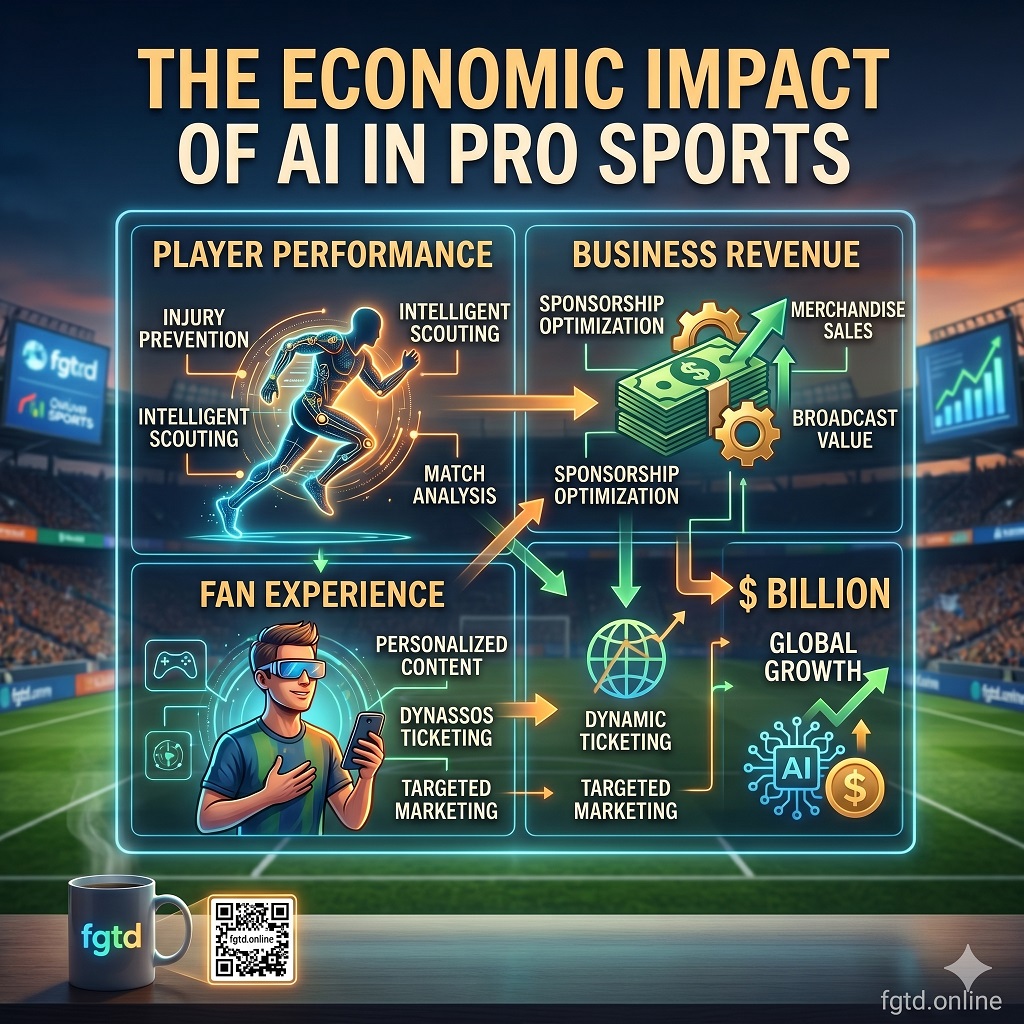
The Economic Impact of AI in Pro Sports
The intersection of elite athletics and cutting-edge technology has reached a fever pitch in 2026. While fans once focused solely on the physical prowess of athletes on the field, the modern sports industry is now governed by an invisible hand: Artificial Intelligence. For the readers of fgtd.online, understanding the economic shift in professional sports is essential, as AI has moved from a “performance aid” to the primary driver of revenue, valuation, and market expansion.
We are no longer just looking at a game of inches; we are looking at a game of gigabytes. From ticket pricing algorithms to predictive injury modeling that protects billion-dollar rosters, AI is fundamentally rewriting the balance sheets of global sports franchises. This comprehensive analysis explores the multi-faceted economic impact of AI in professional sports.
1. Protecting the Most Valuable Assets: Player Health and Longevity
In professional sports, the most significant capital expenditure is player salaries. When a star athlete worth $50 million a year sits on the bench due to a preventable soft-tissue injury, the economic loss extends beyond the game—it impacts broadcasting ratings, jersey sales, and team valuation.
Continues after advertising
Predictive Injury Modeling
AI systems now ingest data from wearable sensors (tracking heart rate variability, sleep quality, and biomechanical stress) to predict “red zones” for athletes.
- The ROI of Availability: By reducing injury rates by even 10%, a team can save millions in “lost” wages. AI allows trainers to prescribe “load management” with mathematical precision, ensuring that the highest-paid assets are available for the highest-revenue games (playoffs and championships).
- Extended Career Horizons: AI-driven recovery protocols are extending the peak performance years of athletes. An extra two years of elite play from a franchise player can represent hundreds of millions in additional revenue for a club.
2. The Algorithmic Front Office: Maximizing Roster Value
The “Moneyball” era has evolved into the “Algorithm Era.” AI is now used to identify market inefficiencies in player trades and scouting, ensuring that every dollar spent on a transfer or a contract is optimized for maximum on-field return.
Market Value Prediction
AI models analyze global player databases to identify “undervalued” talent in lower leagues or different regions. By predicting how a player’s style will translate to a specific league’s tactical environment, teams avoid the “sunk cost” of expensive transfer busts.
- Smart Contracts: We are seeing the rise of AI-structured contracts where bonuses are tied to advanced metrics (expected goals, defensive efficiency, or pressure rate) rather than just traditional stats. This aligns player incentives directly with the team’s economic success.
3. Revolutionizing the Fan Experience and Monetization
For sports franchises, the stadium is no longer just a physical location; it is a data-gathering engine. AI is being used to extract more value from every fan, both inside the arena and across the globe.
Dynamic Ticket Pricing
Similar to airlines, sports teams now use AI to adjust ticket prices in real-time. Factors such as weather, team winning streaks, the “star power” of the opposing team, and even social media sentiment are analyzed to set prices that maximize “gate receipts” without leaving seats empty.
Personalized Fan Engagement
AI-driven “Hyper-Personalization” ensures that a fan receives a different marketing experience than a fan in London.
- Next-Best-Action Marketing: If an AI predicts a fan is likely to buy a jersey after a specific win, the system triggers a personalized discount code to their mobile device instantly.
- Virtual and Augmented Reality (VR/AR): AI is powering “virtual courtside seats,” allowing teams to sell an unlimited number of premium “digital” seats to fans worldwide, decoupling revenue from the physical constraints of stadium capacity.
4. The New Frontier of Sports Betting and Real-Time Data
The legalization of sports betting in various global markets has created a massive secondary economy. AI is the engine behind the “In-Play” betting markets, which now account for the majority of wagering volume.
Micro-Betting Logistics
AI algorithms process thousands of data points per second to set odds for “micro-events” (e.g., will the next pitch be a strike? Will this penalty kick be saved?).
- Economic Synergy: Sports leagues are now selling their “Official Data” feeds to betting operators at a premium. The speed and accuracy of this AI-processed data have become a multi-billion dollar commodity.
- Integrity Monitoring: Ironically, AI is also the primary tool for protecting the economy of sports. AI monitors betting patterns globally to detect anomalies that might suggest match-fixing, protecting the “fair play” brand that the industry’s value depends on.
5. Broadcasting and Content Production: Slashing Costs
The cost of producing a high-quality sports broadcast has traditionally been astronomical, requiring massive crews and expensive equipment. AI is democratizing this process.
Automated Production
AI-powered camera systems (like Pixellot) use computer vision to track the ball and the players without a human operator.
- Expanding the Long Tail: This technology allows lower-tier leagues, youth sports, and niche competitions to broadcast their games professionally at a fraction of the cost. This opens up new advertising and sponsorship tiers for sports that were previously “un-broadcastable.”
- Real-Time Highlight Generation: AI can instantly identify a “slam dunk” or a “goal” and generate social-media-ready clips in seconds. This speed allows teams to capture the “viral window” of a game, driving massive engagement and ad revenue.
6. Sponsorship ROI and Brand Alignment
Sponsorships are a cornerstone of sports economics. Historically, measuring the impact of a logo on a jersey or a stadium hoarding was an educated guess.
Computer Vision Branding Analysis
AI now scans every frame of a broadcast and every social media post to calculate the exact “Equivalent Ad Value” of a sponsorship.
- Precise Valuation: If a brand’s logo is visible for a total of 12 minutes during a match with a specific clarity and audience size, AI provides a dollar-value report. This transparency allows teams to command higher prices for “prime” visual real estate and gives sponsors the data they need to justify their investments.
- Targeted Digital Overlays: In 2026, the technology exists to show different sponsors on the perimeter boards depending on who is watching. A viewer in Brazil might see a “Mercado Pago” ad, while a viewer in the US sees “Visa”—all on the same board during the same live game. This “Multi-Casting” effectively doubles or triples the ad inventory of a single stadium.
7. The Risks: Ethics, Privacy, and Economic Disparity
While the economic impact is largely positive, AI in sports presents significant challenges that could threaten the industry’s long-term health.
- The “Data Arms Race”: There is a growing economic divide between “Data-Rich” clubs (like those in the Premier League or NBA) and “Data-Poor” clubs in smaller markets. This could lead to a permanent competitive imbalance where the wealthiest teams use AI to monopolize all the best talent and insights.
- Player Privacy: As teams collect more “biometric” data, the question of who owns that data becomes critical. If an AI predicts a player will decline in two years, does the team have the right to use that “private” health prediction to lower their contract offer? This is a major point of contention in 2026 labor negotiations.
- The “Uncanny Valley” of Fan Engagement: If fans feel that every interaction is an “optimized” attempt to extract money from them, brand loyalty could erode. The “Human Element” of sports—the unpredictability and the raw emotion—must be preserved to maintain the underlying value of the industry.
8. Case Study: The “Smart Stadium” ROI
Consider the renovation of a major European stadium in 2026.
- AI Crowd Management: Reduces wait times at concessions by 15% through predictive staffing, leading to a 20% increase in food and beverage sales.
- AI Energy Management: Slashes stadium utility costs by 30% by optimizing lighting and cooling based on real-time occupancy and external weather.
- Facial Recognition Entry: Reduces security labor costs by 40% while speeding up fan entry, allowing for more pre-game commerce time.
The total “Economic Lift” from these AI integrations can pay for the multi-million dollar technology investment within just three seasons.
Read More👉 AI Game Masters: Matches Where the Rules Change in Real Time
Conclusion: The New Bottom Line
The economic impact of AI in professional sports is nothing short of a total transformation. It has moved the industry from a “spectacle business” to a “high-tech data business.” For the audience of fgtd.online, the takeaway is clear: the most successful franchises of the future won’t just have the best players; they will have the best algorithms.
AI is making sports more efficient, more profitable, and more global. By protecting athlete health, maximizing roster value, and hyper-personalizing the fan experience, technology is ensuring that the sports economy continues to outpace traditional GDP growth. As we look toward the 2028 Olympics and beyond, the “intelligence” behind the athlete will be just as important as the strength within them.
The game has changed. It’s time to play by the new rules of AI economics.