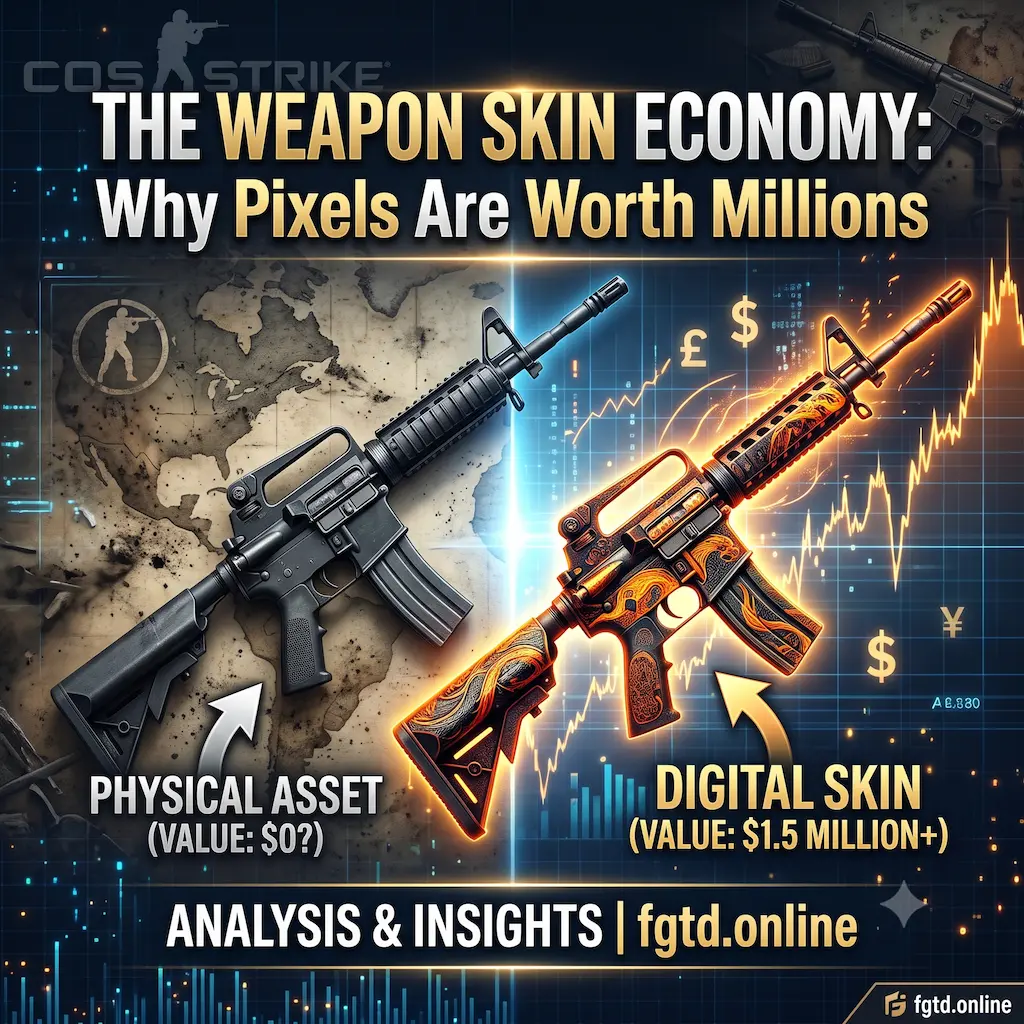
The Weapon Skin Economy: Why Pixels Are Worth Millions
In 2013, a software update changed the financial landscape of gaming forever. When Valve introduced the “Arms Deal” update to Counter-Strike: Global Offensive, it wasn’t adding new maps, weapons, or competitive balancing tweaks. Instead, it introduced a system of purely cosmetic textures—virtual finishes for in-game firearms known as “skins.” These items offered absolutely zero gameplay advantages; a default rifle and a cosmetic rifle fired the exact same digital bullets with the exact same recoil patterns.
Fast forward to today, and these purely cosmetic pixels have laid the foundation for a highly sophisticated, multi-billion-dollar global commodity market. Rare digital knives and weapon finishes routinely trade for tens of thousands of dollars, with one-of-a-kind collector items fetching offers well over a million dollars in cash or cryptocurrency.
What began as a simple monetization strategy for video game publishers has transformed into a decentralized alternative asset class, complete with its own liquid trading platforms, professional market makers, speculative bubbles, and intricate supply-and-demand dynamics.
Continues after advertising
To understand how an intangible string of code can hold the financial weight of real-world luxury goods, one must look past the surface of gaming and examine the underlying psychological triggers, software-defined scarcity models, and open economic architectures that drive the weapon skin economy.
1. The Psychology of the Flex: Digital Status and Identity
To comprehend skin valuations, one must first recognize a fundamental generational shift: for digital natives, virtual spaces have become just as socially significant—if not more so—than physical ones. In a competitive matchmaking arena where millions of eyes watch the same lobbies every single day, an ultra-rare weapon skin serves as the ultimate expression of identity, skill, or sheer financial power.
In behavioral economics, this is known as conspicuous consumption. It is the same psychological mechanism that drives individuals to buy luxury watches, designer clothing, or rare sports cars in the physical world. A luxury timepiece tells the exact same time as a basic digital watch, yet people pay premiums for the heritage, craftsmanship, and social signal it broadcasts.
In the digital realm, a rare skin behaves exactly like a Swiss watch. When a player clutches a round in front of teammates and opponents, everyone in that lobby is forced to spectate their perspective. Pulling out an incredibly rare, historically significant knife skin instantly broadcasts status to the entire community. It creates a localized micro-flex that signals deep investment in the subculture.
Furthermore, because top-tier professional esports athletes showcase these identical cosmetics on global tournament main stages in front of millions of streaming viewers, these pixels inherit an immense layer of cultural heritage and aspirational branding, locking in their desirability.
2. Software-Defined Scarcity: The Mathematics of Wear and Floats
Unlike physical collectibles, which can be printed endlessly if a manufacturer chooses to violate consumer trust, the supply of weapon skins is governed by rigid, unyielding software parameters written directly into game client engines. The value of a skin isn’t just determined by how good it looks; it is determined by an absolute mathematical lottery determined at the exact microsecond the item is generated.
When a virtual case is unlocked, the game’s backend server algorithm assigns three foundational, immutable variables to the skin:
The Rarity Tier (The Grade)
Skins are explicitly segmented into standardized quality tiers, ranging from mass-market “Consumer Grade” items up to the ultra-rare “Covert” and “Special Rare” categories (such as knives and gloves). The drop probabilities are steeply exponential; while a basic blue skin drops frequently, the mathematical odds of pulling a top-tier gold item from a case sit at a brutal, unyielding ~0.26%.
The Pattern Index (The Seed)
Many premium skin finishes use an expansive, randomized texture matrix mapped across the 3D weapon model. The system assigns a specific “Pattern Seed” integer between 1 and 1000. This number determines the exact coordinate alignment of the texture on the weapon. For skins like the legendary Case Hardened line, a specific seed can shift the texture to display 100% pure, vibrant blue top coatings (a “Blue Gem”), transforming a standard fifty-dollar gun into a seventy-thousand-dollar collector’s holy grail based purely on a lucky number.
The Float Value (The Wear Metric)
Perhaps the most brilliant piece of economic engineering in gaming history is the “Float Value.” This is a precise 64-bit floating-point number between 0.00 and 1.00 that determines the exact physical wear, scratches, and paint degradation displayed on the digital item:
- 0.00 – 0.07: Factory New
- 0.07 – 0.15: Minimal Wear
- 0.15 – 0.38: Field-Tested
- 0.38 – 0.45: Well-Worn
- 0.45 – 1.00: Battle-Scarred
Crucially, a skin’s float value never changes. A gun does not degrade or scratch as you use it in matches; it stays permanently frozen in its birth state. Because collectors chase perfection, skins with “low-float” numbers (such as a 0.00001 Factory New rating) command astronomical financial premiums over identical skins with average floats, turning the skin market into an active playground for forensic mathematical evaluation.
3. Open vs. Closed Loops: Why Valve Wins Where Others Fail
The global gaming landscape is filled with titles that sell cosmetic skins—Fortnite, Call of Duty, and Valorant generate billions of dollars annually from digital cosmetics. Yet, a skin bought in Fortnite is financially worthless the moment it is purchased, while a skin in Counter-Strike can literally buy a house. Why does this divide exist?
The answer lies in the architectural design of the marketplace: Closed Loops vs. Open Loops.
Games like Fortnite run a strictly closed economic loop. When you pay money into their ecosystem, your capital is instantly converted into non-transferable in-game currency. The skin you buy is permanently locked to your individual account. You cannot trade it to a friend, you cannot list it on an open auction block, and you can never cash out your funds back into real-world fiat currency. The value is purely experiential, and the liquidity is absolute zero.
Valve engineered Counter-Strike on an open loop. By integrating the game directly with the Steam Community Market and allowing an open Steam Web API layer, Valve allowed players to freely trade items from account to account. This structural openness allowed third-party software developers to build massive, independent peer-to-peer (P2P) marketplaces completely outside of Valve’s internal platform.
On these external marketplaces, skins are traded using real-world cash, cryptocurrencies, and bank wires. Because items can be freely bought, sold, and liquidated back into tangible wealth, weapon skins became a pseudo-currency. They possess all the core characteristics of money: they are durable (pixels don’t degrade), divisible (via tier variations), portable (transferred across accounts instantly worldwide), and crucially, highly liquid. The open loop transformed a cosmetic purchase into a legitimate capital investment.
4. The Anatomy of Market Speculation and Safe Havens
Because the weapon skin market features high liquidity, organic demand, and hard supply caps, it has attracted professional financial speculators, day traders, and hedge-fund style investment groups who treat digital assets with the same analytical rigor applied to Wall Street options or physical fine art.
Investors build diversified skin portfolios categorized by risk profiles and asset behaviors:
High-Yield Liquid Commodities
Items like standard Field-Tested AK-47 Redlines or basic Vanilla Knives act as the bedrock index funds of the skin economy. They have massive daily trading volumes, razor-thin buy-sell spreads, and predictable price stability. Traders use these liquid commodities as temporary storehouses of value when transitioning capital between different rare assets.
Discontinued Disappearing Assets
The rarest tier of the skin economy belongs to items tied to ancient game “Operations” or tournaments from a decade ago (such as the legendary 2014 EMS One Katowice tournament stickers). These items no longer drop from active gameplay pools.
Furthermore, because players actively apply these rare stickers onto weapons or use old weapon skins in “Trade-Up Contracts” (a mechanical burning loop where ten lower-tier items are permanently destroyed to roll for one higher-tier item), the total global supply of these historic assets is actively shrinking every day.
This deflationary dynamic triggers immense price appreciation, turning items like the M4A4 Howl or the AWP Dragon Lore into unassailable safe-haven assets for digital wealth protection.
5. Systemic Operations: Preserving the Digital Trade Grid
Managing an economy where millions of dollars in virtual goods change hands every hour requires an underlying server infrastructure that prioritizes absolute uptime, flawless database synchronization, and robust asset security. Because skin trading relies on rapid peer-to-peer item transfers across complex international networks, even minor operational latencies or network bottlenecks can cause catastrophic trading drops.
To maintain market confidence, modern third-party trading portals and transaction routers require world-class, zero-downtime server setups capable of handling massive spikes in API call velocities during high-traffic esports tournaments.
When a major competitive match concludes, trading volumes explode instantly as thousands of fans scramble to buy or sell items highlighted on screen.
If an inventory tracking server experience configuration drift, or if database write speeds choke under the pressure of concurrent trade requests, users face frustrating transaction freezes and failed trade alignments.
To prevent these performance bottlenecks and eliminate data transport lag, progressive tech enterprises deploy optimized cloud server architectures and policy-as-code management layers. These systems monitor active multi-region database clusters and localized network hubs continuously, ensuring that processing response times stay under sub-millisecond thresholds. Maintaining an unassailable infrastructure perimeter is vital to prevent transaction data mismatches and secure core transaction flows, giving users absolute platform visibility and absolute execution safety across web properties like fgtd.online.
6. The Shifting Regulatory Perimeter: Legal Hurdles for Digital Assets
As the financial scale of the weapon skin economy expanded into the billions, it inevitably collided with the physical world’s legal systems, financial regulatory bodies, and consumer protection acts. The borderless nature of digital pixels creates an intense challenge for traditional legal frameworks designed around geographic boundaries.
Anti-Money Laundering (AML) Compliance
Because high-value skins can be transferred instantly between anonymous accounts across international borders, global financial watchdogs have placed the ecosystem under intense scrutiny. Large third-party skin portals are now forced to implement rigorous Know Your Customer (KYC) identification protocols, verifying the real-world identities and banking records of high-volume traders to prevent illicit capital networks from washing funds through digital item registries.
Gambling and Loot Box Legislation
The fundamental mechanics of unlocking a weapon case—paying a fixed fee ($2.50 for a key) to spin a randomized wheel with a tiny probability of winning a jackpot item—shares deep psychological and structural parallels with traditional slot machines. Multiple nations (such as Belgium and the Netherlands) have legally designated loot boxes as unauthorized gambling, forcing developers to alter their monetization structures regionally to avoid crippling statutory enforcement penalties.
Read More👉 Esports Fashion: The Streetwear Culture in Pro Gaming
Conclusion: The Permanent Financialization of Virtual Realities
The rise of the weapon skin economy is not a temporary trend, a localized gaming gimmick, or an unhedged speculative bubble bound to burst and vanish overnight. It represents a fundamental, permanent evolution in how human beings define ownership, value, and identity in an increasingly digital society. The historical model of treating video games as throwaway toys has been replaced by a reality where virtual assets command the financial liquidity, institutional interest, and cultural permanence of real-world investments.
By combining the emotional pull of status and identity with the absolute precision of software-defined scarcity and open market structures, the gaming community has built a resilient alternative economy entirely out of thin air. In this hyper-connected global ecosystem, the definitive advantage belongs to the platforms, traders, and infrastructure systems that can process data safely, secure assets flawlessly, and manage high-velocity transactions as fast as the market moves.
As long as competitive virtual worlds continue to capture global human attention, those strings of cosmetic pixels will continue to hold the power to move millions of dollars across the international financial landscape.
Hosting high-throughput transaction engines, processing real-time inventory synchronization models, validating secure trade APIs, and managing ultra-secure data infrastructures requires world-class, zero-downtime server architecture. Secure your enterprise digital asset infrastructure on an unassailable foundation by exploring the premium hosting configurations at fgtd.online.