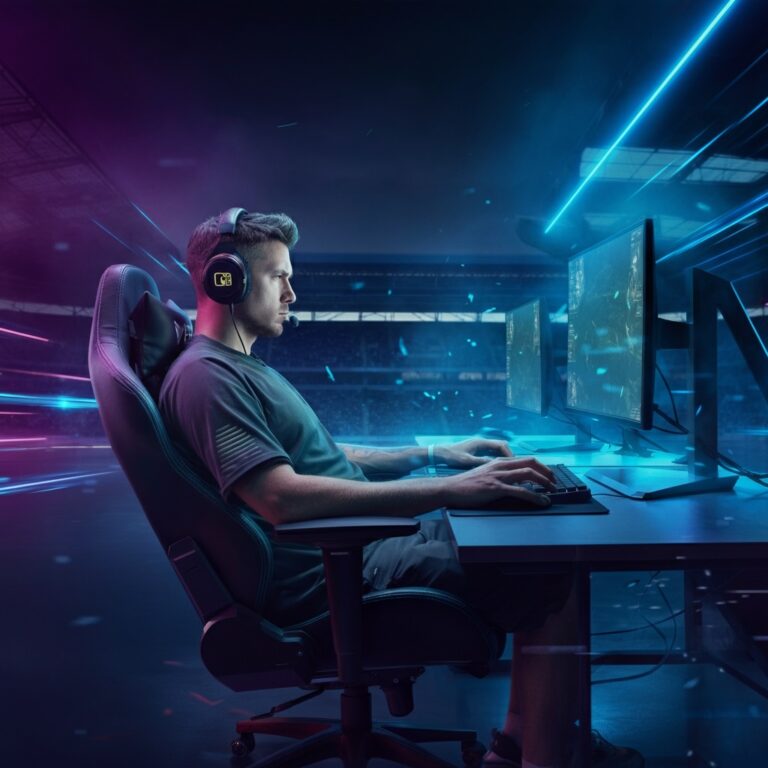
Next-Gen Esports: The Tech Driving Competitive Gaming
Esports has permanently transcended its origins as a niche subculture. Today, the competitive gaming ecosystem commands global audiences on par with traditional sports leagues like the NBA or Premier League, filling physical stadiums and driving multi-billion-dollar media ecosystems. Yet, unlike traditional athletic endeavors bounded by human physiology and physical equipment, esports is structurally coupled to technology. The digital playing field is built entirely out of code, silicon, data pipelines, and raw networking protocols.
In professional gaming, a single millisecond of latency, a dropped data packet, or an unoptimized hardware clock speed can mean the difference between a championship-winning play and immediate tournament elimination.
As competitive mechanics evolve, the technical dependencies of the esports matrix are expanding exponentially.
Continues after advertising
To sustain this hyper-competitive global arena, engineering teams, engine architects, and event coordinators deploy a sophisticated infrastructure stack. From ultra-low-latency fiber routing and edge compute virtualization to AI-driven analytical telemetry and neural-interface anti-cheat software, look inside the core architecture powering next-gen esports.
[Legacy Esports]: Peer-to-Peer Networks ➔ 60 Hz Local Monitors ➔ Static Spectator Feeds
[Next-Gen Esports]: Edge Node Routing ➔ 360 Hz+ Variable Refresh ➔ AI-Orchestrated Multi-Cam Streams
1. The Core Infrastructure: Sub-Millisecond Network Orchestration
At the absolute foundation of any digital competition is network architecture. While a casual consumer might perceive online gaming as a stream of fluid visual feedback, an esports data pipeline is a relentless torrent of raw user-input state synchronizations. When twenty professional players execute inputs at up to 400 Actions Per Minute (APM) in a high-stakes tactical shooter, the infrastructure must process, validate, and broadcast those state changes with near-zero jitter.
Overcoming the Laws of Physics: Edge Compute and Custom WANs
In global online competitions, routing traffic over the standard public internet exposes packets to unpredictable queuing delays, bad BGP (Border Gateway Protocol) routing decisions, and congestion spikes. To circumvent this systemic vulnerability, major publishers (such as Riot Games with Riot Direct) build custom, software-defined global Wide Area Networks (WANs).
[Player Client Node] ➔ [Localized ISP Edge] ➔ [Proprietary Private Fiber backbone] ➔ [Esports Match Engine Server Node]
By peering directly with regional Internet Service Providers (ISPs) and routing game-state traffic across private, dedicated dark fiber pipelines, network engineers bypass the standard internet’s unpredictable hops.
Furthermore, match engine servers are no longer locked in centralized hyperscale data centers. Next-gen esports infrastructures leverage decentralized Edge Compute Clusters. Game servers are containerized and deployed at localized metropolitan edge nodes, bringing physical computation closer to player clients to consistently achieve a sub-15 millisecond ping threshold.
Tick Rates and Netcode Engineering
The responsiveness of an esports title is bound by the tick rate of its server software—the frequency with which the match engine calculates game states per second. Early competitive titles operated on 30 Hz or 60 Hz loops. Next-generation competitive titles deploy dedicated 128 Hz to 240 Hz tick rate architectures.
At 128 Hz, the server updates the virtual world state every 7.8 milliseconds:
$$\text{Update Interval} = \frac{1000\text{ ms}}{128\text{ Hz}} = 7.8125\text{ ms}$$
Processing states at this frequency requires sophisticated netcode engineering. Systems implement advanced Lag Compensation and Deterministic Client-Side Prediction algorithms. When a client executes a motion input, the local engine renders the result instantly, while synchronously sending the input token to the server.
The server acts as the absolute arbiter of truth, processing all incoming player input tokens chronologically, reconciling spatial discrepancies caused by transit delays, and broadcasting the corrected absolute state back to the entire network cluster without introducing visual stutter or positional rollback.
2. Hardware Engineering: Eliminating Input Lag and Motion Blur
When competition moves to an offline Local Area Network (LAN) stadium setting, networking lag drops close to zero. The optimization frontier then shifts entirely to the physical endpoint hardware: the interface between human neurological reaction times and silicon execution.
Total System Latency: From Click to Photon
Professional esports organizations evaluate hardware through the lens of Total System Latency. This metric measures the entire chronological loop from the exact microsecond a player presses a mechanical switch on their peripheral to the moment the corresponding photon leaves the monitor screen and hits their retina.
[Mouse Click] ➔ [USB Polling Pipeline] ➔ [OS Input Buffer] ➔ [Game Engine Frame Compute] ➔ [GPU Render Pipeline] ➔ [Display Refresh Loop]
To compress this pipeline, modern peripheral and silicon manufacturers have engineered specialized technological protocols:
- High-Frequency USB Polling Arrays: Standard peripherals pool inputs at 1,000 Hz (once per millisecond). Next-gen esports mice and keyboards execute at 4,000 Hz to 8,000 Hz polling rates, dropping raw hardware input registration latency down to a fraction of a millisecond.
- Direct GPU Bypass Frameworks: Technologies like NVIDIA Reflex and AMD Anti-Lag revolutionize the software rendering pipeline. Historically, game engines generated frames and queued them up in an OS render buffer, waiting for the GPU to become available. This introduced a queuing backlog. Modern bypass frameworks link the game engine’s internal update loop directly with the GPU render clock, dynamically sampling inputs at the exact microsecond the graphics card is ready to draw a new frame, eliminating the buffer layer entirely.
High-Refresh Display Dynamics
The visualization matrix requires ultra-smooth frame distribution. While standard enterprise displays operate at 60 Hz or 120 Hz, the professional esports standard has accelerated into 360 Hz and 540 Hz Variable Refresh Rate (VRR) territories.
A 540 Hz display refreshes its entire pixel grid every 1.85 milliseconds. Combined with cutting-edge OLED or Fast-IPS panels capable of sub-0.03ms grey-to-grey pixel response times, modern monitors eliminate ghosting and motion blur. This extreme visual clarity allows tracking high-velocity targets across complex 3D environments with pixel-perfect accuracy.
3. Broadcast Automation: Re-Engineering the Spectator Experience
Esports viewership metrics frequently rival legacy broadcast media networks, yet producing a live esports broadcast is infinitely more complex than filming a traditional stadium sport. A football match requires tracking a single physical ball across a single field. A battle royale esports title, conversely, features 60 to 100 independent competitors navigating massive 16-square-kilometer virtual terrains simultaneously, executing engagements in multiple zones concurrently. Human broadcast directors simply cannot track this level of distributed chaos manually.
To solve this production challenge, modern production desks implement AI-Driven Broadcast Automation.
[Live Match Engine State Data Feed]
│
▼
[AI Real-Time Kill/Engagement Predictor]
│
▼
[Automated Virtual Camera Routing Matrix] ➔ [Instant Broadcast Video Stream]
Algorithmic Virtual Camera Direction
Instead of relying on human operators to manually pan camera perspectives within the game engine, modern production systems hook directly into the live server’s state API. An AI orchestration layer evaluates hundreds of spatial data points every millisecond—tracking weapon firing vectors, utility grenade trajectories, health deterioration slopes, and player positioning groupings.
Using predictive analytics, the algorithm anticipates engagements before they occur, automatically routing the virtual broadcast camera perspective to the exact spatial coordinate where a critical firefight or team elimination is about to manifest, completely eliminating dead air and missed plays from the live feed.
High-Throughput Data Overlays and Augmented Reality
Because the entire competition occurs inside a digital environment, every micro-action is inherently indexed data. Next-gen broadcast pipelines run high-performance parser engines that extract telemetry out of the game engine in real time.
This data is fed into real-time graphical rendering engines, populating on-screen broadcast overlays with instantly calculated metrics: accuracy ratios, predictive survival percentages, and tactical map vectors. In physical stadium environments, these streams are projected via real-time Augmented Reality (AR) setups directly above the stage, overlaying tactical spatial data loops over the physical player desks to immerse the live audience inside the match architecture.
4. The Cryptographic Arms Race: Next-Gen Anti-Cheat Frameworks
The integrity of esports as a legitimate commercial industry relies entirely on the absolute guarantee of fair play. Because millions of dollars in prize pools, corporate sponsorships, and betting lines rest on match outcomes, cheating is no longer a minor nuisance—it is an economic threat vector. As malicious software developers build highly sophisticated, evasive execution tools, anti-cheat infrastructure has evolved into a highly specialized cryptographic arms race.
Kernel-Level Architecture
Traditional anti-cheat software operated at the user-space layer of the operating system (Ring 3). This left them vulnerable; if a malicious software executed at the kernel layer (Ring 0), it could mask its existence entirely from the anti-cheat scanner. Modern competitive ecosystems require drivers that initialize at Ring 0 kernel space from the moment the operating system boots up.
[Ring 3: User Space] ➔ Legacy Applications / Standard Games
│
▼
┌──────────────────────────────┐
│ [Ring 0: Kernel Space] │ ➔ Next-Gen Anti-Cheat Engines / OS Core
└──────────────────────────────┘
Software like Riot’s Vanguard or EA’s Anti-Cheat monitor the system’s absolute memory allocations, preventing unauthorized hypervisors or untrusted kernel drivers from injecting memory modifications or manipulating game-engine state code.
AI-Based Behavioral Analysis
As cheat developers turn to external hardware modification devices—such as custom DMA (Direct Memory Access) PCI-Express cards that read memory signatures off a completely separate physical computer—software-only detection systems hit physical limits. To counteract this, modern anti-cheat architectures employ cloud-hosted Machine Learning Behavioral Analysis Engines.
Instead of searching for a specific signature of a malicious file on a hard drive, the AI analyzes user behavior telemetry: mouse trajectory curves, acceleration vectors, reaction latencies down to the microsecond, and crosshair positional groupings. Cheating software relies on automated aim-correction vectors that move a cursor with mathematical precision.
By running anomaly detection models against real-time telemetry streams, the cloud engine can spot the subtle, non-human signatures of algorithmic aim-assistance devices instantly, issuing automated hardware bans to the cheating node mid-match.
5. Web3 and Decentralized Tournament Infrastructure
As grassroots competition expands globally, organizing lower-tier and amateur tournaments presents immense logistical and trust friction. Traditional tournament platforms suffer from payment delay cycles, manual verification disputes, and regional gateway restrictions. Next-gen esports infrastructure increasingly leverages Web3 primitives and smart contracts to decentralize competitive frameworks.
Automated Escrow Smart Contracts
By deploying automated tournament grids directly on hyper-scalable Layer-2 blockchain networks, organizer friction is completely erased. Teams deposit entry stakes into an immutable escrow smart contract.
JSON
{
“tournament_id”: “GLOBAL_CHALLENGE_2026_09”,
“match_status”: “COMPLETED”,
“verified_winner”: “TEAM_ALPHA_WALLET_0x71C…”,
“prize_pool_escrow”: “50000_USDC”,
“distribution_protocol”: “instant_execute_smart_contract”
}
Once the match completes, a decentralized oracle pulls the official cryptographic match result directly from the publisher’s API and feeds it to the contract. The ledger verifies the winner instantly and dispatches the stablecoin prize pool directly to the players’ digital wallets without requiring manual administrative auditing, clearing houses, or international banking rails.
6. Financial and Scale Dynamics: The Esports Technology Blueprint
Building and maintaining a globally viable next-generation competitive infrastructure requires an intersection of high-capital computing assets. The technical parameters can be quantified across definitive operational performance indicators:
| Technical Performance Vector | Legacy Infrastructure Target | Next-Gen Esports Framework | Operational / Revenue Impact |
| Server Update Velocity | 30 Hz – 60 Hz tick loops | 128 Hz – 240 Hz dedicated cycles | Eliminates registration discrepancy and ensures raw input synchronization |
| End-to-End Handshake Latency | $60\text{ms} – 120\text{ms}$ average public BGP routing | $<15\text{ms}$ via edge routing arrays | Enables globally synchronized competitive matches across multi-state zones |
| Peripheral Data Throughput | 1,000 Hz standard USB polling | 4,000 Hz – 8,000 Hz native streaming | Compresses physical response tracking down to sub-millisecond timelines |
| Defect / Cheat Identification | Reactive user reporting and batch bans | Proactive Cloud AI Behavioral Auditing | Guarantees absolute fair play integrity for brand sponsorships and sports betting |
7. The Horizon: Brain-Computer Interfaces and XR Competitions
Looking out toward the ultimate trajectory of next-generation competitive gaming, esports technology will soon dismantle the boundaries of traditional mouse-and-keyboard peripherals entirely.
Non-Invasive Brain-Computer Interfaces (BCI)
The ultimate compression of input latency involves moving past physical muscle movements. Emerging esports research labs are experimenting with non-invasive BCI headbands equipped with high-density electroencephalography (EEG) sensor nodes.
These arrays interpret neural motor intent signatures directly. Instead of a player physically clicking a mechanical mouse switch to fire a weapon, the BCI detects the neural command pathway at the motor-cortex level, executing the corresponding action inside the game engine up to 100 milliseconds faster than physical execution routes allow.
Extended Reality (XR) Spatial Esports
As spatial computing and high-density augmented reality headsets approach performance parity with traditional monitors, competitive gaming will shift out of flat 2D monitors into true 3D environments.
XR spatial tournaments will require athletes to interact physically within augmented arenas, utilizing multi-spectral motion capture arrays, real-time spatial audio computing, and hyper-scalable localized network cells to merge physical athletic capabilities with infinite programmatic digital design lines.
Read More👉 New technologies are redefining the stadium experience
Conclusion: Orchestrating the Future of Competition
Next-gen esports represents the most technologically demanding vertical in the modern entertainment sector. It is an ecosystem where hyper-scale data engineering, cutting-edge fix-network infrastructure, advanced human-computer interaction hardware, and heavy cryptographic security loops must coalesce perfectly to facilitate a single competitive match.
For publishers, network architects, and platform developers, investing in this infrastructure is no longer an optional performance optimization strategy—it is a baseline absolute requirement for user retention and institutional trust.
The organizations that successfully master this digital paradigm shift will not simply own market share within the competitive gaming industry. They will establish the structural high-velocity data networks, automated broadcasting systems, and localized edge compute blueprints that will govern the wider global digital economy for decades to come.
Enjoyed this breakdown? Visit fgtd.online regularly for deeper analytical research into esports engineering, cloud-scale financial banking infrastructure, and the next frontier of enterprise digital tech.