New technologies are redefining the stadium experience
The Battle Against the Living Room
For thousands of years, the concept of the stadium remained fundamentally unchanged. From the Roman Colosseum to the concrete bowls of the 20th century, the core value proposition was simple: build a massive structure, put an event in the center, and pack as many people around it as possible. The fans brought the atmosphere; the building merely provided the seating.
However, over the last two decades, stadium operators realized they were no longer just competing with rival teams; they were competing with the modern living room. The advent of massive 4K (and now 8K) OLED televisions, affordable surround sound, high-speed internet, and cheap food from the refrigerator created an unparalleled home-viewing experience. Why spend a small fortune on tickets, navigate brutal traffic, and stand in endless lines for lukewarm food when the broadcast at home offers perfect replay angles and pristine comfort?
To survive, the physical stadium had to evolve from a passive concrete bowl into an active, intelligent ecosystem. In 2026, the modern sporting venue is less a building and more a giant, habitable computer. Driven by a desperate need to offer an experience that cannot be replicated on a couch, architects and technologists are merging the physical and digital worlds.
Continues after advertising
In this comprehensive exploration for fgtd.online, we will dissect the cutting-edge technologies transforming the stadium experience, from frictionless entry and augmented reality to underground greenhouses and biometric security. Welcome to the era of the Silicon Colosseum.
I. The Invisible Foundation: Hyper-Connectivity and Private 5G
None of the modern miracles of stadium technology are possible without a robust digital infrastructure. Ten years ago, attending a game with 70,000 other people meant accepting that your smartphone would become a useless brick. Cellular networks simply collapsed under the density of thousands of people trying to upload photos simultaneously.
Today, connectivity is considered as essential as running water.
- High-Density Wi-Fi 6E and Wi-Fi 7: Modern stadiums are outfitted with thousands of hidden access points, engineered to provide gigabit speeds to individual seats. This isn’t just for the fans’ convenience; it is the backbone of the stadium’s operational network.
- Private 5G Networks: Rather than relying on public telecom towers, new venues like SoFi Stadium in Los Angeles and the Tottenham Hotspur Stadium in London utilize private 5G networks. This provides ultra-low latency and massive bandwidth.
- Edge Computing: To process the colossal amount of data generated during a match, servers are being moved on-site (Edge computing) rather than to distant cloud data centers. This reduces latency to milliseconds, which is critical for real-time betting, augmented reality overlays, and high-speed security algorithms.
The modern fan’s mantra is “pics or it didn’t happen.” Stadiums now guarantee that fans can stream, post, and share in real-time, effectively turning every attendee into a live broadcaster and marketing agent for the venue.
II. The Frictionless Journey: Biometrics and Walk-Through Retail
The most universally hated aspect of attending a live event is the queue. Queuing to park, queuing to enter, queuing for security, queuing for a beer, and queuing for the bathroom. Technology is systematically assassinating the line.
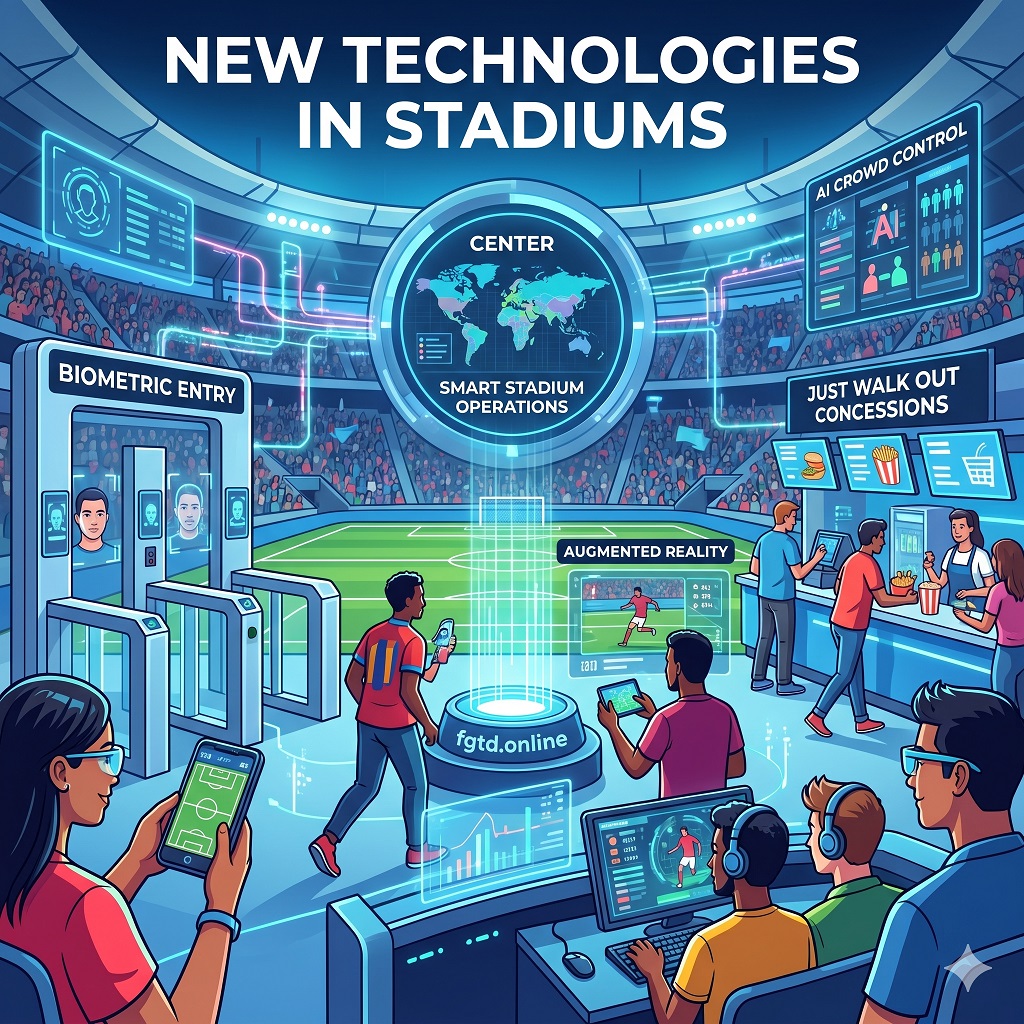
1. Biometric Ticketing and Security: The paper ticket died years ago, replaced by the QR code on a smartphone. Now, even the smartphone is becoming obsolete for entry. Through opt-in facial recognition systems (partnering with companies like CLEAR), your face is your ticket. Fans can walk up to a gate, look at a camera, and the turnstile opens instantly. Simultaneously, traditional metal detectors are being replaced by advanced threat detection systems (like Evolv Technology). These use artificial intelligence and advanced sensors to scan fans as they walk at a normal pace without emptying their pockets or taking off their bags. The system can distinguish between a smartphone and a weapon in milliseconds, eliminating the bottleneck at the front gates.
2. “Just Walk Out” Concessions: Pioneered by Amazon and now adopted by stadiums globally, frictionless retail has revolutionized the halftime rush. Fans scan their palm or their credit card at a turnstile to enter a concession stand. The ceiling is lined with hundreds of AI-powered cameras, and the shelves are equipped with weight sensors. You walk in, grab a hot dog and two beers, and simply walk out. The AI tracks what you took and automatically charges your card. What used to be a 20-minute ordeal that caused fans to miss crucial game moments is now a 30-second fluid motion. This not only vastly improves the fan experience but has also been shown to increase concession revenue by up to 30%, as fans are no longer deterred by long lines.
III. Merging Realities: Augmented Reality (AR) and The Second Screen
While the home viewer has the benefit of on-screen graphics, stat overlays, and multiple camera angles, the live fan historically only had their naked eye and a distant jumbotron. Augmented Reality (AR) is bridging this gap, offering a “second screen” experience that makes the living room jealous.
Using their 5G-connected smartphones (and increasingly, AR smart glasses), fans can point their cameras at the live pitch to unlock a hidden digital layer:
- Real-Time Player Tracking: Imagine looking through your phone and seeing a digital halo above a player, displaying their current running speed, heart rate, or total distance covered.
- Trajectory and Shot Analysis: In baseball or cricket, AR can trace the exact arc of a pitch or a hit in real-time. In football, fans can see the calculated probability of a penalty kick going into the net before the player even strikes the ball.
- Wayfinding: AR is also used practically. If you need to find your seat, the nearest restroom, or a specific food vendor, your phone’s camera can display floating digital arrows guiding you through the complex concourses of a mega-stadium.
During pre-game shows and halftimes, teams are using Mixed Reality (MR) for massive entertainment spectacles. A fan looking at the field through their phone or the jumbotron might see a massive, hyper-realistic CGI panther leaping across the stadium roof (as famously done by the Carolina Panthers) or a dragon breathing fire onto the pitch.
IV. Smart Operations: The AI-Driven Building
Beneath the flashy fan-facing features, the stadium is constantly thinking. The integration of the Internet of Things (IoT) and Artificial Intelligence has turned stadium operations from a reactive chore into a predictive science.
Thousands of sensors track temperature, foot traffic, energy consumption, and plumbing status. AI algorithms analyze this data in real-time.
- Dynamic Crowd Control: If the system detects that the bathrooms on the east concourse are backing up, the stadium’s official app can push a notification to fans in that section, offering them a discount on a beer if they walk to the less-crowded west concourse, naturally redistributing the crowd and easing the bottleneck.
- Predictive Maintenance: Sensors can alert maintenance crews that a specific beer keg is about to run empty, or that a bathroom stall requires cleaning before a fan ever has a chance to complain.
- Energy Optimization: Stadiums are massive consumers of electricity. Smart grids adjust lighting and HVAC systems based on real-time occupancy. If a section is empty, the climate control and lighting in that specific zone are dialed back, saving thousands of dollars and reducing the carbon footprint.
V. Engineering Miracles: Retractable Pitches and Transformative Spaces
To justify their billion-dollar price tags, modern stadiums cannot be used for just 15 to 20 sporting events a year. They must be multi-purpose entertainment monoliths capable of hosting a football match on Saturday, an NFL game on Sunday, and a Taylor Swift concert on Tuesday.
This requires engineering that borders on science fiction, primarily concerning the playing surface.
- The Santiago Bernabéu’s Subterranean Greenhouse: Real Madrid recently completed a renovation that includes a retractable pitch. However, unlike older stadiums that roll the pitch outside, the Bernabéu is located in the middle of a dense city. Their solution was to split the pitch into massive trays and lower them into a 30-meter-deep underground cave beneath the stadium. This subterranean greenhouse is equipped with automated irrigation, ultraviolet LED lighting, and climate control, keeping the grass pristine while the concrete floor above hosts a concert or a tennis match.
- Tottenham’s Dividing Pitch: In London, the Tottenham Hotspur Stadium features a natural grass soccer pitch that literally splits into three pieces and retracts into a parking garage, revealing a permanent, artificial NFL turf underneath. The transition takes just 25 minutes.
These transformative capabilities allow stadium operators to maximize their return on investment without compromising the integrity of the professional playing surface.
VI. Officiating and The Game Itself: The Digital Referee
Technology isn’t just changing how we watch the game; it’s changing how the game is officiated and played. The stadium infrastructure is now directly tied to the sporting rules.
- Semi-Automated Offside Technology (SAOT): Used extensively in top-tier soccer, this relies on a network of 12 dedicated tracking cameras mounted beneath the stadium roof. These cameras track 29 data points on every individual player, 50 times per second, calculating their exact position on the pitch.
- Connected Ball Technology: The match ball itself is now a piece of stadium tech. Embedded with an Inertial Measurement Unit (IMU) sensor placed precisely at its center, the ball sends data to the video operation room 500 times per second. This allows absolute precision in detecting exactly when a ball is kicked, ensuring that offside decisions are mathematically flawless rather than relying on human eyesight.
- Hawk-Eye and Goal-Line Tech: While older, systems like Hawk-Eye in tennis and cricket use an array of high-speed cameras to triangulate the exact position of the ball, removing human error from boundary and goal-line decisions.
VII. Sustainability: The Green Colosseum
As global pressure mounts to combat climate change, the optics of massive, energy-guzzling stadiums have become problematic. Consequently, the latest stadium technologies are heavily focused on sustainability.
The Mercedes-Benz Stadium in Atlanta was the first professional sports stadium in North America to achieve LEED Platinum certification. It captures millions of gallons of rainwater to use for its cooling towers and irrigation, preventing local flooding. Massive solar panel arrays on the roofs and surrounding properties generate enough renewable energy to power the stadium for a substantial portion of the year.
Furthermore, advancements in materials science mean that newer stadiums are being built with lower-carbon concrete and recycled steel. The technology of the future is not just about flashing lights and digital screens; it is about building massive structures that exist in harmony with their local environments.
Read More👉 Controller or Keyboard? The Debate That Defines Esports Identity
Conclusion: The Synthesis of Concrete and Code
The stadium of the future—which we are increasingly experiencing today—is a masterclass in the synthesis of architecture and software. It is a venue that recognizes you as you walk through the gates, charges you for food without you ever opening your wallet, surrounds you with augmented digital overlays, and optimizes its own energy use while you cheer.
The living room will always offer unparalleled comfort and convenience. But the new technologies embedded in modern stadiums aim to offer something the living room never can: an experience that is hyper-connected, frictionless, and utterly immersive. The roar of the crowd has been digitized, optimized, and monetized. By turning the physical venue into a smart, responsive ecosystem, the Silicon Colosseum ensures that there is still no better place to be than right in the middle of the action.