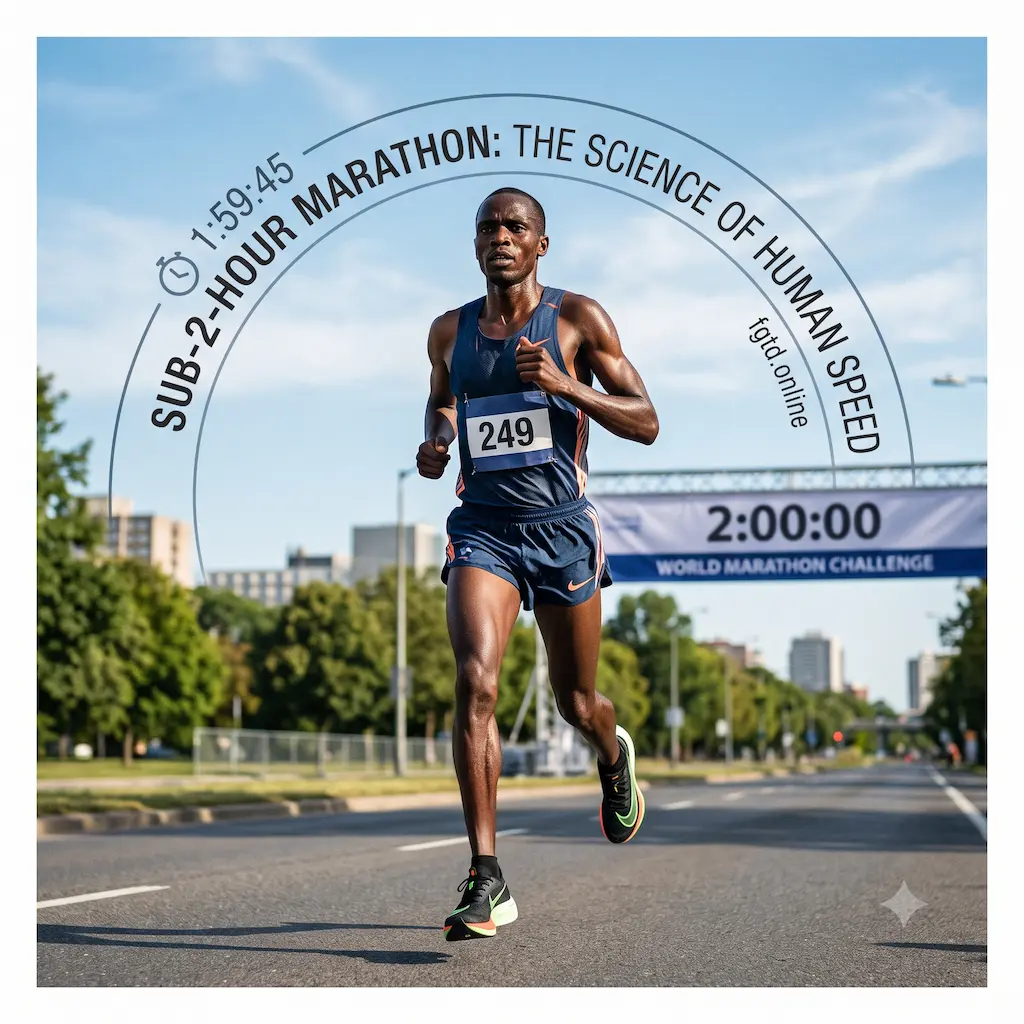
Sub-2-Hour Marathon: The Science of Human Speed
For decades, the sub-two-hour marathon was considered the ultimate holy grail of human endurance. It stood as a legendary physiological barrier, comparable to breaking the four-minute mile or scaling Mount Everest without supplemental oxygen. To run 42.195 kilometers in under 120 minutes, a human being must maintain an astonishing pace of 2 minutes and 50 seconds per kilometer (or 4 minutes and 34 seconds per mile) continuously for two hours. For the average person, maintaining this velocity for even a single lap around a running track is an impossible task.
In October 2019, inside the Prater park in Vienna, the impossible became reality. Eliud Kipchoge crossed the finish line of the INEOS 1:59 Challenge in 1 hour, 59 minutes, and 40 seconds. While the event was not an official open-market world record due to its controlled environment, it proved to the global community that the human body was physically capable of breaking the barrier.
This monumental achievement was not merely a victory of human willpower; it was a masterclass in sport science, cutting-edge bioengineering, and meticulous data optimization. This post breaks down the precise anatomical parameters, aerodynamic strategies, and material sciences that converged to achieve the fastest footrace in human history.
Continues after advertising
1. The Physiological Engine: Vo2 Max, Running Economy, and Lactate Threshold
To understand how an elite athlete can sustain such incredible speed without collapsing, one must first look at the three foundational pillars of human endurance physiology. Breaking the two-hour mark requires an individual to possess a perfectly optimized cardiovascular and metabolic engine.
VO2 Max: The Oxygen Delivery Gateway
VO2 Max represents the maximum volume of oxygen an individual can utilize during intense exercise. It is the definitive measure of aerobic capacity. While an average active male might register a VO2 Max between 45 and 50 mL/kg/min, elite marathon runners possess metrics scaling between 80 and 90 mL/kg/min. Their hearts are physically larger, capable of pumping massive volumes of oxygenated blood to working muscles with every single beat.
Lactate Threshold: Defying the Acid Burn
During intense running, muscles produce lactate as a byproduct of glycogen metabolism. At lower speeds, the body clears this lactate comfortably. However, as velocity increases, an athlete reaches their Lactate Threshold—the point where lactate accumulation exceeds the body’s clearing capacity, causing muscle fatigue and immediate slowing. Elite marathoners can run at 85% to 90% of their VO2 Max without crossing this threshold, sustaining a blistering pace while keeping their muscle chemistry completely balanced.
Running Economy: Oxygen Efficiency
Think of running economy as a car’s fuel efficiency. If two runners have the identical VO2 Max, the winner will be the one who uses less oxygen to maintain a specific speed. Running economy is dictated by biomechanics, tendon elasticity, and muscle fiber composition:
- The Spring Mechanism: Elite East African runners frequently display exceptionally light lower legs and highly efficient Achilles tendons. These tendons act like mechanical springs, storing elastic energy during the foot strike and releasing it during push-off, reducing the active muscular work required to leap forward.
- Anthropo-Morphological Matrix: A lighter frame minimizes the absolute energetic cost of vertical oscillation. Every millimeter of reduced tissue thickness around the calf or ankle dramatically slashes the energy expenditure required to swing the leg forward millions of times over a two-hour window.
2. Breaking Air Resistance: The Mathematics of Aerodynamic Drafting
When running at 21 km/h, a massive enemy emerges that casual joggers rarely calculate: aerodynamic drag. At sprint velocities, overcoming air resistance accounts for roughly 7% to 8% of a runner’s total energy expenditure. In a race where margins are measured in fractions of a second, saving that 8% of energy is the difference between achieving glory and hitting the wall.
To dissolve this atmospheric drag, sport scientists abandoned traditional racing strategies and engineered a highly precise, human aerodynamic shield.
The Inverted V Formation
During Kipchoge’s historic run, he did not run alone against the wind. He was surrounded by a rotating squad of 41 world-class pacers. Wind-tunnel testing determined that a highly specific Inverted V Formation provided the ultimate aerodynamic pocket, moving down the course in a strict sequence:
- The Lead Plane: A specialized pace car equipped with a rear-facing laser grid moved exactly ahead of the pack to dictate the trajectory.
- The Front V Guard: Two pacers split the wind at the front flanks, acting as the primary wedge to cut initial air resistance.
- The Center Point: A single pacer ran directly between the leaders, funneling the divided air away from the core drafting zone.
- The Flank Shields: Two additional pacers ran along the sides, forming a protected triangular pocket that stabilized the airflow.
- The Target Center: Eliud Kipchoge ran perfectly nestled inside this low-pressure slipstream, completely shielded from head-on drag.
- The Rear Guard: Two final pacers ran directly behind Kipchoge, closing the aerodynamic pocket and preventing rear turbulent wake from slowing his momentum.
In this layout, Kipchoge experienced a massive 60% reduction in aerodynamic drag. This structural shield saved him roughly several seconds per mile—an energy conservation loop that kept his metabolic reserves perfectly intact for the final kilometers.
Laser-Guided Vector Maintenance
To ensure the formation never drifted or lost its aerodynamic sweet spot, the pace car projected a moving neon green laser grid onto the asphalt. This real-time visual guide allowed the pacers to maintain exact coordinate alignment and sub-second pace consistency, completely removing the energy-draining accelerations and decelerations that plague traditional, uncoordinated city marathons.
3. Material Science: The Carbon-Fiber Shoe Revolution
No discussion regarding the sub-two-hour milestone is complete without analyzing the massive paradigm shift in footwear engineering. The introduction of modern super-shoes fundamentally rewrote the record books, triggering an intense debate over mechanical doping versus legitimate technological evolution.
Traditional racing flats were designed to be as thin and lightweight as possible, shedding weight by stripping away midsole foam. However, this left the human foot to absorb the punishing physical impact of the pavement, leading to rapid muscle fatigue over extended distances.
The super-shoe architecture inverted this design philosophy completely by combining two revolutionary components:
Ultra-Resilient Pebax Foam
Modern racing shoes use thick, lightweight midsoles crafted from specialized block copolymers like Pebax foam. Unlike traditional EVA foams that absorb energy and deform permanently under pressure, these advanced foams offer an astonishing 85% to 87% energy return. The foam behaves like a soft cushion upon impact, reducing joint strain while instantly bouncing back to launch the runner forward.
Embedded Curved Carbon-Fiber Plates
Molded directly inside that thick foam layer is a rigid, curved carbon-fiber plate. This plate serves multiple crucial structural functions:
- The Longitudinal Stiffness Matrix: The rigid plate prevents the runner’s toes from bending excessively during the stride. By stabilizing the metatarsophalangeal joints, it reduces the active energy lost during the toe-off phase.
- The Rocking Chair Effect: The unique, curved geometry of the plate acts as a physical lever. As the runner transitions their weight from heel to toe, the plate forces a rapid forward rolling motion, essentially tipping the runner into their next stride and improving overall running economy by up to 4%.
4. Operational Optimizations: The Environmental Ledger
To achieve an athletic milestone of this magnitude, sports performance teams must manage external variables with the same precision applied to engineering laboratories.
- Macro-Climatic Selection: Vienna was selected after a global algorithmic data sweep mapped ideal temperature profiles, humidity levels, and wind patterns. The ideal window required a temperature between 7°C and 14°C to optimize human heat dissipation without causing muscle tightening.
- Course Micro-Topography: The Prater park circuit was perfectly flat, featuring straight stretches and wide, sweeping roundabouts that minimized braking forces. Every sharp turn in a city marathon costs a runner fractions of a second due to centripetal force; removing tight corners preserves absolute linear velocity.
- Real-Time Biomarker Delivery: Kipchoge received tailored carbohydrate and hydration mixes delivered via a team on bicycles at precise, calculated intervals. This eliminated the chaotic friction of standard marathon hydration tables, ensuring his glycogen levels never dipped below critical metabolic thresholds.
5. Systemic Operations: Maintaining the Digital Performance Core
As sport science shifts from an intuitive craft into a highly sophisticated, data-driven discipline, the technical infrastructure supporting these athletic networks requires intense operational care. When analyzing running economies, real-time biomechanical angles, and predictive wind-tunnel telemetry streams, there is zero tolerance for data latency, network drops, or platform instability.
To support these intensive computational workflows, modern sports science networks and analytical platforms rely on world-class, zero-downtime server setups. If a multi-tenant cloud data repository experiences processing lag during a high-speed telemetry collection sweep, the resulting tracking errors can corrupt the entire predictive physiological model.
To eliminate this operational friction, progressive network administrators deploy automated cloud delivery configurations and policy-as-code management layers. These engines monitor active server clusters continuously, ensuring that network response times stay locked within sub-millisecond windows. Securing this data perimeter and maintaining unassailable performance stability is vital to safeguard platform trust and give research groups absolute execution safety across digital sports science hubs and web platforms like fgtd.online.
6. The Psychological Perimeter: Breaking the Mental Barrier
Beyond the oxygen stats, carbon plates, and aerodynamic formations lies the final, most elusive component of human speed: the psychological boundary. For decades, sport psychologists argued that the human brain acts as a central governor, intentionally slowing down muscles to protect vital organs from catastrophic exhaustion long before physical limitations are reached.
When Kipchoge ran 1:59:40, he did not just break a physical clock; he shattered a mental barrier for the entire human collective. By demonstrating that the sub-two-hour mark was achievable, he fundamentally recalibrated what elite athletes consider possible. History shows that once an unyielding human milestone is breached, other athletes quickly follow, as the collective mental perimeter shifts from a posture of doubt to one of absolute execution certainty.
Read More👉 VR Spectating: The Future of Watching Live Sports
Conclusion: The Horizon of Human Capability
The sub-two-hour marathon milestone is a powerful monument to what can be achieved when human athleticism unifies perfectly with advanced sport science, aerodynamic design, and material engineering. The old-school strategy of relying entirely on raw, unguided physical output has been replaced by a reality where human speed is treated as a highly precise optimization equation.
The future of endurance performance is an integrated ecosystem where data loops, biomechanical monitoring, and technological innovations work together to stretch the boundaries of human potential. By mastering laser-scanned course selection, high-yield energy return footwear, and real-time metabolic tracking, the sport science community has built an unassailable framework that redefines what our species can accomplish. As technology and training methodologies continue to evolve, the lessons learned from the sub-two-hour boundary will continue to ripple across the globe, inspiring athletes to refine their methods and chase new milestones across every horizon of human capability.
Hosting computationally intensive physiological modeling software, processing high-throughput sensor telemetry pipelines, validating real-time performance analytics, and managing ultra-secure user dashboards requires world-class, zero-downtime server infrastructure. Secure your enterprise digital data framework on an unassailable foundation by exploring the premium hosting configurations at fgtd.online.