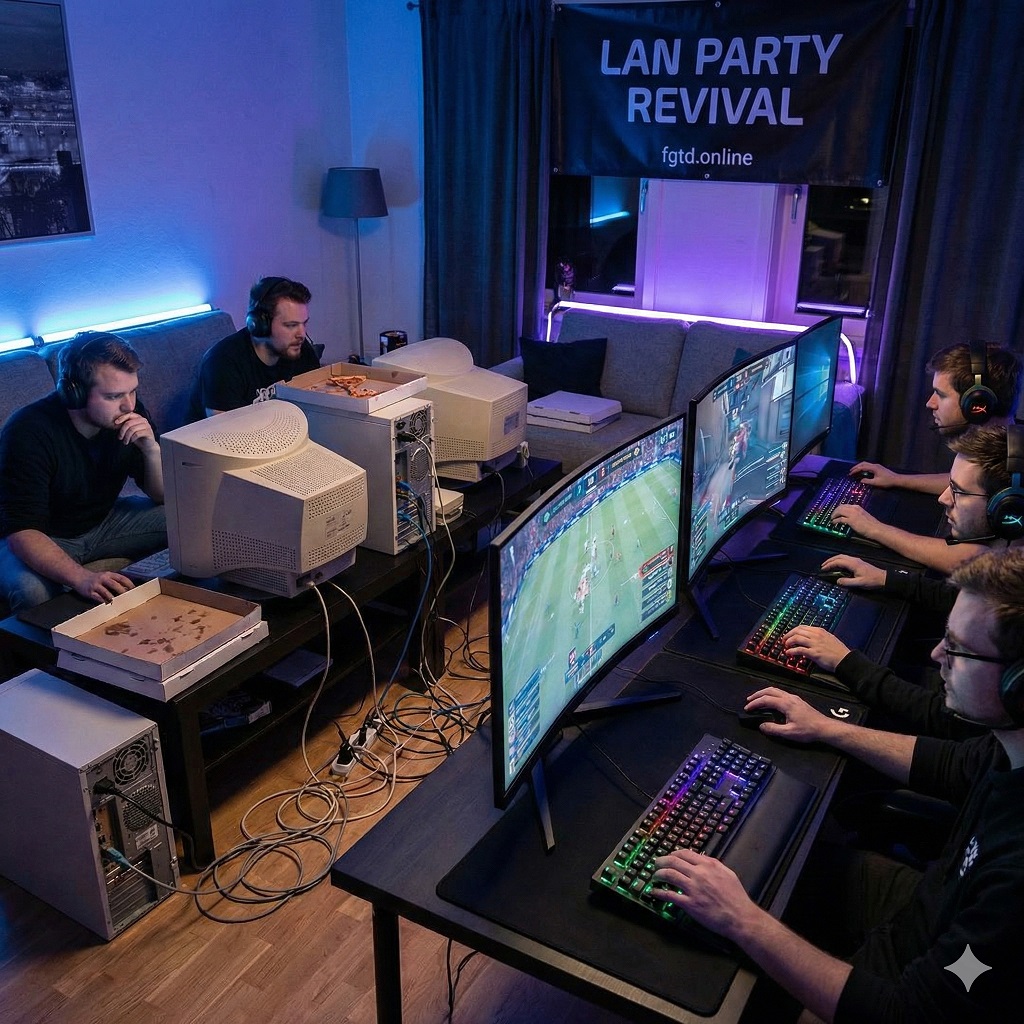
The Return of LAN Parties – Nostalgia Meets Competition
The Smell of Ozone and Pizza
If you close your eyes and think back to a specific weekend in 1999 or 2004, you might be able to smell it. It’s a specific, pungent bouquet: the ozone smell of heating electronics, the cardboard scent of lukewarm pizza, the fizz of energy drinks, and the stale air of a room that hasn’t seen an open window in 48 hours.
For a generation of gamers, the LAN (Local Area Network) party was not just a way to play; it was a pilgrimage. It involved physical labor—disconnecting a beige tower that weighed as much as a small child, lugging a 17-inch CRT monitor into the trunk of a car, and driving to a friend’s basement to spend the weekend tripping over Ethernet cables.
Then, broadband internet arrived. Xbox Live and Steam promised us a utopia where we could play with anyone, anywhere, without leaving our chairs. We traded the hassle of travel for the convenience of high-speed connection. We traded the tangled wires for Wi-Fi.
Continues after advertising
But recently, something shifted. Despite having fiber-optic internet and 5G, gamers are packing up their rigs again. From massive stadium events to intimate Airbnb weekends, the LAN party is back. It turns out that while the internet gave us the world, it cost us the room. This is the story of the return to the local network—where nostalgia meets the unmatchable speed of light.
I. The Death of Distance: Why We Left the Basement
To understand the revival, we must understand the decline. In the late 90s, the LAN was a necessity. Dial-up internet (56k) was insufficient for the fast-twitch reflexes required by games like Quake III Arena or Counter-Strike. If you wanted to play a multiplayer shooter without “lag”—the digital delay between your action and the server’s response—you had to be physically connected to the same switch.
The LAN party was a solution to a technical bottleneck. It was an infrastructure workaround.
By the mid-2000s, that bottleneck vanished. Broadband became ubiquitous. Voice over IP (VoIP) services like Ventrilo, TeamSpeak, and later Discord allowed us to hear our friends without sitting next to them. The friction of gaming disappeared. You could log on, play a match, and log off.
The “death” of the LAN was celebrated as progress. No more hauling gear. No more network troubleshooting (configuring IP addresses manually at 2 AM). But as the years passed, we began to notice the side effects of this convenience. The social texture of gaming changed.
II. The Latency of Loneliness: The Problem with Modern Matchmaking
Modern online gaming is a technological marvel, but a sociological disaster.
Today, most competitive gaming happens via “Matchmaking.” An algorithm assesses your skill level (MMR), finds nine other strangers with similar numbers, and throws you into a lobby. The interaction is fleeting. If you make a mistake, you are flamed. If you win, you disconnect. There is no permanence.
The “Toxicity Crisis” in modern gaming is largely a symptom of anonymity and distance. It is very easy to scream racial slurs or insults at a username on a screen. It is much harder, and socially dangerous, to scream those same things at a person sitting three feet away from you, who can physically reach over and unplug your keyboard (or punch you in the arm).
The return of the LAN party is, in part, a rejection of this sterile, hostile environment. Gamers are craving the “High Five Moment”—that instant when you pull off an impossible clutch victory, and instead of typing “GG” into a chat box, you stand up and scream while your friends physically grab you. You cannot simulate the energy of a room erupting in laughter or cheers over a digital connection.
III. The New Era: From Basements to Boutique Events
The modern LAN party looks very different from its ancestors. The dusty basement has been replaced by more sophisticated venues, and the demographic has shifted.
1. The “Adult” LAN Weekend The teenagers who hauled CRTs in 2001 are now adults with disposable income. They are renting large Airbnbs, hiring catering, and setting up high-end networks for weekends. These are “Boutique LANs.” They aren’t just about the games; they are about reconnecting with old friends. The focus has shifted from pure competition to social cohesion. The “BYOC” (Bring Your Own Computer) culture remains, but now the computers are $3,000 liquid-cooled works of art, not beige boxes.
2. The Barcade and Local Esports Scenes Cities around the world are seeing a rise in “Esports Bars” and gaming lounges. These venues provide the infrastructure (PCs, consoles, high-speed switches) so players don’t have to haul gear. They host weekly Super Smash Bros. or Street Fighter tournaments. The Fighting Game Community (FGC) never really left the LAN; they kept the flame alive because fighting games demand zero latency. Now, shooter and strategy players are returning to these shared spaces.
3. The Mega-Festivals Events like DreamHack (which started in Sweden) have exploded globally. These are massive conventions where thousands of people bring their PCs to a single stadium. It is a festival of lights, screens, and sleeping bags. It proves that despite the internet, people want to be alone, together.
IV. The Technical Argument: The Pursuit of the “Zero Ping”
Beyond the social aspect, there is a hard, technical reason for the LAN revival: Competitive Integrity.
In online gaming, “Peeker’s Advantage” and “Lag Compensation” dictate the outcome of fights. If you have a ping of 50ms and your opponent has a ping of 20ms, the server has to do mathematical gymnastics to decide who shot first. Often, you will die behind a wall because, on your opponent’s screen, you were still visible.
On a Local Area Network, ping is effectively zero (usually <1ms). The game becomes “pure.”
- No Lag Compensation: What you see is exactly what is happening.
- Instant Feedback: The game feels crisp, responsive, and fair.
For the aspiring competitive player, the LAN environment is the only place to test true skill. This is why, despite online qualifiers, the finals of every major eSport (from League of Legends to Valorant) are played on LAN. The return of local tournaments allows amateur players to experience the game the way the pros do—without the interference of internet infrastructure.
V. The Infrastructure of the Modern LAN
Hosting a LAN party today involves new challenges and new tools. In the old days, the biggest challenge was file sharing (getting the cracked .exe of Warcraft III to everyone). Today, the challenge is Bandwidth.
Modern games are massive. Call of Duty can be 200GB. If 20 people come to your house and try to download an update simultaneously, your internet will crash.
This has led to the rise of home-brew server solutions like Lancache. This is a piece of software that runs on a local server. When the first person downloads a game update from Steam or Battle.net, the Lancache stores a copy. When the second, third, and twentieth person try to download it, the server serves it from the local network, not the internet. This allows downloads at speeds of 10 Gigabits per second, rather than internet speeds.
The modern LAN host is part network engineer, part event planner. They are dealing with high-end routers, managing power load (so the circuit breakers don’t trip), and curating a “playlist” of games that works for everyone.
VI. The Retromania Factor
We cannot discuss the return of LANs without discussing the software. While modern games like Valorant and Rocket League are popular, the heart of the LAN revival is retro gaming.
Modern games often lack dedicated LAN support. Developers want you online to sell you skins and battle passes. Older games—Halo: Combat Evolved, Unreal Tournament 2004, StarCraft: Brood War—were built for the LAN.
There is a thriving subculture of “Retro LANs” where the rule is: Nothing released after 2010. This solves two problems:
- Hardware Equality: You can run Quake III on a potato. No one needs a $4,000 GPU to compete.
- Game Design: Older multiplayer games were designed with a different philosophy. They were simpler, faster, and often more chaotic. They didn’t have “skill-based matchmaking” algorithms trying to manipulate your win rate. They just offered a map and some guns.
Read More👉 Top Esports Tournaments to Follow in 2025
Conclusion: The Human Bandwidth
In a world where the “Metaverse” is trying to convince us that digital proximity is the same as physical proximity, the LAN party stands as a stubborn counter-argument.
We have realized that high-speed internet is a utility, but it is not a community. A Discord server is a great place to chat, but it is not a place to be. The return of the LAN party—whether it’s five friends in a living room or 5,000 strangers in a convention hall—signals a shift in how we value our leisure time. We are willing to undergo the inconvenience of travel and setup because the payoff is something the internet cannot transmit: Presence.
The LAN party is no longer about accessing the game; we can do that from our phones on the toilet. It is about accessing each other. It is about the shared pizza, the screen-cheating accusations, the tangle of cables, and the feeling that for a few hours, the rest of the world has paused, and the only thing that matters is the match on the screen and the people in the room.
The rules haven’t changed, but our appreciation for them has. The ping is low, but the spirits are high. Long live the LAN.