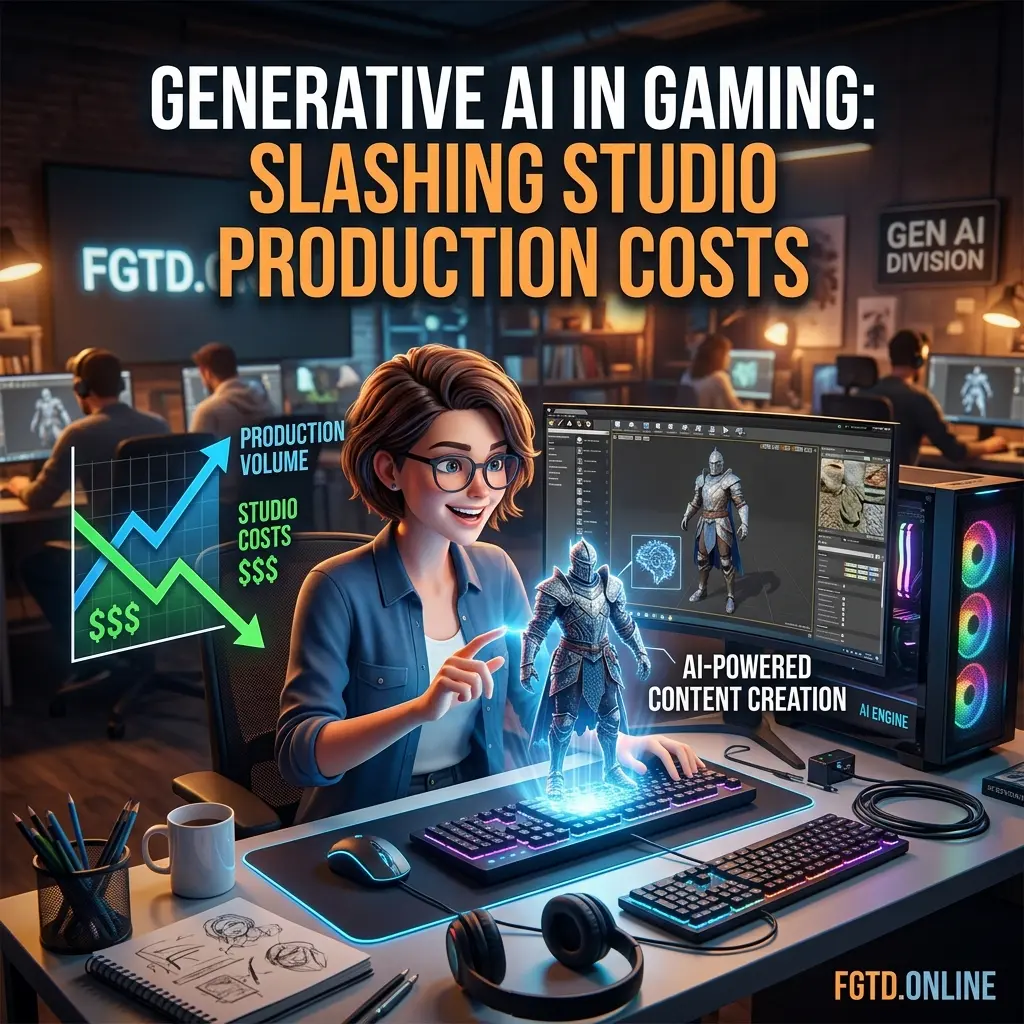
Generative AI in Gaming: Slashing Studio Production Costs
The commercial economics of AAA video game development have reached an unsustainable inflection point. Over the past two decades, player expectations for visual fidelity, open-world scale, cinematic narrative depth, and fully voice-acted dialogue have inflated development cycles and production expenditures. What once required a team of thirty engineers and a five-million-dollar budget now regularly demands hundreds of specialized artists, seven-to-ten-year production schedules, and capital commitments exceeding two hundred to three hundred million dollars per title.
When a single commercial failure can threaten the survival of a major studio, the video game industry faces an urgent mandate to restructure its cost architecture.
Enter Generative AI in game development.
Continues after advertising
Far from being merely an experimental novelty, generative artificial intelligence has rapidly matured into an industrial-grade production pipeline accelerator. By augmenting and automating repetitive tasks across 3D asset generation, procedural level design, non-player character (NPC) narrative scripting, dynamic localization, and real-time voice synthesis, generative machine learning models are fundamentally altering studio economics.
By integrating intelligent algorithmic pipelines into core game engines, development studios can compress multi-year prototyping cycles into weeks, reduce asset outsourcing expenses, and shift human talent toward creative direction and high-level mechanics.
This post examines how generative AI is transforming modern game development, analyzes cost-reduction pipelines across artistic and technical disciplines, contrasts traditional manual game production with AI-assisted workflows, and explores the operational future of scalable interactive entertainment.
1. The Broken Economics of Legacy Game Production
To understand why studios are aggressively adopting generative AI, one must examine the cost drivers that have created the current industry margin squeeze:
- The Asset Inflation Trap: Modern 4K and 8K display standards require thousands of bespoke, photorealistic 3D assets—from individual tree bark textures and weather-beaten masonry to complex architectural ruins and photorealistic weapon models. Modeling, texturing, rigging, and baking lighting into these assets demands thousands of hours of manual labor, often outsourced to third-party art studios across multiple continents at enormous financial expense.
- The Dialogue and Voice Acting Bottleneck: Immersive open-world role-playing games (RPGs) feature hundreds of thousands of lines of recorded dialogue. Coordinating voice actors, sound engineers, physical studio recording booths, and multi-language localization teams represents one of the largest single budget line items in AAA development.
- Lengthy Pre-Production and Concept Iteration: Developing a compelling game concept historically required concept artists to sketch, paint, and discard thousands of visual drafts over six to twelve months before a 3D production pipeline could even be approved.
- Rigid NPC Behavioral Logic: Traditional non-player characters operate on hard-coded decision trees and pre-baked script triggers. Creating believable, reactive game worlds required massive narrative teams to manually write branched dialogues that covered only a fraction of potential player interactions.
2. Core Production Pillars Transformed by Generative AI
Modern generative AI does not replace core creative vision; it eliminates production bottlenecks by automating labor-intensive workflows:
1. 2D Concept Art, Texture Synthesis, and Material Generation
In early pre-production, diffusion models and specialized image-generation architectures allow art directors to explore hundreds of visual themes, environmental palettes, and character silhouettes in hours rather than months:
- Diffusion-to-PBR Pipelines: Beyond flat 2D concept images, modern neural networks generate physically based rendering (PBR) texture maps—including diffuse, normal, roughness, metallic, and ambient occlusion channels—directly from natural language prompts or reference photographs.
- Dynamic Texture Variant Generation: Rather than artists hand-painting ten variations of a brick wall or cobblestone street, generative models produce mathematically coherent variations instantly, eliminating repetitive environment tiling and drastically cutting art outsourcing budgets.
2. 3D Mesh Generation, Automated Retopology, and Rigging
Transforming 2D concepts into game-ready 3D geometry has historically been one of the most technical and expensive production hurdles:
- Text-to-3D and Image-to-3D Inference: Neural radiance fields (NeRFs) and gaussian splatting techniques allow developers to generate watertight 3D meshes from single concept images or textual descriptions within seconds.
- Automated Retopology: High-poly sculpted models cannot run efficiently in real-time game engines without clean, low-polygon topology. AI retopology tools automatically analyze curvature and edge flow, generating optimized quad-dominant polygon meshes suitable for real-time physics and rendering.
- Auto-Rigging and Motion Retargeting: Machine learning algorithms identify anatomical joint pivots on generated creature and humanoid models, automatically binding bones and skin weights. Animation libraries can then be retargeted across completely novel body shapes without manual bone painting.
3. Procedural Level Design and Dynamic World Population
While procedural generation (such as Perlin noise algorithms) has existed for decades, generative AI introduces semantic understanding to world-building:
- Context-Aware World Layouts: Developers define high-level environmental rules, and generative layout models populate terrain with logically arranged biome clusters, foliage, roads, and interior clutter that mimic real-world geography and architectural logic.
- Rapid Prototyping of Quest Environments: Level designers can describe a dungeon layout or tactical multiplayer arena in plain language, generating interactive blockout geometry directly inside engines like Unreal Engine or Unity for immediate playtesting.
4. Generative Dialogue, Synthetic Voice, and Real-Time Localization
Voice production and narrative writing are experiencing an unprecedented revolution:
- Large Language Models for Ambient NPC Interaction: Instead of ambient NPCs repeating three canned lines of dialogue, embedded small-parameter language models generate endless contextual banter based on in-game weather, recent player actions, and faction alignment.
- High-Fidelity Neural Voice Cloning and TTS: Developers use generative audio engines to produce fully voiced dialogue across placeholder characters, minor quest givers, and dynamic system announcements.
- Automated Multi-Language Localization and Lip-Syncing: Generative pipelines translate dialogue into dozens of languages while synthesizing localized voice tracks that match the original actor’s vocal timbre, pitch, and emotional cadence. Simultaneously, facial animation tools analyze phonemes and deform 3D facial meshes to produce frame-accurate lip-syncing across every supported language automatically.
3. Structural Comparison: Traditional Studio Pipelines vs. Generative AI-Assisted Pipelines
Evaluating the mechanical, operational, and financial differences between legacy production methods and AI-assisted workflows demonstrates why studios are restructuring their development stacks:
Concept Art and Pre-Production Iteration
- Traditional Studio Pipelines: Manual drafting; concept artists hand-paint variations over weeks and months, limiting creative exploration due to time and budget constraints.
- Generative AI-Assisted Pipelines: Accelerated brainstorming; diffusion models generate comprehensive environmental and character mood boards in minutes, allowing directors to lock visual targets early.
3D Asset Creation and Optimization
- Traditional Studio Pipelines: Labor-intensive; high-poly modeling, manual retopology, UV unwrapping, and material painting require significant internal art teams or expensive third-party outsourcing.
- Generative AI-Assisted Pipelines: Automated pipeline acceleration; models produce baseline 3D meshes, clean edge-loop topology, and complete PBR material maps with minimal human cleanup.
Voice Acting and Narrative Localization
- Traditional Studio Pipelines: Studio-bound and costly; requires booking physical recording facilities, contracting voice actors across multiple international territories, and manual audio editing.
- Generative AI-Assisted Pipelines: Synthetic scale; neural voice models generate infinite situational dialogue, with automated neural voice synthesis and frame-accurate lip-syncing across dozens of languages.
World-Building and Level Populating
- Traditional Studio Pipelines: Hand-placed prop distribution; environment artists spend thousands of hours placing individual bottles, rocks, and debris across vast open-world maps.
- Generative AI-Assisted Pipelines: Semantic procedural generation; AI algorithms interpret environmental logic, auto-populating massive terrains with realistic clutter, foliage, and structural damage in seconds.
4. The Economic Impact on Studio Budgets and Indie Viability
The strategic implementation of generative AI produces two distinct macroeconomic shifts across the gaming industry:
1. AAA Studio Margin Recovery
For major publishing houses, slashing asset creation and localization costs by 40% to 60% drastically lowers the break-even threshold for ambitious blockbusters. Capital can be redirected away from brute-force asset production toward gameplay innovation, network stability, and refined mechanics, mitigating the existential financial risk associated with multi-hundred-million-dollar releases.
2. The Democratization of Indie and Mid-Tier Studios
Historically, small independent studios with small teams could never compete with the scale or visual fidelity of major publishers. Generative AI serves as an equalizer:
- A team of five to ten developers can now deploy production-grade textures, voiced ambient dialogues, and vast geometric environments that previously required hundreds of outsourced artists.
- This unlocks a creative explosion in mid-tier development, allowing small teams to produce ambitious narrative RPGs and visually rich open worlds on lean indie budgets.
Read More👉 Private Equity in Sports: The Rise of Multi-Club Ownership
Conclusion: Engineering the Future of Interactive Worlds
Generative artificial intelligence represents a permanent, structural shift in the video game development paradigm. The historical era of solving game scale by throwing hundreds of outsourced artists and hundreds of millions of dollars at brute-force 3D asset modeling is coming to an end.
By transforming 3D asset generation, procedural level construction, environmental texturing, and voice localization into automated, AI-assisted workflows, forward-thinking studios are successfully protecting their profit margins while expanding the scope of interactive entertainment.
As underlying machine learning models become more spatially aware, multi-modal, and natively integrated into leading game engines, studios that master these tools will deliver richer, more reactive game worlds faster and at a fraction of historical costs—permanently establishing Generative AI in Gaming: Slashing Studio Production Costs as an essential cornerstone of modern digital entertainment development.